Premature baby tooth loss.
Why are a child’s primary teeth so important?
One of the key functions performed by baby teeth is acting as placeholders for the set of permanent teeth that will replace them.
If a baby tooth is lost early, and adequate steps aren’t taken in a timely fashion to preserve the space it occupied, problems frequently develop.
Depending on the child’s current stage of dental development, that could be issues with permanent tooth alignment, or even impaction (a tooth whose path of eruption is blocked).
An example of possible complications.
Here’s an explanation about how losing even a single baby tooth prematurely can result in problems that can be difficult, time-consuming and costly to fix later on in life.
Consider the following scenario centered around a child’s primary second molar.
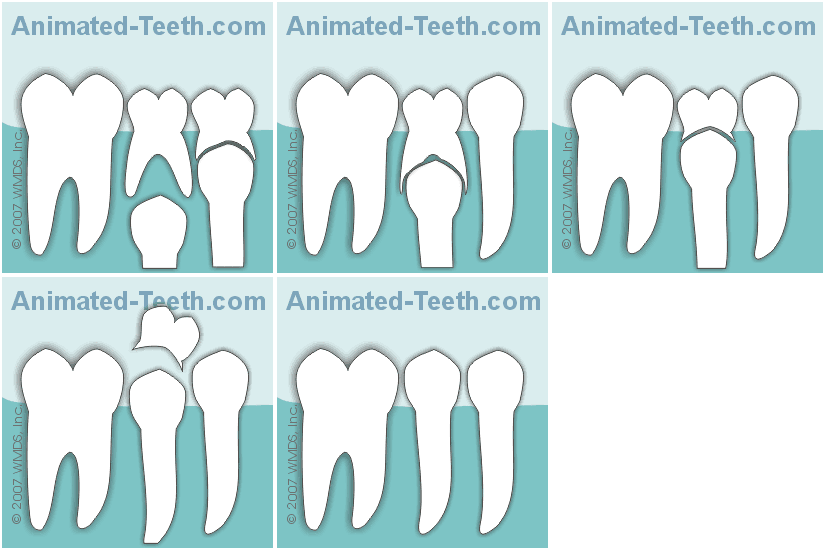
How the normal tooth eruption process works. – Deciduous teeth are replaced by permanent ones.
1) How things usually work.
- It creates an eruption path for the bicuspid to follow that helps to guide it into its proper position.
- And because the primary second molar is retained in place until the very last stages of the eruption process, it acts as a stabilizer that keeps the neighboring teeth in place.
2) What happens when a baby tooth is lost too early?
If in our example the child’s 2nd primary molar is lost prematurely, its stabilizing influence is lost too.
The complication of early baby tooth loss.
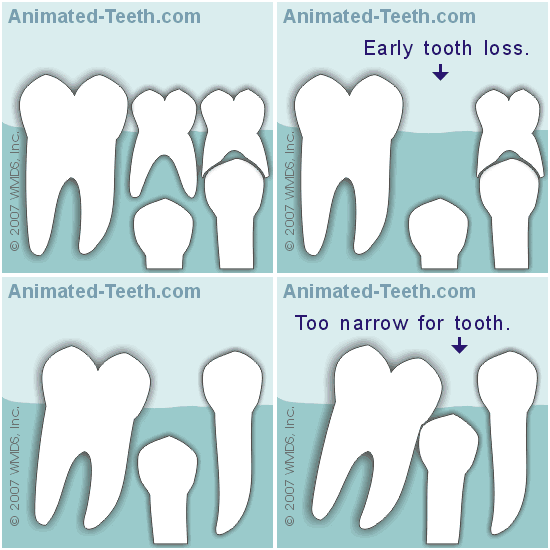
The early loss of a baby tooth can result in the loss of space for the permanent one.
- That means the next tooth back (the permanent first molar) may drift or tilt forward. This is a common occurrence.
This shift in position can also affect the positioning of the teeth that bite against the tooth, and also those teeth that ultimately will come in behind it (the 2nd and 3rd molars).
- Although much less likely, the tooth in front of the erupting 2nd bicuspid (the 1st permanent bicuspid, a tooth that has already come into place) may drift backward.
- As a worst-case scenario, the erupting 2nd bicuspid may become impacted (prevented from erupting altogether) because much of the space it was intended to occupy has been encroached upon by its neighboring teeth. (This is the case we show in our animation.)
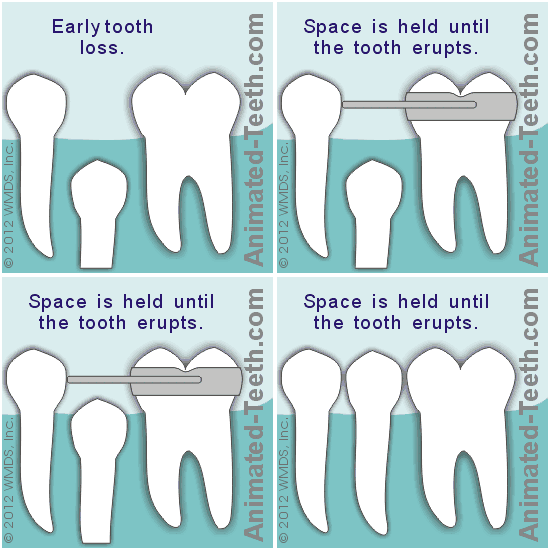
A space maintainer holds the lost baby tooth’s space until its permanent replacement has come in.
3) How a space maintainer can prevent problems.
As a result, and solely due to just wearing this type of simple device, the need for major orthodontic work later on so to correct the complications that likely would have occurred is totally avoided.
4) Details about the use and importance of space maintainers.
- Studies suggest that almost all cases of primary molar loss (1st or 2nd), results in some degree of space loss. (This is the case we’ve illustrated in our animation above.)
- Most of the space lost is sacrificed during the first 6 months following the loss of the baby tooth.
- The space that results from the premature loss of the tooth is most at risk if either of the permanent teeth on either side of it is actively undergoing the eruption process.
- As an example of the outcome for a child’s permanent teeth, one study determined that children who had lost one or more deciduous molars or canines (eyeteeth) before the age of 9 were more than three times likely to be in need of orthodontic treatment.
▲ Section references – Dean, Law
Space maintainer design.
These appliances are typically metal band-and-wire devices. They are frequently referred to as band-and-loop appliances. (In some cases, especially those in which the anchor tooth is badly broken down, a metal crown is placed over the supporting tooth rather than a band.)
- The band fits around the anchor tooth on which the maintainer will be cemented.
- A wire attached to the band extends from it, across to the tooth on the other side of the missing tooth’s space, and then back as a continuous loop.
An effort is made to design the wire loop’s shape so the eruption of the permanent tooth is not impeded by it.
- The fit of the wire against the distant tooth is just passive but it must make rigid contact so no loss of space occurs.
- No attempt is made for the appliance to provide chewing function in the region of the missing tooth.
▲ Section references – Dean, Nowak
More complex designs.
When maintaining the space of just a single tooth, an appliance’s design can be quite basic (as shown in our graphic above).
But in other cases, its design may need to be relatively complex, simply depending on the location of the missing teeth, and the availability of teeth on which to anchor the appliance.
Besides just fixed (cemented) design, some space maintainers are removable or semi-attached appliances.
Things to know.
1) How long is the maintainer left in place?
A space maintainer is usually removed as soon as the erupting permanent tooth has penetrated through the gum tissue. At this point, the tooth has pierced the bone and will therefore be in place soon.
2) How long will it take for the permanent tooth to erupt?
As a rule of thumb, when a baby tooth is lost prematurely:
- If less than half of the permanent tooth’s root has yet formed, its eruption will be delayed. (See our tooth eruption timetable.)
If closer to 3/4ths of root formation has already taken place, its eruption will tend to be accelerated.
- It’s considered that it takes an erupting permanent bicuspid 4 to 6 months to penetrate 1mm of bone (a little less than 1/16th of an inch). The distance measurement is taken from x-rays.
▲ Section references – Dean
3) A space maintainer isn’t always needed.
Not all lost baby teeth create a need for space maintainer placement. It simply depends on how much time it will take the permanent tooth to erupt. If the dentist feels that the permanent tooth will come into place before any detrimental tooth shifting will have a chance to take place, then one won’t be required.
Determining factors.
When making this determination they will consider the current stage of dental development of the patient, as well as evaluate the current status (position, percentage formed, etc…) of the replacement tooth via the use of an x-ray.
▲ Section references – Dean
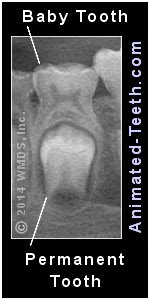
A permanent tooth forming underneath a baby tooth.
4) The best space maintainer is the natural tooth.
How are space maintainers placed?
Having a space maintainer made, and then placed, is a simple process.
The steps.
- Your dentist will take dental impressions of your mouth. (An impression of each jaw, upper and lower, may be required.) This way they’ll have a copy of the space and neighboring teeth that can be given to their dental laboratory.
- The dental lab will create plaster casts from the impressions. They’ll then use them as a model on which they’ll fabricate your space maintainer.
- When it’s done, they’ll deliver it back to your dentist’s office. (The time allowed for the fabrication process is usually a week or two.)
- At your appointment, your dentist will simply slip your appliance into place and check it. They’ll adjust its shape and fit as is necessary.
- Once they’re satisfied, they’ll go ahead and cement it onto your tooth.
▲ Section references – Nowak
How are space maintainers taken off?
Since it’s just cemented on your tooth, removing a space maintainer is usually pretty easy.
The dentist might be able to just pull it off. (They may have a special tool that helps them with this.) Or if not, they can use their drill to cut the band that surrounds your tooth. Either way, getting it off should just take a moment or two, and no anesthetic should be needed.
What precautions do you need to take when wearing a space maintainer?
Wearing your appliance should be a non-event. But you do need to practice some simple common-sense measures.
- Eating. – You should be a little bit careful when eating, especially hard or crunchy foods.
Your space maintainer is only cemented in place, and placing pressure against it (like chewing hard foods on it) may dislodge it.
- Cleaning your teeth. – There are no special instructions needed for cleaning around your appliance other than just being as thorough as you can.
In general, a space maintainer will tend to trap food and debris. So, if you don’t clean both it and the teeth it involves thoroughly, a cavity or gum irritation could develop.
- Keep on the lookout. – Take a good look at your maintainer when it’s first put in, and then over the months and/or years that you wear it, keep an eye on it.
If something looks different about its shape or position, or with the tissues or teeth that it involves, let your dentist know.
What should you do if your space maintainer comes off?
If your appliance comes off, put it in a safe place. Then let your dentist’s office know what has happened so they can make an appointment for you to cement it back on.
- Don’t delay in reporting. When you’re not wearing your maintainer, your teeth have the potential to shift.
- If it will be some time before you can appoint with your dentist, seek their advice. They may suggest that you can help to minimize the potential for tooth shifting by carefully wearing your appliance (although loose on your teeth) some hours each day.
How much does a space maintainer cost?
Here’s a ballpark estimate of what your dentist’s fee might be.
$185.00 – $295.00
Small city or town vs. large metropolitan area.
How did we come up with this estimate?
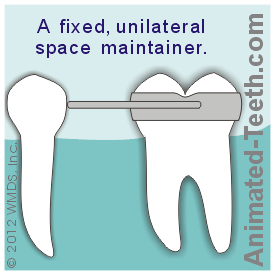
A space maintainer cemented in place.
Notes:
- This is the type of appliance illustrated in our graphic.
- It’s used to hold the space for one tooth (or possibly multiple adjacent teeth) on just one side of a jaw (upper or lower).
- This does not include the fee for extracting any baby teeth, if that is needed.
The cost of a fixed, bilateral space maintainer (a single appliance that involves protecting spaces on both sides of a jaw) typically runs on the order of about 50% more.
Does dental insurance cover space maintainers?
Dental plans often do provide benefits for this procedure but some restrictions may apply.
- Placement may be limited to applications that protect the space associated with lost back teeth, not front ones.
- There may be an age restriction. For example, this benefit may only be provided for children under the age of 14 years.
- This procedure may be payable only once per area per lifetime of the patient.
These restrictions aren’t universal. You’ll simply have to examine the conditions outlined in your policy.
Other things to know.
- If your space maintainer comes off, expect that your dentist will charge a recementation fee.
- If your appliance is lost, expect that your dentist will charge you full price for a new one.
Page references sources:
Because the fee estimates we show above have been developed by different means, you may also find the survey of dental fees published by DentistryIQ an interesting independent source: DentistryIQ – 2017 dental fee analysis by region and CDT procedure code
Dean JA, et al. McDonald and Avery’s Dentistry for the Child and Adolescent. Chapter: Eruption of the Teeth: Local, Systemic, and Congenital Factors That Influence the Process
Law CS. Management of premature primary tooth loss in the child patient.
Nowak AJ, et al. Pediatric Dentistry: Infancy through Adolescence. Chapter: The Dynamics of
Change.
All reference sources for topic Baby Teeth.