Treating canker sores with prescription medications.
images.
This page describes the use of prescription drugs in the management of canker sores (recurrent minor aphthous ulcers).
The medicines discussed include: Orabase combined with triamcinolone (Kenalog) (or other corticosteroid) | amlexanox (Aphthasol, Lexanox) | tetracycline | minocycline | doxycycline | chlorhexidine (Peridex, Paroex)
Independently, we discuss the use of Magic Mouthwash [viscous lidocaine, diphenhydramine (Benadryl) and Maalox (or a similar antacid)] to provide canker sore pain relief.
On label / Off label uses.
Some of the medications we cover on this page have been specifically formulated for the purpose of treating canker sores.
Others are drugs that have been developed for, and are primarily used to treat, other conditions but have also been found to be beneficial for this purpose too. This is termed an “off-label” application.
How do these drugs work?
In regard to a mechanism of action, the prescription medications used to manage aphthous ulcers tend to fall into one of two main categories:
A) Anti-inflammatory medicines.
Anti-inflammatory compounds can help to minimize the extent to which a canker sore’s ulceration will form. The idea is that the smaller the actual size of the ulceration, the quicker it will heal.
Specific medications –
In this category, this page discusses the use of amlexanox (Aphthasol) and triamcinolone (Kenalog) in Orabase (or other corticosteroid: fluocinonide (Lidex), betamethasone (Diprolene), and clobetasol (Temovate)).
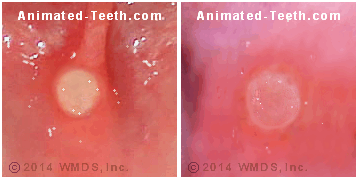
Pictures of canker sores (aphthous ulcers).
B) “Anti-bacterial” collagenase-inhibiting medicines.
These compounds are produced as a part of the body’s inflammatory response. And they cause the breakdown of collagen (an important tissue protein) and therefore their presence aids in ulcer formation. If the activity/presence of these compounds can be reduced, a smaller lesion will form. With smaller sores healing more quickly.
Specific medications –
In this category, this page discusses the use of tetracycline, minocycline, doxycycline and chlorhexidine (Peridex, Paroex).
Additional information: This page The biology of canker sore formation. provides background information that may aid in your understanding of how both classes of drugs (anti-inflammatory and collagenase-inhibiting) work.
When should a prescription medication be considered?
Canker episodes that only occur a few times a year, only last for a few days and just cause minimal pain are probably managed just as well using OTC medications Read Now or even home remedies Read Now.
But for people who frequently experience painful breakouts (on the order of once every month or so), with each lasting five to 10 days, investigating the benefits of using prescription medication is probably warranted. Bringing the subject up with your dentist or doctor is the place to start.
Topical vs. systemic medications.
The case for topical applications.
Whenever the use of prescription medications seems necessary, it’s generally considered that a topical approach (the product is applied directly to the sores) should be tried first.
- This is usually found effective for the management of routine canker sores (recurrent minor aphthous ulcers, the type of lesions discussed on our pages). Especially if the medication’s application is begun during the forming lesion’s prodromal stage. Description
- With topical application, little of the medication is usually absorbed systemically (either directly through the skin/ulcer or via ingestion). And as such, the potential for side effects like those associated with systemic (taken internally) drugs are avoided.
- (We’ll also mention that canker sores are not contagious. When treating them (touching them, disposing of applicators used to apply medication, etc..), there are no special concerns about the potential for their spread. For more details: Canker sores are not contagious. )
The primary focus of the kinds of treatments discussed on this page is topical applications (oral pastes or rinses).
Indications for the use of systemic medications.
In cases where the patient’s canker sore outbreaks are aggressive and constant, and situations where a topical treatment is found to be ineffective in providing relief, the use of systemic drugs may be the needed alternative.
▲ Section references – Belenguer-Guallar
Note –
Prescription medication should only be used under the supervision of a health care professional. What may seem like a harmless application to you could, in some instances, result in creating significant medical consequences.
A) Anti-inflammatory medications.
1) Topical corticosteroids –
Kenalog in Orabase –
a) The active ingredient.
Triamcinolone acetonide (Kenalog, Adcortyl) is a synthetic corticosteroid. Corticosteroids are compounds that have an anti-inflammatory effect and therefore can help to limit the full extent to which a sore’s ulceration will form.
[Fluocinonide (Lidex), betamethasone (Diprolene), and clobetasol (Temovate) are other corticosteroids that have been used in similar a fashion to triamcinolone.]
b) The base component.
The Orabase aspect of this mixture is simply an “oral paste” that has been specially formulated to be able to adhere to the wet tissues of the mouth.
In use, it both creates a protective film over the sore that holds the Kenalog in place, and also covers over and protects its ulcerated surface.
Effectiveness / Research.
A study by Abbasi compared the use of Adcortyl ointment (0.1% triamcinolone in Orabase) with amlexanox paste (Aphthasol, discussed below). The study’s findings were that both products were effective (no differences found) in reducing canker sore pain and ulcer size (reduced ulcer size correlates with reduced healing time).
In the paper’s discussion however, it did note that amlexanox might be the preferred treatment due to its effect of reducing lesion recurrence and the potential for Candida overgrowth with corticosteroid use (see below).
In a literature review of the subject of aphthous ulcer treatments, Belenguer-Guallar states that the use of triamcinolone in Orabase is “particularly indicated in patients with small and mild erosive lesions.”
How is it used?
- Triamcinolone 0.1% in Orabase is typically considered the standard preparation, although formulations ranging from 0.05% to 0.5% have been investigated. (Some researchers consider the 0.1% concentration to be the most effective formulation.)
- It’s typically applied 4 times per day directly to the affected area from the time the first signs of lesion formation are noticed until healing has occurred.
- After application, avoiding activities for 20 minutes that might dislodge the ointment (eating, drinking) aids effectiveness. Application after meals and at bedtime makes a good regimen.
- Early initiation of treatment is beneficial and may prevent full ulcer formation. Patients who experience noticeable prodromal symptoms, such as tingling or swelling, should begin treatment as soon as these signs are noticed.
- The regular use of triamcinolone has not been shown to decrease the rate of recurrence of canker sore outbreaks.
Oral side effects.
▲ Section references – Abbasi, Chavan, McBride, Belenguer-Guallar
2) Corticosteroid rinses –
Dexamethasone elixir (0.5 mg per 5 ml) is sometimes used in the treatment of canker sores. A common regimen involves rinsing with and spitting out the solution three times per day.
Oral rinse formulated with triamcinolone has also been investigated.
Oral side effects.
▲ Section references – McBride, Chavan, Belenguer-Guallar
3) Systemic corticosteroids –
Systemic steroids may be used in the management of canker sores. But if they are, they’re typically considered rescue therapy for persons with acute severe outbreaks.
▲ Section references – Chavan, Belenguer-Guallar
4) Aphthasol –
Amlexanox (Aphthasol, Lexanox) is a topically applied prescription medication specifically developed for the treatment of canker sores.
Note: Discontinued.
Aphthasol was discontinued in the US in 2014. Amlexanox is still available in other parts of the world. And research papers continue to be published showing its effectiveness.
While we don’t know precisely why its manufacture was discontinued, we’re under the impression that it was due to a lack of demand. It seems likely that most people, especially those with relatively benign lesions, found its cost hard to justify in light of the self-limiting nature of their aphthous ulcers.
How does the compound amlexanox work?
Its precise mode of action is not known but it’s thought that it has both anti-allergic and anti-inflammatory properties.
More specifically, it’s thought to inhibit the formation and release of histamine and leukotrienes from mast cells, neutrophils and mononuclear cells (types of white blood cells associated with a person’s immune system).
Effectiveness / Research.
Studies have shown that amlexanox use tends to both speed up healing and reduce the number of days that a sore is painful.
In an early study by Binnie, subjects were evaluated on the third day after the first appearance of their canker sore. 44% of those that had been using Aphthasol since day 1 reported complete resolution of pain, whereas only 20% of non-users did. Also, 21% of users reported complete ulcer healing by day 3 whereas only 8% in the non-user group did.
A more recent study by Bhat found that the use of amlexanox “as soon as possible after noticing symptoms” (i.e. the prodromal stage) was effective in reducing ulcer size, pain, redness of the surrounding tissue and exudation (fluid emitted from the lesion). This study also found that subjects experienced a reduction in the rate of recurrence of ulcer outbreaks for up to 6 months.
How is it used?
Aphthasol is an “oral paste.” When it’s applied, it forms a film over the lesion so to both hold the product’s active ingredient (amlexanox) in place, and also to cover over and protect the sore’s ulcerated surface.
▲ Section references – Binnie, Bhat, Abbasi
B) Collagenase inhibitors.
1) Tetracycline –
Clinical studies have shown that rinsing with a tetracycline solution several times a day can reduce canker sore pain and speed up healing. (Tetracycline is a commonly prescribed antibiotic.)
How is it used?
Instructions for adults typically include creating an oral suspension by dissolving a 250-mg capsule in 180 ml (3/4 cup) of water. This solution is then swished with and then spit out, 4 times per day for several days.
The regular use of tetracycline rinse has not been shown to reduce a person’s frequency of outbreaks.
Dental side effects.
If tetracycline is ingested (swallowed) during periods of tooth formation, permanent tooth staining can result. For this reason, it’s generally contraindicated for use with children and pregnant women.
▲ Section references – McBride
2) Minocycline –
Like tetracycline, the antibiotic minocycline is also sometimes used in the management of aphthous ulcers.
How is it used?
A common regimen is 100mg dissolved in 180 ml of water (3/4 cup), rinsing with and spitting out this suspension twice daily for 4 to 5 days.
Dental side effects.
Like tetracycline, minocycline is also known to cause tooth staining. However, with this drug person’s of all age groups may be affected.
▲ Section references – McBride
3) Doxycycline –
A literature review of canker sore treatments by Belenguer-Guallar suggests that doxycycline is the most effective metalloproteinase inhibitor (discussed above), and therefore a good choice for treating canker sores.
How is it used?
The mentioned regimen is 100mg dissolved in 10 ml of water, rinsing with and spitting out this suspension four times a day for three days.
Dental side effects.
Tooth staining is generally considered less of a concern with doxycycline use as opposed to the other antibiotics mentioned above.
▲ Section references – Belenguer-Guallar, Poyhonen
4) Chlorhexidine –
Peridex and Paroex are prescription anti-bacterial mouthwashes whose active ingredient is chlorhexidine gluconate. Rinsing with this compound has been shown to speed up canker sore healing but not to reduce ulcer pain.
How is it used?
Instructions usually involve rinsing with (and then spitting out) the product 3 times a day, for as long as the lesions persist.
This regimen is sometimes used in conjunction with topical steroid treatment (see triamcinolone above).
Note: The activity of chlorhexidine gluconate can be negatively affected by certain types of compounds, including some that are routinely found in toothpaste formulations. So for maximum effectiveness, be sure to read your product’s directions.
Side effects.
Peridex is formulated with an alcohol base, which may be irritating to sores. Paroex may be the preferred product for this application because it’s non-alcoholic.
▲ Section references – Chavan, Belenguer-Guallar
“Magic Mouthwash”
A common prescription solution for canker sore pain relief is an equal-part concoction of viscous lidocaine, diphenhydramine (Benadryl) and Maalox (or a similar antacid). (A mixture of diphenhydramine and Maalox alone is sometimes used as a home remedy treatment Directions.)
Viscous lidocaine is a thick anesthetic gel (a numbing agent). Diphehydramine is an antihistamine that in this application also acts as a numbing agent. The antacid component helps the mixture to adhere to oral surfaces.
How is it used?
The mixture is swished/held in the mouth for a period of one to two minutes, 3 to 4 times per day (such as after meals and before bedtime). The solution is then spit out.
▲ Section references – Akintoye
Additional medications and classes of drugs.
As mentioned above, the intention of this page is a discussion of prescription medications often used with routine canker sore cases (recurrent minor aphthous ulcers). And in most situations, the topical use (oral pastes and rinses) of the compounds discussed above provide aid and a satisfactory solution.
Many of the reference sources we’ve linked to on this page discuss the use of additional medications, many of which are taken internally. And while that route of administration lies beyond the scope of this page, people who suffer from severe outbreaks might use our resources as a starting point for collecting information about drugs that might be beneficial for their case that could then be discussed with their dentist and medical doctor.
▲ Section references – Belenguer-Guallar
Page references sources:
Abbasi F, et al. Effectiveness of Amlexanox and Adcortyl for the treatment of recurrent aphthous ulcers.
Akintoye SO, et al. Recurrent aphthous stomatitis.
Belenguer-Guallar I, et al. Treatment of recurrent aphthous stomatitis. A literature review.
Bhat S, et al. A clinical evaluation of 5% amlexanox oral paste in the treatment of minor recurrent aphthous ulcers and comparison with the placebo paste: a randomized, vehicle controlled, parallel, single center clinical trial.
Binnie W, et al. Amlexanox Oral Paste: A Novel Treatment that Acccelerates the Healing of Aphthous Ulcers.
Chavan M, et al. Recurrent aphthous stomatitis: a review.
McBride D. Management of Aphthous Ulcers.
Poyhonen H, et al. Dental staining after doxycycline use in children.
All reference sources for topic Canker Sores.