When does a crown make a better choice than a filling?
Dental Crown or Large Filling – Which makes the better choice?
You may find yourself in a situation where your tooth needs to be rebuilt. And your dentist says that either a dental crown or a filling might be placed. If so, a question that then comes to mind is …
Will choosing crown placement …
- the repair that costs more Crown Fees than placing a filling Filling Fees
- and takes more appointment time (usually two visits vs. just one)
… really make a significantly better choice?
That’s the subject of this page.
In our discussion, we examine the crown vs. large filling issue from the standpoint of what might make the best choice in terms of creating the most favorable long-term outlook for your tooth. And we explain situations where choosing one approach rather than the other might result in a significant negative outcome, with tooth fracture being a primary concern.
(Not discussed on this page is the subject of how long each type of restoration is likely to last. Generally, it’s expected that a dental crown will tend to last longer How long?. But a filling can provide reasonable service too How long? if placed in appropriate situations. Use the links for further details.)
Choosing between dental crown and large filling placement – Factors to know and consider.
When it comes to deciding what type of restoration, a large filling or crown, will be placed for your tooth, there are a number of issues that must be understood and weighed before an appropriate decision can be made.
The remainder of this page explains what you need to know. Its topics include:
- Does your tooth need strengthening? – Broken-down teeth frequently do. If so, placing a dental crown probably makes the safer choice than a large filling.
- Did you know that fillings can create a wedging effect that can lead to tooth fracture? – This isn’t always a big concern but is a risk that may exist.
- Keep in mind, just because a large filling can be placed doesn’t mean that doing so makes an equivalent alternative to a crown. – Make sure you know what you’re getting, and what the outlook for your chosen restoration is expected to be.
- What constitutes a large filling and how does filling size affect tooth strength? – We explain established guidelines (and show illustrations) about the correlation between big fillings and tooth strength.
- Why do so many big fillings do just fine? – When should you consider replacing a large filling with a dental crown?
a) Does your tooth require strengthening?
One of the biggest differences between having a dental filling or crown placed is the greater level of protection that the crown provides.
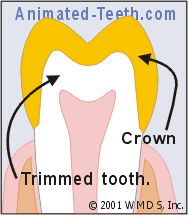
The way a crown encases its tooth helps to reinforce it.
- Crowns strengthen teeth. – One of the hallmark characteristics of a dental crown is the way that it reinforces and strengthens a tooth. This is due to the way it cups over and encases it (see illustration).
A crown literally acts as a rigid splint that holds the tooth together. And that means that once one has been placed, the tooth can withstand a greater level of chewing forces without risk of damage.
- Dental fillings don’t offer as much protection. – In comparison, a filling just rests in or on a tooth and generally doesn’t offer any substantial strengthening effect. And as we explain below, and especially in the case of large filling placement, choosing this option may leave the tooth with a significant risk for future fracture.
(Related page: Broken teeth – Repairs and outcomes. Example scenarios.)
Of course, if your tooth doesn’t really require strengthening, then placing a crown is overkill. And in fact, doing so makes a poor choice for your tooth.
Background details about issues associated with dental filling size –
Actually, you can’t have a valid discussion about crowns vs. fillings, without first describing the size of the filling that’s planned.
1) With small fillings, there’s usually no concern about tooth strength.
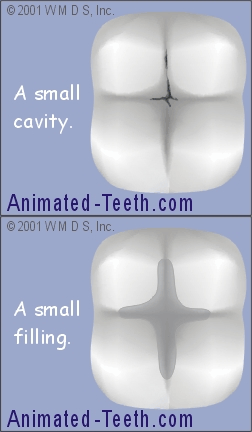
For small repairs, placing a filling makes the right choice.
With this situation, placing a filling (vs. a crown) is actually the superior choice.
In cases where only a minor amount of repair is needed, placing a crown instead of a filling can actually be detrimental to the tooth. That’s because:
- The aggressive amount of tooth trimming that’s needed for crown placement How much? can stress it. Even to the point where irreversible harm may come to the tooth’s nerve tissue A possible consequence., thus triggering the need for root canal treatment.
- Also, crowned teeth can be more difficult for a patient to clean. For example, removing dental plaque from around its gum-line edges can be challenging, with a primary concern being the development of gum disease and associated complications.
Of course, these events don’t occur in all cases. But the potential for them is great enough that placing a crown isn’t justifiable if a simpler type of restoration can satisfy the tooth’s needs.
2) How large fillings may leave a tooth at risk.
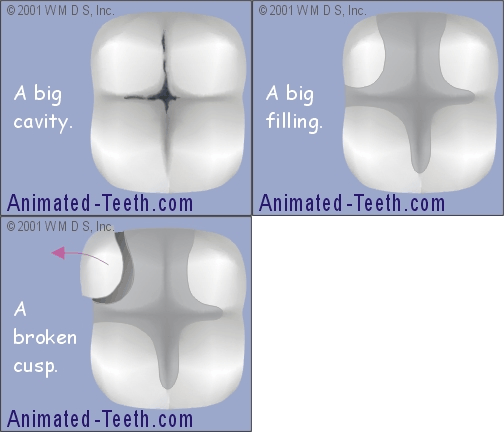
Large dental fillings can leave a tooth vulnerable to fracture.
An analogy.
The structural integrity issue we’re discussing here is a little like what you find with an eggshell.
- If you take a raw egg and you want to break it open, it really takes a pretty firm rap. That’s because an eggshell, as an intact unit, is a surprisingly strong object.
- Now, in comparison, say you’ve broken the egg open and the two halves of the empty shell are lying on their sides. In this condition, it’s a simple feat to crush each piece flat.
- That’s because the shell’s structural integrity has been compromised. It’s no longer an intact unit that’s capable of withstanding forces well.
How filling preparation size affects tooth strength.
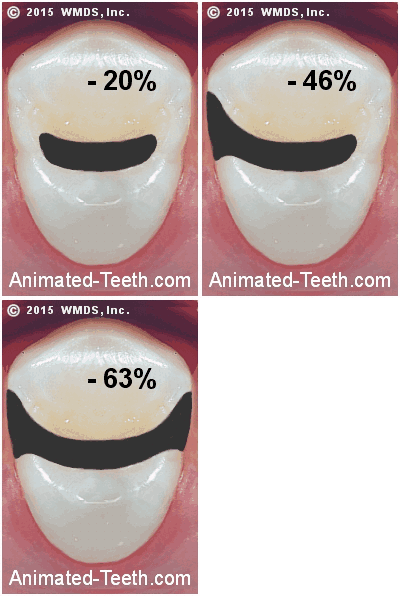
The numbers shown are the reduction in tooth stiffness (a measure of tooth strength).
That’s why teeth that have big fillings can be fragile.
Research evidence.
Our animation illustrates the amount of reduction in stiffness that the study reported takes place when preparations for standard types of fillings are made.
- 1 surface cavity preparation = -20%
2 surface = -46%
3 surface = -63%
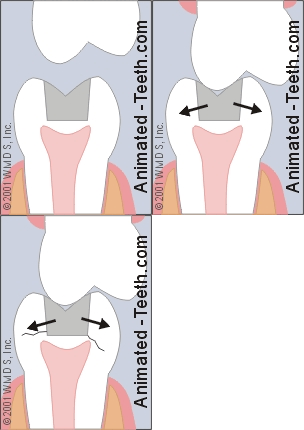
A filling may create a wedging effect that ultimately cracks its tooth.
b) Fillings can create a wedging effect that leads to tooth fracture.
A major difference between crowns vs. fillings.
▲ Section references – Rosenstiel
This effect can take place with either large or small fillings. But as discussed above, those teeth that have comparatively larger restorations may already be at comparatively higher risk of fracture, and therefore this issue is of greater concern for them.
c) The question isn’t only “if” a large filling can be placed.
Don’t confuse the issue of “can a filling be placed” vs. “should one be.”
Dentists are humans just like anyone else. And sometimes an aspect of the treatment options they offer has to do with trying to satisfy their patient’s wishes (with cost concerns often being the primary factor when crowns are involved).
Know what you’re getting and what the restoration’s outlook is.
Just because a dentist may feel that they can successfully anchor a filling in your tooth, you still need to ask them what they expect the restoration’s outlook will be.
Should the restoration be considered to be a “permanent” fix? Or instead, just an interim solution, with a crown hopefully placed before any further harm occurs?
Even the latter approach doesn’t necessarily make a bad plan. But if that’s your situation, you should be fully aware of it.
d) Guidelines – What constitutes a ‘big’ dental filling? When should a crown be placed instead?
As mentioned above, and discussed in further detail below, a big part of determining when a crown is indicated for a tooth instead of a large filling has to do with what size the filling would need to be.
That’s because when larger amounts of tooth structure are missing, the tooth is typically in greater need of reinforcement (a function that crowns, as opposed to fillings, excel in providing).
Of course, deciding when a proposed filling may be “too big” (to provide needed strength or predictable service) is really only something your dentist can determine. During their evaluation, here are some of the issues they will consider.
Intercuspal distance = Cusp tip to cusp tip.
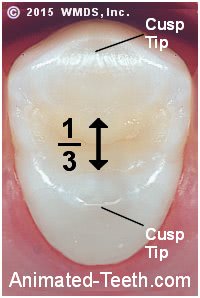
Fillings greater than 1/3 the distance between cusp tips tend to significantly weaken a tooth.
Crowns vs. large fillings – Common guidelines.
- A study by Larson determined that fillings that take up just 1/3rd of the “intercuspal distance” of a tooth (see picture) reduce the tooth’s resistance to fracture by more than one-half.
- A paper by Geurtsen states that a tooth’s risk for fracture increases substantially as its filling approaches 50% of its intercuspal distance.
This paper’s recommendation was that fillings, composites (white, tooth-colored), or amalgam (silver, metal), should not exceed 1/3 to 1/4 this distance.
So, in cases where the size of the proposed filling will equal or exceed these general guidelines, serious consideration should be given to crown placement instead.
Of course, your mileage may vary.
Not all dentists are as conservative as the above guidelines in what they recommend. And from a practical standpoint, many teeth that have “large” fillings do just fine, even over the long term. (A quick look in your own mouth may confirm this.)
▲ Section references – Larson, Geurtsen
These are all “big” dental fillings.
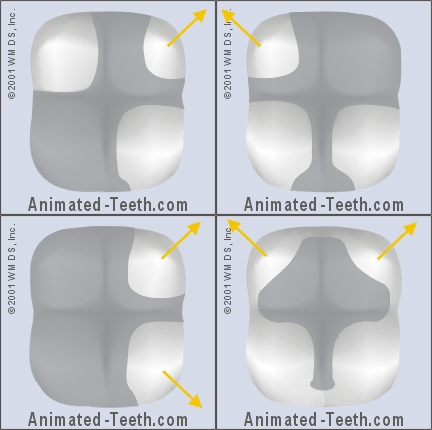
The arrows indicate the most fragile portions of the tooth.
Examples of “large” fillings.
Generally speaking, they’re the tooth cusp that the filling encroaches on the most. (Cusps that don’t meet the requirements stated in the general rules given above.)
e) Not all teeth with large fillings are initially or will become problematic.
Possibly by now you’ve already been to the mirror so you can judge the size of the dental fillings in your mouth. Did you see any “large” ones?
Now, ask yourself, how long have those big fillings been in place? What’s your answer? Two years, five years, longer? If so, what’s the deal? If teeth with large fillings are so weak, why haven’t parts of yours already fractured off? Don’t these teeth need dental crowns, immediately?
What do experts say?
We found a section in the dental treatment planning textbook authored by Stefanac that discusses this type of scenario at length.
It goes as far as to state that diagnosing the need for a dental crown for a tooth that has a large filling that has provided acceptable service for some years and has no obvious deficiencies “is one of the most common opportunities for overtreatment in dentistry.”
When should large filling replacement be considered?
The book suggests that basic reasons for intervening include: a defect in the filling, the identification of tooth decay or a fracture line in the tooth, and pain on biting. And states that short of the presence of one or more of these symptoms, making a compelling case for crown placement can be difficult.
Of course, as it should, the book expounds on more detailed scenarios and considerations that could be factors that tip the scale in favor of one treatment approach over the other. But the salient point we took away from this text was that the act of crown placement can have unintended consequences, and as such a decision to place one must be based on a reasonable justification.
(We’ll also state that we noticed that there’s an added implication here that large fillings (at least those that survive an initial number of years) can make a reasonable choice for teeth.)
So, what should you do if you have some big fillings?
Obviously, with this subject, there are no cut-and-dried answers. The hope is, based on both their knowledge and clinical experience, that your dentist can provide an educated opinion about which of your teeth have a true need for a crown.
▲ Section references – Stefanac
Don’t overlook that prevention is really the key.
As this page has discussed, in many, many cases the debate between placing a filling or a crown simply boils down to how much tooth structure has been lost. And that suggests that a person’s potential for requiring a crown can be reduced if steps are taken to help to keep tooth damage to a minimum.
Of course, in many cases, you’ll have no control over this factor at all. But there actually are some habits and lifestyle choices that do increase a person’s risk for tooth damage, and therefore crown placement. If you’d like to learn more, read this page: 8 things you can do to reduce your chances of ever needing a dental crown. Proactive steps.
Page references sources:
Geurtsen W, et al. Diagnosis, therapy, and prevention of the cracked tooth syndrome.
Larson TD, et al. Effect of prepared cavities on the strength of teeth.
Reeh E, et al. Reduction in tooth stiffness as a result of Endodontic and Restorative procedures.
Rosenstiel SF, et al. Contemporary Fix Prosthodontics. Chapter: Principles of Tooth Preparation.
Stefanac SJ, et al. Diagnosis and Treatment Planning in Dentistry. Chapter: Evidence-Based Treatment Planning.
All reference sources for topic Dental Crowns.
Comments.
This section contains comments submitted in previous years. Many have been edited so to limit their scope to subjects discussed on this page.
Comment –
Crown or filling?
I am told I need a crown for the last bottom tooth that has a large filling. I do not have a tooth above it that bites down on it. Is the crown necessary?
Chery M.
Reply –
It may be that with certain jaw movements that that tooth does come into contact with other teeth and therefore receives biting pressure, and thus could benefit from the protection (strengthening effect) of a crown.
With a little testing, you should be able to determine this, and possibly you already have.
If the filling and tooth are in good repair, and it receives zero chewing forces, we tend to agree with you that we’re unclear of the benefit that the crown will provide.
If the there is an obvious defect with the tooth or filling, possibly the dentist feels that the needed restoration is so large that creating one “in the mouth” (as fillings are) would be difficult if not impossible, or would produce less ideal results.
Beyond that, if the tooth has had root canal treatment your dentist may feel that a crown creates a better seal over the tooth, thus better protecting that work.
Staff Dentist
Comment –
Repair for broken tooth.
The tooth on the right side upper(fourth tooth from the front) cracked. There is no pain. The dentist said I need a crown ASAP and he was ready to start the build up right then and there. But because of his extremely high pressure on me to start it and for several other reasons during the consultation, I don’t trust his judgment or his work. (For example, because I wanted to take time to decide what to do, he said he would do me a special favor that would last a month and he put a temporary adhesive on the broken off portion of the tooth onto the existing tooth, and the broken tooth fell off 5 minutes after I left the office!!)
How come it does not exist that a filling material is available instead of a crown. Everything I’ve read says that a filling material for A build-up will not last a long. Of time. This seems very odd considered the high technology we have today.
Needless to say, I do not want to spend $1,700 on a crown. Maybe I should catch a cheap trip to Europe and have the work done there. Any additional help or Insight that you have would be appreciated. Thank you.
SP
Reply –
It’s hard to say much much. Even if the perfect filling material did exist (has incredible strength, creates an astoundingly strong bond with tooth structure, and preferably comes in a number of shades of white) (and no, this material does not exist, here’s the best restoratives dentistry has to offer right now) two deficiencies would still always persist.
1) As opposed to a dental crown that can be crafted to the “perfect” shape at the leisure of the dental technician, doing the same under the impromptu act of filling creation (in the mouth environment, often with poor visibility or access, possibly under time constraints related to the material setting, etc…), especially for very large restorations, can be difficult or even impossible.
2) A crown provides protection for the entire tooth (by the way it cups over it). As this page discusses, fillings don’t do that. So even with the perfect filling material, many teeth would still remain at risk for further fracture.
Fillings and crowns are simply different types of restorations fundamentally.
—
The cost of crowns varies, according to the type or dental office making it. So, there might be some relief for your situation by investigating those options.
—
In regard to “dental tourism,” certainly most cases of crown placement don’t require further follow up. But in the case that complications arise, having the dentist who made the crown locally is an advantage.
Staff Dentist