Which are the best Sonicare brush heads? – We compare Sonicare’s replacement heads according to design, intended purpose, brushing effectiveness, interchangeability, size.
Sonicare replacement brush heads.
If you own a Sonicare that uses their standard-version click-on brush heads (most models do), you’ve made a good choice.
That’s because even though your toothbrush came with a specific type of head originally, when it’s time to buy replacements, you can choose from any of the other click-ons we show on this page. And that’s a big assortment, and a powerful option to have.
What should you look for in a replacement brush head?
There are a number of factors that you should consider. They of course include brush design and intended purpose along with cleaning effectiveness. But other factors need to be considered too such as their convenience of use, head size, interchangeability, replacement intervals, and cost. We discuss all of these issues on this page.
As a companion page, we also explain what Sonicare’s BrushSync feature is because you may need one of these “smart” heads in order for all of the features of your toothbrush to work.
Which Sonicare brush heads do we think are the best ones?
In terms of effectiveness (plaque removal), we’re inclined to lean toward the A3 Premium All-in-One, C3 Premium Plaque Control, and W3 Premium White. We’ve used these and like the results we get.
But our experience doesn’t necessarily mean that you’ll feel the same way because your mouth and your needs may be very different than ours. And because of that, you owe it to yourself to scroll through this page to get an idea of which heads may make a good choice for you.
For each head, we show its picture and explain what characteristics it has and how it differs from others. From there, you should be able to make an educated decision about which to try.
What brush head choices (styles/designs/sizes) does Sonicare offer?
We periodically visit the Sonicare (USA) website to see what brush heads they currently have listed. Right now, this is the group of replacement heads they show.
The Sonicare brush head lineup.
- A3 Premium All-in-One
- C3 Premium Plaque Control
- W3 Premium White
- G3 Premium Gum Care
- AdaptiveClean
- C2 Optimal Plaque Control
- G2 Optimal Gum Care
- W DiamondClean
- i InterCare
- InterCare
- C1 SimplyClean
- C1 ProResults
- SimplyClean
- S Sensitive
- For Kids
- TongueCare+
- E-Series
Except one, all of these brush heads are universal Click-On style.
With the exception of their E-Series (and also the PowerUp and Philips One brush heads which are generally not discussed on this page), Sonicare’s other heads feature their Click-On (snap-on) design. It’s this kind of head that can be used universally with Sonicare’s toothbrush lines, with the exception of the PowerUp Battery, Philips One, and Essence.
Preface to the remainder of this page.
For the most part, our information below is self-explanatory. It’s all been taken directly from the Sonicare (USA) website and various promotional materials it links to. It’s just been formatted into a single page so it’s easier for you to make comparisons between each kind of head.
Sonicare’s brush head “ratings.”
We think it’s important to mention the “rating” information Sonicare promotes for each of their heads on their website and in advertising and informational materials.
Our impression of these statistics (“20X more …,” “10X more …,” “100% more …,” etc…) is that they’re generally qualified statements primarily concocted as selling points for advertising copy. But beyond even just that impression, the other problem with this data is that Sonicare doesn’t always provide the same precise set of statistics for each head, thus making a true apples-to-apples comparison between all of their styles of heads technically impossible.
Despite this deficiency, we’ve still chosen to show these ratings on this page because we know of no other source for similar information. And as such, we consider it the only available proxy, no matter how incomplete or inconsistent, for making any level of comparison between individual Sonicare brush heads.
Beyond that specific application, however, we assign no value to this rating system at all and just consider it fodder for creating advertising hype.
Our affiliate links can be used to shop Sonicare replacement brush heads on Amazon.com or Walmart.com
Tip: Keep in mind that if your toothbrush model uses standard click-on heads (all but Essence, Philips One and PowerUp do) you’re not restricted to just using the kind your brush came with. You can choose from any of the click-on designs.
The Sonicare brush head lineup.
► A3 Premium All-in-One –
Notes and impressions –
This is their best one.
Sonicare’s newest brush head is the A3 Premium All-in-One. And its design is repeatedly referred to in Sonicare promotional materials (like those for the 9900 Prestige toothbrush which comes with it) as being their “all-time best brush head.”
How much better?
Well, these same promotional materials do cite statistics spouting the effectiveness of this brush head’s design. However, and like mentioned above as a common problem, in the case of the All-in-One only some of the benchmarks given correspond directly with the statistical claims for other brush head designs. Thus making a truly valid head-to-head comparison across the whole line essentially impossible.
The statistical proof.
Among the stats cited for the A3 Premium All-in-One are that it can “remove up to 20x more plaque even in hard-to-reach areas*,” “remove up to 100% more stains in less than two days***,” and “clean deep for gums that are up to 15x healthier in just two weeks**.”
We’ve left Sonicare’s attached asterisks in the statements above just so you can get an idea of how qualified/restricted those claims are. The liberal use of asterisks in conjunction with Sonicare statistics is very common in their promotional materials for all of their brush heads.
You can assign whatever value you want to them. We simply long for the day when Sonicare chooses to state facts that can simply be taken at face value without further qualification.
Other All-in-One properties and characteristics.
The A3 Premium All-in-One is one of Sonicare’s microchipped BrushSync brush heads.
(Some toothbrush models require the use of a BrushSync head for full functionality. – The Brushsync system manages brushing mode/brush head syncing and brush head replacement reminders. For more information, see our BrushSync Explained page for details about this system and which toothbrush models and brush heads are BrushSync capable.)
As a final point, we’ll also state that besides being Sonicare’s best brush head, we find that the All-in-One tends to also be their most expensive one. (Possibly the current pricing premium associated with this head is simply because it’s still new.)
The All-in-One brush head.
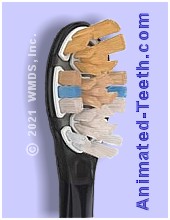
Details about the A3 Premium All-in-One.
- Sonicare ratings for:
Plaque removal (in hard-to-reach areas) vs. manual toothbrush = 20X.
Plaque removal vs. manual toothbrush (like shown below for other heads) = No number is reported.
Stain removal = 100% more in 2 days.
15x healthier gums in 2 weeks. - How does Sonicare seem to rank the brushing effectiveness of this brush head?
- Bristle stiffness = Soft
- Standard size only.
- BrushSync head = Yes.
- Replacement interval = 3 months.
- Estimated cost per brush head = $15.00
What’s different about the All-in-One’s design?
There are a couple of factors that make this brush head different than Sonicare’s others.
Angled bristles.
The outer bristles on the All-in-One are flared outward and Sonicare states that this aids with plaque removal. In our picture, the head’s top and bottom bristles give a hint of this flare, especially when compared to the other pictures of heads on this page.
Longer bristles.
A similar comparison of pictures on this page also shows how the All-in-One’s bristles are longer than most other heads.
Triangular bristle tips.
The All-in-One has been designed with triangular-shaped bristle tips. Sonicare says this shape helps to remove stains more effectively.
Historically, toothbrush manufacturers have rounded and polished toothbrush bristle tips, primarily as a safety feature for the gum and tooth surfaces they scrub against. We don’t know what testing Sonicare performed regarding this issue but do trust them to make an appropriate, safe choice for consumers.
Comments.
We’ll take Sonicare’s word for it that the All-in-One head is their most effective head. We’ll also mention that with the introduction of the 9900 Prestige (the first brush to come out with this head already installed), Sonicare seems to be significantly downplaying the need to use different brush heads paired with a specific brushing mode to accomplish various goals (like whitening or gum health). Evidently, they feel this brush head (when paired with full-intensity Clean mode) does just as well.
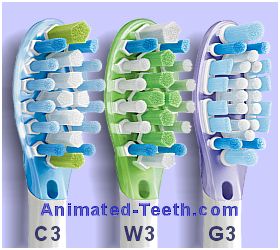
C3 Premium Plaque Control | W3 Premium White | G3 Premium Gum Care.
► C3 Premium Plaque Control –
Details about the C3 Premium Plaque Control.
- Sonicare ratings for:
Plaque removal vs. manual toothbrush = 10X.
Surface contact = 4X. - How does Sonicare seem to rank the brushing effectiveness of this brush head?
- Bristle stiffness = Medium Soft
- Standard size only.
- BrushSync head = Yes.
- Replacement interval = 3 months.
- Estimated cost per brush head = $10.00
Comments.
Sonicare promotional materials use the phrase “our deepest cleaning brush head” on their website for the C3. (Still, even with the introduction of the All-in-One head.) We’ll take that as meaning they still feel it’s one of their most effective brush head designs for removing dental plaque.
► W3 Premium White –
Details about the W3 Premium White.
- Sonicare ratings for:
Plaque removal vs. manual toothbrush = 10X.
Surface contact = 4X.
Stain removal = 100% whiter in 3 days. - How does Sonicare seem to rank the brushing effectiveness of this brush head?
- Bristle stiffness = Medium soft. Side bristles are embedded in soft plastic to give them greater flexibility.
- Standard size only.
- BrushSync head = Yes.
- Replacement interval = 3 months.
- Estimated cost per brush head = $10.00
Comments.
From its name, one would assume that Sonicare considers this to be their best brush head for removing surface staining from teeth. We don’t have much to say about that claim.
We will point out that in regard to stain prevention, any of their “10X” plaque removers should be an equivalent choice. That’s because preventing tooth staining (in terms of something that toothbrushing can remedy) has to do with completely removing plaque and debris from tooth surfaces before it has had a chance to calcify and subsequently pick up discoloration.
Bristle design.
We couldn’t help but notice how similar the bristle arrangement of the C3 and W3 heads are (see picture above). And with an essentially identical design, one would have to assume that any extra benefit that the W3 can provide would primarily be due to differences in bristle stiffness.
We do notice that Sonicare uses the term “polishing bristles” when describing the W3. But whatever difference that specifically entails, they describe both brush heads as being “medium soft.”
► G3 Premium Gum Care –
Details about the G3 Premium Gum Care.
- Sonicare ratings for:
Plaque removal vs. manual toothbrush = 10X.
Surface contact = 2X.
7x healthier gums in 2 weeks. - How does Sonicare seem to rank the brushing effectiveness of this brush head?
- Bristle stiffness = Soft
- Standard size only. (But this head is comparatively smaller than the C3 and G3.)
- BrushSync head = Yes.
- Replacement interval = 3 months.
- Estimated cost per brush head = $10.00
Comments.
Sonicare suggests that this brush head provides “superior plaque removal at the gum line.” And they state that the soft sides of this head (the portion that holds the bristles, see picture above) are able to flex, thus allowing them to “adapt to the contours” of the person’s gumline.
This “flexing sides” design is also mentioned in regard to the C3 and W3 heads. Although in our picture above, you can see how the design of the W3 is slightly different, which may allow it to provide more of an effect.
Notes and impressions –
This next brush head is similar to the C3, W3 and G3 in the sense that Sonicare categorizes it as a “10X” head (in regard to plaque removal). But note, this is not a BrushSync-capable head.
► AdaptiveClean –
Details about the AdaptiveClean.
- Sonicare ratings for:
Plaque removal vs. manual toothbrush = 10X.
Surface contact = 4X.
“Improves gum health” in 2 weeks. - How does Sonicare seem to rank the brushing effectiveness of this brush head?
- Bristle stiffness = Regular
- Standard size only.
- Replacement interval = 3 months.
- Estimated cost per brush head = $10.00
Comments.
In terms of bristle appearance, this head seems essentially identical to the C3 Premium Plaque Control head shown above. And Sonicare tends to describe it in a very similar fashion (flexing sides, similar rating values, etc…).
Notes and impressions –
The next heads we discuss (C2 Optimal Plaque Control, G2 Optimal Gum Care, W DiamondClean and i InterCare) are all BrushSync capable.
But different than those above, Sonicare evidently considers these heads to have a less effective design. (They are designated as “7X” brush heads in regard to plaque removal.) Some of these are “top” designs from previous years.
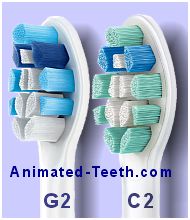
G2 Optimal Gum Care | C2 Optimal Plaque Control
► C2 Optimal Plaque Control –
Details about the C2 Optimal Plaque Control.
(Formerly the ProResults plaque control.)
- Sonicare ratings for:
Plaque removal vs. manual toothbrush = 7X. - How does Sonicare seem to rank the brushing effectiveness of this brush head?
- Bristle stiffness = Regular
- Standard size only.
- BrushSync head = Yes.
- Replacement interval = 3 months.
- Estimated cost per brush head = $8.30
► G2 Optimal Gum Care –
Details about the G2 Optimal Gum Care.
- Sonicare ratings for:
Plaque removal vs. manual toothbrush = 7X.
“Helps to improve” gum health. - How does Sonicare seem to rank the brushing effectiveness of this brush head?
- Bristle stiffness = Regular
- Standard size only.
- BrushSync head = Yes.
- Replacement interval = 3 months.
- Estimated cost per brush head = $8.30
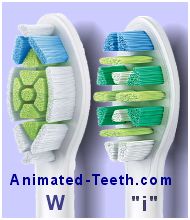
W Diamond Clean | i InterCare
► W DiamondClean –
Details about the W DiamondClean.
- Sonicare ratings for:
Plaque removal vs. manual toothbrush = 7X.
Stain removal = 100% whiter in 7 days. - How does Sonicare seem to rank the brushing effectiveness of this brush head?
- Bristle stiffness = Regular
- Standard size only.
- BrushSync head = Yes.
- Replacement interval = 3 months.
- Estimated cost per brush head = $6.75
► i InterCare –
Details about the i InterCare.
- Sonicare ratings for:
Plaque removal vs. manual toothbrush = 7X.
“Improves gum health” in 2 weeks. - How does Sonicare seem to rank the brushing effectiveness of this brush head?
- Bristle stiffness = Regular (This head is designed with extra-long bristles intended to aid with removing plaque from in between teeth.)
- Standard size only.
- BrushSync head = Yes.
- Replacement interval = 3 months.
- Estimated cost per brush head = $10.00
Notes and impressions –
The remainder of the brush heads described on this page are not BrushSync capable. Generally, they are either specialty or else older (less efficient) Sonicare designs.
► InterCare –
Details about the InterCare.
- Sonicare ratings for:
Plaque removal vs. manual toothbrush = 6X.
“Improves gum health” in 2 weeks. - How does Sonicare seem to rank the brushing effectiveness of this brush head?
- Bristle stiffness = Regular (This head is designed with extra-long bristles intended to aid with removing plaque from in between teeth.)
- Standard size only.
- Replacement interval = 3 months.
- Estimated cost per brush head = $10.00
► C1 SimplyClean –
Details about the C1 SimplyClean.
- Sonicare ratings for:
Plaque removal vs. manual toothbrush = 3X. - How does Sonicare seem to rank the brushing effectiveness of this brush head?
- Bristle stiffness = Regular
- Standard size only.
- Replacement interval = 3 months.
- Estimated cost per brush head = $7.00
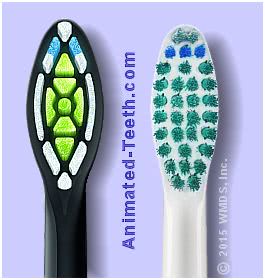
DiamondClean and original ProResults brush heads.
► C1 ProResults –
Details about the C1 ProResults.
- Sonicare ratings for:
Plaque removal vs. manual toothbrush = 3X. - How does Sonicare seem to rank the brushing effectiveness of this brush head?
- Bristle stiffness = Regular
- Standard size only.
- Replacement interval = 3 months.
- Estimated cost per brush head = $8.10
► SimplyClean –
Details about the SimplyClean.
- Sonicare ratings for:
Plaque removal vs. manual toothbrush = 2X. - How does Sonicare seem to rank the brushing effectiveness of this brush head?
- Bristle stiffness = Regular
- Standard size only.
- Replacement interval = 3 months.
- Estimated cost per brush head = $8.30
► S Sensitive –
Details about the S Sensitive.
- Sonicare ratings for:
Plaque removal vs. manual toothbrush = “Helps to remove plaque.” - How does Sonicare seem to rank the brushing effectiveness of this brush head?
- Bristle stiffness = Ultra-soft
- Standard size only.
- Replacement interval = 3 months.
- Estimated cost per brush head = $8.20
This seems to be Sonicare’s head specially designed for those whose gums and teeth are ultrasensitive and therefore require a soft-bristled brush head.
We will point out that it would be expected that a head that has ultra-soft bristles would be a less efficient plaque-remover than those that feature Sonicare’s “Regular” or “Medium Soft” ones.
This point is possibly evidenced by the fact that Sonicare does not state a “plaque removal” rating for this brush head like it does its other ones.
► For Kids –
Details about the For Kids.
- Sonicare ratings for:
Plaque removal vs. manual toothbrush = 2X. - How does Sonicare seem to rank the brushing effectiveness of this brush head?
- Bristle stiffness = Soft
- Standard and Compact sizes.
- Replacement interval = 3 months.
- Estimated cost per brush head = $10.00
The For Kids heads are intended for use with the For Kids toothbrush handle. The heads (both sizes) are smaller and have softer bristles than Sonicare’s heads intended for use by adults.
► TongueCare+ –
Details about the TongueCare+.
- Bristle design = 240 latex-free rubber MicroBristles.
- Standard size only.
- Estimated cost per brush head = $5.00
FYI: The use of this head is just one way of cleaning your tongue. Here’s our page that covers manual tongue brushing and scraping.
► E-Series –
Details about the E-Series.
- Sonicare ratings for:
Plaque removal vs. manual toothbrush = No number is reported. (Historically this was reported as a 2X brush head.) - How does Sonicare seem to rank the brushing effectiveness of this brush head?
- Bristle stiffness = Regular
- Standard and Compact sizes.
- Replacement interval = 3 months.
- Estimated cost per brush head = $6.50
Note: Unlike every other brush head described on this page, the E-Series has a screw-on design (not click-on). It can only be used with a very limited number of Sonicare models (Essence or other old-style Sonicare toothbrush models.)
About the prices we show in the information above.
It’s been our experience that we’ve found the MSRP information reported on the Sonicare (USA) website incomplete (some brush head models do not have an MSRP stated). As a workaround for this shortcoming, we’ve chosen to list actual prices we’ve found on online retailer websites.
Since we assume that most people will buy in quantity, we’ve looked for offerings where the head comes packaged in multiples (usually 3 but in some cases 2 to 5). And then based on that product’s price, we’ve calculated the per-brush-head cost we show above.
FYI: It would have been our assumption that as you descend on down our page that each brush head listed would tend to be lower in cost. As it turns out, we absolutely didn’t always find this to be the case, so pay attention when you compare or shop. You may find that older, less-efficient brush heads may not be any less expensive than one of Sonicare’s current models.
Our affiliate links can be used to shop Sonicare replacement brush heads on Amazon.com or Walmart.com
Tip: Keep in mind that if your toothbrush model uses standard click-on heads (all but Essence, Philips One and PowerUp do) you’re not restricted to just using the kind your brush came with. You can choose from any of the click-on designs.
Brush head features and issues to consider.
Which Sonicare brush heads are the most effective?
Sonicare has a couple of different “rating” systems that they cite when touting the effectiveness of their various brush heads. Three of these “statistics” that we’ve taken from their website (USA version) and included in the information above are their claims about plaque removal, tooth surface contact, and gum health.
a) Which Sonicare brush heads are best at removing plaque?
Here’s how Sonicare ranks the comparative effectiveness of their heads in regard to “plaque removal as compared to a manual toothbrush.”
- “20x more” – A3 Premium All-in-One
(Note: Here the statistic is given as 20X more “in hard-to-reach areas” vs. a manual toothbrush. That’s different than for the brush heads below where the phrase “in hard-to-reach areas” is not included.)
- “10x more” – C3 Premium Plaque Control, W3 Premium White, G3 Premium Gum Care, Adaptive Clean
- “7x more” – C2 Optimal Plaque Control, G2 Optimal Gum Care, W DiamondClean, i InterCare
- “6x more” – InterCare
- “3x more” – C1 SimplyClean, C1 ProResults,
- “2x more” – SimplyClean, For Kids, E-Series.
Using the ratings – Observations and comments.
a) Sonicare brush heads vs. a manual toothbrush.
We want to point out that a person can be very effective in removing dental plaque from their teeth just using a plain-old manual toothbrush. And in fact, suggesting that using an electric brush is substantially more beneficial than a manual one is generally the more difficult case to make. (Note: With either method, flossing is still needed to complete the job.)
When cited on its website’s pages (USA), Sonicare doesn’t link to the study parameters, data or statistical analysis on which their rating system is based, so we don’t have that information to look at and understand.
But we would suggest that whatever first goes through your mind when you see the words “10x more” probably isn’t what was actually measured by their study and rating system. So we wouldn’t be overly swayed by the statement.
b) Sonicare brush head vs. Sonicare brush head.
We would expect that the rankings above probably do fairly accurately reflect the comparative effectiveness/efficiency of Sonicare’s brush heads.
So when trying to pick out a head that is best for removing plaque, choosing a 20X or 10X head probably does make a better choice than a 2X one. (We tend to think of it as the higher-X head probably does a better job when identical amounts of time and effort are expended.)
But beyond that, we’ll simply state that their 10X heads are a relatively new design, and there are literally decades of published scientific studies that have documented that using previous generations of Sonicare models are good plaque removers.
So, apparently you can be effective with either. And as stated above, we would think that whatever goes through your mind when you see the term “10X more” probably isn’t exactly what was actually measured by their study and rating system, so don’t be overly swayed by it.
b) Brush head surface contact.
This rating that Sonicare bestows on some of their brush head designs is an indication of the level of tooth-to-bristle contact that takes place during use. A higher value would generally be associated with heads that are more effective plaque removers.
The basis of comparison used is “X” times “more surface contact than a DiamondClean brush head.”
c) Gum-health rating.
This rating system has the qualifiers: “X” times “healthier gums” in “X” weeks, with the toothbrush set in Gum Care Mode vs. a manual toothbrush as measured by GBI (Gingival Bleeding Index, which is a measure of gum tissue bleeding when probed).
We have no comment to make here other than to say that we’re not unduly impressed by this “statistic.”
Which Sonicare models can be used with which brush heads?
a) Click-on style –
b) Screw-on style –
How long do Sonicare brush heads last?
Suggested replacement intervals.
Sonicare’s standard recommendation is that brush heads (all styles) should be replaced every 3 months.
Blue indicator bristles.
Sonicare incorporates blue “reminder” bristles into their heads. Their color gradually fades to white with use.
We will point out that Sonicare has used the word “reminder” when naming these bristles, meaning they’re not necessarily a precise indication. We’ve read online user comments that suggest that the color change sometimes signals replacement before a full 3 months has elapsed.
BrushSync brush head replacement indicator.
Toothbrush models that utilize Sonicare’s BrushSync system and compatible brush heads can track brushing session pressure and duration. Using that information, the brush then calculates and signals when brush head replacement is due.
An equally good test.
A perfectly reasonable evaluation of brush head integrity is to just compare it to a new one. For example: Do the bristles look frayed and worn? Does the bristle arrangement itself look misshapen or damaged? After using the head, do you notice a lack of effectiveness?
If you answer yes to any of these questions, then it’s time for a replacement.
Other things to know about brush head longevity.
Here are some additional points we’ve noticed when reading Sonicare user manuals.
- It’s recommended that brush heads that have bent or crushed bristles should not be used. Damaged bristles may break off while brushing.
- If the toothpaste you use contains peroxide, baking soda or other types of bicarbonate (these are ingredients frequently found in “whitening” toothpaste), be sure to rinse your brush off thoroughly after use.
Residual amounts of these compounds can cause damage to plastic components, like brush heads or even your toothbrush’s handle.
Brushing efficiency- New vs. old brush heads.
There is no question that newer brush heads tend to clean more effectively than older ones. But of course, this would be true for any type of brush, manual or powered.
Research.
▲ Section references – Jenkins
BrushSync brush heads.
Sonicare’s newest toothbrush lines require the use of BrushSync/Smart brush heads (for full functionality). Features of the BrushSync system are:
- Brushing mode paring – The toothbrush handle is able to identify the type of brush head that’s been mounted. It then switches the brush’s mode and intensity to the optimal settings for that head.
- Brush head replacement reminders.
Toothbrush models vary by way of which BrushSync capabilities they feature. Our BrushSync Explained page makes note of these differences and lists which brush heads are BrushSync capable.
Standard vs. Compact brush head sizes.
For some people, the choice of using a smaller brush head size might be an option that they’d like to have. Unfortunately, Sonicare seems to have discontinued some of its previous “Compact” offerings (DiamondClean, ProResults).
- We’re under the impression that the For Kids is the only click-on head that currently offers a Compact option. (Note: Both the Standard and Compact versions of the For Kids are already smaller in size than Sonicare “adult” brush heads.)
- Sonicare states that the G3 Premium Gum Care head is smaller in size than its other “adult” heads.
- The screw-on E-Series head comes in both Compact and Standard “adult” sizes.
Which size should you use?
As you might expect, Compact heads are frequently favored by people who have a relatively small mouth or limited oral access (children, some adults).
Additionally, people who have special needs or circumstances, such as hard-to-reach locations or dental braces, frequently find using a smaller head helps.
Size vs. brushing efficiency.
You might anticipate that just using a Standard-sized head makes the best choice for most adults. They may, but research doesn’t necessarily seem to confirm this.
Research.
#1 –We ran across a Philips Sonicare “data on file” document (Putt) that included an evaluation of the brushing effectiveness of both DiamondClean heads, Compact and Standard.
As compared to the study’s reference brush, the Standard version showed a performance improvement of just 33%, whereas the Compact was documented at 45%. Yes, the Compact head was the more effective brusher.
#2 –We also found a published research study (Biesbrock) that included the evaluation of Sonicare e-Series brush heads in both Compact and Standard form.
▲ Section references – Biesbrock, Putt
You’ll need to consider all factors.
The discussion above is meant to simply point out that you owe it to yourself to experiment. Don’t just use a Standard-size head because you think you’re supposed to. If you struggle with the larger size, try a smaller head and determine which seems best to you.
We do need to point out that the studies above involved Standard and Compact versions of the same brush head model, an option that’s not available in today’s lineup. And choosing the comparatively smaller G3 vs. the C3 or W3 heads can’t be considered a truly lateral alternative because of differences in bristle arrangement and stiffness. So you’ll need to pay attention to how these factors affect your brushing experience.
From reading consumer comments online, it’s our impression that people frequently prefer using a smaller brush head. However, these same posters also frequently mentioned that smaller heads tend to wear out more quickly than Standard ones, thus making them the more expensive option.
Click-on vs. screw-on brush heads.
Almost all current Sonicare models have a design where their brush head snaps into place over a rod on the toothbrush handle. This is in comparison to the older-style e-Series brush heads that have a large screw-on fitting (currently, only the Essence model uses this type of head).
a) Snap-on heads are more convenient.
If your situation is one where you’ll share your brush, the click-on design is convenient because it makes the process of switching heads easier and quicker.
b) Brushes that use click-on heads are easier to keep clean.
Due to their design, toothbrush models that use snap-on brush heads tend to be easier to keep clean than screw-on ones.
With the latter, gunk tends to accumulate underneath the head’s screw-on collar. Debris entry is via gasket joints where the stem of the brush passes through the head’s casing, and then also where the casing meets the brush’s body.
Especially in the case where the brush head is seldom removed, the amount of debris that can accumulate can be surprising. In online reviews on retailer websites, this is a very common mention.
There are some solutions for this problem:
- Placement of a silicone cover (e.g. Sonic Seal) over the brush head. It acts as a barrier to seepage.
- Removal of the brush head after each use and cleaning and drying both it and the toothbrush body (This is the most time-consuming option.)
- The application of silicone grease at each joint may help to prevent/minimize leakage.
Brush head identification.
If you share a Sonicare toothbrush, how do you keep track of which brush head is yours?
Unfortunately, all we have to report is that the current design of Sonicare brush heads isn’t very helpful in dealing with this issue.
In the past …
Historically Sonicare has used a couple of different methods for brush head identification. This includes interchangeable colored rings that could be slipped onto the base of a head’s stem. And geometric shapes (triangle, square, etc…) or colored dots printed near the stem’s base.
Nowadays, we simply don’t see these markings, and we’re at a loss to explain why they’ve been discontinued.
DIY solutions.
As suggestions, try marking the head with an indelible marker in some location that doesn’t get much wear and tear. Or whittle a notch (like by using a knife or fingernail file) somewhere on the head’s stem or base.
As a point of irony, when using a BrushSync brush head (on a BrushSync capable handle), your toothbrush can identify the mounted head as being unique but a human user can’t.
[Philips and Sonicare are registered trademarks of Koninklijke Philips Electronics N.V.]
Our affiliate links can be used to shop Sonicare toothbrushes on Amazon.com or Walmart.com
Tip: The higher-end Sonicare models are great toothbrushes, and more refined, but they’re pricey too. It’s our opinion that the mid-price models HealthyWhite+ and ProtectiveClean 6100 make a good middle-of-the-road, best-value purchase.
Page references sources:
Biesbrock AR, et al. Clinical Evaluations of Plaque Removal Efficacy: An Advanced Rotating-Oscillating Power Toothbrush versus a Sonic Toothbrush.
Jenkins W, et al. Plaque Removal in vivo study Plaque removal efficacy of “new” vs. “old” Philips Sonicare ProResults brush heads.
Putt M, et. al. Plaque removal efficacy of two novel Philips Sonicare DiamondClean brush heads.
All reference sources for topic Electric Toothbrushes.