Rebuilding your tooth after its root canal treatment.
filling?
of crowns.
Every tooth treated will need a final restoration.
After a tooth’s root canal therapy has been completed, it will require some type of permanent dental restoration.
This page discusses the different options you have in deciding how your tooth is rebuilt (crown vs. filling), and details that need to be considered when selecting between them.
Considerations:
- Choosing between a filling and a dental crown, based on the needs of your root canalled tooth.
- Fillings vs. crowns – What does dental research say about which makes the better choice.
- How soon does your tooth’s final restoration need to be placed?
You may also be interested in these additional topics about rebuilding root canalled teeth:
- Can a tooth’s original crown be reused? When?
- Will a post and core What’s this? be required?
A) A crown or a filling after root canal – Which makes the best choice?
For the most part, the two basic options that you have for restoring an endodontically treated tooth are the placement of a dental crown or else a filling.
Here are some of the issues that need to be considered when choosing between the two.
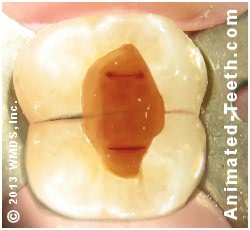
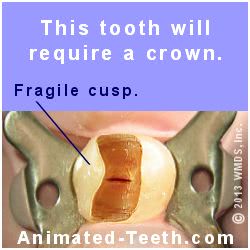
Teeth that have had treatment may require strengthening.
1) The tooth may need strengthening.
Weakening has occurred during their treatment.
- When a conservative opening can be made in a virgin tooth (one that did not have a previous dental restoration), the reduction in tooth stiffness that results may just be on the order of 5% or so. (Eliyas)
- But with many cases, like when the tooth’s individual root canals have been difficult to locate, the dentist may need to remove a comparatively greater amount of internal tooth structure, to the point where the tooth may become significantly hollowed out.
Previous damage.
Teeth that end up requiring root canal treatment have often already experienced some type of significant event, and as a result, are already in a weakened state.
This tooth is very hollowed out and should have a dental crown placed.
- It’s common that treated teeth have previously suffered levels of trauma that have resulted in crack formation or outright fracture. The loss of tooth structure due to the effects of advanced tooth decay can significantly weaken a tooth.
- When repairs are made, it’s been found that the need for a filling on the chewing surface of a back tooth tends to reduce its stiffness on the order of 20%.
Larger fillings, like those whose extension is such that they touch neighboring teeth, have been found to result in an over 60% reduction. (Eliyas)
Changes in tooth dentin.
The flexural strength of dentin (the hard, calcified tissue that makes up the bulk of a tooth) is likely reduced by the various chemical agents frequently used during the cleaning phase of root canal therapy (Eliyas).
Each of the above suggests that by the time its root canal treatment has been completed a tooth may be at substantial risk for fracture, even when exposed to normal chewing forces.
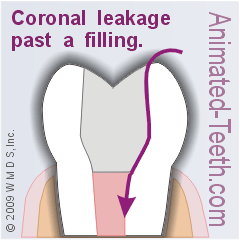
If contaminants re-enter a tooth, its completed treatment will fail.
2) The tooth will require a proper seal.
3) Restoration longevity / durability is an important factor.
The final restoration that a dentist places must be one they feel can provide lasting service. The specific physical properties that the restoration needs, however, will vary on a case-by-case basis.
Examples.
a) Relatively intact teeth.
It’s possible that a tooth that …
- Just has a conservative access cavity …
- And no other history of significant tooth structure loss (such as a previous cavity, filling or breakage)
… might be successfully restored with just the placement of a dental filling.
This approach may be best suited for front teeth (incisors and canines) where the direction of force applied is typically non-axial.
▲ Section references – Eliyas
b) More involved cases.
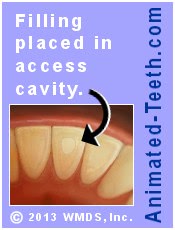
Conservative access openings in front teeth may only require filling placement.
What type of final restoration makes the right choice for your tooth?
- Placing a dental crown has increasingly become the “standard of care” that’s considered appropriate for endodontically treated molars (see next section).
(Related page: Can a tooth’s existing crown be used after its root canal therapy is finished? When? | Why not?)
- For other teeth, especially relatively intact front ones (incisors and canines), and even possibly premolars, the decision to place a dental filling may make a perfectly appropriate choice.
When a filling is considered.
The decision here is basically one of judging if the requirement for sealing the access cavity (to protect the integrity of the tooth’s root canal work) can be met by a filling, especially over the long-term where restoration strength, durability and longevity will all be factors. (A crown is generally considered to provide an excellent seal and lasting service for a tooth.)
Additionally, the filling (its size and shape) must also meet the needs of the tooth in terms of not leaving it at significant risk for catastrophic failure (i.e. tooth fracture). (This risk is significantly minimized by crown placement.)
Additional considerations.
Generally, the advantage of placing a filling instead of a crown is that it avoids the aggressive tooth trimming that the latter requires (there’s nothing favorable about grinding down a tooth if it doesn’t need the benefits that a crown can provide), and a crown’s greater expense.
How to decide.
The decision between the two typically boils down to these points:
- The extent of original tooth structure that remains. – Is the tooth still structurally intact? Or does it need significant rebuilding and strengthening?
- The degree of wear and tear and level of force the restoration (and tooth) is expected to be subjected to. – Can a filling be expected to provide predictable lasting service? (Small ones typically can. With many larger ones, there would be a question.)
Obviously, your decision will almost always be based on the advice of your dentist. But it’s these types of issues and factors that they should have considered, and be able to provide an explanation to you about. There is no cookie-cutter best choice that applies to all cases.
B) Dental research confirms the benefit of dental crowns.
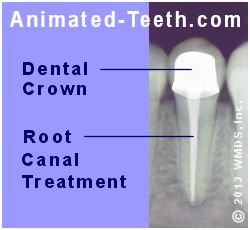
X-ray showing a tooth’s completed treatment and dental crown.
2) Nagasiri (2004) – This study evaluated 220 molars that did not receive dental crowns after root canal treatment. The survival rates of these teeth at 1, 2 and 5 years were 96%, 88% and 36% respectively.
▲ Section references – Aquilino, Nagasiri, Lynch
Click image to jump to topic Dental Crowns.
C) How soon does the permanent restoration need to be placed?
The phrase “as soon as is reasonably convenient” (meaning not an emergency but definitely a priority), often applies to this situation.
Why the rush?
In general, the temporary restoration that has been placed is just that. Here’s why:
- It can’t be relied upon to provide adequate protection or strengthening for the tooth over the long term, thus leaving it at risk for fracture.
- When compared to a permanent restoration, the seal that a temporary creates isn’t as lasting Why this is a concern., thus placing the tooth at risk for recontamination.
Considerations related to COVID-19.
The COVID-19 pandemic has affected the way dentistry is practiced. And one change is for dentists to strive to limit the total number of dental appointments needed to complete their patients’ treatment plans. So, don’t be surprised if your dentist suggests that even on the day on which your tooth’s root canal treatment has been completed, you plan for a longer appointment so aspects of creating the final restoration for your tooth can be accomplished too.
Doing so can be beneficial in several ways. Of course, reducing the total number of individual office visits required to complete your treatment plan can help to minimize the number of opportunities during which the virus might be spread. But also, by going ahead and persevering with getting your final restoration placed, you reduce your chances that unplanned additional visits will be needed too. (Like to manage the situation where a temporary restoration has been lost or has broken.)
Page references sources:
Aquilino S, et al. Relationship between crown placement and the survival of endodontically treated teeth.
Eliyas S, et al. Restoration of the root canal treated tooth.
Lynch C, et al. The influence of coronal restoration type on the survival of endodontically treated teeth.
Nagasiri R, et al. Long-term survival of endodontically treated molars without crown coverage: A restrospective cohort study.
All reference sources for topic Root Canals.
Comments.
This section contains comments submitted in previous years. Many have been edited so to limit their scope to subjects discussed on this page.
Comment –
Is crown necessary?
My tooth that’s just had root canal had a filling in it for years and it did just fine. My dentist said we should now place a crown. Is that really necessary? It’s a big added expense. I’d rather have another filling placed.
Heather
Reply –
We’re not going to have enough information about your tooth and situation to know what’s needed. Your dentist is in a position to have an idea, and evidently they think that crown placement makes the best plan.
There are two important factors that you should keep in mind:
1) The restoration that’s placed needs to be able to create a seal that prevents bacteria and such from seeping back into the interior of your tooth (see coronal leakage link above). Crowns are very good at preventing this.
2) Your tooth probably isn’t as strong and fracture resistant as it was previously. (For example, it’s been substantially hollowed out during your root canal treatment.)
It’s not so much that a filling can’t provide a seal and serve as a strong restoration, it’s just that crowns do this so much more reliably and predictably. Evidence of this is found in the studies mentioned above. Teeth that have had crowns placed after their root canal treatment tend to have a higher survival rate.
That doesn’t mean that all teeth require a crown. It in part depends on how much tooth structure has been lost. In your case, we’re assuming that the filling that existed previously was somewhat sizable (a repair large or involved enough that root canal treatment was ultimately needed).
If instead the hole in the tooth is just a small one (and really only your dentist would be able to make this judgment), a filling might suffice just fine.
Ideally the crown (or whatever permanent restoration is chosen) would be placed promptly after the completion of your tooth’s endodontic work. If finances or such make that difficult, bring the issue up with your dentist and see if they can offer any solutions/alternative plans (payment plan, placing the crown as soon as your next insurance cycle allows, etc…). Good luck.
Staff Dentist
Comment –
Composite filling in root canalled tooth one year before crown?
I need to have a root canal in a molar tooth, since there is a cavity under the old silver filling on the chewing surface. From two other root canalled molars I know the tooth needs a crown and that it takes some time for the lab to create the crown. But I don’t have the time waiting for that, as I am expatriated to Asia very soon. Therefore I will ask my dentist to prepare a regular composite filling in my root canalled molar tooth, hoping that such a filling will last a year or so (as a temporary one-year solution), then I will have the crown once I return from Asia. Is that a suitable solution for a root canalled molar? Don’t know if one year is too long to wait for a crown on a weakened root canalled molar tooth even though it has a composite filling or whether it will break during that year. Alternative is to get a crown while I am in Asia
Flemming
Reply –
In regard to the timing of the crown placement, we’ll defer to your dentist’s opinion. There is no question that a 1 year delay in placing the crown isn’t usually ideal. But for some teeth (possibly even a molar) some type of conventional filling might provide an adequate final restoration. Just ask your dentist what they would do for their own tooth (wait until you return, or have the crown placed in Asia).
In regard to making a go of a dental filling. The quality of the coronal seal of the restoration can be improved by the dentist extending the filling down into the opening of each of the canals just a few millimeters.
(Here’s a link to a paper that discusses exactly that, and mentions that dental composite creates the superior seal as compared to other restorative materials. But also mentions that all groups showed some leakage, so that might be your answer right there.
An assessment of coronal leakage of permanent filling materials in endodontically treated teeth: An in vitro study.)
In regard to filling placement and protecting a potentially fragile tooth, your dentist would probably make the occlusion on the tooth as passive as possible (meaning it doesn’t get much pressure when you bite down or slide your teeth around when touching). And then of course, you would want to favor the tooth as much as possible.
While it would mean utilizing a different dentist, same-day crown placement is a possibility in some dental offices. Probably the most durable type of crown they would have to offer is (monolithic) IPS e.max. You might ask your dentist about suggestions with this option.
And finally, if you’ll Google “best dental schools in the world” (and consider that a proxy for the type of dentistry practiced in that country), several seem to be in Asia.
Staff Dentist
Reply –
Thanks a lot for a very informative and detailed answer. I had my root canal done yesterday. My dentist was clearly in his opinion that I should have the crown very soon and that 1 year delay is far too long. But he accepted my wish and made a composite filling (don’t know if he extended it down the canals as you mention). But he shaped the tooth/filling so it will not have the hard pressure for chewing and of course I will try to favor the tooth as well. He also mentioned that dentists should be quite good in Asia, so maybe I should consider have the crown while staying there.
Flemming
Comment –
Restoration After Root Canal
I had a root canal performed on my #2 molar. I would be OK with only a filling as the tooth is not visible and the repair would be less expensive than a crown.
RamondJ
Reply –
The issue isn’t about appearance. Instead it’s (always) about how well the restoration seals the tooth (so to prevent coronal leakage) and possibly a restoration is needed that can strengthen your tooth.
If you haven’t already, you should read this page about final restorations for root canalled teeth. (Make sure to read the statistics section.)
Possibly just placing a filling is satisfactory for your situation. But only your dentist can advise you on this issue.
Staff Dentist
Comment –
Very informative.
Hi, thank you for the great site, it’s very informative!
I had a root canal done for my upper first molar 12 years ago. I remember the dentist at the time mentioning that the tooth might become brittle over time and break at some point but no crown placement was offered. Since then I’ve seen a number of different dentists and while they have remarked that the root canal is quite extensive, no-one has suggested getting a crown, this includes an endodontist that I saw for an unrelated issue earlier this year.
However, reading information on your site and other sources it seems that crowns are the current standard of care for root canal aftercare. So should I be getting one? Does the fact that the tooth has been OK for the last 12 years means it’s a good sign and a prediction that it might last or has the tooth been getting brittler and I am at ever greater risk of splitting it as the time passes?
I’m a bit worried about getting a crown because it comes with its own fair share of possible complications and difficulties. Also it seems that with a crown it is not recommended to eat hard food such as nuts and popcorn and I imagine those would be the likely culprits for why a root canal tooth with a filling might break too. If so, could I just stop eating hard food now and not get the crown? Even now I consciously chew nuts and seeds with my wisdom teeth (of which I have all 4), to take the pressure off of the first molars, is that a good thing to do?
Thank you so much!
Toothy
Reply –
A dentist not suggesting work vs. you specifically asking them about the need for treatment really are two different things. So if you haven’t recently, you should bring up the subject with yours, pretty much the way you have here and let them advise you.
Here’s an article titled: Are full cast crowns mandatory after endodontic treatment in posterior teeth?. It seems to take the same general stance on issues as we’ve discussed them here on this page but provides greater detail.
You’ll note there is a section that addresses the issue of tooth structure changes after endodontic treatment.
And it mentions how the size/extent of the filling in the tooth significantly affects the tooth’s strength, and therefore whether or not a crown should be placed. (Here’s our similar page: Choosing between a crown and filling.)
You’re right that there can be possible complications with crowning a tooth. So one should only be placed for good reason. But if placed, the type should be one where concerns about breakage are non-existant or minimal.
The linked article above discusses “full cast crowns,” meaning all-metal ones. But there are other, more aesthetic appropriate crown options for molars too (scroll down on that page just a bit).
Forces directed to teeth can cause cumulative effects. Generally, small initial cracks can grow in size due to continued exposure to heavy forces. So, in regard to your root canalled tooth and/or its neighbors, you should keep that in mind.
Like stated initially, you should bring up this issue with your dentist, the person that can evaluate your specific situation, so they can advise you one way or the other. Good luck.
Staff Dentist
Comment –
Crown question.
5 years ago I had a root canal done on canine #11. It died because my or orthodontist turned it too quickly. My dentist at the time placed a post in the tooth but never mentioned needing a crown. This year I went to a new dentist who recommended getting a crown done as the post is exposed on the back of the tooth. SHould you crown a front canine that from the outside looks okay? Thank you
HR
Reply –
Your question is hard to answer because it depends on how much of the tooth is original tooth structure vs. dental materials.
It’s usually considered that a post is only required if it is needed to help anchor the dental materials that are used to rebuild the tooth. (Our post and cores page explains.)
So if a large portion of your tooth was missing after the completion of the root canal work (possibly just on the backside), it would be expected that post placement was indicated. And it’s very common that related to the substantial rebuild job needed that crown placement often makes the preferred way to rebuild a tooth.
Following that scenario, that fact that your post is now exposed implies that the filling material originally placed has deteriorated (or at least substantially worn down) in just a few years. If so, a crown typically provides a more lasting, better sealing, restoration and probably therefore is indicated.
One can’t help but to notice that you state that your tooth required root canal treatment related to orthodontic trauma (as opposed to structural damage caused by advanced decay or tooth fracture).
It’s sometimes possible that with this situation (structurally pristine front teeth) the access cavity made can be quite conservative, and following the root canal procedure just placing a filling suffices. (A post isn’t needed because the filling needs no aid in retention.)
So consider the situation where just placing a filling can be considered an adequate final restoration for the root canal work, and (for whatever reasons) a post just happens to have been placed. And now the post is exposed.
Is it exposed because it wasn’t trimmed short enough originally and had just a thin layer filling material over it that has since worn down? With a possible solution being trimming the post shorter so a more adequate thickness of restorative can cover it?
So as you can see, only a dentist who has seen your tooth can answer these questions and make an appropriate treatment recommendation. So just ask again. But as they explain your situation, it would be expected that the issues described above might be mentioned.
It should be pointed out that, at least in theory, the exposed post places you at risk for the complication of coronal leakage, so you need to pursue a remedy of some fashion in a timely manner.
Staff Dentist
Comment –
Do we need both filling & a crown after Root canal?
I was suggested that after Root canal, filling will be applied immediately and after few weeks a crown needs to be added.
So my understanding is, you need to do Root canal first, filling next & optionally decide to have a crown.
or is it possible that we just do Root canal & crown directly without doing a filling?
SJ
Reply –
If you know that you do want a crown placed on the tooth, there’s usually no requirement for a separate filling step. The access cavity does need to be filled in and sealed off with some type of permanent material (ranging from dental cement to some type of filling material, depending on the preference of the dentist).
But whether doing that (often quick and simple) step should just be included in the cost of the crown could be debated. (Here’s an article that somewhat discusses that point. Generally, it would be considered that “core placement” (extensively rebuilding the tooth) would be a more involved procedure (and therefore a more justifiable fee) than just placing a filling.)
After quizzing your dentist some more, they may offer some additional information that makes it obvious why doing things the way you state is needed. But for most cases, that way (root canal, filling, wait a few weeks, crown procedure) certainly isn’t a requirement.
Staff Dentist
Comment –
Do I need a crown?
My front tooth with pulp necrosis had a root canal last week and the dentist just completed the treatment with a filling yesterday. As I see now, the tooth is totally fine; but it’s a little bit discolored compared to other teeth. Should I need a crown in this case?
JN
Reply –
Crowns are preferably placed for reasons other than just making a color change. A prime example is when the tooth needs strengthening, like discussed above.
When placing a crown isn’t the ideal solution, there are still ways to lighten a tooth:
1) Teeth bleaching treatments. – There are methods where the bleaching agent is applied externally or even inside the tooth. Both methods have pros and cons. Only your dentist could help you decide what’s the right choice for your tooth.
2) Placing a veneer. – With this method, the end result is one where the tooth’s color is changed as if a crown had been placed. It’s just that this is a less aggressive procedure (less tooth trimming) and therefore more favorable for your tooth.
Staff Dentist