What to expect after your root canal appointment.
pain.

precautions.
What happens after root canal visits?
Whether you’re between appointments or your dentist has completely finished your tooth’s root canal work, you’ll no doubt want to know what to expect and what you should do during the hours and days that follow.
In our coverage of these issues, we’ve divided this page into the following subsections:
a) Post-root canal visit pain – What can happen, what to do.
It’s a disappointing fact but some percentage of people will experience some level of discomfort (and possibly even swelling) after their scheduled root canal visit.
For those who do, the first half of this page provides information about possible causes and remedies.
b) Root canal aftercare – What you must do.
Even though your tooth’s root canal therapy is now finished, you’ll need to keep in mind that all of the other dental work it needs still hasn’t been completed.
The care and precautions that you take over the days and weeks until it has been, can have a significant effect on the ultimate outcome of both it and its just completed root canal work.
a) Will you have any pain after your root canal appointment?
Quite possibly yes. It’s generally reported in dental literature that somewhere between 40% to almost 60% of patients will experience some level of discomfort after having had endodontic treatment.
It’s important to keep in mind however that these numbers include all cases lumped together, ranging from those where the level of discomfort experienced ranged from just slight to the most severe.
How much pain can you expect?
Study #1 –
The findings of a study by Sadaf give an idea of what might be expected.
- This study monitored 140 patients during the day (24 hours post-op) following the completion of their (two-visit) root canal therapy.
- 57% reported no discomfort after their work. For those who did, 22% reported mild, 19% moderate, 1% intense, and 1.4% unbearable pain.
Study #2 –
A second study we’ll mention was performed by ElMubarak. It monitored patients completing their endodontic treatment (requiring either 1 or 2 visits) at points 12 and 24 hours post-op.
The findings were somewhat different than those reported by Sadaf. With this study, both time intervals shared similar numbers:
- At 24 hours – 89% developed no discomfort. 2% experienced mild, 1% moderate and 9% severe postoperative pain.
▲ Section references – ElMubarak
Study #3 –
A study by Ali followed 270 patients who underwent one-appointment endodontic therapy for up to 72 hours following their treatment. Of these patients:
- 55% experienced some level of postoperative pain.
- Broken down into groups: 26% of patients experienced slight pain (no analgesic needed), 21% moderate (pain relievers were required) and 7% severe discomfort.
Endodontic flare-up.
The studies above evaluated patients after the completion of their work. But some root canal visits are intermediary ones, where just a certain stage of the process is performed.
To address this difference we’ll cite a literature review by Tsesis. This paper evaluated published research involving “endodontic flare-up.”
- Flare-up was defined as pain or swelling that developed after any type of scheduled root canal appointment that necessitated the need for an unscheduled dental visit to address it.
- (For this review, the flare-up had to occur within 48 hours following the patient’s procedure.)
The paper determined that the incidence rate for flare-up lay on the order of about 8%.
Comment – This number isn’t exactly inconsequential. However, this paper also reveals that for the vast majority of people (92%), if problems do develop they are generally relatively easy to manage (most likely via the use of OTC or prescription products, if needed). But that doesn’t mean that the members of this group didn’t suffer at all or weren’t inconvenienced.
What to expect over longer time frames.
- At two days post-op: 80% of patients had no pain, 8% had slight pain, and 12% had moderate to severe pain.
- At day 7: 93% of patients had no pain, 4% had slight pain, 3% had moderate pain and one was experiencing severe pain.
▲ Section references – Al-Negrish
What type of pain can you expect following root canal work?
What’s common –
- The discomfort typically starts within a few hours after your root canal appointment.
(Premedicating with an OTC pain reliever may help to minimize the level of pain you experience. Discussed here.)
- The pain may persist for several hours up to several days.
- The severity of the discomfort gradually decreases over time.
▲ Section references – Makhtari, Sadaf
While you should always feel free to contact your dentist whenever you have concerns, experiencing any of the following issues should definitely prompt you to do so.
Reasons to contact your dentist –
- Severe pain or a sense of pressure that lasts for more than a few days.
- The development of swelling inside or outside your mouth.
- Symptoms return that are similar to what you experienced prior to your treatment.
Additional reasons to contact your dentist –
- Your bite on the treated tooth feels uneven (see below).
- The temporary crown or filling that’s been placed on your tooth has dislodged.
- Experiencing an allergic reaction to medications you’ve been given or have taken is possible. Watch for signs such as itching or the formation of a rash or hives.
What causes after-root canal treatment pain?
Overinstrumentation is a common cause of post-treatment pain.
a) The discomfort you notice is probably due to inflammation.
- Root canal files that have poked beyond the end of the root. This is referred to as “overinstrumentation” (see animation).
(This is why one of the first steps of root canal treatment involves measuring each canal’s length. How that’s done. The dentist’s goal will then be to stay within the confines of these measurements Using markings found on each file. as they perform the tooth’s work.)
- The escape (extrusion) of bacteria and debris from the root’s tip.
- Leakage of solutions and medicaments used during the root canal process from the tooth into the tissues surrounding its root.
These events aren’t necessarily preventable.
It’s important to point out that despite a dentist’s best efforts to minimize the chances of each of the above from occurring, being able to absolutely prevent them is something that lies far beyond their control.
b) Infection may play a role.
It’s possible that the process of performing a tooth’s root canal therapy has triggered the activation of bacteria living in association with it. If so, an acute infection may develop.
But in the majority of cases, the discomfort a person notices after their appointment is primarily due to tissue inflammation without the complication of active infection.
What might trigger post-op infection?
The general scenario involved is one where during the cleaning and shaping process How this is done. the action of the dentist’s files within the tooth’s root canal(s) results in the escape of bacteria into the tissues that surround its root(s).
Studies have shown that despite their best efforts, the extrusion of debris from a tooth during cleaning and shaping tends to occur regardless of the technique the dentist uses (Sipaviciute). We’ll also mention that it would be impossible for the dentist to know if, or to what extent, this event had taken place.
Whether or not what has occurred will trigger a significant event is quite variable. Factors such as the virulence of the microorganisms involved, their numbers deposited in the root’s surrounding tissues and the effectiveness of the person’s immune system in response to them will all play a role.
c) Additional possibilities.
▲ Section references – Ingle, Sipaviciute
Does post-op pain indicate that your root canal treatment has failed?
There’s no reason to expect that what you experience immediately after having your endodontic treatment performed is an indicator of its long-term success.
- The development of pain immediately after receiving treatment correlates with the intensity of the tissue irritation that took place during the work.
- Root canal treatment failure Signs, symptoms, reasons. occurs when a source of tissue injury still persists over the long-term.
This generally relates to deficiencies associated with the work and therefore its inability to provide its intended purposes. What root canal accomplishes.
Predictors of pain after root canal work.
There are some risk factors that tend to correlate with which patients will or won’t experience discomfort after their root canal appointment.
Preoperative pain = Postoperative pain.
A study by Sadaf (linked above) determined that the biggest risk factor for postoperative discomfort is having preoperative pain. 83% of patients whose tooth hurt prior to their root canal appointment experienced pain afterward. In comparison, only 17% of those without symptoms did.
As lesser factors, this study also determined that:
- Females are more likely to experience discomfort (65% vs. 35% for males). (Other studies have reported similar findings.)
- Possibly the type of tooth receiving treatment is a factor. With this study, 50% of patients experienced moderate pain when a lower molar was treated vs. 35% for upper ones. Lower numbers were associated with other types of teeth. (Not all studies have found tooth type to be a relevant factor.)
Other studies have reported similar findings.
- 69% of patients that had no preoperative pain remained pain-free following their tooth’s procedure.
Of the group that did have preoperative pain, 100% also experienced postoperative discomfort.
- Only 4% of the no pre-op pain group experienced severe post-op pain.
73% of the group that had pre-op pain had severe post-op pain.
- This study also determined that the treatment of premolar and molar teeth was more likely to be associated with postoperative pain than front ones. And that treating lower teeth resulted in post-op pain more so than uppers.
Managing post-root canal pain.
Since the most likely cause of discomfort after a root canal appointment is periradicular (around the root) tissue inflammation (see above), a dentist’s initial treatment is typically focused toward managing it. A paper by Jayakodi discusses the following treatment approaches.
Note.
Whenever a medication is selected for use, the patient must evaluate the product’s labeling so to make sure it’s use is appropriate for them. The product’s dosing recommendations should not be exceeded.
NSAID analgesics.
Dentists frequently use over-the-counter (OTC) “nonsteroidal anti-inflammatory drugs” (NSAID’s) as their first choice in treating tissue inflammation triggered by root canal work.
Dosing.
For healthy full-sized adults (with no complicating factors and under the guidance of their dentist), a common regimen is: 200 to 400 mg orally every 4 to 6 hours as needed for pain relief.

Acetaminophen.
In cases where the use of an NSAID cannot be tolerated by the patient (known sensitivity to NSAIDs or aspirin, gastrointestinal ulcerations, NSAID complicated hypertension), a dentist will typically turn to the use of acetaminophen (Tylenol).
Dosing.
For healthy full-sized adults (with no complicating factors and under the guidance of their dentist), a common regimen is: 325 to 650 mg every 4 to 6 hours as needed for pain relief.
Prescription medications.
If the patient’s pain can’t be controlled by one of the above drugs, a narcotic analgesic (prescription pain reliever) may be required. It’s sometimes given in combination with an NSAID.
Antibiotics.
As stated above, tissue irritation as opposed to active bacterial infection is the most common cause of a patient’s pain after root canal therapy. And for that reason, the initial treatment of what a dentist interprets as a routine case typically won’t include the use of an antibiotic.
If at any time they have reason to suspect that infection does play a role, an antibiotic will be prescribed.
Keep in touch with your dentist.
▲ Section references – Jayakodi
Preventing anticipated post-root canal treatment pain.
Before your appointment.
“Premedicating” with an NSAID before root canal work may help to limit or prevent the amount of postoperative discomfort a patient experiences. Ibuprofen (Motrin, Advil) is frequently used. Ask your dentist what makes an appropriate choice and plan for your case.
▲ Section references – Mokhtari
Following your appointment.
In cases where premedication with an NSAID before your appointment was not considered, per your dentist’s recommendation taking a dose before the local anesthetic used for your procedure has worn off can be effective in helping to prevent or limit post-endodontic treatment pain.
While the time frame involved is shorter than with premedication and therefore likely to provide a less pronounced benefit, the idea is that the NSAID can start to have an effect prior to that point when any pain can be felt.
Other possible sources of pain after root canal.
a) Gum tissue trauma.

A rubber dam clamp.
- The tenderness you notice should just be minor and can be expected to disappear in a day or so.
- The use of a salt-water rinse may help to speed up healing. (1/2 teaspoon of salt to a cup of warm water. Rinse every three to four hours. Spit the rinse out.)
b) A high temporary filling.
If the “bite” of the filling that your dentist placed at the completion of your dental visit is too “high” (too tall, in the sense that when you close down you strike the filling first), your tooth may become traumatized and begin to hurt.
- The needed solution is that you return to your dentist’s office so they can buff the filling down until its bite is correct.
- Since this trauma causes inflammation of the tissues that surround the tooth, even after the filling has been trimmed the pain may continue for some time.
The inflammation management techniques discussed above would be appropriate for this problem too.
b) Root canal aftercare: What precautions should you take?
After an appointment, don’t look for trouble. It’s usually best to exercise caution with a tooth that’s either having endodontic therapy or has just had it completed.
Favor your tooth.
Until your dentist tells you otherwise, you generally avoid using your tooth too extensively. Here are some reasons why:
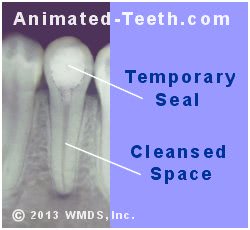
Take it easy on your tooth’s temporary filling.
1) The filling may break.
This is a very serious complication and one that can lead to root canal treatment failure. This is why upon the completion of your tooth’s endodontic work its permanent (final) restoration should be placed as soon as can reasonably be arranged.
2) The tooth may break.
Since the way their tooth feels is now back to normal, a person is often eager to make use of it again.
Until your dentist has had a chance to finish rebuilding your tooth What will be needed?, it should be considered fragile. What a disappointment it would be to spend the time, effort, and money to have root canal treatment performed, only to have the tooth irreparably break or crack before it was fully restored.
3) Foods to watch out for.
In light of the above, avoid using a root canal tooth to bite into or chew hard or crunchy foods. Notably, this might include items like raw vegetables (carrots, celery), nuts and hard candies. But really, due to a tooth’s potentially fragile state, any number of other kinds of foods might be able to cause damage too.
Maintain proper oral home care.
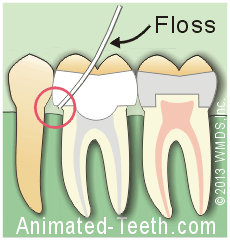
1) Flossing.
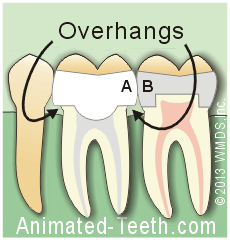
This type of restoration often isn’t as finely crafted as “permanent” ones are. For example (as illustrated in our graphic).
- Restoration “B” represents a “permanent” filling placed in a tooth following its root canal treatment. Notice how its contours match that of its tooth.
- Restoration “A” represents a temporary restoration, and notice how its contours extend past the side of its tooth. These ledges are referred to as “overhangs.”
Precautions. What to watch out for when you’re flossing.
The potential problem that exists is that when you floss you may snag on a temporary filling’s overhang.
- If your floss feels like it’s starting to wedge, back off. Forcing your way may end up with getting your floss stuck or breaking your filling.
- If you get into trouble or are close to it, let go of one end of your floss and then pull it out to the side.
- Despite the temporary nature of this restoration, report the difficulties you’ve noticed to your dentist so they can trim away the excess filling material.
(If you can’t clean your gums around your tooth properly they will become tender and sore. Poor gum health will also make the process of creating the final restoration for your root canalled tooth more difficult.)
2) Tooth brushing.
All teeth require regular brushing and a tooth that is receiving, or has received, root canal treatment is no exception. In the case where your gums or tooth are sensitive, simply do the best that you can.
Rebuilding your tooth after its work has been completed.
All teeth that have received root canal therapy will need some type of final (“permanent”) restoration.
The kind that’s chosen, as well as the time frame in which it’s placed, can greatly influence the long-term success of a tooth’s treatment. Use this link for a discussion about the different types of restorations that might be placed When? | Why? following root canal treatment.
Page references sources:
Al-Negrish, A. et al. Flare up rate related to root canal treatment of asymptomatic pulpally necrotic central incisor teeth in patients attending a military hospital.
Ali A, et al. Influence of preoperative pain intensity on postoperative pain after root canal treatment: A prospective clinical study.
ElMubarak AHH, et al. Postoperative Pain in Multiple-visit and Single-visit Root Canal Treatment.
Ingle JI, et al. Ingle’s Endodontics. Chapter: Treatment of Endodontic Infections, Cysts, and Flare-ups.
Jayakodi H, et al. Clinical and pharmacological management of endodontic flare-up.
Mokhtari F, et al. Effect of Premedication with Indomethacin and Ibuprofen on Postoperative Endodontic Pain: A Clinical Trial.
Sadaf D, et al. Factors Associated with Postoperative Pain in Endodontic Therapy.
Sipaviciute E, et al. Pain and flare-up after endodontic treatment procedures.
Tsesis I, et al. Flare-ups after endodontic treatment: a meta-analysis of literature.
All reference sources for topic Root Canals.
Comments.
This section contains comments submitted in previous years. Many have been edited so to limit their scope to subjects discussed on this page.
Comment –
Pain after root canal.
I had a root canal yesterday morning and after the numbness wore off I realized that it still hurts just as bad or more than it did before. I talked to the dentist this morning and he said he felt the procedure went well so he’s not sure what could be causing the pain. He thinks maybe the infection still is bothering me so he prescribed another antibiotic to go along with the one I am already on. Any thoughts on why this tooth would still be hurting if the dentist is sure the procedure was successful?
DR
Reply –
As discussed above, a common cause of post-root canal pain is inflammation. The inflammation is your body’s response to irritation triggered by activities that occurred during the procedure, many of which are simply not preventable or are caused unknowingly by the dentist.
Also as discussed above, when appropriate for the patient, a dentist frequently has them take an NSAID medication for pain relief, frequently one that is available on an over-the-counter (OTC, non-prescription) basis.
Whatever is decided as the cause or the plan for relief, a dentist will usually feel (so check with them) that it’s important for a patient to continue to take their antibiotics as prescribed, to completion (meaning all of the pills/capsules originally dispensed are ultimately taken).
Staff Dentist
Comment –
Pain after initial filling of root canal
I experience a worse pain after initial appointment after temporary filling ….using medicines but after 3-4hours pain is recurring. ..no swelling noted….now its 2days already but still pain persists. ..i just started antibiotic. ..next appointment after 5days….what to do else???please reply
Sbinu
Reply –
Here’s some general information. We’re assuming of course that you have already been in contact with your dentist and sought their attention.
In general terms, the most common cause of post-root canal treatment pain is inflammation. In managing that, a dentist will usually rely on the use of NSAID medications.
If the chosen NSAID alone does not adequately control the patient’s pain as it’s helping to decrease and control the inflammation that exists, the dentist might consider the use of a prescription narcotic pain reliever. (Generally narcotics can be expected to provide a higher level of pain relief.)
The use of the narcotic might replace the NSAID, or else some type of combination therapy or combination product might be used where receiving the benefits of both types of medications are possible.
Less common is the situation where post-root canal pain is caused by active infection associated with the tooth. For the most part, the obvious signs associated with infections (swelling, indications on x-rays, pus venting) take time to develop, so making a diagnosis of this type of scenario can be difficult initially.
Unlike a pain reliever, when oral antibiotics are taken it generally takes a day or so for them to start to have much of an effect. (That’s why some antibiotic regimens start with a loading dose, and then a lower one for the remainder of the dosings.) While the antibiotic is creating its effect, the patient is kept comfortable via the use of pain relievers.
While not especially commonplace, shorter durations of relief might be provided by the dentist numbing up the patient’s tooth again (use of a local anesthetic, giving a dental shot). Long-lasting anesthetics (bupivacaine) can take several hours to wear off (6 or so).
There can be other possible solutions, needed treatments or management methods. But what the dentist needs the most is a diagnosis of what is the primary underlying cause of the pain so they can target their treatment directly toward that.
They can only make that determination via understanding your symptoms, examining/evaluating you and, unfortunately, seeing how your symptoms develop over time.
You state “… next appointment after 5days ….what to do else???”. We find it hard to believe that your dentist expects you to go 5 days unattended while having difficulties.
As the provider of your endodontic treatment, it’s your dentist’s obligation to help you through whatever treatment complications crop up. So be in touch with them. It’s the squeaky wheel that gets oiled. If they don’t continue to hear from you they will likely assume your symptoms have subsided. We hope this is over for you soon.
Staff Dentist
Comment –
Pain after 5 days
I am now into my 6th day following root canal treatment. I have suffered quite severe pain throughout. Most nights it wakes me up. I have tried not to take too many painkillers and I don’t want to rely on such. I have been taking 8/500 cocodamol and occasionally 30/500cocodamol . I was told by my dentist that it could take up to 2- 3 weeks for things to settle down. I have been brushing 4 – 5 times a day and mouth washing , but more than that I am not sure there is much I can do. Anecdotally I have heard that these things can take some time. Do you have any advice for me to help?
SMJ
Reply –
Your dentist most likely expected that as each day passed after your endodontic treatment the level of pain you experienced would continue to subside. What you’re experiencing seems beyond that, so without question you should report to them.
The medication you are taking, co-codamol, is a combination pharmaceutical containing paracetamol (referred to as tylenol in the USA) and codeine. Both of those compounds are pain relievers but neither has anti-inflamatory properties.
As discussed above on this page, the most common cause of post-root canal treatment pain is inflammation of the tissues that surround the treated tooth’s root. And because of that, pain relievers that also have an anti-inflammatory effect are typically more effective in controlling/resolving the patient’s post-op discomfort.
Ask your dentist about the possibility of including or switching to a medication that has anti-inflammatory properties (see NSAID discussion above).
Staff Dentist
Comment –
Query
Hello …. I also done first step of RCT yesterday,actually my tooth pains very badly from last 3 days ,Dr.tell me that there is a infection over the teeth and so much severe dental cavity … She clean the pulp and infectious area , and then place some medicine with cotton(it must be iodine)and then temporary filling cement which will be removed after some time or day . She tell me now tooth will not pain ….. But it’s still have pain even I can’t eat or place upper teeths on the RCT tooth even while doing brush i feel much pain … Will you please tell me when my pain will stop n I can eat properly ……
Amruta
Reply –
Your solution lies in contacting your dentist. Dentists expect patients to call if they are having problems.
There are a few more questions to be asked beyond what you tell us in your narrative, so we won’t speculate as to the precise cause or solution. But what you describe seems to lie within the realm of common complications, so handling your problem will probably be routine to your dentist.
Depending on the nature of the problem, in cases where immediate treatment from a person’s dentist isn’t possible (weekends, late hours), they may prescribe medications (antibiotics and/or pain relievers are a possibility) over the phone to the pharmacy so the patient can start with them and be comfortable until they can be seen.
Staff Dentist
Comment –
Swelling after root canal treatment
I had root canal treatment on LR4 in the afternoon two days ago. There was no swelling before the treatment. My jaw started to swell yesterday, chipmunk look, and has continued over night and seems worse today. Is this to be expected? The clinic is closed today, and I wonder if I need to go to A&E.
Marina
Reply –
Yes, it would be our interpretation of what you state that you need attention. The timing of the swelling suggests that there’s an active infection associated with your tooth.
You don’t state whether your tooth’s endodontic treatment was fully completed, or there is a second visit to come. Either way, what you’re experiencing is most likely just a temporary set back (as opposed to case failure). But each scenario would be handled differently by your dentist.
You state that your dentist’s office is closed. But don’t overlook that it’s common for a dental office to at least offer telephone support during off hours.
It’s common for the management of what we interpret as being your situation to include a regimen of oral antibiotics, and generally the sooner that’s started the better. So telephone contact with your dentist, and their calling a pharmacy, could get that going for you (if they think it’s needed). If some type of hands-on treatment could aid your situation too, they might offer to do that for you too.
In lieu of your dentist, yes, a visit to an emergency room would likely result in at least a prescription for antibiotics.
Staff Dentist
Comment –
Discomfort after completed root canal.
I had a root canal procedure completed like 3 months ago,after like a week i felt discomfort and sensitivity in the tooth and went back to the dentist who did an ex-ray and it showed that the filling had had gone beyond the tip of the tooth.He had to redo it again and it was completed like a month ago.All was well until a week ago when i felt discomfort and slight pain again.went back to the dentist and the x ray showed that all is well.the work was well done.what could be the problem?i had feeling this way.sometimes i feel like the left part of my mouth is numb but the pain is manageable but irritating
Ann K
Reply –
If you’ve read through our root canal complications/failure page, you’ll see that there’s a myriad problems that might exist, so it’s impossible for us to wager much of a guess.
In regard to x-ray evaluation, while it might be used to definitively diagnose a tooth’s condition, and while everything looking good on the x-ray is never a bad sign, the look of treatment on a film may not reveal all that is going on. For example, it may simply be too early for signs to have appeared.
What’s needed is for you to continue to monitor your tooth and stay in touch with your dentist about your status and changes you notice. You don’t mention if the dentist treating your tooth was a general dentist or endodontist. For difficult cases, evaluation by a specialist may be needed to diagnose what’s going on.
Staff Dentist
Comment –
Post root canal numbness.
I had a root canal 5 days ago. I am experiencing numbness on several of my adjacent teeth including my left front tooth. I called my dentist and he said it was infection From the treated tooth and prescribed antibiotics. He said I should notice the numbness subsiding within about 24 hours. So far no effect from the penicillin. What are your thoughts. Thank you.
Bill
Reply –
Normally it takes oral antibiotics about 24 hours to begin to have an effect. So there might be some question if your dentist was stating that fact or really expecting your condition to resolve by then.
You don’t say if the treated tooth was an upper or lower one. There is a postoperative complication termed paresthesia, which is much more likely to be a problem when a lower tooth has been treated. It’s associated with persistent numbness.
With root canal work, it could be a complication associated with the numbing injection, or the work itself. We don’t discuss this complication on our pages as it specifically relates to endodontic cases, but do cover it as a complication associated with tooth extractions (use the link).
Staff Dentist