What are the alternatives to having root canal treatment for a tooth?
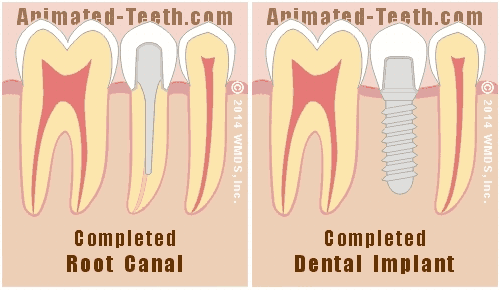
vs. implant.
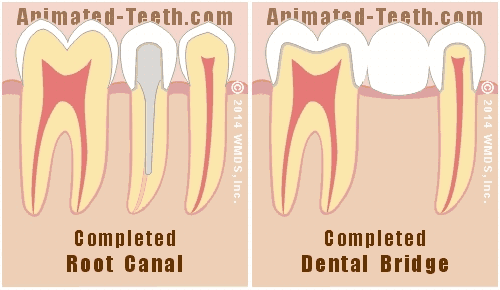
vs. bridge.
What are the alternatives to root canal?
Since there is no other type of dental procedure that accomplishes the same set of goals as endodontic therapy Procedure objectives., there is no directly comparable alternative procedure that can be used to salvage teeth that have problems within their nerve space.
Tooth extraction.
That means that beyond seeking a second opinion to confirm your tooth’s diagnosis, not opting for root canal treatment means that the only other alternative dental procedure that exists, in terms of creating a permanent solution to your tooth’s internal problems, is having it extracted. (Hargreaves)
But doing so doesn’t mean that you don’t still have options.
Just because you’ve had a tooth extracted doesn’t mean that you have to remain toothless.
As outlined on this page, individual teeth that have been extracted might be replaced via the placement of a dental implant, dental bridge or removable partial denture. Or in some cases, orthodontic treatment might be used to close in the missing tooth’s space.
▲ Section references – Hargreaves
What treatment alternatives do you have if you decide not to have root canal therapy?
Option #1 – Delay your procedure.
This option of course really isn’t an “alternative procedure.” But this plan may offer a way for your tooth to be saved.
We’ve listed this consideration first because we want to make it clear that in most cases (per your dentist’s recommendation) salvaging your tooth usually makes a wise choice.
When might a delay-treatment approach be used?
This is the type of plan you might go with if your procedure’s cost, or finding the time to schedule it, is the obstacle.
Important ! – As we discuss here, this is not an option that should ever be chosen on your own. It should only be opted for after consulting with your dentist because otherwise you place yourself at risk.
As examples, infected teeth are thoroughly unpredictable and can result in an acute flare up Signs | Symptoms at any time. Also, long-standing tooth infections can be more difficult to successfully resolve.
Option #2 – Have your tooth extracted.
While simply having your tooth pulled may seem to be the cheapest and easiest fix, this option may turn out to be the poorest choice over the long haul. And possibly the most expensive one too if this decision results in the need for some type of corrective dental work later on.
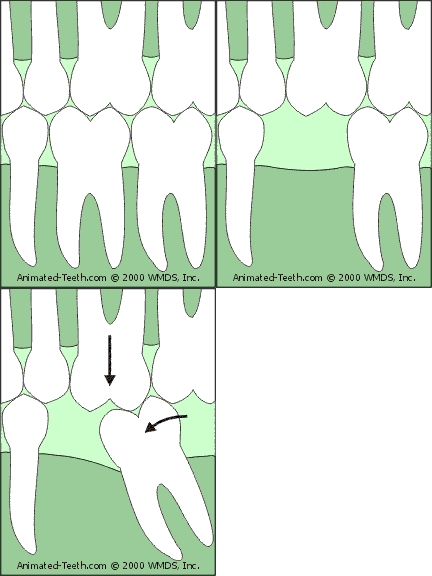
The space resulting from a tooth extraction can allow neighboring teeth to shift.
Potential problems.
Psychological barriers may lead to this choice.
We certainly understand how certain issues may weigh on a patient’s mind and subsequently steer them toward a choice for extraction. This can include concerns about the likely success of root canal treatment, as well as being able to tolerate having it. We discuss these issues here.
A seldom offered extraction alternative.
While any dentist will have no trouble explaining the benefits of replacing a root canalled tooth that has been extracted, when researching this topic we were surprised to see a paragraph in an endodontic textbook (linked below) that stated that little actual research exists about the harmful effects associated with the failure to do so.
▲ Section references – Torabinejad
Retainers.
Somewhat different than that stance, we would suggest that other than immediately noticed issues (which one would expect would prompt immediate tooth replacement), the potential for complications associated with teeth shifting over time would be the issue of most concern.
In many cases, this process could be kept in check by the dentist making their patient a retainer to wear. Assuming that patient compliance with wearing it wasn’t an issue, while seldom offered, this alternative could offer a suitable, cost-effective, although intrusive, solution for some cases.
Option #3 – Tooth extraction and replacement.
Opting to have an extraction instead of root canal treatment is easier to envision as appropriate treatment if plans are made to have the lost tooth replaced.
As outlined below, there are a number of ways to accomplish this. They include placing a dental implant, dental bridge or removable partial denture.
Make sure you know what you’re getting.
While an extraction-and-replacement approach can make a good plan, be sure to ask your dentist a lot of questions about what your replacement tooth will be like.
Saving your tooth via root canal treatment is a way of preserving the status quo. In comparison, any type of replacement tooth will, at least in some way, be different than what you have now. Make sure you know what you’re getting before you make a decision.
#3a – Extraction + Dental implant placement.
Just a few decades ago this option didn’t even exist. Nowadays, it’s so often the choice that’s considered that we’ve dedicated a page specifically to this topic: Dental implant vs. root canal. Which makes the better choice?
… as compared to root canal treatment.
Having treatment vs. a dental implant.
- A root canal approach can likely be completed within a shorter overall time frame than implant placement and restoration.
Implant cases often require some months for the healing process alone. However, this waiting period isn’t always necessary. (Only your dentist can determine what’s needed for your case.)
In comparison, start to finish, root canal therapy and the creation and placement of whatever type of final restoration is needed should be able to be completed within a time frame of 30 days or so.
- Some people may notice subtle differences between their implant and the natural tooth they could have saved. This can include things like the way it’s explored by their tongue, the way it accumulates debris or is cleaned. For most people, however, these issues should be minor.
… as compared to other replacement techniques.
- The way a dental implant becomes fused with bone tissue Osseointegration. makes it the most life-like type of replacement tooth.
(In comparison, at most, the artificial tooth of a bridge only rests against its underlying gum tissue. Sometimes debris collection in this area is a problem. Debris collection is typically less of an issue with implants.)
- As compared to other tooth replacement techniques, placing an implant does not involve making changes with neighboring teeth (see below for a comparison).
… cost comparison.
- Using our dental procedure costs index Procedure fees., we estimate that an implant approach (extraction + implant placement + implant abutment + dental crown) would cost roughly 50% more than a root canal one (molar root canal + dental post and core + dental crown – the most expensive scenario possible, see below).
- In regard to the above calculation, the implant-associated costs would be the same for replacing any kind of tooth.
In comparison, molars have the highest root canal fee. Additionally, not all teeth will require a post and core, or possibly even a dental crown. So a lower fee for many cases would be likely.
- For a scholarly evaluation of this topic, use this link: Root canal vs. implant – Which is the more cost-effective option? Pros / Cons
- If a dental plan or insurance is involved, you’ll need to check what procedures are covered. For example, some policies may not cover dental implants.
#3b – Extraction + Dental bridge placement.
A dental bridge is another way to replace a missing tooth. Until implants came into vogue, it was usually considered the preferred method. A dental bridge spans the space of a missing tooth.
Having treatment vs. a dental bridge.
… as compared to root canal treatment.
- A dental bridge is more tedious to maintain than a natural tooth. Dental floss must be used to clean underneath the artificial tooth that replaces the missing one.
- A root canal approach can be expected to be completed within a slightly shorter overall time frame than this one. (1 month vs. 1 1/2 to 2)
That’s because a dentist will usually want to wait at least 30 days after an extraction for bone healing to take place Healing timeline. before creating the permanent bridge for that space.
… as compared to other replacement techniques.
- When a bridge is made, the teeth on either side of the missing tooth’s space are trimmed down (just like for a dental crown The steps.). In some cases, this may mean that otherwise perfectly healthy teeth may need to be altered. (Dental implants don’t pose this problem.)
- Like a dental implant, a bridge is fixed firmly in place and is not removable. (Compare to removable partial denture below.)
… cost comparison.
- Using our fees index, we estimate that a dental bridge approach (extraction + 3-unit bridge) would cost roughly 25% more than a root canal one (molar root canal + dental post and core + dental crown – the most expensive scenario possible, see below).
- In regard to the above calculation, the bridge costs would be the same for replacing any tooth. In comparison, molars have the highest root canal fee. Additionally, not all teeth will require a post and core, or possibly even a dental crown. So for many cases, the fee would be less.
- If a dental plan is involved, an evaluation of its benefits and possible restrictions on what types of dental procedures are covered needs to be evaluated before a decision is made.
#3c – Extraction + Removable partial denture.
A removable partial denture is an appliance that has one or more artificial teeth attached to it. When it’s slipped into place, its artificial teeth fill in the spaces of the person’s missing natural teeth.
… as compared to root canal treatment.
- It should be easy to imagine how wearing a removable appliance is different than having your own natural tooth (which is what you still have if you opt to have root canal therapy). People certainly do, however, adapt to wearing partials.
- A root canal treatment approach can be expected to be completed within a slightly shorter overall time frame than this one. (1 month vs. 1 1/2 to 2).
That’s because a dentist will usually want to wait at least 30 days after an extraction (so to allow for jawbone healing) before creating a removable partial for that tooth’s space.
… as compared to other replacement techniques.
- A dental bridge or tooth implant is firmly fixed in place, a removable partial denture is not. This is a big difference.
A bridge or implant may ultimately feel like a natural tooth to you. But even though you may become accustomed to wearing a partial, you’ll always consider it an appliance that’s worn.
- Over the long term, a partial may create a wedging and loosening effect on the wearer’s teeth. This is not an issue with a bridge or implant.
- Removable partial dentures typically arch around and grasp onto teeth on both sides of a person’s mouth (left/right). They’re designed this way because it improves their retention and stability. That means, as compared to a bridge or an implant, wearing one can seem like a mouthful.
- For all of these reasons, most people would probably prefer having a bridge or implant than a removable partial denture.
… cost comparison.
- Using our dental costs index, we estimate that a removable partial denture approach (extraction + cast partial denture) would cost roughly 30% less than a root canal one (molar root canal + dental post and core + dental crown – the most expensive scenario possible, see below).
- In regard to the above calculation, the partial denture costs would be the same for replacing any tooth.
In comparison, molars have the highest root canal fee. Additionally, not all teeth will require a post and core, or possibly even a dental crown. With these considerations, in some cases one could expect a root canal approach to be the less expensive scenario.
- If a dental plan is involved, an evaluation of its benefits and possible restrictions on what types of dental procedures are covered needs to be evaluated before a decision is made.
Option #4 – Extraction and orthodontic treatment.
Extracting a tooth that’s in need of root canal therapy, and then closing in the space that remains via orthodontic treatment, may make a workable alternative in some cases.
There will be a number of dental issues that will play a role in determining the feasibility of this approach. And it will be the relatively special case where it can be applied.
But for those cases where its application is a possibility, and especially in cases where it would make an improvement for the patient’s entire mouth, it should be considered.
It may be possible to delay your treatment until a more favorable time.
In those cases where a tooth requires endodontic therapy, it’s always best to go ahead and make plans to have it performed sooner rather than later.
In some cases, however, a patient’s travel plans, other scheduling conflicts, the need for other dental work, or else financial considerations may make this impossible.
Your dentist may be able to temporize your tooth.
Treatment delays can sometimes be accommodated. Your dentist may be able to temporize your tooth by performing the initial steps of root canal treatment (the ones that can make it so your tooth feels better and its behavior is more predictable).
- This temporization stage needs to be considered just that, a temporary alternative. Your dentist will need to outline for you what time frame they consider appropriate before your treatment must be resumed.
- Your dentist must also discuss those precautions you need to take, and explain the signs and symptoms that may indicate that changes are occurring within your tooth and attention is required.
- Temporization is never a first choice but rather a make-do one.
Only delay treatment after discussing matters with your dentist.
You should never make a decision to delay having root canal treatment on your own. You must discuss this matter with your dentist. That’s because:
- Any tooth that is in need of root canal treatment but has not yet received it is unpredictable.
- The tooth could remain asymptomatic for an indefinite period or, at the other extreme, flare up (cause pain, produce swelling) at any time.
- The infection associated with it could cause damage to surrounding bone tissue, possibly even to the point of compromising adjacent teeth.
- In regard to future options, teeth that have more established infections can be less responsive to endodontic therapy (have a lower success rate).
Reasons a patient may opt for an extraction rather than having root canal.
Beyond just cost, there are additional factors that may weigh heavily on a patient’s mind and influence their decision between salvaging their tooth with root canal treatment or having it extracted.
a) Are you convinced that your tooth can be restored?
You may find you have concerns about your dentist’s ability to successfully treat and rebuild your tooth, especially when the long-term is considered.
As a patient, this may not be an issue that you’re able to accurately pass judgment on. However, to give you help on this matter we do have a page that includes information about root canal success rates. Study findings.
In the case where you’re aware that your tooth has a troublesome history (such as has been problematic in being able to retain restorations), you should bring up what you know and quiz your dentist about what will be different about working with your tooth this time.
b) Will you be able to endure your treatment?
For many people, having root canal work will be a new and unfamiliar procedure. And in the case where a tooth has a history of being problematic (such as hasn’t numbed up well for previous procedures), or simply the person has apprehensions about sitting through the root canal process, having an extraction may make the more attractive choice.
We won’t pretend that having root canal is never a painful experience for the patient (we’ve dedicated an entire page to the subject of root canal pain What to expect.) but it can usually be acceptably managed.
As above, before basing your decision of root canal vs. extraction solely on historic events, ask your dentist what factors are different this time that should make your tooth’s treatment a more pleasant event.
Page references sources:
Hargreaves KM, et al. Cohen’s Pathway of the pulp. Chapter: The core science of endodontics.
Ingle JI, et al. Ingle’s Endodontics. Preface.
Torabinejad M, et al. Endodontics. Principles and Practice. Chapter: Evaluation of endodontic outcomes.
All reference sources for topic Root Canals.