Looking for information about other Dental Topics?
Full Website Index• Animated-Teeth.com •

How much do dental implants cost? / How cost-effective are they?
Costs associated with dental implant placement.
As this page outlines, the cost of having a tooth replaced with a dental implant breaks down into the following three expenses:
- Placing the implant. (The surgical process.)
- Placing the implant abutment. (Preparing the implant to receive its restoration.)
- Restoring the implant. (Placing the crown, bridge or denture.)
This page also discusses the cost-effectiveness of choosing a dental implant as compared to saving the tooth via the use of root canal treatment.
a) Fees for placing a tooth implant (implant surgery).
- Single dental implant.
$1545.00 – $2470.00 Notes #1, #2.
Low fee = Small rural city or town.
High fee = Large metropolitan area.
[How we calculate our cost estimates for procedures.]
Note #1: The fee range shown above applies to the process of placing a single “endosteal” tooth implant. This is the most common kind and the type we describe on our pages.
Note #2: Some implant systems require a second-stage surgery where, after healing, the gum tissue lying over the implant is trimmed, so to expose it and make it ready for restoration. There may or may not be an additional charge for this procedure, you’ll simply have to ask.
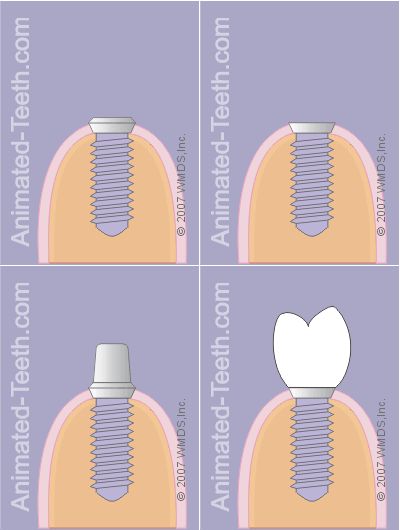
Implant fees include the cost for: a) Implant placement. b) The abutment. c) The crown.
b) Costs associated with placing the implant’s abutment.
- Abutment for a single dental implant.
$315.00 – $495.00
Note: In some cases, a custom-fabricated abutment may be required. If so, you can expect that the above fee will be increased on the order of $100.00 to $200.00.
c) Costs associated with placing the implant’s restoration or appliance.
The fee for this dental work should be somewhat similar (or possibly higher) to that which the dentist charges for these restorations/appliances for natural teeth or ordinary circumstances.
Are implants covered by dental insurance?
Coverage for tooth implants by dental plans tends to vary. In past years, implants were often excluded. More recently, now that the success of this treatment approach has been proven, many companies do provide benefits for this procedure.
Implants typically fall under the classification of “Major” dental services. Major services are frequently covered (check your plan) at a rate of 50% (of the dental insurance company’s UCR fee, after the policy’s deductible has been met).
Which is the more cost-effective, root canal or implant?
A dental patient may be faced with the following two choices. Should they …
- Save their tooth via root canal treatment.
- Have the tooth extracted and replaced with a dental implant.
Our previous page explained how both of these treatment options can be expected to have a similar success rate.
This page evaluates the same choice from the standpoint of which approach might be expected to be the more cost-effective solution.
There’s actually a research study that looked into this issue.
Study title: “Evaluation of the cost-effectiveness of root canal treatment using conventional approaches versus replacement with a dental implant.” (Pennington 2009)
This paper, authored by British researchers, developed an economic model that estimated the lifetime costs associated with treating an upper front tooth that had a “nerve” infection.
The treatment options evaluated were: 1) Root canal with post and crown. 2) Dental implant with crown. 3) Fixed bridge. 4) Removable partial denture.
What did the study determine?
In regard to expected lifetime costs (to age 75), the researchers came to the following conclusions.
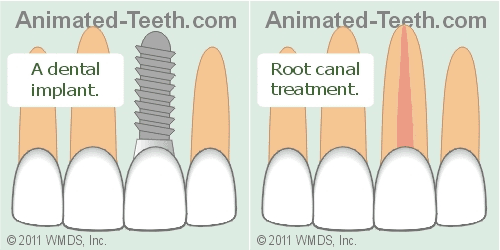
Which is more cost-effective, implant placement or root canal treatment?
1) Initial treatment.
2) Re-treatment.
In the case that a tooth’s initial root canal had failed, conventional (non-surgical) re-treatment of the tooth made the more cost-effective choice, as opposed to going ahead and extracting the tooth and placing a dental implant.
[This study did suggest that at an estimated lifetime cost of 12 to 15 pounds per year ($18 to $23) that a re-treatment approach could be expected to be more costly than tooth extraction and replacement with a bridge or denture.]
3) Failed re-treatment.
If the tooth’s root canal treatment failed yet again, it would be expected that surgical re-treatment would be required.
With this scenario, the model suggested that tooth extraction and replacement with an implant, bridge or denture would be more cost-effective (than surgical endodontic re-treatment).
The conclusions in plain terms…
If your dentist thinks that conventional root canal treatment provides a suitable solution for your tooth (as its initial or first re-treatment), from a standpoint of cost-effectiveness, research suggests that it should make a good choice.
What did this study use as expected survival rates?
Per their own review of available dental literature, the authors of this study determined the following.
- After 20 years, 25% of teeth receiving root canal treatment and a dental post and crown will be lost. This includes teeth that have been endodontically re-treated.
- After 20 years, 10% of first implants will fail.
Note: These rates differ from the findings of other research studies that have shown a similar success rate for both treatment approaches.
Our comments.
It seems that if an equal success rate (like that determined by other studies) was factored into this model, the scales would be tipped even further in favor of root canal treatment as being the more cost-effective choice.
Last reviewed: January 11, 2025
Author: Paul Cotner, DMD — retired dentist.
Published by: WMDS, Inc. — owner of Animated-Teeth.com.
Educational information only — not a substitute for professional dental care.
Page references sources:
Pennington M, et al. Evaluation of the cost-effectiveness of root canal treatment using conventional approaches versus replacement with an implant.
Comments.
This section contains comments submitted in previous years. Many have been edited so to limit their scope to subjects discussed on this page.
Comment –
Dental Implants
I went to a Dentist about a yr ago, but started the work for implants but i couldn’t pay the bill. Do i have to go back to that same dentist or can i go to another dentist to complete to work?
Ron
Reply –
If the implant has been placed but not restored (not yet had the “tooth” portion mounted on top of it), in theory any dentist should be able to complete the work.
Since there are different brands of implant systems, as well as sizes and matched parts, there might be an issue of getting the right abutment to screw onto the implant you have. (Your previous dental records should have that information if things can’t be figured out.)
And also, the new dentist would need to feel comfortable with the work that had already been performed, since the success of their treatment would be predicated upon that.
Staff Dentist
Reply –
Pay for previous work.
Go back to your previous dentist and man up.
Explain your financials and he will work with you.
He probably has a family that depends on him getting paid for his work done
just like you. If you want to be a deadbeat find another sucker for a dentist and
promise to pay him and then run away again.
Paul
Reply –
non-payment
Wow! That was harsh. I had the same thing going on. I ran out of money and had to go to another dentist and didn’t go back to the old dentist because I was too ashamed to return. Thank GOD I didn’t sign a payment agreement upfront. Dental insurance is high and should be looked into for anyone with bad teeth or a history of dental care.
Ron J