Directions for wearing Crest Whitestrips® – Part 2
This is the second half of our instructions for using Crest Whitestrips® products. On this page we cover:
- How to perform individual treatments. – How long are the strips left on? How often are they used? Can you wear them for longer? When do you apply the Blue Light?
Things to know about performing your whitening sessions. – Are back-to-back treatments allowed? Is it OK if you miss or skip a session? What activities can you do while wearing your strips?
- Getting results. – How long does it take? Ways to speed up your results. Possible solutions for uneven whitening.
- Steps to take when terminating a treatment session. – Removing your strips. Cleaning your teeth and gums.
(FYI: Part 1 of our directions covers how to get ready to perform your treatments and how to place the strips.)
4) Performing your Crest Whitestrips® treatments.
a) How long should you leave your strips on?
Once you have your strips positioned, your bleaching session has begun. So, take a look at your clock and start timing.
!! The recommended treatment time varies with each Whitestrips® product.
While the way you use all Whitestrips® is essentially the same, the application periods for various product versions can be entirely different. As shown in the table below, times can range from 5 minutes all of the way up to 2 hours.
A part of this difference is due to the fact that whitening strip products can vary substantially in the concentration of peroxide that their whitener contains. And that means staying within your product’s guidelines is not just a “best results” but also a safety and side effects issue too.
In all cases, you must refer to the instructions that have come with your specific product for directions about how long and how often your strips should be worn.
Application times for different Whitestrips® products per day.
As the years go by, it gets harder and harder to keep the new products and name changes that Crest® introduces straight. But here are the application times for some of their current and also some not-so-new products as we understand them.
5 minutes, once a day strips.
Crest 3D White Whitestrips® Stain Shield
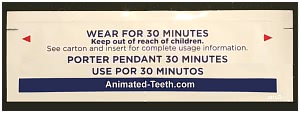
Many Whitestrips products are worn for 30 minutes. Check your instructions.
30 minutes, once a day strips.
Crest 3D White Whitestrips® Gentle Routine
Crest 3D White Luxe Whitestrips® Glamorous White
Crest 3D White Whitestrips® Glamorous White
Crest 3D White Whitestrips® Brilliance White
Crest 3D White Luxe Whitestrips® Professional Effects
Crest 3D White Whitestrips® Professional Effects
Crest 3D White Whitestrips® Professional White
Crest 3D White Whitestrips® Advanced Vivid
Crest 3D White Whitestrips® Classic Vivid
Crest 3D White Whitestrips® Vivid
1 hour, once a day strips.
Crest 3D White Luxe Whitestrips® Supreme Flexfit
Crest 3D White Whitestrips® 1 Hour Express
2 hours, once a day strips.
Crest 3D White Whitestrips® Intensive Professional Effects
Note: Products, as well as product names and versions, can change, so be sure to check your instructions.
You can always wear your strips for less time.
The treatment times stated above are the maximum duration your strips should be left on. But remember, you can wear your strips for shorter periods. For example, you might do so as a way of managing side effects.
The trade-off is that you’ll get less whitening effect per strip. And that means to reach the same whitening endpoint, you’ll have to use additional quantities of product.
Is it OK to wear teeth whitening strips longer than their directions state?
No, it’s never a good idea to use any tooth whitening product in a manner that lies outside the guidelines specified in its directions, teeth whitening strips included. As far as reasons why you shouldn’t extend a session:
- A unique feature of whitening strips is that the manufacture dispenses the quantity of whitener, not the end-user.
- That implies that through testing, they have determined what amount of whitener is required to remain effective for the duration of the recommended treatment period, yet not be likely to create side effects.
- You are unlikely to gain any overwhelming whitening benefit because the whitener tends to become depleted during the recommended application time.
- But you will be placing yourself at somewhat greater risk (although probably just minimally) for experiencing side effects (primarily tooth or gum sensitivity).
Can you reuse a strip?
No, there would be no purpose in doing so. It’s expected that the active ingredient found in a strip’s whitener (hydrogen peroxide) will be fully depleted, or nearly so, at the end of its recommended application period.
Applying the Whitestrips® “Blue Light.”
Some Whitestrips® kits come with the “Crest Blue Light device.” If yours did, the light is applied at the end of your bleaching session. (After that point when you have worn your strips for their full recommended duration.)
How the Blue Light is used.
- With your strips still in place, the light is turned on and shown on one strip (upper or lower) until the device automatically turns off. The process is then repeated for the other strip.
- The light and strips are then removed. Your treatment has now been completed. Your session is then terminated as outlined below.
Things to know.
We feel obligated to mention the following points:
1) It’s easy to make the case that scientific research does not support the claim that using a light during teeth-bleaching treatments improves whitening results. (We discuss this topic at length on our page “Is using a bleaching light really necessary?”
2) If despite that evidence you are inclined to believe that the use of the Blue Light represents a significant advantage, we would reply:
- Our search of published research has not been able to identify a single study that evaluated the use of Whitestrips® in conjunction with the Blue Light device.
If this technique did provide some significant advantage, it would be expected that someone, either a sponsored (by Crest®) or independent researcher, would be eager to document that fact and get that information published.
- It would seem humorous to think that a disposable light, one that probably just costs a few dollars to make, would possess a level of technology that the bleaching lights sold to dentists for hundreds to thousands of dollars, whose use has been thoroughly investigated by research, don’t have.
(We’d like to point out that our comments above aren’t intended to just single out the use of the Crest® Blue Light. We would feel that the practice of performing light treatment in association with any and all at-home whitening systems, for the same reasons outlined above, is dubious.)

One pair Crest Whitestrips (upper/lower).
b) Performing additional treatment sessions per day.
More frequent wear may be permissible.
This same web page makes the exception that 3D White Whitestrips® Stain Shield and Gentle Routine should be limited to once-a-day. We don’t have information on other types of Whitestrips®.
▲ Section references – Crest.com
Can you perform the additional treatment sessions back to back?
Yes, with Whitestrips® “twice a day permitted” products it’s permissible to perform one treatment immediately after the other.
- Remove your first set of strips.
- Remove (wipe, brush, rinse) any residue they’ve left behind. (See “Removing Strips” section below.)
- Apply your day’s second set of strips and wear them for their prescribed amount of time.
c) What happens if you miss a whitening session?
Missing one of your treatment days is of no concern. However, since the whitening results you will ultimately get will generally depend on the total number of treatments you have performed, you’ll want to make any missed sessions up.
But whether you perform and complete your whitening process precisely as directed, or just somewhat close to that regimen, will make no difference.
Spreading your sessions out can help to minimize side effects.
There can be a good reason for you not to perform multiple whitening treatments (when allowed by your product) each day, or even just regular treatments on consecutive days.
A person’s potential to experience whitening side effects correlates directly with their level of exposure to the whitener within a specified time frame. As a way of helping to minimize or control side effects, allowing extra time between sessions (hours or day(s), depending on what regimen was originally considered) can be beneficial.
d) What activities can you do while performing your treatments?
You can do pretty much any physical activity you want while your strips are in place, so long as it doesn’t dislodge them. And if you’ve chosen one of the Advanced Seal® or FlexFix® style of strips, your activities may not be hampered much at all.
- For obvious reasons, you shouldn’t smoke or eat while performing your treatments.
Drinking doesn’t make an especially great choice either. Even if the strips stay in place (which Crest® says some designs will, use the link above), the liquid might dilute the whitener and therefore diminish its effect on your teeth.
- Wearing your strips during times when you’ll need to do a lot of speaking, especially in public, might be problematic. You’ll just have to experiment and see what you’re able to do.
- You should not perform whitening sessions while you sleep. Besides the potential for running longer than your product’s recommended treatment period, you might also swallow one of your strips.
No matter what activities you decide to do, it’s a good idea to check your strips every once in a while to make sure that they’re still in place. And, for the reasons discussed in Part 1 of our directions, if you do find that you need to touch your whitening strips, make sure that you rinse your fingers off afterward.
Excessive salivation can be a nuisance.
When you place something in your mouth, your body typically responds by increasing its flow of saliva. (Your mouth gets confused, it thinks that the item is possibly food.)
Wearing whitening strips can trigger this phenomenon too, and the increase in saliva that occurs can be a nuisance. The build up of liquid tends to make performing treatment sessions a bit yucky. And it can make it difficult to keep the older, less-adherent style of strips in place (especially the lower ones).
What can you do?
There isn’t really a solution for this problem. But the good news is that your body’s response should diminish over time.
Focusing on some other task (rather than the fact that you have strips in your mouth) can help to make your sessions more tolerable. So, maybe your treatment time would also be a good time to balance your checkbook, wash the dishes or mow the yard.
You may notice foaming.
Experiencing some minor level of bubble or foam formation can be a somewhat common experience for people performing treatments. When saliva reacts with hydrogen peroxide (the active ingredient found in a WhiteStrip’s® whitener), oxygen is released, which produces bubbles, and if at a high rate, foaming.
Must you maintain a “white” diet during your treatment process?
While it is true that chromogenic agents such as coffee, tea, cola, red wine and dark-colored fruits will tend to cause tooth discoloration over time, research suggests that an exposure to these kinds of items isn’t deleterious to the level of whitening results you’ll achieve.
We explain on this page: Is it necessary to maintain a “white” diet during your course of bleaching treatments?
5) Terminating a bleaching session.
a) Removing your whitening strips.
At the end of its allotted time period, a treatment session is terminated simply by removing your strips.
That’s easy enough to do, just peel them off. (With Advanced Seal® and FlexFix® strips you may be surprised by how firmly they’re anchored.)
Strips disposal.
You’ll need to be careful in the way you discard your used strips. That’s because some of the hydrogen peroxide whitener (bleaching agent) on them may not be totally depleted.
- Make sure to dispose of them in a manner where they are unlikely to come into contact with anything that they might irritate, mar, stain or blemish. Besides just inanimate objects, this includes you, other people and pets.
- Always wash your hands after handling teeth whitening strips.
b) Clean your teeth and gums.
Once your strips have been removed you should rinse, wipe or brush away any residual whitener that remains on your teeth and gums.
If you notice (post-treatment) sensitivity when performing this task …
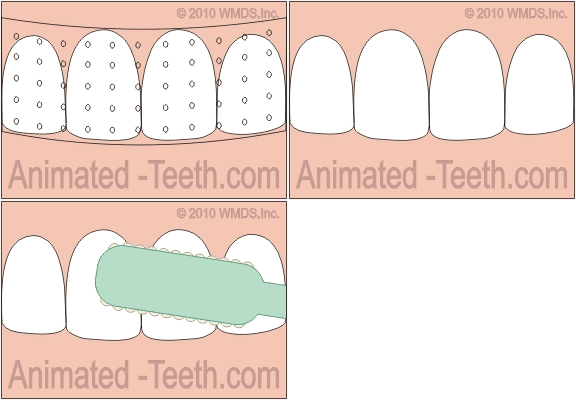
Any residual whitener can be brushed away.
- If using a toothbrush, use a regular soft-bristled one and make sure to be gentle with the motions you create.
- Rinsing with lukewarm water, as opposed to room temperature or colder, will help to keep the level of sensitivity you experience to a minimum.
- (FYI: This page discusses methods of controlling sensitivity caused by whitening strip usage.)
Be sure to wash off your fingers, toothbrush, etc… after you’ve finished cleaning the residue of the whitener away.
6) How long will it take to start to notice results?
That point in time when you’re likely to first notice a lightening effect will depend on both:
- The type of strips you are using (whitener peroxide concentration, frequency of use, duration of whitening sessions, etc…)
- The potential your teeth have to lighten. (Some types of staining are more difficult to resolve than others.)
As a general rule of thumb (with cases that ultimately do respond favorably to treatments), you’ll probably first start to notice results about halfway through your box’s supply of strips, possibly sooner.
- That would be around day 7 for products intended for use over a two-week period.
- For 10-day products, Crest® suggests results will be noticeable as soon as day 3.
- Strips that have a comparatively high peroxide concentration whitener (like Whitestrips Supreme®) would also be expected to start to show a color improvement in just a matter of days.
Performing additional treatments each day will speed up getting results.
Teeth whitening is a cause and effect process. And for teeth that have the potential to respond, the longer their exposure to the whitener (while staying within the guidelines of the product you are using), the more rapidly you will notice results.
As mentioned above, with many Whitestrips® products it is permissible to perform two whitening sessions per day. Here’s the link to that section of this page.
How many whitening kits can you use?
Crest® suggests that it’s permissible to use as many as two boxes of their whitening strips per year, although this recommendation varies according to exactly which Whitestrips® product is used.
We cover this subject in detail on our “Extending your whitening strips treatments” page.
7) Whitening difficulties.
a) White spots following treatment sessions.
After a person has removed their strips at the end of their whitening session, they may discover that white spots/areas have formed on their teeth.
Having this phenomenon occur isn’t terribly uncommon. And the good news is that these spots are no cause for alarm. Crest® publications refer to them as temporary and state that they’ll go away on their own after a few hours.
The cause.
The white spots form in areas where the tooth’s enamel has become dehydrated (dried out). (Remember, your tooth’s surface has been behind a plastic strip where saliva can’t get to it.) As oral moisture rehydrates the area, it’s normal appearance will return.
b) Uneven whitening.
Some people may notice that their treatments have resulted in an effect where some of their teeth, or just some tooth areas, have lighten to a greater degree than others.
Possible solutions.
- As a first check, you should make sure that all of your teeth are covered over by and have the same degree of intimate contact with the strip during your treatments.
- Assuming there aren’t any overlooked dental restorations involved, the problem might be as simple as certain teeth or areas of staining are slower to respond than others. If so, over time the issue should tend to resolve itself.
- If problems persist, you might halt your bleaching efforts and search for a way to just selectively treat the stubborn teeth to see if they will “catch up.” As possibilities, you might cut up a strip and apply just pieces of it. Or consider using a whitening pen.
Consulting with your dentist may offer a more definitive explanation and remedy.
Page references sources:
Crest.com – Frequently Asked Questions.
All reference sources for topic Teeth Whitening Strips.
Comments.
This section contains comments submitted in previous years. Many have been edited so to limit their scope to subjects discussed on this page.
Comment –
Treatment Frequency
This is a great site! Thank you for all the info that I couldnt find on the Crest website.
But I’m still not sure how long (# of days) I’m supposed to use the strips, and how often. I understand less frequent may help avoid side effects. But do I use it say every other day for a week? A month? Until I feel my teeth are white enough?
The instructions included with the strips said “use up to two kits per YEAR”. The kit I have has 14 sets of two strips each. So that means 2 kits per year would be a total of 28 treatments per year. Can I use it every day, once a day for 28 days? I have the Glamorous White strips.
I got this from Costco so it came with 4 treatments of the one hour express strips. Can I use this in addition to the 28 max per year?
Hope I wasn’t too confusing. Thank you for your advice! Aloha!
Cheryl
Reply –
This would be our biggest concern with your post, the statement: “Until I feel my teeth are white enough?”
That’s the problem with at-home products, the potential for over use, either accidental or when seeking unrealistic results.
Our response would simply be: What’s the rush?
Here are the facts:
a) Whitening results generally correlate with the total exposure to the whitener (strips), whether that exposure is stretched out or compressed in time.
b) The exception to the above is the fact that for everyone only a certain level of lightening improvement is possible. Beyond that point, using more strips will not create further results but will still have the potential to cause side effects.
c) The potential for side effects correlates directly with the amount of exposure to whitener within a timeframe. Extending the time frame, reduces the potential.
If you’re trying to avoid side effects, using strips every other day until all 14 sets in your kit have been used can make a good plan. If side effects crop up and you want to continue, let things settle down first and then try wearing the remaining strips even less frequently.
If with your first kit problems did occur, it makes no sense to continue treatment with a second kit immediately.
With dentist supervised treatments, using the equivalent of two kits back to back would likely be tolerated uneventfully by most people. But when on your own, you should error on the side of safety. Wait some weeks (at least until any residual sensitivity has disappated) before starting up again.
In regard to the express strips, the concentration of whitener on them will be greater than with your others. So, expect more potential for side effects when wearing them.
It seems to us the way the 4-treatment express kit is marketed, it’s intended to be roughly equivalent to the 14-strip Glamourous kit that you have. So consider the express kit as your second annually-allowed kit.
Beyond that, tell your dentist what you’ve been up to at your next check up and let them help you decide if using more kits seems a reasonable choice.
Staff Dentist
Comment –
Harmful to swallow?
It says it creates more saliva so can you swallow your saliva during the treatment or do you have to spit it out?
Tony
Reply –
Best practice would be to spit it out. Swallowing bleaching compounds will tend to create the side effect of throat irritation.
Staff Dentist
Comment –
The only difficulty I have had is the amount of saliva produced, which I did not want to swallow. And the more you think about this, the more you produce. So, what worked for me was, once the strips in place, folding a square of absorbent kitchen paper into a pad, placing it over my lower teeth with my tongue resting on this, and replacing the pad from time to time. This absorbed any saliva and removed the problem for me. Not an attractive look, so obviously only useful in fairly solitary confinement!
Lynda
Comment –
Question
Would using one strip a week (3D White Luxe) have a positive result or do they have to be used closer together?
Bill
Reply –
Theoretically, teeth respond to the total amount of whitener they are exposed to.
So whether you use (say) 14 strips at a rate of once a day or once a week, the total cumulative whitening effect should be the same.
However, using them once a day will likely produce results fast enough that you notice that your teeth are lightening. With a once-a-week rate, you likely won’t notice much affect at all but one will have taken place. Sporadic use of strips might be considered “maintenance” whitening.
Staff Dentist
Comment –
Gentle 3D Whitening Strips
I have sensitive teeth that have become yellowed over the years. I’ve never had my teeth professionally whitened, nor do I have caps/veneers/bonding. I started the daily use of the gentle strips 2 and 1/2 weeks ago. I can see a difference in my teeth: they are no longer yellow. However, they are not “white”; my three questions are these: 1. Will I continue to see an improvement in the color as I complete the 28 days? 2. My front two teeth don’t seem to be getting as white as the other teeth, even though they were not stained any differently and I do not have anything artificial on them: any explanation/advice on this? 3. After I complete the 28 days, what should the maintenance schedule be (using gentle strips again)? Once a week? Once a month? One full week every other month?
Thanks so much for your help. Incidentally, I do not smoke, drink coffee or tea, or drink red wine.
Jenny K.
Reply –
It’s certainly possible that you will experience a continued whitening effect. The whole whitening process is simply cause and effect (the greater exposure to the peroxide (concentration, time), the greater the whitening effect (speed, level of results).
Sooner or later a point is finally reached where no more whitening effect is possible (the teeth have lightened as much as they will).
In regard to your front teeth, there are just so many possible factors and variables it’s impossible to know exactly what is occurring. (Are all teeth getting an equal exposure to the strip, is it simply some teeth need a greater/longer exposure before showing results, …)
If this is of utmost concern, you might consider trimming strips so only certain teeth are treated, in an attempt to get them to “catch up” with your other ones, and then proceed from there. It may be tedious and a waste of materials but then at least you are more in control of things. Otherwise it’s likely that the uneveness will take care of itself over time.
As far a touch ups go, you might just wait to see how noticeable any relapse that occurs is before treating it.
As compared to most other Whitestrips products Gentle Routine strips create a relatively minimal exposure to peroxide (relatively low concentration whitener, short treatment duration). (Hence the reason they are less likely to cause sensitivity.) So using a touch up regimen of once or twice a month would seem reasonable and unlikely to cause unmanageable side effects for you.
Staff Dentist
Comment –
Discomfort Issue
Can I wear my strips for longer?
BBass
Reply –
The whitener on a strip will deplete as time goes by. And while some whitening potential probably remains after the recommended time frame stated in the instructions, it’s unlikely to be much. And for that reason wearing your strips for longer wouldn’t be expected to provide much extra benefit.
Wearing your strips longer also exposes your gum tissue to the whitener for a longer period of time and therefore might make experiencing side effects more likely.
Staff Dentist
Comment –
Light application.
Do I remove the strips before applying the light?
Margarita
Reply –
We totally get your confusion, and are confused about that point too:
1) On the Crest website, the instructions are vague and imprecise.
2) In the comments on that page, some comment posters state they have worn the strips for an hour first, then afterward applied the light.
3) We called the Crest helpline. That person said the light was applied to the strips for a part of the time while they are worn. But this person seemed unsure. They certainly didn’t know the answer off the top of their head.
4) Since the Crest phone representative seemed confused, we decided to email Crest and get an answer that way. Unfortunately that response will take a few days. When we get an answer we will post it here.
With other whitening methods, the bleaching light is applied when the whitener is on the teeth.
Probably more important to state, we’d be of the opinion that the use of a light adds little if anything to the whitening process. It would be our guess/opinion that Crest’s purpose in packaging a light with their strips is that it helps to sell more kits (is a gimmick), as opposed offering a scientifically proven technique that substantially adds to the whitening process.
Staff Dentist
Reply –
We apologize for the delay on this. We heard back from Crest and here is what they stated:
—
Wear the strips for 1hour.
After 1hour, press and hold the two buttons on the light simultaneously to turn on the light then release.
Then place the light on the top strip until the light automatically turns off after a few minutes. Repeat on the bottom teeth.
Remove the light and strips when finished.
—
Our personal opinion, we’d have little faith that the use of the light plays a significant role in the whitening process.
Staff Dentist
Comment –
3D Whitestrips expiration date.
I both a big box of 3d WHITESTRIPS in April 2013 and still I didn´t use them: are them still good to start the treatment?
Grace
Reply –
It seems fairly unlikely that using the strips would be effective.
The whitener found on whitestrips is hydrogen peroxide, and this form of peroxide in particular poses challenges for manufacturers in delivering a potent product, much less some years after its manufacturing date.
Since it’s just a matter of the whitener being depleted, there should be no problem in using the strips to see what results you get. Just don’t expect much.
Staff Dentist
Comment –
Bought pkg. of combo crest 3D glamorous white & one hour express.
Got combo pkg. I’m confused, do you use one and then the other, in what order or use them completely independent of each other?
Sigrid
Reply –
What you have is two equivalent products. Either is intended to provide a similar whitening process and create a similar level of results.
Whitening results are simply cause and effect, based on the total exposure of your teeth to the whitener.
The Luxe Glamours White product has a 9.5% hydrogen peroxide whitener that is on your teeth for 30 minutes a day, for 14 days.
The Express product has a 10% hydrogen peroxide whitener that is on your teeth for 60 minutes a day, for 7 days.
Both products will deliver a similar cumulative exposure of whitener to your teeth, and therefore can be expected to create a similar whitening result.
Using both products over the same time frame would equate to double treatments. That is not advised. Side effects would likely be a problem for you.
Choose whichever kit seems most attractive to you and use it alone. Save the other kit for somewhere later on down the line. Store the unused kit in a dark, cool place (your refrigerator).
Staff Dentist
Comment –
crest professional effects
Bought 10 strips from e bay, I’ve used 5 so far without any visible results.. .. So disappointed. My teeth is still yellowish brown
Leo
Reply –
WhiteStrips is a reasonable approach to whitening but not all types of staining are so easy to resolve.
You should finish the box and then discuss your experience with your dentist. Under their supervision they might suggest that you try another box (whitening is a cumulative effect). Or possibly they might feel that a tray-based whitening system might be more appropriate for your case.
Staff Dentist
Comment –
Must I use all 14 treatments?
I have the 3D Whitening Strips. My teeth have minimal yellowing and no stains. If I am satisfied with their appearance after 7 treatments, can I just finish the remaining treatments when I notice they are not a white again? And naturally before product expiration or is there a compelling reason to use all 14 treatments within a 30 day period? Thank you for this informative site.
Patty
Reply –
Your thinking is correct. There’s absolutely no reason to continue with treatments if you’re already happy with the color change that’s occurred.
It’s so refreshing to hear from someone who evidently understands the difference between teeth that have been whitened and look natural, as opposed to those who aren’t happy unless their efforts have reached a hideous level of white that never occurs naturally in human populations.
And yes, just anytime in the future use any number of the remaining strips as you feel is indicated.
FYI: Storing unused strips in your refrigerator is the best environment. Just in case you forget about having them, expired strips can be expected to work although less effectively. Using them is not harmful.
Staff Dentist
Comment –
Applications.
I have the one hour express strips, they come in a pack with several strips, I know you use one a day for one hour, but how long should i wait before I use another strip? the next day? the next month?
sk
Reply –
Per the Crest website for their “3D White 1-Hour Express Whitestrips”:
“Usage: Apply once a day for 1 hour. Full results in 7 days.”
So, their intended recommendation is a maximum of 1 treatment per day. But keep in mind that it’s perfectly fine to use the strips less frequently.
Whitening teeth like this is simply cause and effect, nothing more. If after a few treatments your teeth are the color you’re after, then call it quits. Put your remaining strips in the refrigerator (to maximize their shelf life) and use them for touch up whitening as you need them.
Staff Dentist
Comment –
Eating and drinking after treatment.
With other teeth whitening products it recommends that you don’t eat or drink any coloured foods for up to 24 to 48 hours after each treatment. Is this the same with the crest luxe whitening strips?
Helen
Reply –
Almost all teeth bleaching methods involve the use of peroxides, including Whitestrips. And peroxides can have an effect on the surface porosity of tooth enamel, which tends to make them more susceptible to staining until natural processes reverse the effect.
This effect would be greatest with high-concentration/one-visit treatments, like a dentist performs in their office.
So while what you state is a best practice for any bleaching method, implementing it with a low whitener concentration at-home product is difficult and of less concern. (If you’re performing daily treatments, how do you abstain from dark foods and beverages for 24 to 48 hours?)
While it would seem a good idea to abstain from dark consumables for an hour or two immediately following your at-home treatment, in reality that level of staining that occurs is probably only a minor burden and inconsequential to the duties of your next strip.
Update: We’ve added a new page about whitening – Do you need to maintain a ‘white’ diet during periods of performing teeth whitening treatments?
Staff Dentist
Comment –
3D whitestrips
Question- how soon after you remove the strips can you brush your teeth.
Ss
Reply –
It’s OK to brush right after a WhiteStrips session. Use a regular soft-bristled brush and be gentle.
Staff Dentist