Indications for the removal of wisdom teeth.
Reasons to extract third molars.
This page serves as our hub for information about reasons why wisdom teeth, either impacted or erupted Definitions | Pictures, should be removed. Each link in the list below will direct you to that section of our website that explains that indication in detail (including example pictures and diagrams).
Select from these lists –
1) Common (valid) justifications given for the extraction of wisdom teeth.
- Pericoronitis / Infection. – The positioning of some wisdom teeth predisposes them to experiencing recurrent infections.
- Complications associated with tooth decay and periodontal disease. – Wisdom teeth are often difficult to clean, and if so, cavity and/or gum disease formation is likely.
Checklist: Valid reasons to extract wisdom teeth.
- Pain, headache, sensation of pressure.
- Pericoronitis | Recurring infection.
- Complications with decay.
- Complications with gum disease.
- Complications/risks associated with poor tooth positioning.
- Associated pathology (cysts, tumors).
- Issues that place the adjacent 2nd molar at risk.
Print out. Add notes while reading this page.
- Associated pathology (cysts, tumors). – The tissues that form teeth may also spawn cyst or tumor formation. If so, these lesions must be removed and evaluated.
- Risk of damage to adjacent teeth / Root resorption. – The natural process of eruption of a third molar may result in damage to the root of the adjacent 2nd molar.
- Chronic pain, headache, pressure. – While difficult to know in advance, the removal of an impacted wisdom tooth may provide a solution for these symptoms.
- Problems associated with poor tooth alignment. – Although erupted, the final positioning of some 3rd molars will only be marginally acceptable. If so, the patient may be better off without it.
2) Questionable (debated) reasons given for removal.
- Wisdom teeth cause front teeth crowding. – This issue that was once considered a hard fact is no longer. Our page explains why.
- The “all third molars must go” train of thought. – Wisdom teeth that erupt into place may prove to be valuable members of a person’s dentition. And even those that don’t may not pose much of a risk.
We’ve labeled these last two issues as “questionable” because their validity no longer seems universally accepted by the dental profession as a whole (despite having been used previously as a justification, even for decades).
▲ Section references – Koerner
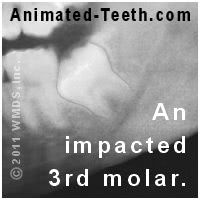
Pericoronitis, tooth decay, gum disease or even root resorption issues might become a factor with this impacted 3rd molar.
What’s the reasoning that lies behind indications for wisdom tooth removal?
The remainder of this page explains (or links out to our pages) that explain the principles and guidelines associated with those extraction justifications that the dental community as a whole generally seem to consider valid.
For the most part, the reasoning associated with each can be explained by the application of one or more of the following standards.
1) Some 3rd molars are hard to properly maintain.
Wisdom teeth frequently have a positioning in the jaw or bone tissue that makes them difficult, if not impossible, to adequately clean and maintain.
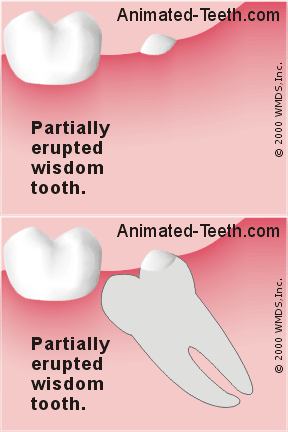
Dental plaque can accumulate underneath a partially erupted tooth’s gum line. But it is impossible to remove.
- Teeth that have erupted but are misaligned or malpositioned.
- Partially erupted teeth, meaning those that don’t fully stick out above the gum line as they should. (see animation)
- People with lax brushing habits.
The problem.
If an environment exists where dental plaque tends to accumulate (for any reason, ranging from patient neglect to situations that are simply impossible to clean), both the tooth and the tissues that surround it will be at increased risk for problems.
This can include tooth decay, periodontal (gum) disease and recurring infections (pericoronitis). Additionally, areas that harbor bacteria and debris can also be a source of breath odors.
So for any of these reasons, whether a current problem or a likely one to come, your dentist may make a recommendation that your unmaintainable wisdom teeth should be removed.
FYI – A dentist’s concern isn’t just for the wisdom tooth itself but also for the neighboring 2nd molar.
- Any gum disease issues that develop will affect it too.
- If the mass of dental plaque that has caused decay on the 3rd molar extends onto the surface of the 2nd, it will be at increased risk for cavity formation too.
That means waiting to remove a wisdom tooth that a patient has persistently shown an inability to clean until a point when an obvious problem has developed may also be a point when the neighboring tooth has already been damaged, possibly significantly so. In extreme cases, both teeth may need to be extracted.
2) The presence of major pathology or abnormalities.
Some very valid reasons to remove wisdom teeth involve situations where they are associated with some type of abnormality or pathology. They can include:
- Cyst or tumor formation.
- Damage to a neighboring tooth caused by the presence of a 3rd molar (such as root resorption).
- Extra wisdom teeth (4th molars) that have an associated condition.
For the most part, the occurrence of these types of conditions is relatively rare.
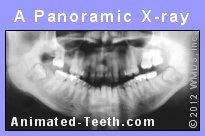
Identifying problems.
Historically, this typically took the form of a survey of 18 to 20 small individual films of your teeth (four of which are intended to show the area of your 3rd molars), or better yet (in terms of diagnosing conditions with wisdom teeth) a single panoramic radiograph (see picture).
While in most cases one of the above general surveys will provide enough information that a diagnosis can be made, the use of 3D (cone beam) x-ray imaging is now fairly commonplace and may be required for more detailed information (either for diagnosis or surgical purposes).
FYI – The ability to identify problems that otherwise could not be detected is one reason why dentists frequently recommend that a full-mouth x-ray examination should be performed every 3 to 5 years.
Even when no pathology is noted (which of course is the hope), this type of evaluation can provide informative details such as the current stage of development, eruption and alignment of the wisdom teeth, or identify cases where one or more of them are absent.
3) Some justifications for extraction are simply no longer universally accepted.
As mentioned above, some of the justifications for wisdom tooth extraction given in previous decades are no longer widely accepted by the dental community as a whole, to the point that some of them are now heatedly debated.
For example, it was previously thought that the process associated with 3rd molars coming in could cause other teeth in the mouth to shift. The fact of the matter is, however, that this “tooth crowding” theory has never been definitively confirmed by research.
Additionally, the basic school of thought that all impacted 3rds must be removed is no longer universally accepted. (This attitude is especially apparent in European countries, see discussion in the box below.)
FYI – While a decision for each tooth should be made on a case-by-case basis, there seems to be growing consensus among many in the dental community that leaving impacted wisdom teeth alone and monitoring them over time may pose less of a risk than those potential complications associated with removing them needlessly. (Friedman)
A standard recommendation for the removal of asymptomatic impacted third molars (a stance still frequently taken by general dentists and oral surgeons in the USA) runs contrary to the conclusions of a Canadian health technology report, American Public Health Association policy, and health technology reports from Sweden, Belgium and the UK. (Boughner)
For more information, see our page: Is it really necessary to have your wisdom teeth out? Monitoring vs Immediate removal.
▲ Section references – Friedman, Boughner
Page references sources:
Boughner J. Maintaining Perspective on Third Molar Extraction.
Friedman J. The prophylactic extraction of third molars: a public health hazard.
Koerner KR. Manual of Minor Oral Surgery for the General Dentist. Chapter: Surgical Management of Impacted Third Molar Teeth.
All reference sources for topic Wisdom Teeth.
Comments.
This section contains comments submitted in previous years. Many have been edited so to limit their scope to subjects discussed on this page.
Comment –
Wisdom tooth extraction question
Hi, I would like to know if it is true that when, the upper right wisdom tooth is extracted the lower right wisdom tooth NEED to be extracted too? This is what my dentist says.
Please let me know. Thank you!
Valerie
Reply –
Both teeth are completely separate entities, so no, with just routine cases there are no reasons why both absolutely have to be extracted. There can, however, be a myriad of reasons why doing so may make the better/right choice.
One would have to imagine that without an upper wisdom tooth to chew against, your dentist envisions a situation where the benefit vs. potential risks associated with the lower wisdom tooth (either now or sometime in the future) makes removing it the better plan. This page outlines the types of concerns your dentist might have.
You should simply ask them what concerns they have. And why extracting the tooth now makes the best approach. It should be simple enough for them to provide you with an answer.
Staff Dentist