Wisdom tooth extraction costs – Fee estimates for third molar removal
impaction
type.
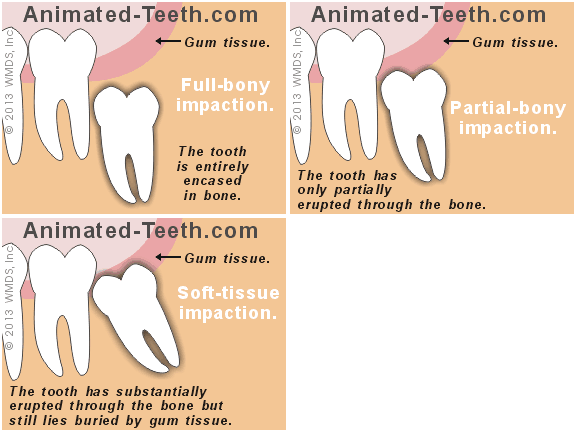
The fee you’re charged is based on your tooth’s extraction classification.
In general, a dentist will try to base their extraction fees on factors such as the expected level of difficulty of the procedure, the amount of appointment time it will take to complete the process, what level of postoperative assistance will need to be provided, etc…
As it turns out, with wisdom teeth, these factors tend to vary in accordance with the tooth’s positioning in the jaw (erupted vs. partially-erupted vs. fully impacted Pictures / Diagrams). And for this reason, fees are typically quoted using the following classifications, all based on the tooth’s basic orientation in the jawbone.
A) Wisdom tooth extraction – Soft tissue impaction.1
Low fee = Small rural city or town.
High fee = Large metropolitan area.
[How we calculate our cost estimates for procedures.]
1) A “soft tissue” impaction is one where although the tooth has penetrated through the surface of the jaw’s bone, at least some portion of the patient’s gums still lies over the wisdom tooth (see animation below).
The tooth might be fully covered over by gum tissue. Or it may be “partially erupted,” meaning that it has penetrated to some degree through the surface of the gums (the case where you can visualize a portion of the tooth).
The extraction process generally involves making an incision in the gum tissue and reflecting it back Flap procedure., so to gain access to the tooth. Removing the tooth. And then repositioning and suturing the gums back into place Placing stitches.. The fee charged should include all of these services.
B) Wisdom tooth extraction – Partial bony impaction.2
$280.00 – $461.00
2) A “partial bony” impaction is one where at least some aspect of the crown portion of the tooth (the part normally extending above the gum line) is still encased in the jawbone.
Impaction classifications.
Definitions of full-bony, partial-bony and soft-tissue impaction classes as they pertain to extraction fees.
C) Wisdom tooth extraction – Full bony impaction.3
3) A “full bony” impaction is one where the wisdom tooth is totally encased in bone tissue.
During the extraction process, an incision will be made in the gum tissue that lies over the tooth and it will be reflected back. Bone covering over the tooth will then be trimmed away. The tooth will often need to be cut into parts Tooth sectioning. before it can be taken out. The gum tissue will then be repositioned and sutured back into place.
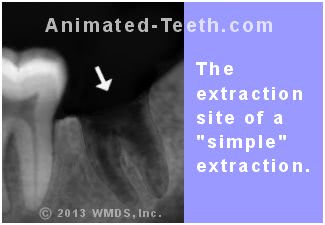
X-ray of the surgical site following a “simple” (fully erupted tooth) extraction.
D) Simple wisdom tooth extraction (non-surgical).4
Related information: Routine extraction costs.
What should be included with the cost of your extraction?
The fee you’re charged should include those steps and consumables that are necessary to perform a (routine) extraction. As an example …
- The fee should include the local anesthetic (dental shots) that’s needed for the extraction process. (Because this step is required for all extractions.)
- But costs for sedation services (discussed next) would not be expected to be included. That’s because what’s used will vary so widely between patients.
Other steps routinely performed during tooth extractions (like minor smoothing of bone and closing the extraction site) should be included too. So should assistance with routine postoperative complications (swelling, bleeding, dry sockets), so don’t hesitate to ask for help.
Costs for sedation services.
In those cases where the patient opts for the administration of some type of sedation Conscious sedation options. during their extraction process, additional costs will be involved.
Administration of nitrous oxide (laughing gas).
$45.00 – $90.00
Administration of intravenous (conscious) sedation.
$262.00 – $410.00
You should not have to pay any additional fee for your dentist to “numb up” your tooth using a local anesthetic (“Novocaine”). This should already be included in the price of the tooth’s extraction. The items above refer to additional medications that may be opted for, primarily as a means of patient management and/or helping the patient to better cope with the extraction process.
To get an exact fee, a consultation will probably be necessary.
Due to the great amount of variability that the process of extracting a third molar can pose, you’re unlikely to find any dentist who will quote a fee for your procedure without having an opportunity to examine you first.
This exam will need to include taking dental x-rays When are x-rays needed?, and these can add to its cost. But these are items that you will need no matter who performs your work.
After you’ve had your consultation, if you decide not to have your treatment performed at that office, or if you simply choose to get a second opinion, you can request that your x-rays be forwarded to another dentist.
Page references sources:
Because the procedure estimates we show are developed by different means, you may find the survey of dental fees published by DentistryIQ an interesting independent source: DentistryIQ – 2017 dental fee analysis by region and CDT procedure code
All reference sources for topic Wisdom Teeth.