Looking for information about other Dental Topics?
Full Website Index• Animated-Teeth.com •

OTC and home-remedy treatments for cold sores (fever blisters) –
Guide to treating cold sores on your own with over-the-counter products and home remedies.
Cold sores, also known as fever blisters, are common and often uncomfortable. Fortunately, various over-the-counter (OTC) products and home remedies can help alleviate symptoms and promote healing.
This page provides a comprehensive list of treatments, including natural remedies like honey, ice, and tea bags, as well as OTC options such as docosanol (Abreva®) and lysine supplements. By exploring these remedies, you can find effective ways to manage your cold sores and reduce their discomfort.
FYI: Beyond the DIY approaches discussed on this page, your dentist may feel that prescription cold sore medication could be beneficial.
Part I: Home remedies for cold sores/fever blisters.
There are a number of home-remedy approaches that can be used to help to treat, manage and/or prevent cold sores (fever blisters).
Most of them involve applying the treatment directly to the sore (such as ice, honey, or a tea bag). One popular approach, however, involves taking oral supplements (lysine).
A) Home remedy treatments for cold sores.
The following group of remedies involves the use of common household items that you probably already have on hand.
1) Try treating your sore with honey.
A research study by Al-Waili evaluated the therapeutic benefit of applying honey to fever blisters. The study’s comparison treatment was the use of the prescription antiviral medication acyclovir cream. Details
▲ Section references – Al-Waili
2) Apply an ice cube.
The use of ice-cube treatment with cold sores is based on two modes of action. One helps to limit the extent of the cold sore’s formation. The other is palliative in nature.
- Applying ice (for five to ten minutes each hour) during the Tingle stage of cold sore formation Description lowers the temperature of the tissue in which the lesion is forming.
This temperature reduction lowers the area’s metabolic rate, which in turn helps to stunt the cold sore’s development. (In essence, this is a form of cryotherapy.)
- The intermittent application of the ice acts as a numbing agent that can help to alleviate the lesion’s symptoms (pain, burning, itching).
Best practices.
- Overdoing the ice application can result in ice burn (overexposure of skin to extreme cold).
- Wrapping the ice in a scrap of cloth helps to avoid the potential for ice burn. When finished, dispose of the cloth.
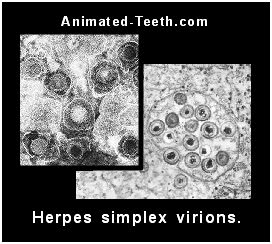
Herpesvirus particles (virions).
3) Put a tea bag on the area where a cold sore is forming.
- A study by Rodu tested the use of a preparation that contained tannic acid as the active ingredient. Its use was shown to be effective in limiting the extent of cold sore formation (as determined by lesion size).
- Some over-the-counter medications contain tannic acid (i.e. Tanac®).
▲ Section references – Rodu, Vilhelmova-Ilieva
Discussion.
Historically it’s been suggested that a moistened tea bag (regular black tea, like that used to brew ice tea) is placed on the area where the first signs of fever blister formation have started to appear (the Tingle stage), with the bag applied for a few minutes every hour.
A number of websites suggest that the FDA has concerns about the safety of the application of tannic acid to the lips as a treatment for cold sores. (We assume this could include tannic acid sourced from tea bags.)
These sites typically suggest that the FDA’s concerns involve the potential for systemic tannic acid side effects (due to absorption through the lips), and follow that with a statement that the warning is not substantiated by research but the FDA does feel that it warrants further study.
- Some sites offer a reference source for this statement, although we could not find the warning in the document cited.
- Our search of the web, and the FDA site itself (via both their website search function and Google), did not find an official source for this warning.
(4/15/2019)
However, this potential concern places us in a position where we must state that a decision to use this home remedy approach is best discussed with your dentist first.
4) Soften scabs with petroleum jelly.
A moisturizing compound like petroleum jelly (Vaseline®) can be applied to cold sore scabs. Doing so helps to moisturize and soften them so they are less likely to crack and bleed.
B) Treating / preventing cold sores using lysine oral supplements.
L-lysine dietary supplements are frequently promoted as a do-it-yourself therapy that can help to:
- Minimize your frequency of cold sore (fever blister) outbreaks.
- Lessen the duration or severity of those outbreaks that do occur.
As we explain below, however, despite the popularity of this advice (which is most notably touted by companies that sell lysine products) this treatment approach is only partially supported by medical research.
1) The basis of this treatment theory: The lysine/herpesvirus relationship.
The theory associated with the use of lysine in treating fever blisters/cold sores is typically this:
- The herpes virus requires arginine (an amino acid) to perform certain vital functions such as protein synthesis and replication.
- Since lysine (another amino acid) and arginine share (and therefore compete for) common pathways when being transported throughout the body, an increased intake of lysine results in a comparatively smaller amount of arginine being available to the virus for use.
- The net effect is one where the arginine deficit inhibits normal herpesvirus function, to the point where cold sores occur less frequently or those that do form are less severe.
How do the facts of this theory stack up?
- a) To the credit of this theory, there is evidence that arginine is a requirement for proper herpesvirus replication and that proteins synthesized by the herpes virus do in fact contain more arginine and less lysine than those proteins synthesized by the host cells they live in.
- b) What’s not so clear cut is that the act of taking lysine supplements is effective in reducing both the frequency, and the duration and severity, of cold sores.
The research that has been published on this topic has been mixed. Studies do seem to suggest that lysine supplements may help to reduce the frequency of fever blister breakouts. But not necessarily that the duration and severity of those cold sores that do form are reduced.
2) Lysine/Cold sores research.
Study: Tomblin (2001)
Title: Lysine for management of herpes labialis.
This team performed a literature review that evaluated seven (randomized, double-blind, placebo-controlled) research studies that had been conducted between 1978 and 1997 that investigated the use of l-lysine in managing cold sores.
[This time frame isn’t as outdated as it may seem. Our search (4/15/19) of the National Institute of Health’s PubMed database only revealed a single clinical study that had been published since this period. (It was one sponsored by a product manufacturer, as opposed to being an independent investigation.)]
The findings of this literature review were:
- Six out of the seven studies did show evidence that taking oral lysine supplements could be effective in decreasing the frequency of fever blister outbreaks.
- Only two of the studies showed evidence that taking lysine decreased the severity or duration of cold sores.
To recap, this review concluded that published research suggested that taking oral lysine supplements may be effective in helping to reduce (but not totally prevent) the occurrence of fever blister outbreaks. But it fails to confirm that this therapy has a treatment effect on those sores that do form (does not lessen symptoms or reduce healing time).
Study: Chi (2015)
Title: Interventions for prevention of herpes simplex labialis (cold sores on the lips).
This literature review performed for the Cochrane Collaboration investigated the subject of interventions for the prevention of cold sore outbreaks. (This organization uses very strict guidelines in determining what studies they will consider as evidence, based on the scientific methodology used by the researchers.)
In the words of this review’s report:
- “We failed to find any evidence of efficacy for lysine …”
- “The available evidence found no preventative effects of lysine …”
For us, the primary takeaway here is that while the benefit of taking lysine supplements may have been shown by some studies (a fact often touted by supplement manufacturers), none of them were especially well-designed research that met rigorous standards. And as such, they were not considered authoritative evidence by the Chi review.
3) Should you consider taking lysine supplements?
You’ll have to decide, preferably in conjunction with your health care provider, if taking lysine supplements is the right approach for you. We should mention:
- The FDA has not approved lysine for the treatment of cold sores.
- No professional organization has stepped forward and made a recommendation in regard to this treatment approach or an appropriate dosing level.
Dosing: If you’re considering taking lysine supplements, be smart about it.
In the studies evaluated by the Tomblin (2001) literature review, the most common dosing of lysine (L-lysine monohydrochloride) lay in the range of 1000 to 1200 mg per day, typically broken up into two or three individual doses taken throughout the day.
L-lysine therapy should only be started after getting a recommendation from your health care provider first. Contraindications associated with the user’s current health status (including renal and hepatic disease) exist. As does the potential for side effects and interactions with other medications.
4) An alternative approach based on the same arginine / lysine theory.
Instead of taking lysine supplements, a person might simply adjust their diet. The idea would be to reduce the intake of arginine-rich foods and increase the consumption of those high in lysine, during those time frames when experiencing a cold sore outbreak is most likely.
Arginine-rich foods – (foods to avoid) – Nuts, seeds, and some types of beans (peanuts, almonds, sunflower seed kernels, walnuts, hazelnuts, lentils, Brazil nuts, cashews, pistachios, flax seeds, kidney beans, soybeans).
Lysine-rich foods – (eat more of these) – Red meats, fish, and dairy products.
C) Home remedy preventive steps.
Here are a few simple things that you can do that should help to minimize the number of cold sore outbreaks you experience.
- Since exposure to light (especially ultraviolet light) can trigger cold sores, when outside shield your face from the sun with a hat. Also, when outside or when using a tanning bed or booth, apply a lip balm that contains a sunscreen having an SPF value of 15 or more. (Rooney)
- Since lip injury can trigger cold sores, minimize the potential for lip damage caused by chapping by applying a moisturizing lip balm.
D) Herbal remedies.
The herbal antiseptics Sage and Tea Tree Oil and also the herbal sedative Violet are sometimes suggested as being useful in treating cold sores. (Please remember that herbal compounds must be used appropriately. You should always discuss your plans with your health care professional before initiating any type of treatment.)
Aloe-vera.
Aloe-vera balm applied 3 times a day to the scabbed area may help to prevent secondary infection, moisturize the scab and enhance healing.
Part II: OTC medications & treatments for cold sores/fever blisters.
The remainder of this page discusses over-the-counter (non-prescription) treatments and medications. These are the kind of items you’ll find on the shelves of your neighborhood store or pharmacy.
OTC product categories:
- Herpesvirus inhibitors. – Docosanol (Abreva ®)
- Numbing agents / Anesthetics.
- Antibacterial products.
- Scab moisturizers.
- Sunscreens.
- Products that contain the compounds:
– Benzylkonium chloride | Lysine | Tannic acid | Zinc
Ways OTC products work.
Non-prescription (over-the-counter) cold sore (fever blister) products typically provide their treatment benefit via one of the following modes of action.
- They help to create an optimal healing environment, so the sore heals as quickly and as uneventfully as possible.
- They provide palliative treatment, meaning they help to relieve the pain, itching, and burning associated with cold sores.
- They create an inhibitory effect on the herpes virus that in turn helps to stunt the extent of lesion formation.
Figuring out how a product works.
Rather than just providing one aspect of cold sore management, some OTC products combine multiple compounds so they can be useful in managing cold sores on multiple fronts.
To help you better understand how the product you’re considering actually works, instead of just listing brand names we’ve also listed the actual compounds typically used to provide different cold sore treatment benefits. Simply compare your product’s ingredient list to the compounds mentioned on this page.
1) Herpesvirus inhibitors – Docosanol (Abreva ®).
Docosanol is an antiviral compound that has been shown to be effective in shortening both the healing time and duration of symptoms of cold sores.
a) How does it work?
Docosanol has an inhibitory effect on herpesvirus replication (reproduction) by way of inhibiting the fusion between the host cell membrane and the virus envelope. (It makes it difficult for the virus to enter into cells where it can replicate.)
Herpesvirus particles (virions).
Early treatment is key.
Just like with any other type of antiviral medication Prescription options., the key to effectiveness with docosanol is that it must be applied at the very earliest signs of cold sore formation (a time period when virus replication is still active and can be affected). Late initiation of treatment provides much less benefit.
b) How effective is docosanol (Abreva®)?
There are two studies that have historically been cited when discussing the effectiveness of docosanol in treating cold sores/fever blisters.
- Habbema (1996) reported that the application of 10% docosanol cream (initiated at the very earliest signs of cold sore formation) shorten healing time in test subjects, on average, by approximately 3 days (as compared with placebo treatment or late treatment with docosanol cream).
- Sacks (2001) reported a more modest treatment benefit. Test subjects initiating the early application of 10% docosanol cream only experienced, on average, an 18-hour reduction in healing time for their cold sores.
▲ Section references – Habbema, Sacks
c) How is Abreva® used?
Product details –
Abreva® is a white cream that dries clear. It has no smell. It can be purchased as a cream in a tube, in a “pump” dispenser, or as a patch.
How the cream is used.
- Treatment should be started once the very earliest sign of cold sore formation is felt (the “tingle” stage Description).
- Apply the cream on and around that region of your face or lip where you feel the cold sore forming. (Abreva® is for external use only.)
- The cream can be spread with your finger or an applicator like a Q-tip. (Wash your hands after application so you don’t spread the herpes virus to others, or even other parts of your own body.)
- The cream should be applied repeatedly (every 3 to 4 hours) throughout the waking hours of your day (5 times daily is recommended).
- Treatment is continued until your cold sore’s last scab has fallen off, or else for up to 10 days (whichever is earliest).
d) Abreva® has FDA approval.
Abreva® is the only over-the-counter (non-prescription) medication that has been approved by the FDA “to shorten both healing time and the duration of symptoms” of cold sores.
It received this approval in July 2000. (FDA approval is only given after a manufacturer has submitted research findings that show evidence that their product is safe and effective for its intended use.)
What’s different about Abreva® and its FDA approval vs. other OTC products?
Many OTC fever blister medications contain FDA-approved compounds in their formulation. But these compounds are only recognized as agents for relieving symptoms, such as itching and burning.
In comparison, Abreva® (docosanol) has FDA recognition that it helps to relieve symptoms and reduce the time needed for cold sore healing.
2) Numbing agents. / Anesthetics.
Topical anesthetics (tetracaine, benzocaine, or lidocaine) and other numbing agents (benzyl alcohol, camphor, or phenol) are frequently included in the ingredient list of non-prescription fever blister products.
The most obvious treatment goal associated with the use of these compounds is reducing cold sore symptoms (burning, itching, and pain), however, there may be other benefits too.
Research studies.
- Cassuto (1989) found that symptoms were experienced over a fewer number of days (2.1 vs. 5.1 days) when an anesthetic cream (lidocaine and prilocaine) was applied to cold sores.
- Kaminester (1999) determined that the application of anesthetic helped to reduce fever blister healing times (5.1 vs. 7.2 days).
▲ Section references – Cassuto, Kaminester, Worrall
Products to look for.
Some brand names of cold sore products that contain numbing agents are: Anbesol®, Blistex®, Campho-phenique®, Carmex®, Orabase®, Orajel®, Tanac®, Viractin®, Zilactin®.
3) Proprietary OTC treatments.
A number of OTC products contain the compounds zinc, lysine Discussed above., benzylkonium chloride, and tannic acid Discussed above.
And while these compounds haven’t been as extensively studied as others, there is some evidence and history that suggests that they are useful in cold sore management.
How do they work?
Presumably, these compounds work by way of having an inhibitory effect on the herpes virus, which in turn, helps to limit the extent of lesion formation (smaller lesions generally correlate with quicker healing). However, for some of them, their precise mechanism is still up to debate.
The concept for the use of some of these items seems to be derived from known home remedy cures (see links above).
a) Topical zinc compounds.
Topical medications (ointments, creams) that contain zinc compounds (zinc oxide, zinc sulfate) may help to speed up the time it takes for cold sores to heal. Especially in those cases where their application is begun promptly upon the first sign of lesion formation.
- A zinc oxide / glycine cream was found to shorten the average healing time from 6.5 to 5.0 days.
- 50% of a treatment group applying 1% zinc sulfate gel to their sores were symptom-free at 5 days, as compared to 35% of the placebo group.
(Opstelten 2008)
▲ Section references – Opstelten, Worrall
b) Products that contain benzylkonium chloride.
Research suggests that the compound benzylkonium chloride (a disinfectant and antiseptic) is effective in inactivating the herpes virus (presumably by way of disrupting the virus’s envelope). Some cold sore medications include this compound as their primary active ingredient.
Products to look for.
Some brand names associated with these types of products are: Viroxyn®, Releev®.
c) Topical products that contain lysine.
Some research suggests that taking lysine as an oral supplement may be effective in helping to prevent fever blister outbreaks more details. In a similar vein, lysine formulations used as a topical cream may have some benefits too.
Products to look for.
Some brand names associated with these types of products are: SuperLysine®, Herpecin-L®.
4) Antibacterial medications.
The herpes virus is just that, a virus, not a type of bacteria. And for that reason, antibacterial compounds won’t be effective against it. However, they can be helpful in managing fever blisters once they have formed.
They do this by way of helping to prevent secondary bacterial infection in the sore. As a result, it is more likely to heal promptly and uneventfully.
Products to look for.
Some brand names associated with these types of products are: Neosporin®, Polysporin®.
5) Medications that moisturize fever blister scabs.
Emollients, moisturizers, protectants, and lip balms can be useful in treating cold sore lesions once they have scabbed over. They help to soften the scabs so they are less likely to crack and bleed. Look for ingredients such as: allantoin, calamine, cocoa butter, and petrolatum (petroleum jelly).
Products to look for.
Some brand names associated with these types of compounds are: Ambesol®, Blistex®, ChapStick®, Herpecin-L®, Neosporin®.
6) Medications that provide sunscreen protection.
Exposure to ultraviolet light (a component of daylight and the lighting used in tanning beds) is generally considered to be one of the common triggers for cold sore outbreaks. View list.
The formulation of many cold sore products includes zinc oxide, or other blocking agents, that provide sun-screen protection. It’s best to choose a product that has an SPF value of 15 or greater. (Rooney 1991)
Research studies.
As much sense as using sunscreen would seem to make, not all studies have necessarily confirmed that using one is beneficial.
- Rooney (1991) exposed test subjects to ultraviolet light. None of the participants using sunscreen developed cold sores whereas 71% of those given the placebo did.
- But a study (Mills 1997) evaluating skiers in natural outdoor conditions found no benefit to using sunscreen lotion.
▲ Section references – Rooney, Mills
Products to look for.
Some brand names associated with products that provide lip sun-screen protection are: Ambesol®, Blistex®, ChapStick®, Herpecin-L®, Neosporin®.
Always wash your hands after treating a cold sore.
Take precautions when treating your cold sores. The herpes virus is contagious!
Each of the stages of cold sore formation and healing must be considered to be contagious. So, after you have applied any type of treatment, you should always properly dispose of any applicator or item that has come into contact with your sore and also wash your hands.
Additionally, you should never share topical cold sore medications (creams, ointments, balms, etc…) with others.
Last reviewed: January 11, 2025
Author: Paul Cotner, DMD — retired dentist.
Published by: WMDS, Inc. — owner of Animated-Teeth.com.
Educational information only — not a substitute for professional dental care.
Page references sources:
Al-Waili NS. Topical honey application vs. acyclovir for the treatment of recurrent herpes simplex lesions.
Cassuto J. Topical local anaesthetics and herpes simplex.
Chi CC, et al. Interventions for prevention of herpes simplex labialis (cold sores on the lips).
Habbema L, et al. n-Docosanol 10% cream in the treatment of recurrent herpes labialis: a randomised, double-blind, placebo-controlled study.
Kaminester LH, et al. A double-blind, placebo-controlled study of topical tetracaine in the treatment of herpes labialis.
Mills J, et al. Recurrent herpes labialis in skiers. Clinical observations and effect of sunscreen.
Opstelten W, et al. Treatment and prevention of herpes labialis.
Rodu B, et al. Determining therapeutic efficacy in recurrent herpes labialis by lesion size analysis.
Rooney JF, et al. Prevention of ultraviolet-light-induced herpes labialis by sunscreen.
Sacks SL, et al. Clinical efficacy of topical docosanol 10% cream for herpes simplex labialis: A multicenter, randomized, placebo-controlled trial.
Tomblin FA, et al. Lysine for management of herpes labialis.
Vilhelmova-Ilieva N, et al. Anti-Herpes Simplex Virus Type 1 Activity of Specially Selected Groups of Tannins.
Worrall G. Herpes Labialis.