How noticeable is wearing Invisalign®? What parts show? –
Just how invisible is wearing Invisalign®?
One of the things patients really like about having treatment with the Invisalign® system is that their teeth are straightened using transparent aligners Details | Specifications instead of a set of brackets and wires (like with traditional braces).
But even though they’re hard to see, they’re not invisible. And as this page outlines, there are a number of tip-offs (visual and otherwise) that others may pick up on that can hint to them that something is going on with your teeth.
Ways people may be able to tell that you’re wearing Invisalign®.
Here’s a list of tip-offs that may betray the fact that you’re having your teeth straightened.
- The look of your aligners.
– Yes, Invisalign® tooth aligners are made out of clear plastic. But that in itself may be what hints to others that you’re wearing them.
- Not all of the parts of the Invisalign® system are invisible.
– It’s only the aligners that are see-through clear. Invisalign® attachments, buttons and elastics are not.
- Your aligners may affect some of your everyday activities.
– Wearing Invisalign® may change the way you do certain things. And if something’s different about you, other people may notice.
1) Noticeable aspects of Invisalign® tooth aligners.
Although unquestionably less obvious than other types of dental braces, Invisalign® aligners aren’t totally undetectable. Here’s why.
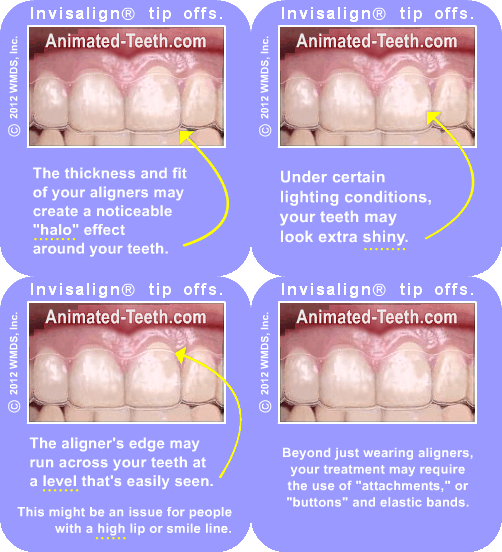
Tip-offs that you’re wearing Invisalign®.
a) They’re made out of shiny plastic.
b) The halo effect.
When you have your aligners in, your teeth are essentially plastic-wrapped. And the thickness of this plastic, or any minute spaces that exist between the aligner and your teeth, can create a “halo” effect. (See picture.)
More about the Invisalign® experience.
- What it’s like for you –
Eating, Drinking, Talking, Pain - How it looks –
Appearance (tip-offs), Staining, Cleaning options. - How it works –
Tooth movement, Treatment details.
c) The edge of your aligners may show.
If you have a relatively high lip or smile line (a “skin grin”), or if your aligners have a design where they just cover over most but not all of each tooth, other people may be able to see that you’re wearing them.
Debris trapped in an Invisalign® aligner.
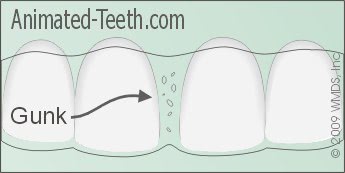
d) Debris accumulation.
e) Surface accumulation.
You may find that smears of colored lip gloss and lipstick adhere to the surface of your aligners, thus betraying the fact that you’re wearing them.
f) Aligner staining.
If you’re not careful in limiting the foods and beverages your aligners are exposed to, or the way you take care of them, their plastic surface can discolor or stain Causes | Prevention, or become scratched and dull. Causes | Prevention If so, they’ll be more noticeable to others when you wear them.
g) Of course, distance does matter.
How obvious any of the above-mentioned factors ultimately proves to be may simply depend on how close the person looking at you happens to be.
- If they’re three feet or more away, the fact that you’re wearing Invisalign® probably won’t be detected.
- But if you work closely with other people, especially the type that pay close attention to detail, your aligners, and the fact that you’re having treatment, may be easily noticed.
2) Not all of the parts of the Invisalign® system are invisible.
It’s only the Invisalign® tooth aligners that are see-through clear. Any “attachments,” “buttons” or elastics (rubber bands) that are used in conjunction with them are not. And if your case requires these kinds of items, they may be a tip-off to others that you are having orthodontic treatment.
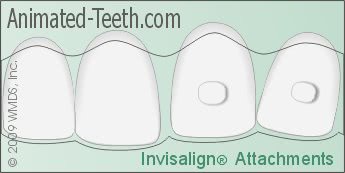
Invisalign® tooth attachments.
- Attachments – “Attachments” are small lumps of dental bonding that are placed on teeth to help to direct aligner forces. Depending on their size and where they need to be placed, they may be quite visible.
Related content: Invisalign® Attachments Details | Pictures
- Buttons – “Buttons” are anchor points for elastic (rubber) bands. Your buttons themselves likely won’t be as much of an issue for you as the quite visible elastics that are hooked onto them.
Related content: Invisalign® Buttons and elastic bands. Details | Pictures

Our affiliate links can be used to shop for Invisalign accessories on Amazon.com
They offer many innovative devices that provide solutions for the issues Invisalign® wearers encounter.
This is an important point about the visibility of the Invisalign® system.
Since its inception, the Invisalign® system has increasingly been used to treat ever more complex cases. And in general, more complex cases are more likely to require the use of these types of treatment additions.
That means the issue of the visibility of these kinds of items, and how noticeable they make your treatment become, is an ever-increasing issue. To give you an idea of how this might affect your experience, consider the findings of the following study.
Research.
A study by Feu showed 252 test subjects pictures of a model’s face that simulated wearing different types of orthodontic appliances, and then asked them to rate the “attractiveness” of their smile.
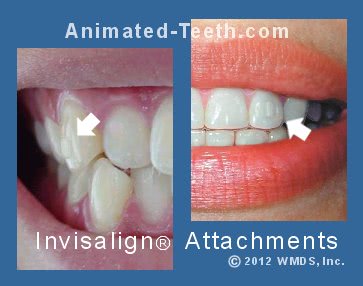
Attachments and buttons can be visible to varying degrees.
- As you would expect, the look of wearing clear tooth aligners scored the highest.
As compared to the appearance of silver (stainless steel) braces with grey elastic bands, wearing clear orthodontic aligners rated 81 vs. 34 for the braces.
- However, when the clear aligner smile included the use of attachments (on 4 upper front teeth, the cuspids and lateral incisors), its “attractiveness” rating fell to 68.
A value of 68 lies on par with wearing ceramic braces Details | Pictures (tooth-colored brackets, stainless steel archwire) which scored 69.
If this increase in visibility is an important factor for you …
- Your dentist should be able to confirm for you Case animation., even before your treatment has begun, if any attachments, or buttons and elastics will be needed for your case.
- Even in cases where they are, they may not be required for the entire duration of your treatment. Once again, your dentist will know (and can be asked) before your case is begun.
3) Wearing your aligners may affect your daily activities.
Although others may not be able to actually see your aligners in your mouth, the way they affect some of your normal everyday activities might give them a hint, or even make it quite obvious, that they’re in there. Here are some examples:
- Your aligners may affect the way that you talk. – Anything new or foreign in your mouth can affect your speech. And this includes orthodontic tooth aligners.
Related content: The effects of Invisalign® on speech. Common problems. | Remedies.
- Wearing your aligners may boost your salivary output. – It’s a common phenomenon that just wearing your aligners triggers your body to produce more saliva.
(The usual explanation is that your body confuses having your aligners in your mouth with receiving food. With the process of eating generally assisted by an increased flow of saliva.)
For most people, needing to conceal this extra sloppiness will be confined to a few days as their body quickly adapts to the presence of their appliances. But for some, having to deal with this issue may persist for a week or even two.
- People may see you remove your aligners. – Invisalign® appliances should be taken out when you eat and drink. And since treatment usually lasts many months, or longer, it’s easy to assume that sooner or later you’ll have to remove them in front of other people.
Related content: Can you drink beverages Precautions | Potential problems. while wearing Invisalign®? | Can you eat No, yes, when? with Invisalign®?
4) Choosing Invisalign® helps you to look smarter.
Yes, we agree. That’s a pretty stupid heading. But it does have some factual merit.
Research.
A study by Jeremiah was set up where it showed 130 test subjects pictures of a model wearing different types of orthodontic appliances. They then asked the subjects about their impression of the model’s appearance in each.
- The study found that the “intellectual ability” (IA) of the model was perceived as being lower when shown wearing ceramic (a score of 6.65) or conventional silver braces (6.67) vs. clear tooth aligners (7.08) or no appliance at all (7.56).
Possible conclusions.
Based on these findings, it’s easy enough to conclude that wearing any type of orthodontic appliance, no matter how marginally detectable, tends to lower other people’s perception of your IA. And since Invisalign® tends to mimic wearing no appliance at all, it affects others’ perception the least.
▲ Section references – Jeremiah
Page references sources:
Feu D, et al. Esthetic perception and economic value of orthodontic appliances by lay Brazilian adults.
Jeremiah HG, et al. Social perceptions of adults wearing orthodontic appliances: a cross-sectional study.
Pacheco-Pereira C, et al. Patient satisfaction and quality of life changes after Invisalign treatment.
All reference sources for topic Straightening Teeth.
Comments.
This section contains comments submitted in previous years. Many have been edited so to limit their scope to subjects discussed on this page.
Comment –
Attachments show.
Ever since I’ve had attachments placed my Invisalign is easy to see. It looks like I have barnacles on my teeth. What can be done.
fdanver
Reply –
As the Invisalign system has advanced over the years so to be able to treat more and more complex cases, the use of attachments seems to have become more common too. The attachments give the aligners more control and precision in making tooth movements, and with some cases (especially more difficult ones) this aids with the case. That means however that the “invisible” aspect of having Invisalign treatment is now lost for some.
If the color of the attachments plays a significant role in why they are so obvious, then possibly your dentist can replace them using a shade of dental composite that matches better.
The only other solution is to insist that they are taken off. Cases can often be treated without using them but usually less quickly and/or predictably.
If your series of aligners have already been fabricated (which they no doubt have) there will probably be a charge for replaning your case and having the new series of aligners made.
Staff Dentist