Looking for information about other Dental Topics?
Full Website Index• Animated-Teeth.com •

Types of orthodontic retainers: Removable (Essix, Hawley, Vivera®) | Permanent – (Bonded, fixed, lingual wire.) | All about ortho retainers A to Z.
Once your dentist has finished the process of straightening your teeth, the retention phase of your treatment will begin.
During this phase, you will be required to wear some type of dental retainers (which at least in theory may last the remainder of your life Probably should.). This is true no matter what kind of braces or orthodontic system was used.
Without proper retention, orthodontic relapse (the return of features of your original malocclusion) is likely to occur.
Orthodontic retainers – What you need to know.
We’ve broken this page into the following sections:
- Kinds of retainers. – Fixed (permanent, bonded) vs. Removable (Hawley, Essix, Vivera®). | Pictures. | Pros and cons.
- How often will you need to wear your retainers? – Example scenarios.
- How long do orthodontic retainers last?
- Retainer costs. – New vs. replacement.
- How to clean your retainers.
What kinds of orthodontic retainers – What are your options?
There are generally two kinds of dental retainers, Removable and Fixed. And, just as their names imply, they differ by way of the fact that one type is permanently attached (bonded) to your teeth whereas the other is removable and just worn according to your dentist’s directions. What’s common?
Kinds of orthodontic retainers.
- A) Permanent (fixed, bonded) retainers.
- B) Removable retainers -
There’s no single best type for everyone.
You’ll need to quiz your dentist about which types of appliances they’ll consider for use with your case. And then ask about the specific advantages and disadvantages they feel each one offers your situation. (Reading this page will help you know what questions to ask.)
Listen seriously to what your orthodontist has to say. Remember, they’ve just completed providing you with months and probably even years of treatment and they’ll no doubt have specific opinions about how suited each type of appliance is for your situation. And also, which type you’ll be most likely to wear as instructed.
This latter point is astoundingly important because, after all, it’s only by wearing your retainers that you can ensure the successful outcome of your orthodontic treatment over the remainder of your life.
You may wear more than one kind of appliance.
It’s quite common that a different type of retainer is used with each individual dental arch (upper/lower). The most common configurations are:
- Hawley upper | Permanent (fixed) lower.
- Essix upper | Permanent (fixed) lower.
A) Permanent orthodontic retainers.
Other terms used.
Other names for “permanent” appliances are “bonded” or “fixed” retainers. Each of these terms simply conveys the fact that this type of retainer is attached directly to your teeth. Once installed, the appliance cannot be removed by the wearer.
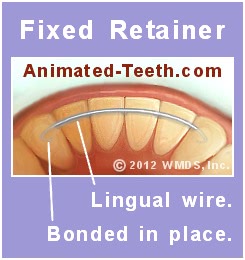
A lingual wire retainer.
What does a permanent retainer look like?
- The simplest form of this type of appliance consists of a single bar or strand of solid or braided wire.
- The wire is bent to a form that fits passively against the backside of the patient’s teeth (tongue or palate side).
- It’s then bonded into place using dental composite (standard dental bonding material).
Fixed retainers were first introduced in the 1970s. (This was an era when many new applications for dental bonding were initially introduced.)
Examples of permanent retainers.
What is a “lingual wire” retainer?
This appliance is composed of a small diameter wire that’s been bonded to the backside of selected lower front teeth (often just to an eyetooth at each end, see picture above). A paper by Valiathan states that this is the most frequently used retainer for lower teeth.
b) Are fixed retainers possible for upper teeth?
Yes, while utilized less frequently than with lower ones, bonded retainers can be designed for upper front teeth too. However, issues associated with the patient’s bite sometimes make using this type of appliance impractical or even impossible.
▲ Section references – Valiathan
How long is a fixed retainer left in place?
Unless there are clear reasons why it should be removed, bonded retainers are typically left in place indefinitely. A study by Booth (2008) found that this type of appliance is capable of providing acceptable service in excess of 20 years.
What are the advantages and disadvantages of permanent retainers?
Advantages.
- Fixed retainers offer excellent service and predictable results.
- Since they’re bonded on, patient compliance is never a concern.
- Because they’re mounted onto the backside of your teeth, they are hard to see.
- Due to their minimalistic nature, they seldom interfere with speech.
Disadvantages.
- They make it more difficult to clean your teeth. Failing to practice effective oral home care can result in complications with gum tissue health or even cavity formation.
Q & A about Permanent retainer advantages and disadvantages-What kinds of cases are ideal for lower bonded retainers?
Research suggests that fixed retainers are better at holding lower front teeth (incisors) in place during the first months immediately following the completion of a person’s active orthodontic treatment than removable ones.
- In cases where the potential for these teeth to relapse is a primary concern, the treating orthodontist may feel strongly about placing a bonded retainer.
- In some cases, a combined approach is used. The patient wears a bonded retainer initially, then later on, a removable one is utilized (for full or part-time wear).
What kinds of cases are ideal for lower bonded retainers?
Research suggests that fixed retainers are better at holding lower front teeth (incisors) in place during the first months immediately following the completion of a person’s active orthodontic treatment than removable ones.
- In cases where the potential for these teeth to relapse is a primary concern, the treating orthodontist may feel strongly about placing a bonded retainer.
- In some cases, a combined approach is used. The patient wears a bonded retainer initially, then later on, a removable one is utilized (for full or part-time wear).
▲ Section references – Meade, O’Rourke
What’s the main disadvantage of having a permanent retainer?
The biggest disadvantage associated with having a fixed retainer is that it makes it more difficult for you to clean your teeth. This is true for both brushing and especially flossing activities.
Study findings about cleaning difficulty. – A study by Sawhney polled subjects who wore different types of orthodontic retainers. One question asked was how difficult it was to maintain oral hygiene.
- In regard to upper retainers, bonded ones were considered the most difficult to clean (24%) vs. Hawley (8%) and Essix (4%).
- Similar findings were found with lower appliances (the most frequent application for fixed retainers) at a rate of 33% vs. Essix (9%) and Hawley (6%).
- A study by Heier evaluated orthodontic patients who either wore removable or bonded retainers at 1, 3, and 6-month intervals.
- It determined that while the subjects wearing fixed retainers did have more plaque and tartar buildup on their teeth, the gum health of the groups did not vary significantly.
▲ Section references – Sawhney, Heier
How do you clean around a permanent retainer?
Performing effective home care typically requires the use of a floss “threader.” This device allows the user to work the floss underneath their retainer’s wire, so they can floss the portion of their teeth in that region.
Related: Details about cleaning around fixed retainers. How to.)
What’s the biggest advantage of having a permanent retainer?
The great advantage of bonded retainers is that the dentist does not have to rely on patient cooperation. Unlike removable retainers that may not be worn, or worn as frequently as instructed, fixed appliances are always in place to perform their duty.
How visible is a bonded retainer?
Due to its positioning on the backside of the wearer’s teeth, it’s usually very difficult to impossible for others to detect. In most cases, this type of appliance is considered to be the least noticeable and therefore most esthetic retainer choice.
Will a bonded retainer interfere with speech?
No, unlike removable retainers that frequently do, the minimalistic nature of a fixed appliance seldom affects the way a person speaks.
B) Removable orthodontic retainers.
There are two basic categories of removable dental retainers. They are the Essix and Hawley appliances. As discussed below, each type offers its own specific advantages and disadvantages.
In terms of usage, a study by Pratt found that 47% of orthodontists (USA) tend to place Essix retainers and 43% Hawley. Possibly more revealing is that another study by Pratt found that nearly half of the respondents reported reducing their use of Hawley retainers over the past 5 years (only 6% reported increasing).
▲ Section references – Pratt, Pratt
1) Essix retainers.
Essix-style orthodontic appliances are sometimes referred to as “invisible” retainers because they’re made out of clear plastic. They may also be referred to as “overlay” retainers because of the way they fully encase the teeth (and even some of the surrounding gum tissue). They were first introduced in the early 1970s.
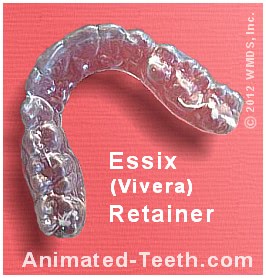
An Essix-style (vacuum-formed) orthodontic retainer.
What does an Essix retainer look like?
In fact…
Essix vs. Vivera®
For Invisalign® patients, wearing Essix retainers may seem the logical choice since they are already familiar with wearing this kind of appliance. But they can be an appropriate choice following any other method of orthodontic treatment too.
How are Essix retainers made?
These are vacuum-formed appliances that are relatively simple to make. Many dentists fabricate them right in their own office. Here are the steps:
- An impression of the patient’s teeth is taken and used to make a plaster cast.
- A thin sheet of plastic (around 0.030 inches, about the thickness of a credit card) is then heated and sucked down over the cast using a vacuum unit to form the retainer.
- Excess plastic is then trimmed away to complete the appliance.
What are the advantages and disadvantages of Essix retainers?
Advantages.
- When worn, they’re fairly invisible.
- They can be taken out to perform oral hygiene.
- Patients tend to comply with wearing them.
Disadvantages.
- Some people will notice interference with speech.
- The retainer’s fit and function are generally nonadjustable.
- Damaged appliances typically can’t be repaired and must be replaced.
Q & A about Essix advantages –How noticeable are Essix retainers?
They’re reasonably invisible. However, and similar to Invisalign® aligners, their plastic surface sometimes gives a shimmer to your teeth that can be a tip-off that you’re wearing them. In fact, a study by Sawhney (2013) found that just 77% of patients who wore upper Essix retainers considered their appearance “good.”
Related page: Tip-offs that you’re wearing Invisalign. Jump to page.
How noticeable are Essix retainers?
They’re reasonably invisible. However, and similar to Invisalign® aligners, their plastic surface sometimes gives a shimmer to your teeth that can be a tip-off that you’re wearing them. In fact, a study by Sawhney (2013) found that just 77% of patients who wore upper Essix retainers considered their appearance “good.”
Related page: Tip-offs that you’re wearing Invisalign. Jump to page.
How good is patient compliance with Essix retainers?
A study by Pratt (2011) polled a group of orthodontists and found that over half felt that patient compliance (appliances worn as directed) was higher with Essix vs. Hawley retainers. Only 6% felt that the reverse was true.
However, a second study by Pratt (2011) that evaluated longer-term patient compliance found that, while initially higher, Essix retainer use decreased at a faster rate than for Hawley appliances. And at 2 years out, patient compliance was greater with Hawley retainers overall.
▲ Section references – Sawhney, Pratt, Pratt (Linked previously.)
Q & A about Essix disadvantages –Can Essix retainers interfere with speaking?
They may, although typically less so than what’s noticed with Hawley retainers. Unfortunately, Essix appliances are non-adjustable in this regard, so your dentist can’t make any improvements for you (adjustments are possible with a Hawley). However, this difficulty typically self-corrects after a short period of verbal practice.
Related page: Remedies for speech difficulties when wearing Invisalign®. Jump to page.
Can Essix retainers interfere with speaking?
They may, although typically less so than what’s noticed with Hawley retainers. Unfortunately, Essix appliances are non-adjustable in this regard, so your dentist can’t make any improvements for you (adjustments are possible with a Hawley). However, this difficulty typically self-corrects after a short period of verbal practice.
Related page: Remedies for speech difficulties when wearing Invisalign®. Jump to page.
A damaged Essix retainer.
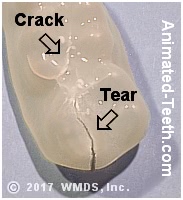
How do you inspect an Essix retainer for damage?
You should look for signs of cracks, holes, tears, or plastic breakage. Also, the appliance’s plastic may be warped if it’s been exposed to (wet or dry) heat. Generally speaking, a damaged Essix appliance cannot be repaired and instead must be remade.
FYI: Despite having a relatively flimsy appearance, studies suggest that Essix retainers have a similar survival rate as Hawley appliances (Keenan, Sun). A study by Sawhney found that upper Hawley and Essix retainers experience similar rates of breakage (25% vs. 23%).
▲ Section references – Sawhney, Keenan, Sun
Additional FAQ about Essix orthodontic retainers.
What’s the difference between an Essix retainer and an Invisalign aligner?
To look at, not all that much. Both are made out of clear stiff plastic and look essentially identical. The big difference between them is the way they fit. Retainers fit passively so they don’t shift your teeth. Aligners fit tightly against selected teeth so they do.
Can an Essix retainer act as an Invisalign aligner?
Yes, if you haven’t worn your retainer as instructed and as a result your teeth have shifted a small amount, when you start to wear it again, its tight fit may shift them back into place just like an Invisalign aligner.
Are Essix retainers stronger/more durable than Invisalign aligners?
Yes, to some degree. A slightly thicker (and therefore stronger, more durable) plastic is typically chosen when fabricating retainers. That’s because their intended lifespan is much longer than the two weeks of wear that’s usual with Invisalign aligners.
Related Q&A: How long do Essix retainers last? Jump ahead.
Can I wear Essix retainers at night?
Yes, absolutely. While the transparent/invisible nature of Essix retainers makes them ideal for daytime wear when your dentist feels that that’s needed, most people seem to prefer wearing them at night while they’re sleeping.
Related Q&A: How much/how often do retainers need to be worn? Jump to page.
Are Vivera retainers better than Essix?
No, not necessarily. Vivera appliances are one brand of Essix-style retainers. Other brands or generic versions can be every bit as good. Primary factors would be the materials used and the care taken during the fabrication process. Usually, it’s your dentist who judges these criteria.
Are Essix appliances as effective as other kinds of retainers?
Yes, if worn as directed. However, it’s your compliance with your dentist’s instructions that’s the key. And if the clear/invisible nature of these appliances makes it more likely that you will wear them, then they make a good choice and can be expected to be just as effective as Hawley or fixed retainers.
Do Essix retainers cause cavities?
No. But if you don’t practice proper oral home care (brushing, flossing, rinsing out periodically), the way an Essix retainer encases your teeth can lead to conditions that can promote cavity formation. The barrier it creates inhibits the diluting/buffering effect of saliva and generally enhances conditions for bacterial growth and decay formation.
Related page: We explain this decay risk here. Jump to page.
How do you clean Essix retainers?
We now cover the subject of retainer maintenance here. Jump to page.
Are Essix retainers comfortable to wear?
Generally, yes, if not, sharp edges can be smoothed down and extensions of the plastic that poke at your gum tissue can be trimmed away. However, making any adjustments is best left to your dentist so the changes made don’t compromise the effectiveness of your appliance.
Related page: Relieving irritation caused by Invisalign aligners. Jump to page.
2) Hawley orthodontic retainers.
Hawley appliances are the granddaddy of retainers. They were first introduced in the 1920s. And even today they are the most used type of retainer for upper teeth. (Valiathan)
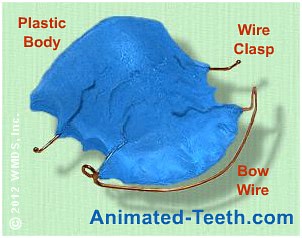
A Hawley orthodontic retainer.
Construction.
The clasps grasp around selected teeth so the retainer is anchored securely. The retaining “bow” wire runs across the front side of the teeth and maintains their alignment.
Appearance.
The most noticeable feature of a Hawley retainer is the bow wire that runs across the front side the patient’s teeth. The plastic body remains well hidden. Sometimes it’s constructed using plastic that has bold colors or a personalized design.
Advantages and disadvantages unique to Hawley retainers.
Advantages.
- A Hawley retainer is adjustable. That means it can be used to further refine the alignment of your teeth. Or, if you’ve failed to wear your retainer faithfully, it can be adjusted as to guide your teeth back into place.
- Hawley’s appear to have a more rugged construction than Essix-style retainers. But as we mentioned above, recent studies have suggested that patients experience similar survival rates for both types of appliances.
- Whereas an Essix must be replaced if damaged, a Hawley can be repaired (either its wire or plastic components).
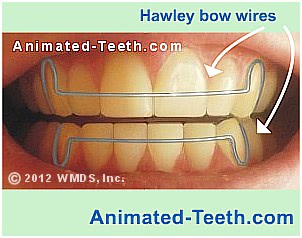
The bow wires of Hawley appliances are quite obvious.
Disadvantages.
- One of the biggest disadvantages of wearing a Hawley is its appearance. It has a bow wire that runs across the front side of the wearer’s teeth and it’s quite obvious to others when the retainer is worn.
However, a study by Sawhney found only about half of Hawley wearers found its appearance objectionable (59% for upper appliances, 53% for lowers).
- The thickness of the retainer’s plastic body (especially in the area behind your upper front teeth) can interfere with speech. If you have this difficulty, however, your dentist should be able to at least minimize this problem by trimming the plastic so it’s as thin as possible.
When polling patients who wore upper retainers, Sawhney found that 82% of Hawley wearers felt that their appliance affected their speech (as opposed to 62% with Essix and 8% fixed).
With lower retainers, these numbers were: 60% Essix and Hawley, 6% fixed.
Following an evaluation of this subject, a paper by Wan simply states that while distortion in speech could be identified in subjects wearing either Hawley or vacuum-formed retainers (Essix), changes in articulation were more obvious in the group wearing Hawley appliances.
General advantages and disadvantages of removable retainers.
Besides the specific factors outlined above for each individual type of appliance, there are some general issues associated with removable retainers that should be considered.
a) Their biggest advantage is also a disadvantage.
Just as their name implies, removable retainers can be taken out. You can remove them when you eat, brush and floss, or during those times when wearing them is not required.
The problem is this also means that they can be lost, or simply not worn (dentists call this “poor patient compliance”). And no retainer can perform its intended function if it’s not in place.
However, when they are worn as directed, studies have shown that the part-time wear of removable retainers is as effective as full-time wear (of removable or fixed appliances). (Meade)
b) Removable appliances may cause excessive salivation.
Wearing anything in your mouth may trick it into producing extra saliva.
That’s because, to our bodies, having something in our mouth is usually a sign that a meal is coming. So in response to wearing your retainer, it will start to produce the extra saliva it thinks it will need for the upcoming “meal.”
This isn’t much of a problem for most people. And over time, your body should return to normal as it realizes that extra saliva isn’t required.
Hawley vs. Essix retainers- Which do most patients prefer?
To give you an idea of how patients seem to feel about wearing these types of appliances, we’ll report the findings of a study by Hichens. This investigation evaluated subjects’ use of Hawley and Essix (vacuum-formed) retainers during the first 6 months following the completion of their orthodontic treatment.
330 patients were involved, broken into roughly equal groups (Hawley vs. Essix). One specific goal of the study was to measure patient satisfaction with the appliance they wore (via the use of a questionnaire). The study’s findings were:
- Patients wearing Essix retainers were somewhat more likely to wear their appliances as instructed (85% Hawley vs. 95% Essix). (The assumption here is that Essix retainers were worn more regularly because they were found to be less objectionable.)
- Wearing a Hawley retainer tended to cause more embarrassment for subjects (17% vs. 7% for Essix), particularly in terms of esthetics (Hawley appliances have a wire that shows) and speech interference (caused by the thickness of the portion of the appliance that covers the palate).
Despite these difficulties, however, both groups complied similarly in wearing their appliances “away from home” (in public). Nor was there a difference in the number of appliances lost (which might be more likely to occur if taken out when “away from home”).
- Comfort levels associated with retainer wear were found to be similar for both groups (around 35% reported never experiencing discomfort, 52% reported occasional discomfort).
- Subjects in the Essix group tended to give a substantially higher rating for their overall experience in wearing retainers (as compared to Hawley wearers) in most measured categories. (Much Better- 33% vs. 9% | Better- 48% vs. 34% | Same- 16% vs. 31% | Worse- 2% vs. 19% | Much Worse- 1% vs. 7%).
In regard to this measurement, however, it needs to be pointed out that this study’s participants only wore one type of retainer. And the rating of their experience was based on a comparison to wearing braces.
So in regard to the statistics above, 33% of subjects thought wearing an Essix retainer was “Much Better” than having braces, while only 9% of Hawley appliance wearers thought so, etc…
Based on all of these findings, it seems reasonable enough to suggest that patients tend to prefer having Essix-style (vacuum-formed) retainers.
▲ Section references – Hichens
How much / how often will you need to wear your retainers?
Once you’ve completed the active portion of your orthodontic treatment, its retention phase will immediately begin. (No matter what kind of braces were used – conventional, lingual, Invisalign®, etc…)
And following through with wearing your retainers as instructed is every bit as important as having completed the process of straightening your teeth in the first place.
Orthodontic relapse.
If you don’t wear your retainers as directed (often enough or for long enough), your teeth will have a tendency to shift back toward their original position. And while it’s not expected that they’ll revert fully, it is common to see hints of the original (corrected) features of a person’s malocclusion start to return.
Orthodontists refer to this process as “orthodontic relapse,” and it’s the primary issue they’re concerned about after the active phase of a patient’s treatment has been completed. They’re concerned about this issue because they know that any degree of relapse that does occur isn’t always a quick and easy situation to correct.
Facts about orthodontic relapse.
- It’s estimated that between 40% to 90% of patients have unacceptable dental alignment 10 years after the completion of their treatment. (Pratt)
- Not wearing their dental retainers as directed is the usual reason people have braces a second or even third time later on in life.
A point that needs to be considered.
▲ Section references – Pratt
How often, and how long, do you need to wear your retainers?
The amount of retainer wear that’s required following a person’s active orthodontic treatment will vary according to the specifics of their case. It can range from none, limited, prolonged to permanent.
- Limited retainer usage may involve just 3 months of full-time wear, followed by 3 months of nighttime-only use.
- Prolonged usage may extend up to a year or more.
- Permanent retention is precisely that, a lifelong regimen of some level of retainer wear.
- “None” may be the option you’re hoping for. But finding out that it does make the best choice for your case (including providing the most predictable outcome) is relatively unrealistic.
The remainder of this page explains factors that will determine which of these categories your case will fall under, and at what point in time. It discusses:
- Retainer wear requirements. – a) Immediately following your completed treatment. b) The years following.
- Over the long term, how much retainer wear will your case require? – How long? How often? | For how many years?
- Why orthodontic relapse occurs. – Biologically why it occurs.
The retention phase of orthodontic treatment – What takes place?
The amount of retainer wear that’s needed during different periods that follow your active treatment will vary.
a) Initially after your orthodontic work.
Once your active treatment phase has come to an end, your dentist will give you retainers to wear.
Why are they needed?
The idea associated with the need to wear retainers immediately following the completion of your orthodontic work is that the fibers and ligaments that anchor your teeth in the jawbone need time to adjust and reorganize to the new position your teeth now hold. Then, once they have, they’ll then be a stabilizing force for the new alignment.
Studies show that this process takes on the order of 7 months to a year (Pratt). So in the meantime, retainers are needed to hold your teeth in their proper position.
Around-the-clock wear or close to it.
Don’t be surprised if at first you’re instructed to wear your retainers twenty-four hours a day, seven days a week. And your dentist will probably have you continue on with this regimen for the next several months, and possibly as long as 1 or 2 years.
We found a study (Lai) that polled dentists (orthodontists) to find out what their usual recommendations were for removable retainers.
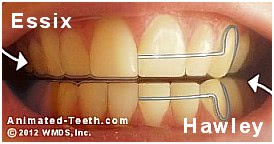
Essix and Hawley appliances are the most frequently used removable retainers.
- On average, the initial stage of a patient’s retention process involved wearing their appliances for 16 hours per day (the range was from 2 to 24 hours), 7 days a week.
- The patient was instructed to keep this schedule for a time period ranging anywhere from 1 to 24 months (with a mean value of 7 to 8 months).
- Only 5% of the dentists polled ended this retention period within 6 months. 88% of the dentists continued it for more than a year.
How often are check-ups?
If you’re wondering how many trips you’ll make to your dentist’s office during this period:
- 75% of the dentists polled appointed their patients for check-ups 3 or more times during the first year of retention.
- 13% checked their patients 5 times or more per year.
- A study by Meade (2013) reported similar findings with over 90% of orthodontists checking their patients’ retainers on average 2.9 times during the first year.
▲ Section references – Pratt, Lai, Meade
b) Later on – The long-term phase of retainer wear.
At that point when your initial phase of retention (and the tooth stabilization it accomplishes) has been completed, your dentist will give you a second set of instructions. These will be those that you’ll need to follow for at least the next several years (prolonged retainer wear), and likely for the remainder of your life (permanent wear).
This regimen will probably be less intense.
With this new phase, it may be that your retainers just need to be worn at night (like while you sleep).
At first, your dentist will probably want you to comply with these instructions 7 days a week. Over the long-term, however, there may be some wiggle room in what’s precisely needed.
Understanding your personal retention requirements.
For many people, the following event may end up happening by accident. If it does, it can help you get an idea of how often you must really wear your retainers in order to maintain your current alignment.
- Some people inadvertently allow a period to pass where they have not been wearing their retainers as regularly as instructed. And when they do start up again, they may find that the fit of their appliances has changed.
They may feel extra tight or snug. If so, this is a sign that some tooth movement (orthodontic relapse) has started to occur.
- This situation needs to be corrected immediately. And a remedy that usually works is for the person to wear their retainers religiously (possibly even around the clock) until they’ve been able to shift the misaligned teeth back into place.
Once this has been accomplished, the more passive fit of their retainers should return.
- Once things have reverted back to normal, the person will always need to make sure that they wear their retainers, at minimum, often enough that the same kind of event never occurs again.
What will your case require, limited, prolonged, or permanent retainer wear?
Despite what you might have wanted to find stated here, we’ll tell you upfront that studies seem to suggest that orthodontists tend to feel that maintaining some level of lifetime retainer wear is usually in the patient’s best interest. (Meade 2013)
But beyond that blanket statement, there are certain case guidelines that tend to influence a dentist’s opinion about how involved (how much, how often, how long) their recommendation about a patient’s retention activities need to be.
a) No-retention cases.
Circumstances may be such that once a person’s orthodontic correction has been completed that there’s essentially no chance of relapse, and therefore no retainer wear is required.
As an example, crossbite cases (like when an upper front tooth has been brought from tucked behind to in front of the lower teeth) can usually be handled this way.
Once the tooth has been repositioned to the front side, it would be essentially impossible for it to find its way back to its original (crossbite) position.
b) Limited, prolonged, and permanent retention cases.
Rather than use dental jargon that you’d have little chance of understanding, we outline below in layman’s terms several conditions and situations that tend to dictate how extensive a patient’s retainer wear will need to be. By no means, however, is this list exhaustive.
- Cases that involve severe tooth rotations, midline diastemas (tooth gaps), a cleft palate, or generalized tooth spacing tend to require more extensive retainer wear.
- Cases completed during periods of active growth will require comparatively more retainer wear as opposed to those where the patient’s growth has slowed to adult levels. (Facial growth continues on throughout adult life.)
- Case completions that have achieved an ideal occlusion (the perfect “bite”) have less potential to relapse.
- If a person’s abnormal habits persist (like thumb-sucking) relapse is more likely.
▲ Section references – Meade, Alam
How many years will you need to wear your retainers?
After weighing the types of factors discussed above, your dentist will then make a determination about the level of retainer wear they feel will be required (months, years, lifetime).
The benefit of lifetime retainer wear.
It’s easy enough to suggest that a recommendation of extended/permanent retainer wear is usually the better side for a dentist to error on. And for the vast majority of cases, it’s the only option that can offer a predictable long-term outcome.
That’s because in addition to the types of factors already discussed on this page, some of which might be of just limited duration, there’s also a natural tendency for tooth movement to occur throughout a person’s lifetime. And as such, the possibility of complications associated with teeth shifting in the future will always be an issue of concern for all patients.
What this issue boils down to.
Not to be glib, but one lighthearted way to wrap up this discussion is to simply state that you need to wear your retainers for as long as you want straight teeth.
Why does orthodontic relapse occur?
You may wonder why alignment relapse tends to take place. Here are some of the issues known to be involved.
- The roots of teeth are anchored in their sockets by a network of fibers (a tooth’s periodontal ligament). During tooth movement, these fibers become stretched and distorted.
Once your braces are taken off, their natural reaction is to pull their teeth back toward their original location. By wearing a retainer, your teeth are held in place as these fibers are allowed time to reorganize and adapt to their tooth’s new position.
- A similar effect takes place with fibers found in the gum tissue that surrounds teeth (the gingival collagen-fiber network). And also in a similar fashion, wearing a retainer holds the teeth in their new position until these fibers have had a chance to reorganize.
- Teeth are surrounded by muscular soft tissues (tongue, lips, cheeks). The persistent pressure they exert can cause tooth shifting.
- Many patients who have completed their orthodontic treatment are still at a stage in their life when their jawbones are still growing. And as these changes take place, the position of the teeth they hold can be affected. Wearing a retainer helps to control these changes.
- It may be that the alignment of the patient’s teeth has been corrected but a habit that originally contributed to their malocclusion has not (thumb-sucking, teeth clenching, and/or grinding). If not, relapse is likely to occur.
▲ Section references – Melrose
Other causes.
Beyond the issues just mentioned, there are many other factors that help to explain why relapse occurs. This includes the classification/type of malocclusion that has been corrected (some are more likely to be associated with relapse than others).
Another is how stable a position in the jawbone the teeth have been moved to. (Moving teeth too far outside of biological norms can be associated with case relapse.)
Everyone’s teeth tend to shift over time.
Other than just the issue of relapse, it’s normal and natural that a person will experience some degree of tooth shifting over the course of their lifetime. This is true whether they’ve had orthodontic treatment or not. (That implies that all humans could benefit from wearing an orthodontic retainer, which is true.)
The bottom line about retainer wear.
For all of the reasons outlined above, it’s pretty obvious that if you want to maintain the exact same perfect alignment that your teeth had the day your braces were taken off or you wore your last Invisalign® aligners over the course of your entire life, some type of retainer wear, probably long-term, will likely be needed.
That’s not to say the amount required may not just be minimal (for example, possibly only a few nights per week). But the only way to guarantee that no changes take place is to continue on with your retainer wear over the long term.
▲ Section references – Pratt
How long do orthodontic retainers last?
Since retainer longevity varies according to the specific type of appliance(s) you wear, we’ve divided our coverage up into the following categories.
- 1) Essix / Vivera® / Invisalign® retainers – (Vaccum-formed, clear plastic retainers.)
Expected longevity. | Problems to look out for. | What to do if yours fails. - 2) Hawley retainers – (Plastic baseplate with metal wire retainers.)
Expected longevity. | Problems to look out for. | What to do if yours fails. - 3) Fixed retainers – (Wire retainers bonded onto the backside of front teeth.)
Expected longevity. | Problems to look out for. | What to do if yours fails.
1) Essix retainers.
An Essix-style retainer.
Vivera® vs. Essix appliances.
Length of service – What can you expect?
a) What do research studies suggest?
While the amount of available research on the subject of retainer longevity is somewhat limited, it seems that the dental community currently interprets what’s been published as suggesting that Essix retainers can be expected to provide a statistically similar “survival outcome” as Hawley appliances (the other most commonly used type of removable orthodontic retainer, discussed next).
b) Number of days of service.
When looking at the raw data from studies, one might have the first impression that Essix retainers have a shorter lifespan than Hawleys.
But as it turns out, there tends to be such a wide range in how long any particular person’s appliances last, that in terms of statistical significance, neither type can be proven to provide a statistical advantage. Here’s what we mean …
Example #1 –
The conclusions of a study authored by Sun were that “no significant differences were observed in survival times between the 2 groups” (meaning clear-plastic vacuum-formed retainers vs. Hawleys).
But at first glance, this study’s data seems to suggest differently.
The study’s raw data showed that on average, upper and lower Hawley retainers lasted for 344 and 140 days respectively, as compared to 175 and 83 days for upper and lower Essix retainers respectively. (Numbers that suggest that Hawleys tend to last almost twice as long.)
But the standard deviation associated with these averages (the range of individual experiences) was substantial enough that no statistical difference could be shown.
For example, the lifespan of lower Hawleys was determined to be 140 days plus or minus 58 days vs. 83 days plus or minus 36 days for lower Essix appliances. So while different, there was enough overlap in what was experienced that neither type showed a statistical advantage in longevity.
Example #2 –
In contrast to Sun’s conclusions, a study by Jin did find a statistically significant difference in the length of service provided by these types of appliances.
The median survival of Hawley retainers was 1529 days (4 years) as compared to only 105 days for plastic vacuum-formed retainers.
Example #3 –
▲ Section references – Sun, Jin
Common types of damage – What to look for.
Background – Appliance thickness.
Evidently, there’s no accepted standard about how thick a vacuum-formed retainer should be.
We’ve seen 0.75, 1.0, 1.5, and 2.0 mm mentioned in research studies. (A credit card is usually .76 mm.) We’re under the impression that 0.75 and 1.0 mm are the ones most commonly used. (You might keep that in mind if shopping for a DIY replacement retainer kit. Pros / Cons)
Thick vs. thin survival rates.
One would think that using thicker plastic would promote appliance longevity but research doesn’t entirely confirm this.
Reasons for failure of clear-plastic/vacuum-formed retainers.
Here are the different types of damage we’ve seen mentioned in research studies.
a) Fracture / Breakage
This is the most-cited cause of failure of plastic vacuum-formed retainers. (43% of failures in the Jin and 59% in the Sun studies mentioned above.)
Breakage is an especially problematic event because no type of repair is possible. Instead, the appliance must be replaced.
Minute cracks.
We will mention that both the Sun and Zhu studies specifically stated that the formation of “slight cracks” in a retainer’s plastic was not categorized as breakage and did not constitute a failure if they did not affect wearing the appliance.
(Despite this, if you see this kind of damage, it would be a good idea to let your dentist evaluate what’s occurred.)
Where breakage tends to occur.
As might be expected, an Essix retainer is most likely to break at its narrowest point, because this region offers the least amount of stiffness/rigidity.
Due to this factor, there seems to be a tendency for lower appliances to break more often than upper ones, frequently at the appliance’s midline (left-right center).
Another point of failure, for both uppers and lowers, is in the area of the eyeteeth. That’s because stress tends to focus in this area when a retainer is removed. Especially in cases where one side is removed first and then the other.
c) Non-fitting
This reason refers to the situation where a retainer has lost its original shape and therefore no longer fits properly.
The shape of an Essix appliance might be distorted by a high-heat event (like being placed in hot water) or being crushed (when not in your mouth or being cleaned, your retainers should be kept in their hard retainer case).
b) Abrasion / Wear
Related to the thin nature of vacuum-formed appliances, it’s easy enough to imagine how over time areas might show signs of wear. Most of the studies we read phrased this type of damage as “serious abrasion causing penetration,” meaning the plastic had been completely worn through.
Small penetrations are probably of little concern (but go ahead and let your dentist decide). Large areas of wear could easily affect the rigidity of an appliance, and therefore inhibit its ability to hold your teeth in place.
As compared to the other types of damage discussed above, this seems to be the least common cause of Essix retainer failure.
What to do if your Essix (vacuum-formed) retainer has failed.
How soon?
You should get in touch with your dentist’s office promptly so they can make plans with you. Fabricating the replacement may take several days. (Cost estimates for replacements. Retainer fees.)
Precautions.
Your teeth have the potential to shift during any period when your retainer isn’t worn, so be prompt about contacting your dentist.
An ill-fitting appliance should not be worn because it may promote tooth movement to occur.
Makeshift solutions.
A DIY boil-and-bite type of athletic mouthguard (obtained from your local store) can be used as a retainer substitute. If it doesn’t feel especially comfortable or secure in your mouth, rather than overnight wear, just wearing it multiple hours per day during waking hours can usually provide an effective compromise.
2) Hawley retainers.
A Hawley orthodontic retainer.
Hawley appliances Details | Specifications
As opposed to vacuum-formed Essix retainers that typically require replacement, if not damaged too extensively, a Hawley can often be repaired.
Hawley and Essix appliances are the most-used types of removable orthodontic retainers.
Length of service – What can you expect?
Number of days.
A study by Jin found a median survival time of 1529 days (4 years) for Hawley retainers. A period roughly 15 times longer than what they determined for Essix retainers.
In contrast, however, other studies have concluded that Hawleys and Essix retainers provide a statistically similar duration of service.
An example.
In its raw data, a study by Sun calculated an average survival duration of 344 and 140 days for upper and lower Hawley retainers respectively. And 175 and 83 days for upper and lower vacuum-formed retainers. And that data seemingly suggests that Hawleys last around twice as long.
But when the standard deviation of the individual measurements was taken into consideration, no statistical difference could be shown. (For example, lower Hawleys lasted for 140 days plus or minus 58 days vs. 83 days plus or minus 38 days for lower Essix retainers. With those ranges taken into consideration, what any one person from each group actually experiences may be quite similar.)
In practice …
It would be our impression that the general consensus of the dental community is that based on the issue of longevity, both types of appliances make a reasonable choice.
Other considerations.
Lower Hawley retainers may be more prone to breakage than upper ones. For example, the data from the Sun study just mentioned shows this tendency (344 vs. 140 days respectively).
▲ Section references – Jin, Sun
Common types of damage – What to look for.
a) Fracture / Breakage
A study by Sun found appliance fracture to be the most frequent cause of Hawley retainer failure (over 60% of failure events).
Where breakage tends to occur.
It’s simple enough to state that the acrylic baseplate of a Hawley appliance is most likely to crack or break in those regions where forces become most focused.
Of course, this includes the thinnest portion of the appliance. (For example, the left-right center of a lower Hawley is usually its narrowest, and therefore most fragile, area.) Forces also tend to become focused where the ends of the appliance’s bow wire are embedded in the baseplate.
As opposed to while wearing your retainers, it’s quite likely that it’s removing them that strains them the most. Appliances that have an especially tight fit may experience stress because the baseplate must flex as it is removed. Removing an appliance one side at a time may amplify the amount of stress that’s created.
Cracks – Early treatment is important.
The Sun study mentioned above stated that “retainers which had slight cracks on the surface were not considered as a breakage unless the retainers could not be worn because of crack expansion.” However, in light of that statement, we do want to point out the following.
- It’s usually quite simple for a dentist to repair any cracks that have formed in the plastic baseplate of a Hawley if the repair is made soon enough.
- If instead the crack is allowed to expand to a point where it is visibly open, or worse yet, the appliance has broken into separate parts, repair may still be possible, but it’s no longer as simple of an affair.
▲ Section references – Sun
b) Non-fitting.
A Hawley retainer may no longer fit because of the damage it has sustained.
Drying out.
The acrylic baseplate of a Hawley retainer contains water content. And if the appliance is allowed to dry out, it may warp and therefore no longer fit properly.
Wire distortion.
The wires of your appliance have contours specifically crafted to match the alignment of your teeth.
If an event bends or distorts these wires, the retainer will at minimum need adjustment, and possibly even replacement.
The solution.
- Generally, if your Hawley is not in your mouth, it should be kept wet or moist. And if you’re away from home, placed in its hard case for protection.
- Wetting your appliance and then placing it in a baggie before putting it in its case, can meet both of the above requirements.
What to do if your Hawley retainer has failed.
How soon?
You should get in touch with your dentist’s office promptly so they can make plans with you. If your appliance can be repaired, that process might be completed at the time of your appointment, or may possibly require a day or two of turn-around time.
Fabricating a replacement appliance may take several days. (Cost estimates for replacements. Retainer fees.)
Precautions.
Your teeth have the potential to shift during any period when your retainer isn’t worn, so be prompt about contacting your dentist.
An ill-fitting appliance should not be worn because it may promote tooth movement to occur.
Makeshift solutions.
A DIY boil-and-bite type of athletic mouthguard (obtained from your local store) can be used as a retainer substitute. If it doesn’t feel especially comfortable or secure in your mouth, rather than overnight wear, just wearing it multiple hours per day during waking hours can usually provide an effective compromise.
3) Fixed / bonded / permanent retainers.
A fixed (bonded) retainer.
Fixed retainers Details | Specifications
The device itself is usually some type of wire whose ends are embedded in small mounds of dental bonding (dental composite) that anchor it in place.
Longevity – What can you expect?
Findings from research.
In an overview of the subject of retainers, Alassiry states that bonded retainers typically provide predictable long-term service. It cites sources that suggest that the survival rate for this type of appliance ranges between 90% to 30% over 3 to 10-year periods.
A study by Jin found a median survival time of 1604 days (over 4 years). In comparison, the same study found survival times of 1529 and 105 days for Hawley and Essix/vacuum-formed retainers respectively.
Case selection.
Alassiry suggests that lower fixed retainers tend to provide longer service than upper ones by a factor of two. However, we’ll point out that the Jin study did not confirm this opinion.
If a factor, this issue may primarily depend on issues associated with the patient’s “bite.” (Like the way the person’s lower teeth direct forces onto the upper retainer.)
Alassiry also cites a source that suggests that most appliance bonding failures tend to occur in the first year, after which the survival of the retainer increases dramatically. (The Jin study also found a declining failure rate over time.)
▲ Section references – Alassiry, Jin
Common types of damage – What to look for.
Bonding failures.
Jin found appliance debonding the most common cause of fixed retainer failure. (For example, it determined that 64% of lower fixed retainer failures were due to this reason.)
The failure can take place at the enamel-to-bonding (dental composite) interface (meaning the composite has come loose from the tooth’s surface). Or more commonly, one end of the wire has come free from its mound of composite (such as due to wear and/or breakage).
Wire breakage.
It’s possible for the wire component of a bonded retainer to break (stress fracture).
Distortion.
Forces directed onto the wire component of a bonded retainer may distort it, thus leading to unwanted tooth movement.
▲ Section references – Alassiry, Jin
What to do if your bonded retainer has failed.
If your retainer has sustained damage or has been lost, obviously, it will need to be repaired or replaced.
How soon?
You should get in touch with your dentist’s office promptly so they can make plans with you. If repair is possible, that can be accomplished at the time of your appointment. Otherwise, fabricating a replacement may take several days. (Cost estimates for replacements. Retainer fees.)
Precautions.
Your teeth have the potential to shift during any period when your retainer isn’t in place. An ill-fitting fixed retainer may cause tooth movement. A loose fixed retainer may cause soft tissue irritation or damage, or be lost entirely and inadvertently swallowed.
Makeshift solutions.
If the retainer is entirely missing, a DIY boil-and-bite type of athletic mouthguard (obtained from your local store) can be used as a retainer substitute. If it doesn’t feel especially comfortable or secure in your mouth, rather than overnight wear, just wearing it multiple hours per day during waking hours can usually provide an effective compromise.
Place the dislodged retainer in a hard container (like a pill bottle) so it doesn’t get damaged any further.
If the retainer is still partially attached, possibly placing white orthodontic wax (readily available at most pharmacies) over its loose end may help to keep it from poking or scratching your tongue.
Costs for replacing lost, damaged, or worn out orthodontic retainers.
Costs for original sets of retainers.
All of the pricing information on this page also applies to a patient’s initial set of retainers. But usually, a dentist has incorporated their “retention phase” fee (their fee for retainers) into the figure presented when initially outlining your orthodontic work’s expense.
(Related page: How much does orthodontic treatment cost? Fees for braces.)
Fees for orthodontic retainers.
Note: The estimates given below are for a single appliance (upper or lower). Having a set of two made typically costs twice the price shown.
A Hawley orthodontic retainer.
a) Hawley retainer –
- $197.00 – $395.00 (one retainer)
Low fee = Small rural city or town.
High fee = Large metropolitan area.
[How we calculate our cost estimates for procedures.]
Is there a chance your retainer can be repaired rather than replaced? –
Repair options.
Hawley appliances can be repaired if the damage they’ve sustained isn’t too great. That goes for both their plastic and wire components. Or if needed, their wire can even be replaced.
Many dentists will have the materials needed to make minor repairs right in their own office. Although, due to only keeping a limited selection on hand, matching the color of the appliance’s plastic base may not be possible. If not, the retainer can be sent to a dental laboratory for repair.
b) Permanent (lingual wire) retainer. –
- $265.00 – $590.00 (one retainer)
Fixed retainers Details | Specifications
A permanent (bonded) orthodontic retainer.
Is there a chance your retainer can be repaired rather than replaced? –
Repair options.
A Vivera® retainer.
c) Essix orthodontic retainer. –
- $130.00 – $310.00 (one retainer)
Is there a chance your retainer can be repaired rather than replaced? –
Repair options.
The Invisalign Vivera® retainer program.
Align Technology, Inc. (the company that makes Invisalign®) offers a dental retainer program under the brand name Vivera®.
This service provides a new set of retainers for the patient every three months. The annual fee for the program is around $500 and up. The system can be used after any type of orthodontic treatment method, Invisalign® or not.
d) Do-it-yourself orthodontic retainer kits. –
- $90.00 – $150.00 (one retainer)
What do we mean by do-it-yourself?
We’re using the terms at-home and do-it-yourself for this method of obtaining a replacement retainer because it’s you, the end-user, who takes the impression of your teeth that’s then used to fabricate the new appliance.
You do this at home and on your own. And the whole replacement process only involves you and the company that fabricates your appliance. Your dentist is not involved at all.
Most DIY retainer companies provide an Essix-style appliance.
What kind of retainer do you get?
With at-home kits, the usual type of appliance that’s delivered is an Essix-style (vacuum-formed clear plastic) one, the type just discussed above (Section c).
However, to know for certain, and to learn specific details about it, you would simply need to check with the company providing the service.
Does using a DIY retainer kit make a good idea?
We don’t see how anyone could possibly make the case that not having your dentist involved in the fabrication of a dental appliance is better than the case where they are.
But at a practical level, it seems easy enough to suggest that in most cases (if everything goes right) the appliance that you end up with is one that’s functionally equivalent to what your dentist would have provided.
When making this decision, here are some points to consider:
Everything depends on the quality of the impression you take.
If the dental laboratory doesn’t have a reasonable copy of your teeth, they can’t make a satisfactory retainer for you.
Generally, it seems that the materials that these kits come with are reasonable enough, although there’s a bit of a one-size-fits-all aspect to them. And of course, you’ll need to be able to follow instructions and be adept at doing what’s asked.
Understanding and performing the steps isn’t rocket science. The biggest disadvantage is simply that you’ll be performing the tasks for the first time. And with impression taking, practice does help to make perfect.
It all boils down to the fit of the retainer that’s fabricated.
Even when taken in a dentist’s office, distortion and flaws can be inadvertently introduced into the impression-taking process. Many of these deficiencies can even be imperceptible to the trained eye.
Of course, the retainer that’s made will share these same flaws, potentially to the point of being unusable or even harmful if worn. And of course, that’s where the luxury of having your dentist make your appliance can be such an asset.
Probably the safest rule of thumb is if your new retainer doesn’t fit fairly identically to your previous one, it shouldn’t be worn.
Minor adjustments.
Of course, there are other factors that can come into play in determining if using an at-home impression approach for retainer replacement, or wearing the one that’s been created using this method, makes sense.
In passing, we’ll mention that some appliances may be perfectly satisfactory yet need some minor adjustment where they rub against your cheek or gums. This link explains how you might make those types of minor adjustments on your own. DYI technique.
What’s your dentist’s policy about the charge for replacing lost or damaged retainers?
The need for retainer replacement is a common one, and often a common headache for dentists.
For this reason, you’ll probably find that your dentist has a fairly explicit replacement policy. And they’ll probably outline it for you the day you are given your appliances.
Here are some of the retainer repair and replacement policies we’ve heard of:
- Some dentists issue a second set of retainers to their patients right off the bat after the completion of their treatment. (This might be most likely in cases where Essix-style retainers are worn because they are relatively easy and inexpensive for the dentist to make.)
If any additional replacements are needed beyond that, their standard fee is charged.
- The dentist’s policy might be one where they will provide one free replacement set if the need arises. This offer may only extend for the first 6 to 12 months post-treatment.
- We ran across an opinion piece in a journal where the orthodontist related that they were so tired of the insinuation that they were profiting from their patient’s misfortune that they provide replacements for free if the patient will make an equal donation to charity.
▲ Section references – Pickron
Check with your orthodontist first.
You’ll probably find the most sympathetic ear (in terms of what fee is charged) from the dentist who provided your orthodontic treatment. After all, they know you, have already profited from providing services for you, and no doubt want to see a good outcome for the work they’ve produced.
Costs for replacements.
Making replacement retainers typically involves the exact same office and laboratory steps as required to make your original ones. So, if that’s the case, it’s only reasonable to expect that the fee you’re charged is your dentist’s regular one.
Multiple replacement sets.
In the case where you find that needing replacements is an ongoing issue for you, you might ask if multiple sets can be made. Especially in the case of Essix retainers, there might be an economy of scale involved that can lower your overall costs.
Contact your dentist’s office promptly.
If you’ve lost or damaged your retainers, don’t put off calling your dentist’s office. Ideally, your appliances should be replaced as soon as possible, and it may take up to a few days to have your new ones made.
Be careful with your retainers.
One really common place where retainers are lost, especially with kids, is right off their lunchroom tray. Retainers are often wrapped in a napkin, forgotten about, and then lost when the tray is emptied.
Another potential problem lies with the family dog. Retainers frequently have a smell that many dogs just can’t seem to resist. So, be sure to keep your retainers up high and out of canine sniffing range and reach.
How much does your dentist pay for your appliances?
You might be curious about the value of the retainers you wear in terms of materials and fabrication costs.
While it’s common for dentists (especially orthodontists) to make their patient’s appliances right in their own office, dental laboratories offer these same services too. Using dental lab fee schedules as a source of information, we’ve compiled the following estimates.
- Hawley retainer - $50.00 to $75.00
- Lingual wire retainer - $35.00 to $60.00
- Essix-style retainer - $30.00 to $50.00
Because the procedure estimates we show are developed by different means, you may find the survey of dental fees published by DentistryIQ an interesting independent source: DentistryIQ – 2017 dental fee analysis by region and CDT procedure code
How do you clean dental retainers? | How often do they need it?
The same plaque and tartar that tends to build up on natural teeth will accumulate on your retainers too.
Add in the fact that you’ll be wearing the same appliances on a long-term basis, it’s easy enough to understand why proper upkeep is important if you expect yours to stay presentable and odor-free.
The cleaning instructions you need vary according to the type of retainers you have.
There are basically three kinds of orthodontic retainers.
- Two of them are removable. (How to clean Essix, and Hawley appliances.)
- The other type is bonded permanently to your teeth. (How to clean around fixed retainers.)
And because each is made of different materials or used under different circumstances, there’s a separate set of instructions and issues you need to know about when cleaning each kind. (Use the links above to jump directly to that information.)
How often do you need to clean your retainers?
The simple answer to this question is “at least daily.” But in reality, the cleaning frequency, and possibly even the level of diligence that’s needed for any particular session, must be based on how much they are worn each day. Here are some examples …
a) Removable retainers (Hawley, Essix) – Overnight wear.
If you’re just wearing your retainers at night when you sleep, then just once-a-day cleaning should be often enough.
Two kinds of removable orthodontic retainers, Essix and Hawley.
- When you first take your appliances out in the morning it’s expected that they may taste stale or have an unpleasant odor.
That’s related to the phenomenon of morning breath Dry mouth., which is due to the reduced level of saliva output that’s produced when you sleep.
- It’s best that the debris that’s accumulated on your retainers overnight (dental plaque, initial tartar formation) is removed before it has any chance of drying out. (If it does, it will tend to be more difficult to remove.)
- If for some reason you decide that your appliances must wait to be cleaned, like until after breakfast when you brush your teeth, at least keep them wet (like in a glass of water).
b) Removable retainers (Hawley, Essix) – Extended wear.
If you’re still at a point where you’re wearing your retainers for a substantial portion of your day, or even around the clock, there are some extra considerations about cleaning frequency to keep in mind.
1) Routine daily care.
It only makes sense that when you clean your teeth you do the same for your retainers too. After all, the exact same type of buildup tends to accumulate on both.
- As mentioned above, the best practice would be to clean them at that time when you first take them out (like before you eat).
- If that’s not possible, the next best choice would be to at least keep them wet while they wait (a baggie with a little water would do if you’re away from home).
- If even that’s not possible, then just make sure you do as thorough a job as possible when you finally do get to them, as to minimize any build-up effect.
2) Intra-day care.
When you wear removable retainers (especially Essix-style ones) some portion of your teeth and gums will be covered over by your appliances.
- This underneath area is a cozy protected location for plaque formation.
- And it may be hard for saliva, which provides beneficial washing and buffering effects, to penetrate into this space.
As a result, problems may develop. And as a worst-case scenario, cavity or gum disease may form. (We discuss this phenomenon here The problem. | Prevention. for Invisalign® aligners, which is a very similar type of appliance.)
On a practical level, there’s a solution that’s easy enough and should deal with this issue effectively. That’s just rinsing with water every few hours.
- The idea is that the agitation will tend to dislodge bacteria, associated debris, and generally retard dental plaque formation.
- Acidic bacterial waste products that have built up underneath the appliance will be flushed away and diluted too.
Some people may be able to accomplish all of this just by loosening up their retainers a little bit in their mouth, rinsing around and underneath them, spitting out the water, and then positioning their appliances fully back in place.
A fixed (bonded) orthodontic retainer.
c) Fixed (bonded) retainers – Permanent wear.
- Your dentist would probably hope that that would include brushing it at least three times a day (after every time you eat a meal).
- With at least one of those three daily sessions accompanied by flossing.
Tartar accumulation may be a problem.
A bonded retainer’s wire that runs across the backside of your teeth will tend to harbor plaque and debris. And anything that’s missed when you clean has the potential to transform into tartar as days pass, so it’s important to be thorough each time.
Some people might anticipate that cleaning more frequently is what’s required when tartar buildup is found to be a problem, and that may be true.
But keep in mind that no number of extra haphazard sessions equates with effectiveness. Only diligent cleaning provides it. And for most people, what’s described above (especially the flossing part) is usually all that’s needed to stifle tartar accumulation.
How do you clean orthodontic retainers?
The cleaning process you use with your retainers will depend on what type you have. (Click a link to jump ahead.)
- Essix (Vivera®) – These appliances are clear vacuum-formed shells that fit over your upper or lower teeth as a unit. They look just like Invisalign® aligners.
- Hawley – If your retainer has a wire on it that runs across the front side of your teeth, it’s generally considered a Hawley appliance.
- Fixed (permanent) – These retainers are bonded directly to the backside of your teeth. They can be as simple as a single curved wire.
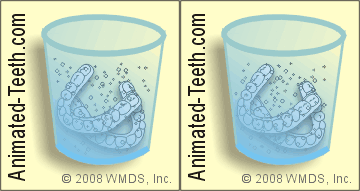
Cleaning Essix-style retainers in a soaking solution.
Essix / Vivera®
It’s common that an effervescent soaking solution is used.
An Essix-style retainer.
A study we ran across.
Concerns about brushing.
We feel that we should point out that the page linked to above has a section that discusses how brushing (especially with toothpaste) tends to scratch plastic surfaces.
And in the case where the same appliance is worn over an extended time frame (like retainers are), micro-scratches might start to: 1) Affect its appearance (make it look more opaque/cloudy). 2) At least in theory, provide more locations for microorganisms to inhabit.
We’re not saying that brushing doesn’t necessarily make a reasonable way to clean Essix retainers but instead that these issues should be considered before choosing it.
Hawley retainers.
Hawley retainers are a type of removable appliance that has both plastic and metal components.
A Hawley orthodontic retainer.
- Cleaning a Hawley should start with brushing. This page explains acceptable cleansers and brush types to use. Directions.
(The page itself is about denture brushing, which applies to cleaning Hawley’s because the plastic used for both is very similar.)
- Brushing should be followed by chemical disinfection. Commercial soaks made for retainers (or probably even dentures) should be suitable. Check their packaging for their recommendations.
Make sure the product’s packaging states it’s safe for use with dental appliances that have metal components.
Permanent (fixed, bonded) retainers.
The most common form of bonded orthodontic retainer is the lingual wire (see picture). And when it comes to cleaning, it offers the two worst scenarios possible.
- It’s fixed in place and can’t be removed, making it hard to access your teeth (especially in between them).
- It’s bonded in a location where tartar formation is frequently a problem.
A bonded (fixed) orthodontic retainer.
The good news in most cases is that it’s just the ends of the retainer that are bonded (see picture). And that means when it comes to cleaning between your teeth, all you have to do is get the floss positioned in between (two teeth) and underneath (the wire) once. From there you can clean every place else.
The ways you do this are simple enough.
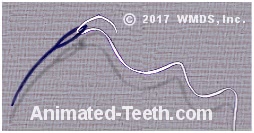
A floss threader and floss.
- One is by using a “floss threader.” There are many forms of this device but basically, it works like a plastic needle and thread. The threader pulls the floss between the teeth as it is passed through.
- As an alternative, some brands of floss come cut into lengths where the tip of one end is very stiff and thus easy to poke in between teeth and under the retainer.
- If you have very big spaces between your teeth, you may be able to just poke your regular floss through on its own.
Once you have your floss in position, it should be simple enough to figure out what to do next and how to do it.
Then, after you’ve cleaned between your first two teeth, you’ll find that you can just lift one end of the floss up over the biting edge of one of them and then down in between it and its neighbor, where you’ll then just continue on cleaning.
2) Brushing around your retainer.
Having a fixed-wire retainer will make it a little harder for you to brush the backside of your teeth. However, the needed solution is simply to be persistent.
And while it certainly isn’t mandatory, you may find that using an electric toothbrush (sonic Best Sonicares. or rotational Best Oral-b’s.) may make cleaning this area easier or go faster.
Last reviewed: May 08, 2022
Author: Paul Cotner, DMD — retired dentist.
Published by: WMDS, Inc. — owner of Animated-Teeth.com.
Educational information only — not a substitute for professional dental care.
Page references sources:
Alam MK. A to Z Orthodontics.
Alassiry AM. Orthodontic Retainers: A Contemporary Overview.
Booth F, et al. Twenty-year follow-up of patients with permanently bonded mandibular canine-to-canine retainers.
Chang CS, et al. An assessment of the effectiveness of mechanical and chemical cleaning of Essix orthodontic retainer.
Heier EE, et al. Periodontal implications of bonded versus removable retainers.
Hichens L, et al. Cost-effectiveness and patient satisfaction: Hawley and vacuum-formed retainers.
Jin C, et al. Survival analysis of orthodontic retainers.
Keenan AV. No statistically significant results for two removable orthodontic retainers.
Lai CS, et al. Orthodontic retention procedures in Switzerland.
LMTmag.com. Removable Prosthetic Fees.
Meade MJ, et al. Retention protocols and use of vacuum-formed retainers among specialist orthodontists.
Melrose C, et al. Toward a perspective on orthodontic retention?
O’Rourke N, et al. Effectiveness of bonded and vacuum-formed retainers: A prospective randomized controlled clinical trial.
Pickron RA. A charitable way to charge for replacement retainers.
Pratt MC, et al. Evaluation of retention protocols among members of the American Association of Orthodontists in the United States.
Pratt M, et al. Patient compliance with orthodontic retainers in the postretention phase.
Sawhney B. Orthodontice Retainers: A survey of patient satisfaction and compliance.
Sun J, et al. Survival time comparison between Hawley and clear overlay retainers: A randomized trial.
Valiathan M, et al. Results of a survey-based study to identify common retention practices in the United States.
Wan J, et al. Speech effects of Hawley and vacuum-formed retainers by acoustic analysis: A single-center randomized controlled trial.
Zhu Y, et al. Comparison of survival time and comfort between 2 clear overlay retainers with different thicknesses: A pilot randomized controlled trial.