Invisalign® problem issues and disadvantages.
Should you choose clear aligner orthodontic therapy?
Removable braces systems like Invisalign®, ClearCorrect®, eCligner®, ClearPath®, or services like the Smile Direct Club® don’t always make the best choice for straightening a person’s teeth.
Some reasons for this are based on inherent limitations and disadvantages associated with this technique that can make it difficult, or even impossible, for your dentist to create an ideal or even predictable outcome for your case.
But even in situations where this method could be considered appropriate, additional factors may make other orthodontic systems better suited or more practical.
Problem issues and disadvantages associated with choosing Invisalign®.
As an introduction to this subject, here’s an outline of issues and concerns that need to be considered before a decision is made that removable aligner therapy makes an appropriate choice for a person’s orthodontic treatment. The remainder of this page then discusses these issues in greater detail.
1) Treatment difficulties posed by the patient’s type of malocclusion.
The challenges posed by some patients’ cases may render them untreatable via a removable aligner system. Or it may be that other types of orthodontic systems may be better suited for handling them. This includes being able to accomplish certain types of tooth movements (like the correction of severe tooth inclinations, rotations, large gaps, etc…) that may lie at the limits of clear aligner technique capability.
Our discussion below includes mention of various techniques or treatment plan adjustments that might be used to overcome these obstacles so a removable aligner system can still be used.
Continue reading about difficulties associated with treating severe malocclusions. Jump to section.
2) Other teeth & dental issues that may pose problems.
Beyond technical issues, other dental factors may render Invisalign® and similar systems unsuited or impractical for a patient’s treatment.
This includes challenges posed by tooth shape and size, difficulties associated with existing or needed dental work, the patient’s stage of dental development (an issue addressed by Invisalign® Teen), etc…
Continue reading about problematic tooth & dental issues. Jump to section.
3) Patient compliance is required.
It’s a simple fact, to work, orthodontic aligners must be worn. And this usually means 20 to 22 hours per day, 7 days a week.
That means that Invisalign® doesn’t make the right choice for uncooperative or unmotivated patients (some teens come to mind). Or those inclined to take excessive liberties in taking time off from wearing their appliances.
Continue reading about difficulties associated with treating uncooperative or unmotivated patients. Jump to section.
4) Higher treatment costs.
You can expect that having clear aligner therapy will cost more than conventional metal braces. (When obtained from the same provider.) And it can be that the standard aligner system is simply more extensive (and therefore more costly) than your case requires.
If so, traditional orthodontic methods may offer a more practical choice. Or, utilizing a “lesser” system like Invisalign® Express or Simpli 5® may provide a less-expensive treatment solution.
Continue reading about factors associated with treatment costs. Jump to section.
5) Risk for tooth decay.
While all orthodontic methods have an increased risk of experiencing tooth decay, the underlying causative conditions are different with removable aligner systems than with conventional braces and you should be aware of them.
Continue reading about factors associated with increased risk for tooth decay. Jump to section.
6) Make sure you understand the Invisalign® experience.
There can be trials and tribulations associated with wearing aligners. And it may be that when these are considered, more traditional, probably less expensive, and possibly more predictable, treatment methods may warrant a second look.
We have a number of pages that describe what it’s like to wear Invisalign® aligners, pros and cons. You owe it to yourself to browse through them just to make sure this method seems a good fit for you.
Understanding the Invisalign® patient experience. Jump to section.
Details about concerns and disadvantages associated with having removable aligner therapy.
1) Invisalign® doesn’t make the best choice for correcting all types of malocclusions.
In comparison to conventional (wire and brackets) braces, removable systems (like Invisalign®, ClearCorrect®, eCligner®, ClearPath®, Simpli 5®, etc…) inherently don’t offer your dentist the same degree of precise control in creating some types of tooth movements.
And due to this limitation, this technique has typically been considered best suited for only treating mild to moderately complex malocclusions.
Having said that, the evolution of clear aligner technique has always been and continues to be dynamic, with methods of treating more and more complex cases continually being devised (see discussion below).
a) Examples of conditions that may be too challenging for Invisalign® treatment.
Due to its diminished amount of control over tooth movements as compared to conventional braces, Invisalign® usually isn’t considered the best choice for treating cases that involve:
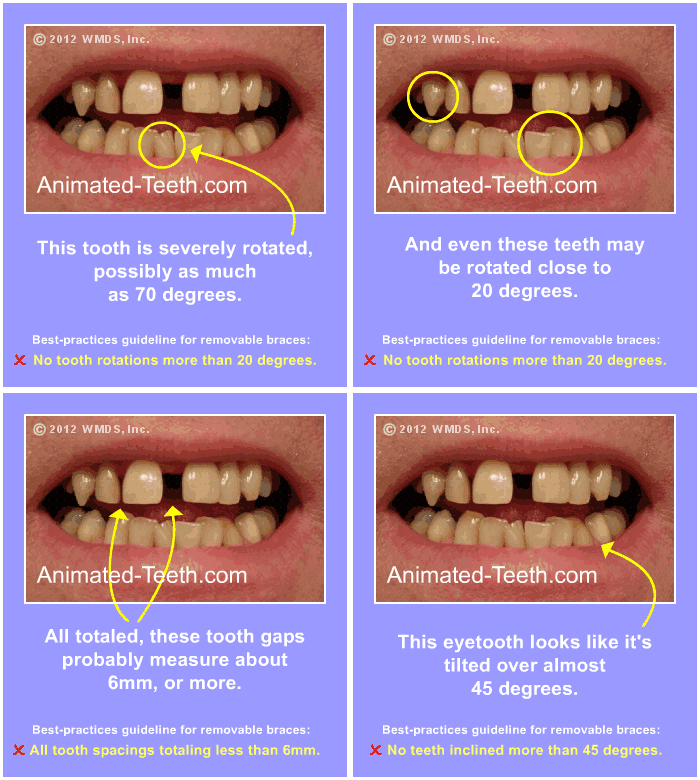
This case makes a poor, or at least very difficult, choice for routine Invisalign® treatment.
- Severely rotated teeth – Teeth rotated from their normal position by more than 20 degrees (especially premolars and lower eyeteeth).
- Teeth that are severely tipped – Teeth angled more than 45 degrees from normal.
- Large tooth spacings – Cases where all tooth gaps (combined) total more than 6 mm per arch. (6mm is roughly 1/4 inch.)
- Crowded/crooked teeth – Cases where the amount of space needed to properly realign the teeth exceeds 6mm (per dental arch).
- Other difficult situations – Severe deep overbites, skeletally based malocclusions, and open bites (or other cases where the extrusion of teeth is required).
FYI: At the bottom of this page, we provide the above information in tabular form alongside comparisons to the same details for Invisalign® Express and Teen.
A 2017 update on Invisalign® (and ClearCorrect®) treatment limitations.
As stated above, applications for clear aligner therapy are constantly expanding. And, in fact, a discussion in a paper by Weir (2017) suggests that due to the amount of time needed for data collection, analysis, and publication, what’s found in published research typically lags the true current level of capabilities of these systems.
The Weir paper collected information from the companies that make Invisalign® and ClearCorrect® and formulated a table that categorized types of orthodontic tooth movements in regard to being predictable, moderately predictable, or difficult to achieve. (The parameters we’ve stated above would fall in the “predictable” category.)
In that table, we noticed that the cutoff points for tooth rotations differed considerably from what we show above. The Weir table (which we assume offers more current information) stated:
Predictable tooth rotations.
- Incisors – Central incisors rotated from their normal position by up to 40 degrees. Lateral incisors up to 30 degrees.
- Canines and Premolars – Up to 45-degree rotations.
- Molars – Up to 20 degrees.
The Weir table also expounded on possibilities for tooth extrusion and intrusion. (The process of raising or lowering a tooth’s position in the jawbone to level out the comparative height of teeth.) These can be difficult movements to accomplish using plastic aligners because they have trouble delivering the needed level of force to the teeth.
Predictable levels of tooth intrusion and extrusion.
- Anteriors (front teeth) – 2.5 mm extrusions. 0.5 mm intrusions.
- Posteriors (back teeth) – Extrusions are not possible. 0.5 mm intrusions.
Also listed in Weir the table but not mentioned in our list above:
Midline discrepancies.
If aspects of your case exceed the limitations usually associated with removable aligner treatment …
It doesn’t mean that a clear aligner system absolutely can’t be or shouldn’t be used for your case. But without question, it is your dentist’s obligation to advise you about likely disadvantages and problems that may be encountered.
It’s also their obligation to discuss treatment alternatives that might avoid these difficulties, whether they personally can provide these alternate services for you or not, so you can make an informed decision about the treatment you receive.
1) You may decide that acceptable vs. perfect results may make a reasonable trade-off.
After all factors and considerations have been weighed (convenience, time, cost, results), you may decide that even with its associated negatives and limitations that using a removable aligner system for your treatment still makes the best choice for you. And that’s a reasonable decision to make, as long as you’ve been properly informed.
2) Possibly a removable aligner system should only be used for a portion of your treatment.
With this approach, more difficult/less-predictable-with-Invisalign® tooth movements are accomplished during a preliminary phase of wearing conventional braces.
Then, once your case has been transformed into a less involved malocclusion that’s more suitable for removable aligner treatment, it can be completed using it.
b) Buttons with elastics and attachments frequently offer a solution for more difficult cases.
As a way of overcoming some of its inherent limitations in creating certain types of tooth movements, the capabilities of the Invisalign® system have been expanded by way of the use of “attachments” and “buttons and elastics” What are these? | Pictures.
- On the upside, using them expands the range of cases that can be treated.
- As a disadvantage, these items that are bonded to the surface of your teeth may be quite noticeable to others as well as a nuisance to you. That means, when they’re required, you do get the benefit of wearing a removable orthodontic system but not one that’s as “invisible” or unobtrusive as you might have anticipated.
Ask your dentist what will be needed for your case. It’s possible that after all other pros and cons are considered and then compared to having traditional braces, the idea of using Invisalign® may hold less appeal.
c) More about the issue of closing large tooth spacings.
The limitation mentioned above about closing large gaps between teeth with Invisalign® may be an issue for your case even if your teeth are severely crowded.
That’s because your treatment plan may involve the extraction of some teeth, as a way of creating space into which your remaining crowded teeth can be realigned. Here’s an animation Extraction case. that shows how this technique is used. (Examples of how other basic orthodontic techniques are used with Invisalign® are illustrated too.)
2) Teeth and dental issues that may interfere with having Invisalign® treatment.
With removable braces, the forces that straighten your teeth are generated and directed by the fit of your plastic aligners. How does this work? And this means that any situation that interferes with creating an ideal aligner-to-tooth relationship may hamper the effectiveness, or predictability, of your treatment.
a) The shape of your teeth may impose limitations.
b) Your teeth must be in good repair before your treatment is begun.
Any new or replacement dental restorations that must be placed while you’re undergoing your Invisalign® treatment may alter the fit of your aligners. Because of this, any planned dental work should be placed either before or after, but not during, your treatment process.
Even having just one tooth fixed can mess things up.
With Invisalign®, the entire series of aligners that you’ll wear is created before your treatment is begun.
And while a small dental restoration might easily be accommodated, a large one that significantly changes the shape of a tooth (and therefore interferes with the fit of your aligners) might cause a need for a “mid-course correction” (having a new set of records taken and a new set of aligners made The process.). Expect that there will be some expenses associated with this service.
c) Some types of existing dental work may interfere with Invisalign® treatment.
The Invisalign® system sometimes requires the use of “attachments” and “buttons” (discussed above). It can be difficult, or in some instances even impossible, to bond these items onto metal or ceramic-surfaced dental work (like crowns and porcelain veneers).
As a separate issue, the presence of dental bridges (a type of dental restoration that anchors multiple teeth together as a unit) may render a patient’s case untreatable with removable aligners.
3) Treatment with removable braces requires patient cooperation and not having that can pose a giant obstacle.
One main feature that makes Invisalign® so attractive to patients is also one of its biggest weaknesses. That is, being able to take your aligners out.
a) With Invisalign®, you’re in control of the success of your treatment.
Being able to take your aligners out whenever you want is a great advantage for you, the patient, but it’s a disadvantage for your dentist, your treatment provider.
Since no progress can be made unless your aligners are worn as prescribed (22 hours per day), your dentist must rely on your motivation and dependability for the success of your treatment.
That means the Invisalign® system is not the best choice for any individual where there’s some question about their ability or desire to comply with their dentist’s directions.
b) Noncompliance can cause big problems.
Patient noncompliance can cause all sorts of difficulties.
- At a minimum, not wearing your aligners as directed will slow the progress of your treatment.
- Worse, not wearing them for some period of time may allow your previous progress to relapse, or even allow your case to veer completely off-track.
c) Noncompliance can be expensive.
Once things have started to go wrong, your dentist may be able to get you back on track by having you re-wear previous sets of aligners (aligners should never be discarded without your dentist’s permission).
If this doesn’t work, however, your treatment will need some type of reset.
- With Invisalign® this is termed a “mid-course correction.”
- Your dentist will need to repeat many of the initial steps of your treatment process so a new set of aligners can be made. The process.
- Some versions of the Invisalign® system include a free mid-course correction if needed. But that is a courtesy and savings for your dentist, not you.
If your dentist has to expend additional treatment time and materials (taking records and impressions), it’s only logical that they should pass these expenses on to you. It may be several hundred dollars.
4) Treatment using removable aligners may cost more.
a) Conventional braces will probably cost less.
You’ll probably find that your cost for Invisalign® is slightly more than for traditional metal braces (when both systems are obtained from the same provider). This isn’t always the case, it may be the same. But it’s unlikely that it will be less. Here’s a page where we discuss costs for different types of orthodontic methods. Braces fees.
b) Insisting on the Invisalign® brand may cost you more.
While the dominant aligner brand is Invisalign®, it isn’t the only system that’s available. Others include ClearCorrect®, eCligner®, and ClearPath®. And in order to increase their market share, these companies may offer their system to dentists at a lower cost and these savings might be passed on to you.
However, since dentists are typically affiliated with just a single brand, you may have to shop around to find out how fees vary.
c) Workarounds for simple cases.
In an attempt to make their system more cost-effective for a wider range of patients, Invisalign® has developed its Express system Details. This is a “lite” version of Invisalign® that’s intended for use with simpler, less-involved cases. And since the patient’s treatment is accomplished using fewer pairs of aligners, the cost for this system is less.
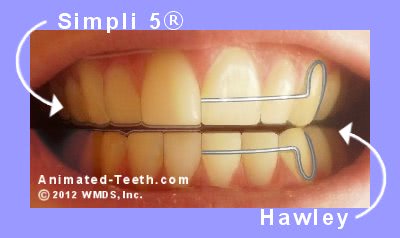
Minor corrections may be cheaper to correct using a traditional Hawley appliance or Simpli 5®.
Simpli5® and Red, White, and Blue® products. Details
5) Wearing Invisalign® can (theoretically) increase your risk for cavities.
One of the big advantages of removable tooth aligners is that you can take them out to clean your teeth. But under certain circumstances, wearing them can place your teeth at increased risk for the formation of tooth decay.
What’s the basis of this risk?
When you wear aligners, your teeth are encased in plastic. And this means that the environment immediately surrounding them is partitioned off from the rest of your mouth where normal biological anti-cavity events take place.
Under certain conditions, like when you don’t follow directions about food and beverage consumption or remove accumulated food particles, bacteria, and associated debris (dental plaque), conditions can develop that place you at increased risk for tooth decay formation. Here’s why.
Of course, this doesn’t have to be the case. If you follow the rules you’re given, you shouldn’t have any problems. But for those who are lax in their habits, their risk of decay can be substantial. And this may be a good reason why Invisalign® might not make the best choice for them.
6) Make sure you’re choosing Invisalign® for the right reasons.
One very appealing aspect of having clear aligner treatment is the idea that your braces are “invisible.” And while that may be true generally, there can be circumstances where others are able to detect that you’re undergoing treatment more readily than you might have expected.
As discussed above, one common scenario involves cases where (easily seen) attachments or buttons with elastics are needed. But even when they aren’t, there can still be additional tipoffs that you’re wearing Invisalign®. Examples.
Beyond appearance, there can be other factors and issues that may turn out differently (less appealing) than you expected and worthy of consideration before committing to this treatment approach. (These links discuss various aspects of wearing orthodontic aligners: Eating, drinking, speech, pain. | Staining | Cleaning)
It’s your dentist’s obligation to discuss all disadvantages and potential problems with you.
Your dentist is supposed to be your adviser.
Your dentist’s role should be one where they simply evaluate your current status and then discuss with you the advantages and disadvantages of all of the various types of orthodontic approaches available to remedy it The usual options., whether they can personally provide this treatment or not.
Few general dentists can offer treatment alternatives.
As a consumer, you need to understand that for a lot of general dentists, clear aligner therapy (like Invisalign®, ClearCorrect®, eCligner®, ClearPath®, or Simpli 5®) is the only orthodontic technique that they have to offer for treating relatively involved cases. (Very few general dentists place conventional wire-and-brackets dental braces.)
That means that a general dentist usually can’t offer treatment alternatives without losing (referring) the patient’s case (such as to an orthodontist who can offer multiple treatment approaches).
This can affect the dentist’s financial bottom line, and might be motivation for them to go ahead and treat cases with removable braces when another technique might be expected to produce a superior, or more predictable, outcome and therefore be in the patient’s better interest.
While most patients won’t have the needed expertise to fully discuss this issue with their dentist, it’s simple enough for anyone to just ask: Are there any reasons why clear aligner therapy shouldn’t be my first choice for my treatment?”
Removable aligner systems specially designed to overcome common treatment difficulties.
Various clear aligner systems have been devised to accommodate the unique needs of specific subgroups of patients. Some of these address issues necessary for successful treatment. Others help to lower patient costs.
The remainder of this page discusses two such products from Align Technology, Inc. (Invisalign® Teen and Express). And two from AOA Lab (The Simpli 5® and Red White & Blue® systems.)
a) Invisalign® Express
The Express program makes it possible for a dentist to treat relatively minor orthodontic cases for a lower fee. Instead of the standard 20 or 30 sets of aligners, this system only involves the use of 10 or fewer, which reduces the dentist’s overhead costs.
(See the chart below for further comparisons between Express and standard Invisalign®.)
a) What kinds of cases can Express treat?
Invisalign® Express is most suited for treating relatively simple cases. This would include those involving minor tooth crowding or rotations, and small midline corrections (teeth aligned off-center). Some common applications include:
- Correcting minor alignment issues for front teeth.
- Correcting relapse that has occurred following previous orthodontic treatment (like that caused by the patient not wearing their retainers).
- Making minor alignment changes in preparation for other dental work, such as placing veneers.
b) Alternatives to Express®.
There are competing clear-aligner systems that can be used to treat many of these same types of cases. Two are offered by AOA Lab (Simpli 5® and Red White and Blue®, discussed below). Because these systems are even more basic than Express® (it uses an even more limited number of aligners), they may provide your dentist with a way of providing your treatment at an even lower cost.
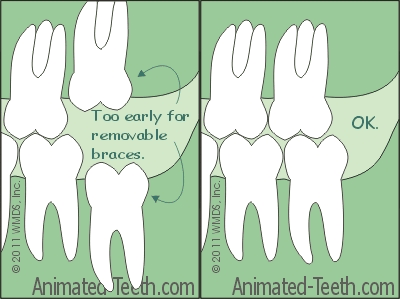
Invisalign® treatment isn’t usually begun until a patient’s second molars have come in.
b) Invisalign® Teen
1) When is it used?
The issue.
Much of the difficulty associated with treating younger children with Invisalign® has to do with managing their permanent teeth as they come into place (erupt) during the treatment process.
2) What age group is Teen used with?
The transitional period described above can take place at different ages with different children.
- The last of a child’s baby teeth usually fall out between ages 10 and 12.
- The 2nd molars have usually come into place by age 12 to 14.
- This places the treatment time window for Teen somewhere between 10 and 14 years.
3) What’s special about Invisalign® Teen?
Teen includes all of the features of standard Invisalign®. But it’s different due to the fact that compensation for tooth eruption is factored into the treatment.
It also includes an allowance for the replacement of up to 6 lost or damaged aligners, something that might be important in treating the potentially less responsible patients that comprise this age group.
A comparison of Invisalign® systems – Express, Teen, and standard.
Note: Teen® includes the same features as standard Invisalign®.
| Standard / Teen | Express | |
|---|---|---|
| Case complexity. | Mild to moderate. | Mild. |
| Intended use. | Full orthodontic treatment. | Minor tooth alignment. Orthodontic relapse. Before other dental work. |
| Number of sets of aligners. | 20 to 30, but can be more. | 10 or fewer. |
| Treatment time. | 1 year. | 6 months. |
| Aligner wearing time. | Around the clock except when eating or brushing. | Around the clock except when eating or brushing. |
| Checkup interval. | 4 to 6 weeks. | 4 to 6 weeks. |
| Estimated patient cost. | See our Braces Costs page. | See our Braces Costs page. |
| Dentist price per case. | See our Braces Costs page. | See our Braces Costs page. |
| Does dental insurance cover treatment? | Usually to the same extent as traditional braces. | Usually to the same extent as traditional braces. |
A comparison of applications for Invisalign® Express, Teen, and standard.
This next comparison table shows that each system can be used to treat a similar range of conditions. But because Express involves the use of fewer aligners (see above), the total amount of tooth movement that can be accomplished with it is less.
Related pages: 1) Invisalign® case selection.
| Standard / Teen | Express | |
|---|---|---|
| Maximum tooth crowding. | Less than 6 mm. | 2 mm or less. |
| Maximum tooth spacing. | Less than 6 mm. | 2 mm or less. |
| Maximum rotation of incisors. | 45 degrees or less. | 15 degrees or less. |
| Maximum rotation of cuspids. | 30 degrees or less. | 10 degrees or less. |
| Maximum midline correction. | 2mm or less. | 2mm or less. |
| Maximum arch expansion. | 2 to 4 mm. | 1.5 mm. |
c) The Simpli 5® and Red White & Blue® systems.
These AOA Lab clear aligner systems are similar to Invisalign® Express in that they are designed to treat less-involved cases.
However, whereas Express might utilize up to 10 pairs of aligners, the Simpli 5® and Red White & Blue® products are five and three aligner systems respectively. And they are only intended for treating minor misalignments of the patient’s front teeth.
That doesn’t mean that these systems are lacking in any way. It’s just that their intended purpose is different.
- Simpli5® is a five-aligner system that can be used to treat one or both of a patient’s dental arches (an “arch” is either the patient’s upper or lower teeth). In the case of dual-arch treatment, a total of five pairs of aligners are worn.
- The Red White & Blue® orthodontic system is a three-appliance product that’s used to treat just one dental arch (either upper or lower).
▲ Section references – AOA Lab
What types of cases can these systems treat?
The Simpli5® and Red White & Blue® systems are used to treat cases that only involve minor to intermediate misalignments of just anterior teeth (front teeth). Examples include:
- Correcting minor malocclusions. – Situations where the corrective measures needed just involve small tooth rotations (10 degrees or less), minor tooth torquing or tipping, or else closing in narrow spaces between teeth (2 mm or less).
The classic case example would be closing the space between a person’s center two front teeth.
- Post orthodontic refinement. – For example, placing the finishing touches on a case after the patient’s wire braces have been removed.
- Correcting orthodontic relapse. – Like that that has taken place because the patient did not wear their retainer.
- Making minor alignment improvements in preparation for dental work. – Such as improving the alignment of teeth before placing a set of porcelain veneers.
- For use with patients who want invisible/removable braces treatment but do not need the intensity of the Invisalign® system (or even Invisalign Express®).
▲ Section references – Kravitz
Comparing fees.
When their use will suffice, it’s expected that cases treated using AOA Lab’s Simpli 5® or Red White & Blue® products will cost less than Invisalign® Express due to the fact that the dentist doesn’t have to buy a more full-featured product than is really needed.
While the following information is achingly out of date, it gives a general idea of the cost comparison between the two company’s systems.
- In 2008, Invisalign® Express, the company’s lowest-priced system, cost the dentist on the order of $750 per case.
- In comparison, and once again in 2008, the Red White & Blue® and Simpli 5® systems cost the dentist around $225 and $600 respectively.
Of course, our statement regarding the relative cost of treatment using these various systems assumes that the dentist passes their cost savings on to the patient.
Page references sources:
Kravitz ND. STb® Social 6 and Simpli5®.
Malik OH, et al. Invisible orthodontics Part 1: Invisalign.
Phan X, et al. Clinical limitations of Invisalign.
Weir T. Clear aligners in orthodontic treatment.
All reference sources for topic Orthodontic Treatment.