Looking for information about other Dental Topics?
Full Website Index• Animated-Teeth.com •

How much do porcelain veneers cost?
This page discusses:
- Fees dentists charge for placing porcelain veneers (dental laminates) – Both conventional and ultra-thin.
- The (seldom explained) long-term expenses you’re likely to encounter once you’ve had yours placed.
- Special circumstances where dental insurance might cover veneers.
Fees for porcelain veneers –
a) Conventional veneers.
Here’s an estimate of the price you might pay to have a conventional porcelain veneer placed on one tooth.
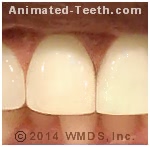
A veneered tooth.
- $755.00 – $1570.00 per tooth.
Low end of range = Small rural city or town.
High end of range = Large metropolitan area.
[How we calculate our cost estimates for procedures.]
This is the type of veneer we discuss on our veneer placement page and involves a protocol where a minute amount of the front surface of your tooth is trimmed back in preparation for the restoration.
b) Ultra-thin veneers / Lumineers®
Here’s an estimate of the price you might pay to have an ultra-thin porcelain veneer placed on one tooth. Brand names for this type of restoration include Lumineers®, DURAthin®, and Vivaneers®.
- $850.00 – $1690.00 per tooth.
In comparison to conventional veneers, the placement of ultra-thins frequently involves the use of a protocol where no tooth reduction (trimming) is performed. Instead, the laminates are bonded directly to the unaltered surface of your teeth.
Why don’t ultra-thin veneers typically cost less than conventional ones?
It is true that the amount of treatment time that a dentist must set aside for an ultra-thin, no-drill veneer case is less than what’s needed for a conventional veneer one. (Because no tooth trimming is performed.)
But this cost savings is typically offset and exceeded by the fact that the dentist’s dental laboratory bill (for fabricating the ultra-thin veneers) will likely be greater than that incurred with traditional laminates. (Especially when a brand-name product is being placed such as Lumineers®, DURAthin®, or Vivaneers®.)
c) Costs for similar procedures.
If you’re interested in making a comparison, the following links provide fee estimates for other types of dental laminates:
- Fees for composite veneers – Veneers made using dental bonding (not porcelain).
Notes:
a) Fees are quoted on a “per-unit” basis.
Dentists usually quote porcelain veneer prices on a per-unit (per-tooth) basis.
That means if you were to have them placed on all six of your front upper teeth you could expect your costs to be exactly six times your dentist’s basic per-unit fee. (There’s usually no discount just because multiple teeth are being treated.)
b) Will temporaries be placed?
The fee quote that your dentist gives you may include the placement of temporary veneers but not necessarily. And just so you don’t get any surprises, you should ask.
FYI: Temporaries are sometimes worn during that time frame (days/weeks) while your permanent laminates are being fabricated. However, with many conventional cases, they are not needed. Also, they are not needed for ultra-thin veneer cases.
c) Will a diagnostic wax-up be used?
One of the demonstration techniques that a dentist can use to communicate with their patients about how their case is anticipated to turn out is a diagnostic wax-up.
- Your dentist may routinely have one up made for each case they perform, and if so its fee may already be factored into the cost of your treatment.
If they do you should be impressed. They can learn a lot about how a veneer case is best handled (especially in terms of tooth preparation) if they have one available.
A dentist may also want to have a wax-up demonstration to show each patient because it helps to ensure that they are clear about the type of results to expect before any work is begun.
- If having one made is not a part of their regular service, a cost will likely be involved, even to the tune of several hundred dollars. (Your dentist’s laboratory expenses for having a wax-up made can run on the order of $20 to $50 per tooth.)
How much does your dentist pay for your porcelain veneer?
In the vast majority of cases, a dentist doesn’t actually make the porcelain veneers they place. Instead, they take an impression of their patient’s tooth and send it to a dental laboratory that then fabricates it for them.
While your dentist’s actual cost for your new veneer may seem small when compared to the full price you pay, keep in mind that it only makes up a portion of the total expense that they incur when performing this work for you.
Estimate of dental laboratory fee: (Your dentist’s cost.)
- Conventional porcelain veneer - $135.00 to $195.00
Are veneers covered by dental insurance?
Insurance plans typically will not provide benefits for procedures that are strictly cosmetic in nature. And, for the most part, porcelain veneers usually fall under that classification. But there can be some exceptions.
Possible coverage for adults.
Coverage might exist if your dentist can make the case that veneer placement will correct a dental-health issue.
This could include the situation where the seal of a previously placed laminate has deteriorated to the point where plaque can now accumulate underneath it, thus placing your tooth at risk for decay. If so, your dentist might be able to obtain authorization from your insurance company for its replacement.
Possible coverage for children.
We’ve seen policies that will provide benefits for veneers for children (ages 8 through 19) who have severe tooth staining caused by tetracycline or fluoride.
Don’t overlook the cost of replacement work.
No dental restoration can be expected to last forever. And this is especially true for those on front teeth where even if structurally sound may be considered cosmetic failures simply due to the development of minor flaws (porcelain chipping, gum recession, etc…). (See our discussion below.)
Replacement costs.
Veneers.
Generally speaking, you can expect the price for replacement porcelain veneers to be the same fee that your dentist currently charges for new (initial) cases. There’s nothing about the process of replacing laminates that makes the job easier or quicker, so the full fee is warranted.
Crowns.
As we explain below, some cases may ultimately reach a point where due to previous veneerings so much of the patient’s tooth enamel layer has been lost that this procedure no longer makes a viable option. If so, dental crowns will need to be placed. Their cost is usually fairly similar to porcelain veneers (fees for dental crowns).
Lost veneers.
It may be possible for your dentist to recement individual porcelain veneers that have come off. Doing so likely isn’t text-book treatment, but it can be a very cost-effective solution if possible. The only other alternative would be to remake the veneer. We discuss the various scenarios that may play out when a veneer debonds on this page.
What are the true costs of having veneers placed?
Unlike most other dental procedures, having dental laminates placed is usually an elective one. And before you have this type of work performed, you should at least give some consideration as to what your total long-term costs will be.
1) There’s the cost of the original (first) placement of the veneers.
(As discussed above on this page.)
2) The cost of replacing the original work at some time in the future must be figured in.
Replacement laminates.
Even if an estimate of a twenty-year lifespan for porcelain veneers is used (which is a pretty optimistic projection), most patients will likely reach a point in their life when their original work will need to be replaced. (We discuss longevity and reasons for veneer failure on this page.)
- A forty-year-old can expect that their veneers will need to be replaced at least once, and possibly twice during their lifetime.
- For a twenty-year-old, this need translates into an expected two or more additional veneerings.
Crowns may be required instead.
With some cases, the complication may crop up that so much tooth enamel has been trimmed away during previous placements that veneers now no longer offer a predictable outcome. (A common problem is that the veneers simply won’t stay in place well.)
When this complication exists, the usual solution is to place dental crowns. And although their per-unit fee is frequently similar to porcelain veneers, they require much more extensive tooth trimming. So what was intended originally as a minimally invasive transformation has now become an aggressive one.
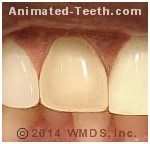
Once a tooth has been prepared (trimmed) for a dental laminate, it won’t look right unless one is in place.
3) Don’t overlook the cost of unexpected repairs.
Replacement requires the same number of visits, and the same treatment time frame, as the initial placement process (usually two visits over two weeks). It will also carry the same cost.
4) Costs associated with side effects and unexpected outcomes must be factored in too.
The placement of porcelain laminates can generally be considered to be safe enough to be an elective procedure. But unexpected or undesired consequences can occur, especially over the long term. And there can be substantial costs associated with resolving them.
Generally speaking, anything that makes a tooth more difficult to clean (like placing a veneer on it) places it at greater risk for complications associated with tooth decay and especially gum disease.
Restoring the patient’s dental health in these situations may involve multiple treatment approaches (such as managing the patient’s gum disease and then replacing their veneers so their appearance is acceptable again). All of which add to the total cost of choosing veneer placement in the first place.
These are just considerations and not necessarily reasons not to have laminates placed.
Don’t be put off by the fact that these extra costs exist. They by no means mean that placing porcelain veneers can’t make an excellent choice.
But since the usual purpose for placing them is just cosmetic, you should consider the above expected and potential expenses and weigh them. You should also take the time to evaluate alternative procedures that might be able to create a similar, yet less costly, end result.
Last reviewed: June 07, 2022
Author: Paul Cotner, DMD — retired dentist.
Published by: WMDS, Inc. — owner of Animated-Teeth.com.
Educational information only — not a substitute for professional dental care.
Page references sources:
LMTmag.com. Crown & Bridge Restoration Fees.
Because the procedure estimates we show are developed by different means, you may find the survey of dental fees published by DentistryIQ an interesting independent source: DentistryIQ – 2017 dental fee analysis by region and CDT procedure code