Looking for information about other Dental Topics?
Full Website Index• Animated-Teeth.com •

The steps of the dental crown procedure – What takes place. What each step is like for you the patient.
The dental crown procedure.
When compared to many other dental procedures, having a dental crown made is a relatively involved process. Here’s a brief overview of the steps. (Use any of the links to jump ahead in this guide.)
- Your tooth and surrounding gums are numbed.
- Using their drill, your dentist reshapes the tooth so it can properly receive a crown. This step is termed “tooth preparation.”
- An impression of the prepared tooth is then taken, either using a putty-like material or digitally with a specialized camera.
- The impression is then sent to a dental laboratory, where the crown is fabricated. (This is why the crowning process has traditionally required two visits, typically about two weeks apart, along with the need to place a temporary crown.)
Alternatively, some dentists have in-office milling machines that can fabricate some types of crowns in less than an hour, allowing for same-appointment placement.
- Once the crown is ready, your dentist will evaluate its fit and appearance. After any necessary adjustments, the crown is permanently cemented into place.
As expected, this guide covers all of the above steps. (Check out this page’s Table of Contents for a complete list of its topics.) But most importantly, we also explain what each step is like for the patient, so you have a better idea of what to expect during your procedure.
While the main focus of this guide is the the steps of the crowning procedure and what they’re like for you, as a start to our discussion, we’ll begin by answering a related question that nearly everyone asks …
How long does the crowning procedure take?
The crowning process usually takes two visits.
It typically takes a dentist two separate appointments to make and place a new dental crown for a patient.
- The first appointment involves: 1) Preparing (shaping) the tooth, 2) Taking its impression and 3) Placing a temporary crown. The time needed to perform these steps typically ranges from 50 to 90 minutes.
(A survey of 1777 dentists conducted by Minye determined that the average amount of chair time scheduled for this portion of the procedure was 76 minutes, plus or minus 21 minutes.)
- During the time period between the two appointments, a dental laboratory will fabricate the crown. Two weeks or so are usually allotted for this process.
- When the patient returns for their second visit, the dentist will evaluate the fit of the crown and then cement it into place. This step can usually be completed in about 20 to 30 minutes or so.
Single-visit crowns.
As a variation of the crowning process, some dentists have the needed equipment so they can make and place dental crowns in a single visit, in just an hour or two of appointment time. How’s this possible?
The steps of the crowning process …
Since most crown procedures are scheduled as two separate appointments, we’ve divided our coverage in the same way.
A) The initial (tooth preparation) appointment.
Step 1: Numbing your tooth up.
Is it painful to have a crown made for your tooth?
No, experiencing pain during your crowning procedure should not be an issue.
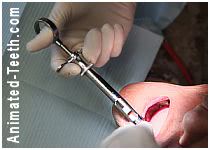
A patient receiving a dental injection.
- Before the process is begun, your dentist will need to anesthetize (numb up) both your tooth and the gum tissue that surrounds it.
- In the case that your tooth has had root canal treatment, it won’t need numbing. However, your dentist may feel that anesthetizing the gum tissue immediately around it is still necessary.
(If you’re curious, here are details about receiving dental injections, like why some hurt more than others. The reasons.)
More about numbing your tooth –
Subscribe to our YouTube channel.
Step 2: Preparing (shaping) the tooth.
a) A specific amount of tooth structure must be trimmed away.
All crowns need to have a certain minimal thickness. This ensures that they have enough bulk to have adequate strength. And in the case of porcelain crowns, enough ceramic thickness to be able to create a life-like appearance.
Preparation of a tooth for a dental crown.
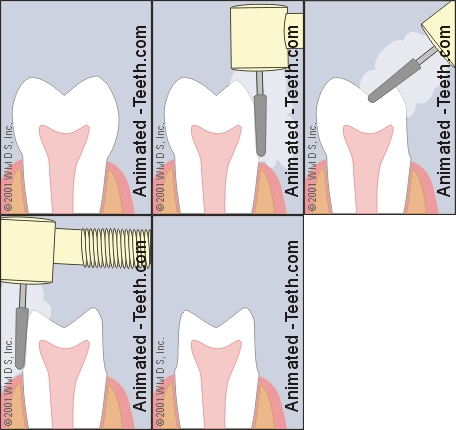
All sides of the tooth must be trimmed.
- For those that feature any porcelain surface Types of crowns., the minimal restoration thickness that’s typically or ideally required lies on the order of two millimeters, which is just a little more than a sixteenth of an inch.
- For all-metal restorations, 1.5 millimeters is considered sufficient.
Quantifying how much reduction takes place.
We ran across an interesting pair of research papers (Edelhoff) that determined the percentage of a tooth’s crown portion (the part of a tooth that lies above the gum line) that is typically trimmed away during the crowning process.
- For front teeth, this figure ranged between 63% and 73%.
- For back teeth, the range extended from 67% to 75%.
(The calculations were for all-ceramic and metal-ceramic crowns. All-metal crowns, like gold ones placed on back teeth, would require slightly less tooth reduction.)
Additional tooth reduction.
▲ Section references – Edelhoff
More about preparing your tooth –
Subscribe to our YouTube channel.
b) The prepared tooth must have a specific shape.
Besides reducing the overall size of your tooth, your dentist must also trim it so it has a generally tapered shape. That’s required so the finished crown (a hard object that can’t flex) is able to slip onto the tooth and into place. (A dentist would state this as saying the crown must have a “path of insertion.”)
The shape of the prepared tooth helps to ensure the crown’s retention and stability.
No crown is held in place by dental cement alone (no cement is that strong). Instead, the shape of the tooth on which it sits plays a significant role in providing for its stability and retention. Here’s how:
- The taller the nub of tooth that extends up into the interior of the crown, the better it will be at resisting tipping forces.
- Crown preparations that maximize the dimensions of the nub (both in height and diameter) maximize the amount of surface area for the tooth/cement interface.
- The more parallel the opposite sides of the nub are, the better the crown will stay in place.
The ideal amount of taper varies according to the type of tooth but generally ranges from 10 to 20 degrees (with each opposing side of the tooth contributing about 1/2 of that total).
▲ Section references – Shillingburg
Due to the importance of these considerations, there can be times when so much tooth structure has broken off or decayed away that the dentist must first “build up” the tooth with filling material Placing a dental “core.” that restores it closer to its original dimensions before they shape it for its crown.
Step 3: Taking an impression of the prepared tooth.
Once your dentist has completed shaping your tooth, they will need to make a copy of it by way of taking a dental impression. There are two different processes by which this step can be performed.
a) Conventional dental impressions –
How the impression is taken.
Most dentists will take an impression of your tooth using a paste or putty-like compound that’s often just referred to as “impression material.”
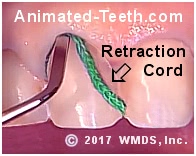
Placing retraction cord.
- 1) The prepared tooth is washed and dried.
- 2) Small diameter yarn (“retraction” cord) is tucked around the tooth, in the space between it and its surrounding gum tissue.
(The idea is that the cord pushes the gum tissue back away from the tooth. Then later, after it’s been removed, the gums will stay back long enough for the impression material to seep around the tooth, thus allowing it to capture a copy of the entire tooth preparation.)
- 3) A small amount of light-bodied (runny) impression material is squirted around the tooth. (Its consistency is similar to mustard.)
(A dentist will sometimes use their air syringe to blow/spread it over and around the tooth.)
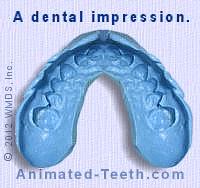
A dental impression.
- 4) A tray that’s been filled with heavy-body (thick, stiff) impression paste or putty is then squished over the tooth and its neighboring teeth, and allowed to sit for some minutes.
(As the tray is seated, the comparative stiffness of the putty that it’s been filled with forces the runny impression paste into all of the nooks and crannies of the tooth and its surrounding gum tissue.)
- 5) As the different impression materials set, they fuse together into a single unit.
- 6) When removed from the mouth, the impression (see picture) contains a copy of the prepared tooth, it’s surrounding gum tissue, and the teeth on that jaw.
▲ Section references – Wilson
How the impression is used.
- The completed impression is sent to a dental laboratory. And there it is filled with plaster to create a cast.
It’s this copy of your mouth that’s then used to fabricate your crown.
- Since the cast is a precise representation of your tooth and its neighboring teeth, if the crown is made to fit on it, it should fit accurately on your tooth too.
(In most cases, a little bit of adjustment is still necessary.)
- Depending on the specific arrangements your dentist has made with the dental laboratory, the amount of turn-around time needed to fabricate a crown is usually on the order of two weeks, possibly less (especially if arrangements have been made in advance).
More about taking the impression of your tooth –
Subscribe to our YouTube channel.
b) Optical dental impressions.
As an alternate method, some dentists have equipment for taking optical impressions. This process involves the use of a small hand-held, wand-like digital camera (intraoral scanner).
Obviously, with this technique no impression paste is used. Retraction cord, however, may still be required so the full extent of the tooth’s preparation is exposed and visible to the scanner.
With some techniques, the tooth is dusted. The powder that’s applied adjusts the reflective properties of the tooth and gums, thus aiding the digital camera in capturing all of the details needed.
How the impression is used.
A digital impression is analyzed by CAD/CAM equipment that then, under the oversight of the dentist or a laboratory technician, designs and ultimately fabricates the patient’s restoration.
For this process:
- The impression might be forwarded to a dental laboratory electronically. The lab will then design and fabricate the patient’s crown and ship it back to the dentist’s office.
- Some dentists have milling machines that can design and fabricate the patient’s restoration right in their own office. Dental crowns “in an hour.”
Step 4: Choosing the shade for your crown.
If your new crown will have a porcelain surface, your dentist will need to judge what shade of ceramic most closely matches your tooth’s neighboring teeth.
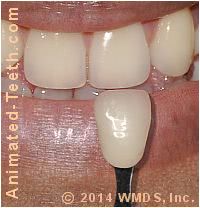
Using a sample from a shade guide to document the color of a tooth.
- In some cases, your dentist will use a series of small, tooth-shaped pieces of dental porcelain, each one having a different color. Collectively these samples are referred to as a “shade guide.”
Samples will be selected from the guide and held in the space that your new crown will occupy, until one is determined to be the best color match.
- As an alternative, your dentist may have an electronic device that will automatically determine the tooth’s shade for them.
Issues.
- While we’ve placed this step low in our outline, determining the shade for your new crown really should be one of the first things that takes place during your appointment. (Like while waiting for your tooth to get numb.)
That’s because while your mouth is open during your procedure, your tooth and neighboring teeth will tend to dehydrate (dry out). And as they do, they will become lighter/brighter in color, thus making precise shade matching impossible. Studies have shown (Burki) that the color of teeth can be affected by dehydration in less than 30 minutes.
- The lighting conditions in which the tooth’s shade is taken is an important factor (Park). Especially for front teeth, an evaluation in natural light, or artificial lighting that’s been spectrum-corrected to mimic daylight, along with other possible lighting environments in which the tooth will be viewed should all ideally be considered.
- Your dentist may value additional input (from you, their assistant, etc…) about which shade appears to match most closely. (A survey by Minye found that 59% of dentists seek this additional input for cases involving front teeth.)
- Additionally, dentists sometimes use photographs to help to communicate their shade selection with the dental laboratory that will make the crown. (Minye found that this occurs in 50% of cases where the esthetics of the case are especially demanding.)
- Beyond the above issues, for crowns whose appearance is critical (like those placed on front teeth) there are additional things to know. We cover them here: Dental crown color mismatch – What can be done? Details.
▲ Section references – Burki, Park, Minye
Step 5: Placing a temporary crown.
In those cases where your dental crown will be fabricated at a dental laboratory, you will have to wait the two weeks or so while it is being made. During this time period, you’ll wear a “temporary” crown.
- Temporaries both protect (cover over) your tooth and keep it from shifting position.
(Ideally, a temporary crown will have the same shape and provide the same function as your future permanent crown. With the single difference between the two being that it’s made using less durable materials.)
- Temporaries are usually made out of plastic, or possibly metal. They may be preformed shells (metal or plastic) Details. that are then customized to fit your tooth. Or made from scratch by your dentist (plastic only).
(Only a temporary that’s custom made out of plastic has the potential to truly replicate the contours and dimensions of your future permanent crown. So if your dentist has gone to the effort of crafting one for you, they should be commended.)
- A temporary crown is cemented using “temporary” cement, so it can be removed easily and predictably at your next appointment.
▲ Section references – Wilson
How long can a temporary crown last?
While not as strong as a permanent one, the materials used to make your temporary crown can probably be expected to withstand the wear and tear of many months of service. (Even 12 months or more.) Check with your dentist.
It is true that the cement used to secure a temporary isn’t as strong as what’s used with permanent ones, so the possibility of it coming off is at least somewhat of a concern. You don’t have to expect that it will. But this possibility is reason enough to monitor the level of force that you expose it to.
If it does come off, you should consider it a significant event and you should make contact with your dentist. As an example, if the loss of the temporary allows your tooth to shift, even minutely, the impression that’s been taken will no longer be accurate and the permanent crown made using it quite possibly can’t be adjusted to fit.
As further information, this page covers the situation where you have a crown come off. What to do. Or if yours has and you have swallowed it, this one provides tips on retrieving it. What to do.
Possible effects of long-term wear.
The fit and contours of a temporary crown frequently aren’t as ideal as a permanent one’s. And if not, being able to remove dental plaque from around the tooth may be difficult.
Persistent plaque accumulation can lead to gum recession, gum disease and/or tooth decay. Each of these factors can compromise the outcome of your current (delayed) treatment, or even the outlook for your tooth, so be as diligent with your oral home care as you can.
B) The crown placement appointment.
Once the fabrication of your dental crown has been completed, your dentist can proceed with the process of cementing it into place.
Step 1: Removing the temporary crown.
For this step, your dentist will:
- Anesthetize (numb up) your tooth. (This step isn’t always needed. It’s often quite painless for a patient to have a crown fitted and cemented.)
- They’ll then remove your temporary crown and clean off any remnants of temporary cement that remain on your tooth.
Step 2: Evaluating the fit and appearance of the crown.
Before your dentist can cement your new dental crown into place, they will first need to make sure it fits well and looks right. As a part of this evaluation:
- Checking the fit. – Your dentist will seat the crown on your tooth and inspect the way that it fits. (This evaluation may include using dental floss, feeling around the crown with a dental tool, and asking you to bite down gently on some carbon [marking] paper).
They’ll then remove the crown and adjust it as needed. (Usually via trimming or buffing it with their dental drill.)
They may need to repeat this process several times before they’re satisfied with the restoration’s fit, both on the tooth and the way it touches its neighboring and opposing teeth.
- Checking the appearance. – Additionally, and especially in those cases where the dental crown will hold a prominent position in your smile, your dentist will likely hand you a mirror and ask you to evaluate the crown’s overall shape and color.
Don’t be shy with your comments and questions. After a crown has been cemented, some changes (like color, and even some types of shape modifications) cannot be made. We’ll repeat this point. Do not let your dentist permanently cement your crown unless you’re satisfied with its outcome.
▲ Section references – Wilson
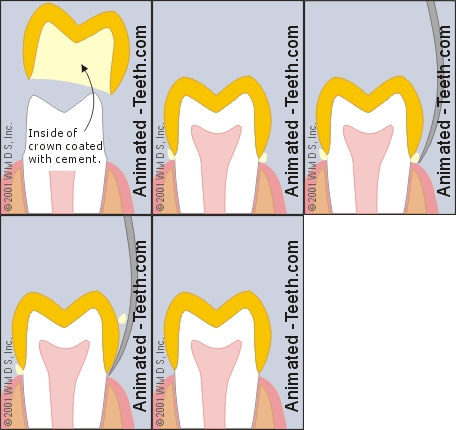
Crowns are cemented in place.
Step 3: Cementing the crown.
- They’ll first place dental cement inside your crown and then seat it over your tooth.
- After a few moments (at a point where the cement has just started to set), your dentist will use a dental tool and scrape away any excess that has extruded from underneath the edges of the crown.
(There should be some excess. The dentist will always place slightly more cement inside the crown than is needed, so there is no chance for voids.)
- After removing all excess cement, your dentist will double check your crown’s “bite” so to ensure that it’s correct. The placement of your new crown is now complete.
▲ Section references – Wilson
Step 4: Precautions for your new dental crown.
At this point, your dentist may give you some instructions. For example, with some types of cement it’s best to take it easy with the crown for the first day (eat nothing exceptionally hard or sticky), so to give the cement an adequate time period over which to cure.
Especially in the case where you have been numbed up, be careful until normal sensation has returned. You could easily bite your lip or cheek by accident, possibly severely.
Once your numbness has worn off, and for the next day or so, gently test the “bite” of your crown so to make sure that it feels right with all types of closing movements. If it doesn’t, let your dentist know so they can correct the problem (a simple matter of buffing down the surface of the crown). Not doing so can lead to (possibly serious and irreversible) complications. What can go wrong.
Looking for more information?
As suggestions for related pages:
Our Types of Dental Crowns guide can help you confirm that the best kind of crown has been planned for your tooth and situation. (A final decision can often be made at the time of your appointment.)
Here’s an FYI-syle page that offers proactive tips about— Steps to take to avoid needing other teeth crowned.
If you’re interested in the financial aspect of this subject, we offer these pages: Fees for dental crowns | Dental insurance coverage for crowns.
Or, if you have questions about some other issue entirely, check out our additional Dental Crown Guides.
Last reviewed: April 24, 2026
Author: Paul Cotner, DMD — retired dentist.
Published by: WMDS, Inc. — owner of Animated-Teeth.com.
Educational information only — not a substitute for professional dental care.
Page references sources:
Burki Z, et al. A randomised controlled trial to investigate the effects of dehydration on tooth colour.
Edelhoff D, et al. Tooth structure removal associated with various preparation designs for posterior teeth.
Minye HM, et al. Preparation Techniques Used to Make Single-Unit Crowns: Findings from The National Dental Practice-Based Research Network.
Park JH, et al. Influence of illuminants on the color distribution of shade guides.
Rosensteil SF, et al. Contemporary fixed prosthodontics. Chapter: Restoration of the Endodontically Treated Tooth.
Shillingburg HT, et al. Fundamentals of Fixed Prosthodontics. Chapter: Preparations for Severely Debilitated Teeth.
Wilson N, et al. Manual of Clinical Procedures in Dentistry. Chapter: Procedures in Prosthodontics.