Looking for information about other Dental Topics?
Full Website Index• Animated-Teeth.com •

Types of Dental Crowns – The differences. | What you need to know.
Understanding the different types of dental crowns.
Dental crowns are used to protect, strengthen, and enhance the appearance of teeth. However, not all crowns are created equal. Differences in materials and construction significantly impact their comparative durability, function, and aesthetics.
This guide covers the different types of dental crowns—all-metal, all-ceramic, porcelain-fused-to-metal (PFM), and preformed shell crowns—pointing out their relative advantages and drawbacks, and highlighting ways in which each excels. It also provides unique insights into each type to further assist you in determining which makes the best choice for your situation.
What are the different types of crowns?
The four basic kinds of dental crowns (“caps”) are:
- All-metal – These restorations are made using either a gold or “white” (silver-colored) dental alloy. They’re known for their great strength and exceptional durability.
- All-ceramic – These crowns are fabricated using either porcelain, or more likely, some type of “engineered” dental ceramic. Some of these materials are known for their superior aesthetics, others for their strength (unfortunately none share both qualities).
- Porcelain-fused-to-metal (“PFM”) – This kind of crown represents a hybrid construction where porcelain is fused as a covering over a metal substructure that encases the tooth. These crowns can provide both good aesthetics and strength.
The latest generation of metal-ceramic crowns utilizes the pressed-over-metal (POM), or pressed-to-metal (PTM), fabrication method.
- Preformed (shell, stainless steel) – Preformed crowns essentially never make an appropriate choice as a permanent restoration. They’re primarily intended for use with children or as temporaries.
Which kind makes the best choice?
As we outline on this page, each type of crown has its own distinct set of characteristics and therefore its own unique advantages and disadvantages, each of which must be weighed and evaluated in light of the patient’s specific situation.
FYI: As an abbreviated version of this page, we offer our walkthrough: Which kind of crown makes the best choice for your tooth? 6 factors to consider.
And if you’re having a replacement crown placed …
Don’t overlook that scrap all-metal (gold, white gold) and metal-ceramic (PFM, POM) crowns have value. So, don’t hesitate to request your old one so you can sell it for its precious metal content. How to. It may have more value than you realize (our page explains).
Overview – Types of dental crowns.
The remainder of this page explains the various types of crowns that your dentist has to offer.
- In essentially all applications, the use of more than one type should be possible, with each making a reasonable option.
- However, the unique characteristics and advantages associated with a particular type will frequently make it the obvious best choice.
A) All-metal dental crowns. / “Gold” dental crowns.
Some crowns are made entirely out of metal. The classic metallic crown is one made out of gold, or more precisely, a gold alloy.
Actually, there are a number of different types of dental alloys that can be used for crown fabrication. Some of these metals are silver (“white”) in color, rather than yellow like gold. (FYI: There are other alloy differences that matter too. What are they?)
Dentists have been placing all-metal crowns for over 100 years, the longest of any type by far.
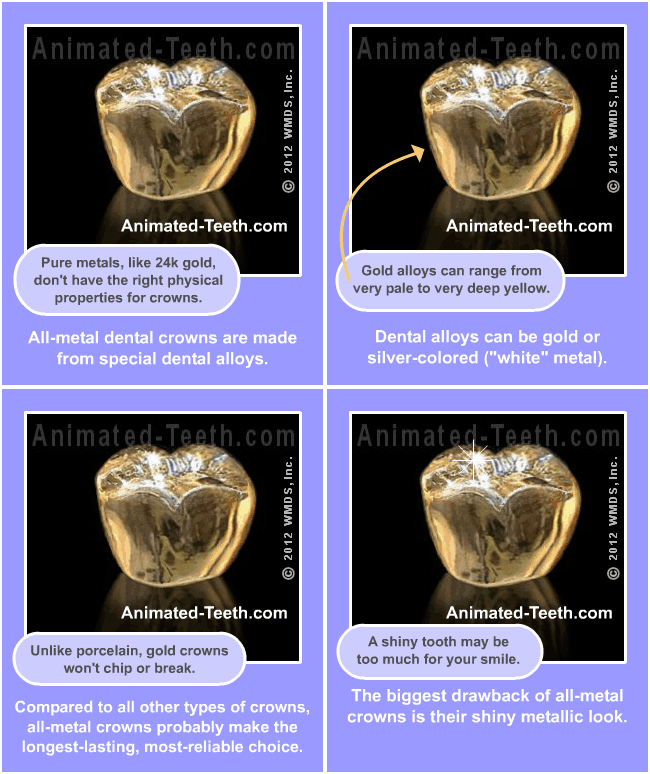
FYI details about all-metal (gold) dental crowns.
1) Advantages of gold crowns.
All-metal crowns made using a dental alloy that has a high gold content have many advantages. They include:
They’re long-lasting.
Gold crowns (and metal ones in general) are very strong and can be expected to withstand even the heaviest biting and chewing forces well.
They will not chip (like porcelain restorations may). It would be uncharacteristic for one to break. And of all of the different types of crowns, all-metal ones generally have the greatest potential for lasting the longest Crown longevity reports..
They’re kind to neighboring teeth.
The precious alloys that are used to make gold dental crowns have a wear rate that’s similar to tooth enamel. That means the crown won’t create excessive wear on the teeth that oppose it (the teeth that it bites against).
Gold crowns are easy for a dentist to work with.
Dental alloys that have high gold content are typically very workable metals. This factor makes it possible for the dentist to achieve a very precise crown-to-tooth fit.
▲ Section references – Anusavice
2) Disadvantages of all-metal crowns.
They’re not white like teeth.
About the only disadvantage of metal dental crowns is their appearance (gold yellow or silver). For this reason, they’re not usually placed on teeth that show prominently when the person smiles (although some people like that look).
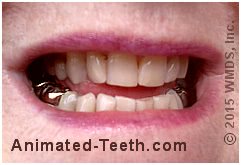
The only disadvantage of gold crowns is they’re not white.
They can, however, make a great choice for some molar applications (2nd and 3rds, possibly some lower firsts). Even for people who don’t want to show an excessive amount of metal.
Be sure to get your significant other’s OK. – If you’re considering some type of metal crown, take our advice on this point. Before giving your dentist the go-ahead to make it, check with your spouse first. They’re the one who will be looking at your smile, and your shiny new crown, the most.
3) If appearance is an issue, consider a porcelain “window.”
Giving a white look to all-metal crowns.
- There can be times when a patient wants or needs the strength, durability and predictability that an all-metal crown can offer.
- But the way placing one would look would be simply too objectionable.
As a solution for this dilemma, it’s possible for metal crowns to be surfaced with porcelain on their side that shows. Dentists refer to this type of option as a “veneer” or “window.”
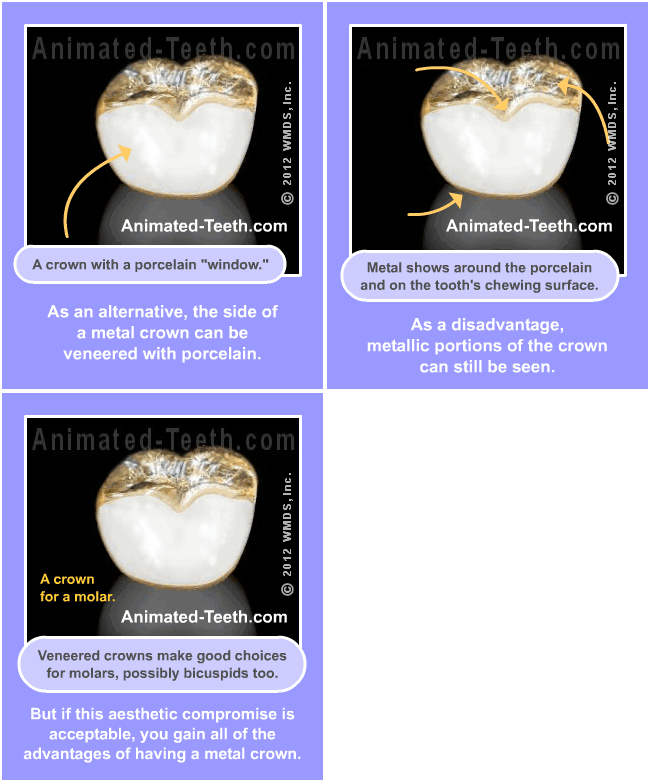
FYI details about veneered metal dental crowns.
Some metal will still show.
The downside is that others will still be able to see a hint of the metal that surrounds the porcelain. And they’ll also be able to see the metal chewing surface of the crown.
But even so, choosing this option may make the look of having a metal crown passable where otherwise it would not.
4) Popularity / Use of all-metal crowns.
It’s probably accurate to suggest that gold crowns aren’t placed as frequently for patients nowadays as they were in decades past.
This trend is probably due to the continued development of high-strength all-ceramic crowns that may provide a reasonable all-white alternative. (However, it’s important to state that right now these alternatives don’t have a long documented track record for service like gold crowns do.)
An example.
We ran across an editorial in the Journal of the American Dental Association (Christensen) that made reference to information reported by a prominent dental lab (Glidewell Laboratories, Newport Beach, CA) in regard to the relative percentage of different types of crowns dentists had ordered in 1997 vs. 2010. (Their manufacturing volume is on the order of 1 million crowns per year).
What they reported.
- In 1997, 12% of all crowns made by the lab were metal but by 2010 this number had fallen to just 6%. (The remainder of Glidewell’s volume would have been either all-ceramic or porcelain-fused-to-metal crowns.)
At face value, one might conclude that the popularity of placing gold crowns is waning rapidly. To temper this data, however, it’s important to note that Glidewell is a national leader in manufacturing certain types of all-ceramic crowns.
That means that their caseload is probably skewed toward providing this service (vs. gold crowns), and therefore their experience is somewhat unique and probably overstates what likely is occurring with the dental lab industry as a whole.
What the editorial also stated.
Despite discussing that there seemed to be a decrease in the popularity of gold crowns, we couldn’t help but notice that the author of the editorial (a practicing dentist) also stated the following: “Most of my dentist patients want gold alloy restorations.”
▲ Section references – Christensen
5) Modern gold crown manufacturing.
Just in passing, we’ll mention that the same kind of CAD/CAM manufacturing technology we discuss below in conjunction with some types of all-ceramic crowns has also been adapted to manufacturing dental alloy restorations.
As advantages over traditional fabrication:
- The factory-made blank from which the crown is milled is likely to have more consistent/predictable physical properties (porosity, grain structure, density, hardness) vs. a “cast” restoration.
- Turnaround time back from the dental lab can be expected to be much quicker (just a day or two). (At this point in time, we’re under the impression that in-office/chairside milling of metal alloy crowns is not possible.)
B) All-porcelain (ceramic) dental crowns.
(All-ceramic crown advantages & disadvantages.)
All-ceramic crowns are just that. Restorations that have a construction where their entire thickness is made up of dental ceramic (a white glass-like material that resembles the look of tooth enamel).
Originally the ceramic used was porcelain. This type of crown was called a “porcelain jacket,” and it was first introduced in the early 1900s.
Nowadays, all-ceramics are typically fabricated out of some type of synthetic or engineered compound, using construction techniques developed in the mid 1980s or after.
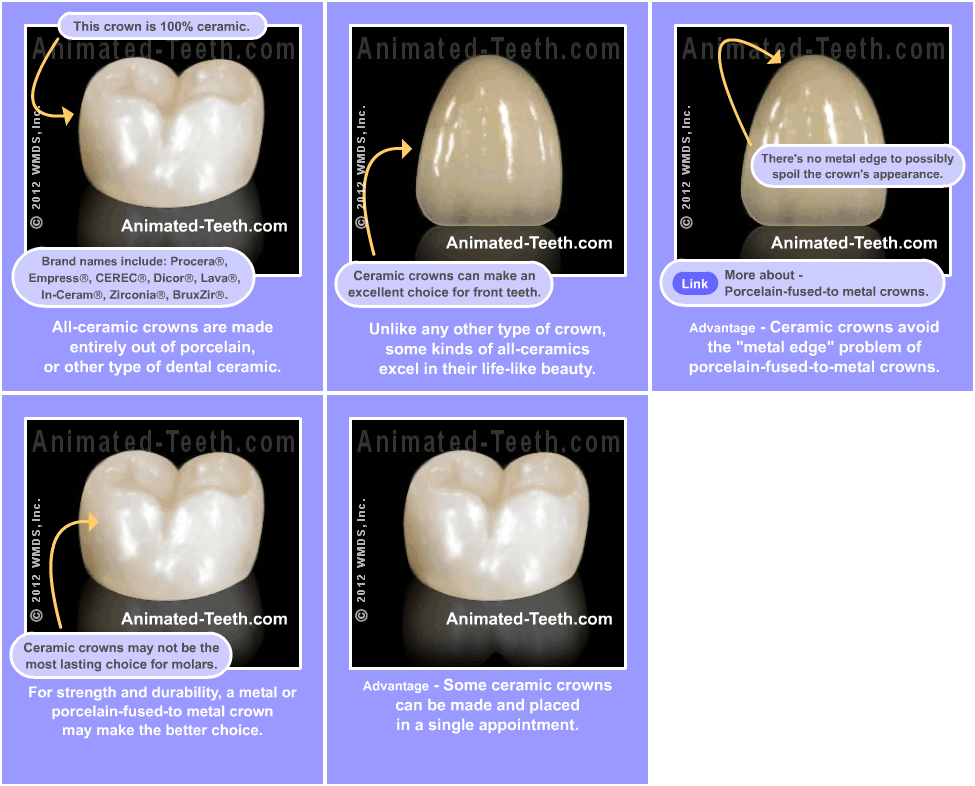
FYI details about all-ceramic dental crowns.
1) Advantages of all-ceramic crowns.
There’s no more natural-looking type of crown.
Due to the life-like translucency of the materials from which they’re made, all-ceramics can be the most aesthetically pleasing of all of the different types of dental crowns. And for this reason, they often make an excellent choice for restoring front teeth.
Note: Not all all-ceramics can make this claim.
It’s important to know that some types of all-ceramic crowns are much better than others in their ability to closely mimic the look and luster of natural teeth. This is due to both the characteristics of the ceramic and the fabrication method used in their construction. Here’s an explanation:
Layered ceramic crowns.
At one end of the spectrum lies those crowns whose full thickness has been crafted by hand by combining multiple layers of porcelain.
Since each layer can be different in terms of shade or degree of translucency, the restoration can be given a very life-like appearance (example B in our graphic).
Unfortunately, due to both the technique involved and the materials used, the strength characteristics of this type of crown are less than with other types. And for that reason, your dentist may be hesitant to place one.
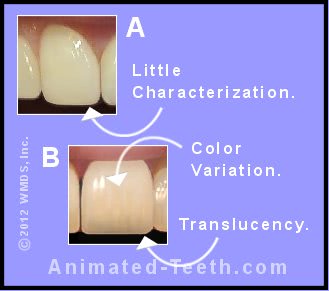
Characterization (slight variances in appearance) is what makes a crown look natural.
Monolithic restorations.
At the other end of the range lies those crowns milled from a single homogeneous cube of ceramic (this is referred to as monolithic construction).
Dentists are drawn to this fabrication method because it can offer advantages in regard to crown strength (see below), and even the speed with which the restoration can be created (one appointment crown placement is possible “1-hour” crowns.).
But in terms of esthetics, because the restoration is milled from a single block, the result is generally one where the restoration just has one uniform color. And that means it really won’t mimic the normal shade and translucency variations found in natural teeth (example A in our graphic).
(It is true that the surface of crowns can be “stained” so to improve their appearance. But for important front teeth, as compared to layered porcelain this method is a second-tier approach to crown characterization.)
The in-between.
As a compromise, all-ceramic crowns for front teeth can be constructed in a fashion where those portions of the restoration that aren’t readily visible are first made (milled, pressed or cast) using ceramics that are generally less natural-looking but have more desirable physical properties.
The front surface of the restoration is then crafted by hand, by adding on individual layers of porcelain.
Doing things this way means the crown can be given both a high level of characterization and also better mechanical properties (such as greater strength).
If its looks are important, you’ll need to ask how your all-ceramic will be made.
For many teeth, the esthetics of their new crown may just be one factor that needs to be considered. But for those front teeth whose appearance is critical, you need to understand that placing an “all-ceramic” doesn’t necessarily equate with placing the most life-like crown possible.
▲ Section references – Zarone, Rosenstiel
2) Disadvantages of all-ceramic crowns.
Concerns about strength and longevity.
Generally speaking, porcelain-fused-to-metal and especially all-metal crowns can be considered to be stronger types of restorations.
That means in the back of the mouth where substantial chewing forces are routinely generated, placing an all-ceramic might not make the best choice. (Your dentist’s judgment will be required on this point.)
In the front of the mouth, crown strength is less of an issue and easily outweighed by the superior aesthetics that an all-ceramic restoration can typically provide.
3) High-strength dental ceramics.
In response to durability issues, synthetic or “engineered” porcelains having enhanced strength characteristics have been developed. The leading compounds in this field are lithium disilicate (IPS e.max®) and zirconia (BruxZir®).
Monolithic construction.
The strongest, most durable construction type for crowns made out of these materials is the “full” or “monolithic” form, meaning the entire thickness of the restoration is made out of a solid, uniform piece of the ceramic (as opposed to construction where individual layers are fused together).
As evidence, a study by Dhima evaluated 226 all-ceramic crowns (on average) 6 years after placement. The most common type of failure was fracture to the core of layered (non-monolithic) crowns (this means the full thickness of the crown had cracked). Based on this finding, the paper advised the use of monolithic crowns on back teeth.
Strength measurements.
As a comparison of the two compounds above, in its monolithic form lithium disilicate has a rating of 360 to 400 MPa (a measure of how much stress the material can withstand without breaking). Solid (full) zirconia has a strength rating in the neighborhood of 1000 MPa, making it the stronger of the two. However, survival-rate studies Findings. suggest that possibly the e.Max product still makes the better choice.
Trade-offs.
One primary disadvantage of monolithic high-strength ceramic restorations is that their appearance generally isn’t as translucent and life-like as other types of porcelain crowns can be. However, for back teeth where great strength is needed the most, this likely isn’t much of an issue.
▲ Section references – Dhima, Shillingburg, Zarone
4) Popularity / Use of all-ceramic crowns.
The editorial we cited above (Christensen) provided information about ceramic crowns too.
The numbers reported.
- In 1997, 16% of crowns made by Glidewell Laboratories were all-ceramic whereas in 2010 this number grew to 50%.
- As we mentioned above, this lab involved is a national leader in promoting and fabricating this type of crown, so their numbers are likely skewed toward them.
- The greatest amount of production growth involved the manufacture of high-strength all-ceramic crowns. (The type considered most appropriate for placement on back teeth.)
▲ Section references – Christensen
C) Porcelain-fused-to-metal dental crowns. (PFM’s)
(PFM crown advantages & disadvantages.)
PFM’s offer a long, tested track record.
Dentists have been placing porcelain-fused-to-metal crowns for patients since the late 1950s. And over the decades that followed, they became the “gold standard” for restoring front teeth, and back ones where a tooth-colored restoration was required.
In more recent decades, their popularity has gradually lost ground to more modern types of restorations. This includes pressed-over-metal crowns (POM’s). (Similar to PFM’s except engineered (synthetic) porcelain is used.) And all-ceramic crowns fabricated using high-strength ceramics.
But despite these trends, it should be kept in mind that different than with these newer methodologies, the classic porcelain-metal crown can boast that it has a very long, well-established track record of providing predictable, lasting service.
How they’re made.
Porcelain-fused-to-metal restorations are somewhat of a hybrid between all-metal and all-ceramic crowns.
When they’re fabricated:
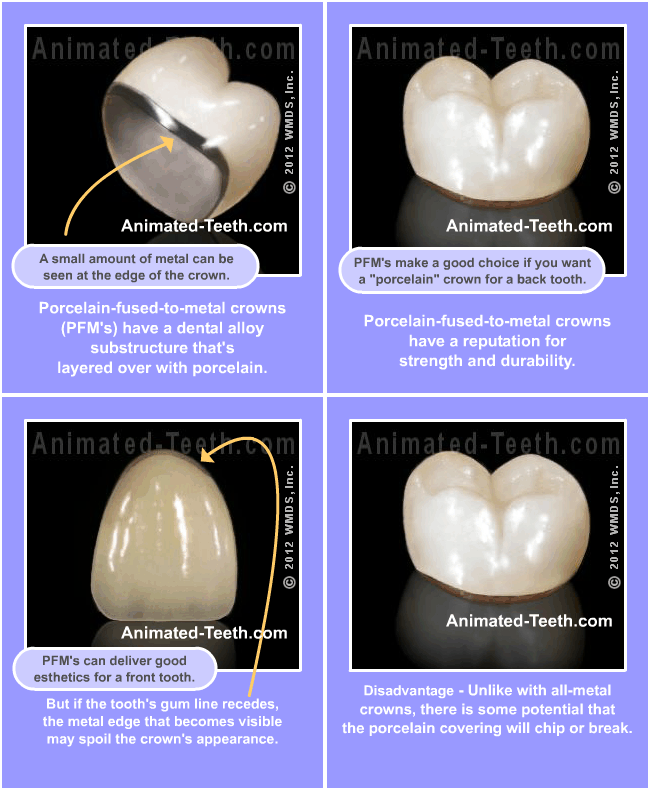
- The dental technician first makes a thin thimble of metal that fits over the tooth.
- A layer of porcelain is then fused over it in a high-heat oven, giving the crown both it’s tooth-like shape and color.
Related Page: Types of dental alloys (precious, semiprecious, nonprecious) Why this choice matters. that can be used when fabricating PFM crowns.
FYI details about porcelain-fused-to-metal dental crowns.
1) Advantages of porcelain-fused-to-metal crowns.
They’re strong.
Due to their great strength, PFM dental crowns can make a good choice for either front or back teeth.
As a class, this type of crown would only place second to all-metal ones in terms of strength and durability. And as mentioned above, PFM’s have a very long, well-documented history of providing lasting service.
They’re natural-looking.
For some people, and some applications, the big advantage of a PFM crown over an all-metal one is simply the fact that it’s tooth-colored.
2) Disadvantages of PFM’s.
There are some disadvantages associated with porcelain-fused-to-metal crowns. They include:
The “dark line” phenomenon.
The metal that lies underneath the crown’s porcelain surface can sometimes be seen as a dark line right at the crown’s edge.
A dentist will usually try to position the edge of a PFM crown just underneath the tooth’s gum line. But, if a person’s gums happen to recede, this dark line can show, thus spoiling the crown’s appearance.
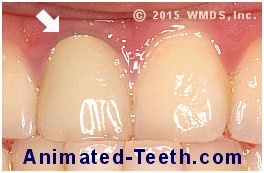
Note the hint of the metal edge of this PFM crown.
Achieving superior aesthetics can be a challenge.
While the appearance of a PFM crown can be excellent, it’s often difficult to create one that’s as natural-looking as the best all-ceramic ones.
For the most part, this difficulty stems from the crown’s metal substructure and how it must be masked by covering it with relatively opaque (less translucent and therefore less natural-looking) porcelain. And while this doesn’t create a problem in all cases, it frequently involves challenges or compromises.
Durability.
It’s possible for the porcelain surface of a PFM crown to chip or break off. (It would generally be expected that a PFM would pose less risk of catastrophically cracking or breaking than most types of all-ceramics. Of course, all-metal crowns avoid this complication altogether.)
If porcelain breakage does occur, it’s very difficult to make a lasting repair. The most predictable solution typically involves making a new crown. As a compromise, some minor chipping may just be smoothed over or polished.
PFM crowns may wear opposing teeth.
The porcelain surface of a porcelain-fused-to-metal crown can create (possibly significant) wear on those teeth that it bites on or rubs against. (Many types of all-metal or all-ceramic crowns are more bio-compatible in this regard.) This issue might be especially important for people who brux (clench and grind) their teeth.
This potential is greatest in cases where during placement the crown’s biting surface needed to be trimmed and it was not subsequently re-glazed (given a glass-like finish in a high-heat oven), or at least thoroughly smoothed and polished.
▲ Section references – Shillingburg, Zarone
3) Pressed-to-metal crowns (PTM’s).
Newly developed fabrication methods along with the use of modern high-strength ceramics have resulted in the development of a new type of porcelain-metal crown. This type of restoration is referred to as the pressed-to-metal (PTM), pressed-on-metal or pressed-over-metal (POM) crown.
Similarities to traditional porcelain-fused-to-metal restorations.
In terms of construction, PTM/POM’s are essentially the same as PFM’s (a ceramic outer layer encasing an underlying shell of metal). But instead of traditional porcelain, an engineered (synthetic) high-strength dental ceramic is used instead (lithium disilicate is common).
Advantages of pressed-to-metal crowns.
PTM’s seem to offer a solution for most of the disadvantages associated with PFM’s.
- The ceramic used has greater strength, chip-resistance and a monolithic (single piece) construction, all of which makes the crown’s outer covering less likely to fracture.
- Some feel the optical properties of the ceramic used gives a superior esthetic result as compared to traditional porcelain.
- The physical characteristics of the ceramic may cause less tooth wear of opposing teeth.
- Due to the ceramic’s great strength, the front side of a PTM crown can be given a fully ceramic edge, thus sidestepping the “black line” difficulty associated with PFM’s (see picture above).
It’s important to point out that despite these apparent advantages, pressed-to-metal (pressed-over-metal) crowns are a much newer type of restoration than PFM’s and therefore do not share their long, proven track record of durability and success. You’ll need to consult with your dentist about the prudence of choosing this less-tested type of restoration for your tooth.
4) Popularity / use of porcelain-metal crowns.
A change in trend seems to be developing.
The editorial cited above (Christiansen 2011) also reported that:
- In 1997, 72% of crowns made for dentists by Glidewell dental laboratory were PFM’s.
- By 2010, this number had fallen to 45%. (The difference between these numbers was made up by an increase in requests for high-strength all-ceramic restorations.)
▲ Section references – Christensen
These numbers suggest that in the past dentists tended to feel that porcelain-fused-to-metal crowns were the only type of tooth-colored restoration that could provide predictable service for back teeth where heavy chewing forces were involved.
In comparison, nowadays it appears that more and more dentists feel that placing newer types of all-ceramic crowns on back teeth makes an acceptable choice.
An update.
In a letter to its customers in the Fall of 2016, the dental lab referenced above stated that it would discontinue making traditional PFM crowns all together in October in favor of pressed-to-metal ones (PTM’s). The reason they gave was that they felt this newer type of restoration offered greater durability and better esthetics.
This isn’t to suggest that other dental laboratories don’t still make traditional PFM’s, or that they’re not still the preference of a large number of dentists. But it does seem to indicate that a shift in opinion is developing.
D) Preformed dental crowns. (shell, stainless steel)
We’ve included this type of crown on this page in an attempt to make our coverage as complete as possible. But as we outline below, in no way should this type of restoration be considered an equal, or even near equal, to the types of crowns discussed above.
What are preformed crowns?
Preforms are a type of crown that’s mass-manufactured in a series of sizes. After choosing the size that matches best, your tooth and the crown are then adapted (trimmed, adjusted) until their fit with each other is considered acceptable. The restoration is then cemented in place.
Other names. / Materials.
Equivalent terms used for preforms are “shell” and “crimped” crowns. (This latter term refers to the way metal preforms are reshaped/bent so they more closely fit their tooth.)
This type of crown may also be referred to in regard to the material from which it’s made.
- Stainless steel crowns – In decades past, the use of stainless steel crowns was commonplace. As variations, some types of metal shell crowns have white (resin) or anodized (gold-colored) surface treatments.
- Other materials – More recently, tooth-colored shell crowns have become more popular. They may be fabricated out of dental composite or polycarbonate (both are dental plastics). Zirconia (a dental ceramic) is used too.
What are the applications for shell crowns?
Due to their shortcomings (explained below), preformed crowns are almost exclusively used with children.
- Their primary application lies with baby teeth. These are teeth that will ultimately exfoliate (fall out) as the child matures.
- A shell crown might be placed on a child’s permanent tooth as a temporary measure (albeit one that may be needed for several years) until they have experienced enough growth and development that a permanent crown can be placed. Age considerations for crowns.
- Except for use as a temporary in between tooth crowning appointments Steps of the crown procedure., it’s rare to find an appropriate application for the placement of a preformed crown on an adult’s permanent tooth.
What are the shortcomings of shell crowns?
When compared to the other types of crowns we discuss on this page, stainless steel and other types of preformed crowns have a number of shortcomings. Many of these deficiencies could lead to problems that result in the loss of the tooth they have been placed on.
Most are based on the fact that preforms have a make-fit placement process. In comparison, the process used with conventional permanent crowns The steps. results in a much superior custom-made restoration.
Reasons why shell crowns don’t make a good choice for permanent teeth.
- Less than ideal contours – The contours of a preformed crown, both its overall shape and the way its edges blend onto its tooth, are never ideal. As a result, plaque accumulation and removal issues are always a concern, thus increasing the patient’s risk for complications with tooth decay and gum disease.
- Less than ideal fit – A fundamental characteristic of a crown’s design is that its close fit on its tooth leaves just a minimal amount of the cement layer exposed. With a shell crown, there is no control over how much of this weakest link is exposed to the oral environment. If the cement erodes, decay may form.
- Other considerations – Related to the above deficiencies, retention of a preform is often difficult. Plastic shell crowns don’t provide the tooth with any strengthening effect. Due to the thin nature of stainless steel crowns, wear and deformation issues could be a problem.
▲ Section references – Dean, Rosenstiel
What does the future hold?
It seems likely that with the advancement of dental materials there will be a time (possibly soon) when an engineered porcelain for use with all-ceramic crowns is developed that features both great strength and ideal aesthetic properties. But it’s important to understand that that day has not yet come.
It’s true that dental science won’t advance unless new techniques are put to the test. But the question is, do you want your case to be a part of that experiment?
Despite their limitations, one thing all-metal and porcelain-fused-to-metal crowns do possess is a long track record of providing lasting service. In comparison, all-ceramics don’t. And until that point when they definitively do, dentists should decide to place them and patients choose to accept them judiciously.
Last reviewed: February 02, 2025
Author: Paul Cotner, DMD — retired dentist.
Published by: WMDS, Inc. — owner of Animated-Teeth.com.
Educational information only — not a substitute for professional dental care.
Page references sources:
Anusavice KJ, et al. Phillip’s Science of Dental Materials.
Christensen GJ. The all-ceramic restoration dilemma. Where are we?
Dean JA, et al. McDonald and Avery’s Dentistry for the Child and Adolescent.
Dhima M, et al. Practice-based clinical evaluation of ceramic single crowns after at least five years.
Rosenstiel SF, et al. Contemporary Fix Prosthodontics.
Shillingburg HT, et al. Fundamentals of Fixed Prosthodontics.
Zarone F, et al. From porcelain-fused-to-metal to zirconia: Clinical and experimental considerations.
Comments.
This section contains comments submitted in previous years. Many have been edited so to limit their scope to subjects discussed on this page.
Comment –
How many types of dental crowns are there?
I’m just trying to confirm what types dental crowns are available? My dentist mentions a cerec crown but I don’t see that listed on this page.
JackyB
Reply –
We realize this page is a bit long, but in a nutshell it attempts to explain that …
There are 3 basic types of crowns: All-metal, All-ceramic and Porcelain-fused-to-metal.
- All-metal crowns are made 100% out of a dental alloy. The composition of the alloy can vary significantly, ranging from formulations that contain a high percentage of precious metals vs. those that are composed mostly of base ones.
- All-ceramic crowns are made 100% out of a dental ceramic. This might be porcelain, or more commonly a specifically developed (engineered) ceramic.
- Porcelain-fused-to-metal dental crowns are a sort of hybrid between the two, in the sense that they have a metal layer that covers the tooth and porcelain outer surface.
The Cerec® crown that you mention is the brand name for a type of all-ceramic crown. What’s unique about them is that these crowns are milled out of a single block of ceramic right in the doctor’s office, which means that they can be placed in a single dental visit.
If you need more information about different crown issues, use the links provided and/or browse through the index at the end of this page’s text.
Staff Dentist
Comment –
Stainless steel crown.
I had a crown placed on my left first upper incisor when I was a kid and chipped a tooth. It’s a stainless steel shell that was placed on the tooth after ( I suppose ) it was shaved down, but I don’t remember the precise procedure.
I’m 64. I had this done when I was in grammar school. It’s still there still doing fine. I don’t give a crap how it looks it bites and it’s been durable.
My former ( retired ) dentist didn’t seem to think this type of prosthesis was still available or that it would be desirable if it were. Personally I think it’s the best thing anyone ever did for one of my teeth. I don’t know if they’re still availble or not but I intend to see and the piece-of-crap composite restorations which have been put on the other upper first incisor have been damaged from normal/natural chewing accidents ( one tooth overlapping the other improperly while biting or chewing and a piece being split off ) and more recently I ate some tough meat for the first time in the year since the most recent composite restoration was placed and ever since the incising surface has been crumbling away.
I want another of those can-caps put on that one to match the other one. I don’t want a $1,500 crown. I don’ t want a $2,000 implant. I want what I know works good, requires only one visit and is cheap. I’ve been “bent over” enough in my life now and, frankly, I’m sick and tired of it. Do procedures that are affordable and work well.
Can’t we stick with crude-but-effective? I’ve had that can-cap on my tooth for like 55 years now. I’ve had people try to knock my teeth down my throat with their knuckles. I’ve had motorcycle and bicycle accidents that would probably have made most people soil their tidy-whities. It’s still there biting apples and yes, somewhat overcooked piece of perch.
Diogenes
Reply –
With several issues in dentistry, we totally agree with you. We’re so disheartened to see more serviceable solutions cast to the wayside simply because they’re not tooth-colored, or what’s currently being pushed by dental manufacturers and their marketing budgets.
In the case of stainless steel crowns, we’re more in line with your retired dentist’s opinion (that this type of crown might not … “be desirable if it were”).
There are a number of issues associated with the placement of preformed crowns on permanent teeth of adults. (That link explains.)
Generally those reasons make that choice less than ideal. Possibly your case is the exception. Hopefully you and your current dentist can work an acceptable solution out.
As far as availability … We Googled around and saw where finding them for back teeth is still possible. We weren’t entirely sure we did notice anyone still manufacturing them for adult/permanent front teeth.
Staff Dentist
Comment –
Zicronium crowns.
I just returned from Budapest and had 10 too teeth crowned with the above zeno zicronium crowns and wow they look so like real teeth , the dentist recommended these for me over emax etc as said I grind my teeth so these would have been the wiser choice and also made a gum shield to wear in bed for my bottom teeth.
P marshal
Reply –
That’s great. It’s nice to hear your report.
For other’s reading, Zirconia crowns are a relatively newer type of high-strength all-ceramic crown. In all cases, the dentist and patient need to decide that this type of crown makes the right choice for them. But there is no question that this type of crown construction is rapidly gaining popularity with dentists (and patients).
Here’s further information/examples about when a Zirconia crown might make a good choice. (Scroll on down that page for the application suggestions.)
Staff Dentist
Comment –
Dental Gold Manufacturing Update
This is a fantastic website! I really appreciate how much information you have compiled and organized.
I’m a career dental technician and passionate about quality patient care and using gold to do that when appropriate. I’ve been reading quite a lot but have not yet found any mention of the CAD/CAM precision-machined gold.
It was introduced to the dental lab community in 2013 and has been shown to produce improved results when compared to cast crowns. The goal was to bring precious metals into the digital dental world so they could continue to serve patients.
This is important because gold was being priced out of treatment plans and in the long run costing all involved more to replace inferior crowns placed in its stead. Strategy Milling, in Pittsburgh, PA is the innovator of the technology.
Tom M
Reply –
Thanks for bringing this to our attention. We’ve added a reference to this issue in our text above. Good luck with your company.
Staff Dentist