Dental crowns (“caps”) – What are they? When is one needed?
1) What are dental crowns?
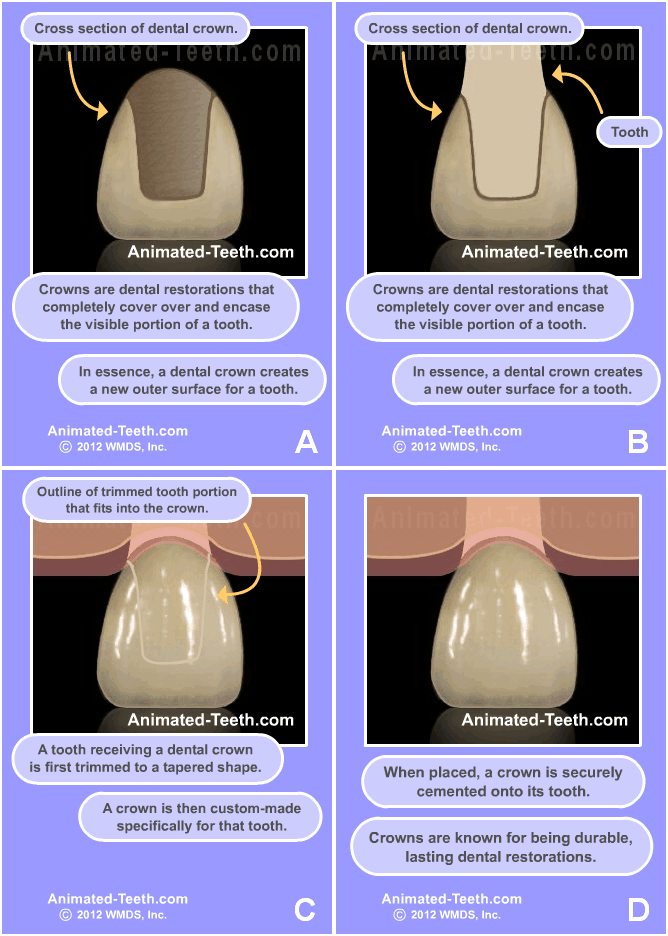
- A crown (“cap”) is a type of dental restoration that fully cups over that portion of a tooth or dental implant that lies at and above the gum line.
- Once placed, it in effect becomes the tooth’s new outer surface. (In comparison, a dental filling just fills in or repairs a portion of a tooth.)
- Crowns are permanently cemented into place. The tooth-crown unit that is created functions and is cared for just like a natural tooth.
2) Why are they placed?
There are several reasons why a dental crown might be made for a tooth. Dentists routinely use them to:
- Repair and strengthen damaged teeth.
- Improve tooth appearance (including color, shape and even apparent alignment).
While some other treatment options do exist Crown alternatives., no other kind of dental restoration provides the exact same set of benefits and advantages as a crown.
For more details about why they’re placed, see below.
Slideshow: What Are Dental Crowns?
3) Other terms for crowns.
Are a cap and a crown the same thing?
What is a tooth jacket?
What terminology does your dentist use?
In dental literature (textbooks, journals, studies, etc…), you’ll essentially never see the word “cap” used. Nor do most dentists use it when conversing with professional colleagues. The word “jacket” does still linger somewhat professionally but its use is far overshadowed by the term “crown.”
▲ Section references – Rosenstiel, Shillingburg
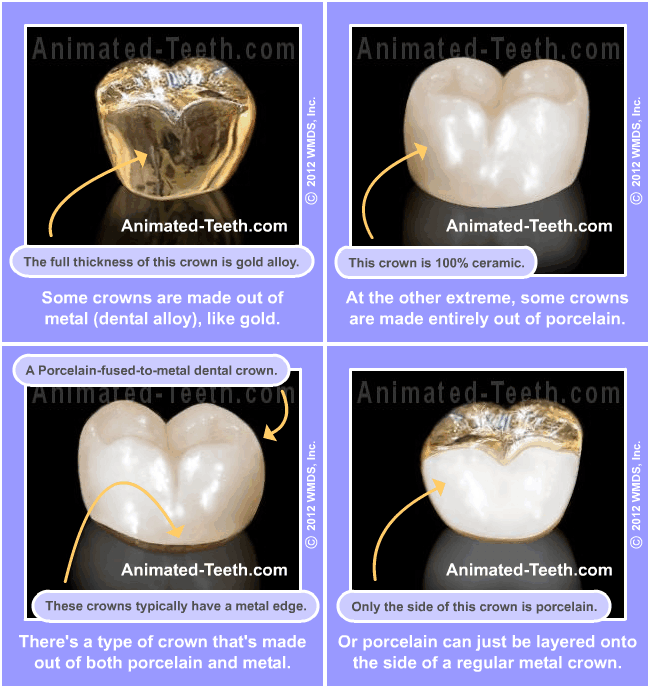
Slideshow: The different types of dental crown construction.
4) What kinds of materials are crowns made out of?
- Porcelain alone – (More frequently, other types of dental ceramics are used.)
- Metal alone – (Options: Precious, semi-precious or non-precious dental alloy. Pros / Cons)
- A combination of dental ceramic and metal alloy – (Porcelain-fused-to-metal crowns).
We’ve dedicated an entire page to this topic. – What type of dental crown makes the best choice for you? Your options.
5) Dental crown age limitations.
While there are no strict age-related limitations regarding when a dental crown can be placed, there are some important issues that should be considered.
How old do you need to be to get a crown?
Generally speaking, and primarily based on growth and development issues that tend to wind down by this point, a dentist will usually prefer to wait until a patient has reached the age of 17 or 18 years before they consider placing a permanent dental crown for them. Here’s why:
- Crest of gum line issues. – During the course of jawbone growth and tooth eruption, the position of a tooth’s gum line will change. Generally, with maturity more of the tooth’s crown becomes visible (although what’s discernible between any two sequential years may just be very minor).
If placed before this process has substantially completed, the gum-line edge of a crown may be revealed Picture., thus spoiling the restoration’s appearance.
Designing a crown so it cups over a greater portion of its tooth will enhance its stability and retention. Tooth preparation goals. Delaying crown placement until the tooth has come closer to its final fully-erupted positioning can make accomplishing this goal easier.
- Pulp chamber size. – The dimensions of a tooth’s pulp chamber (the space inside a tooth that houses its nerve tissue) decrease with age. And generally speaking, the further a tooth’s pulp tissue is from the aspect of the tooth where work is being performed (such as tooth trimming for a crown) the less likelihood for complications with it.
While the difference in pulp chamber dimensions between any two sequential years may be small, the amount of change experienced over the period of adolescence can be significant. With the comparatively smaller size that exists as a late teen providing an advantage.
- Patient cooperation. – The process of making a dental crown for a tooth is one of dentistry’s longer procedures Usual time needed.. The patient must be mature enough to be able to remain still for extended periods of time while their tooth is being prepared, or while impression materials set.
- Issues with dental insurance. – Some insurance policies include permanent crown age-limit restrictions. What ages?
(In cases where a dentist feels their patient is too young to have a permanent dental crown placed, interim alternatives do exist. Options.)
▲ Section references – Dean, Rosenstiel
6) Reasons why dental crowns are placed.
A dentist might recommend capping a tooth for a variety of reasons but most tend to fall within one or more of the following categories:
- Restoring or making changes with a tooth’s shape.
- Reinforcing a structurally compromised tooth.
- Improving a tooth’s appearance.
- Replacement of a failed existing crown. Longevity | Reasons for failure.
(Wilson)
Make sure you understand why a crown is needed.
In some instances, a dentist’s recommendation to place a “cap” is based solely on their judgment, as opposed to clear-cut clinical signs. Adding in the fact that they can be quite costly Crown fees. (and therefore a substantial profit center for a dental practice), creates the situation where finances may influence the diagnosis given.
Just as not placing a crown when one is needed has associated risks Possible consequences., performing the process of crown placement opens the door for potential complications too. Possible consequences.
7) Applications for placing crowns.
A) Rebuilding / Changing the shape of teeth.
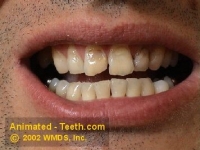
Dental crowns could be used to restore these teeth to their original shape.
Advantages of a crown.
In some instances, it’s conceivable that a dental filling might be placed as an alternative to a crown. But the latter may offer big advantages due to the way that it’s fabricated.
- Crowns are a type of “indirect” dental restoration. That means they are made in a dental laboratory by a dental technician using copies (impressions) of your teeth.
- In comparison, dental fillings are a type of “direct” restoration, meaning they’re fabricated during your dental appointment by applying materials directly to your tooth.
Why indirect fabrication can be an asset.
The big difference between the two methods is that when a dental laboratory is involved (indirect fabrication) the technician will, at their own pace, get an opportunity to evaluate aspects of your bite and jaw movements from a variety of angles using the copies of your mouth they have, and then sculpt your dental crown so it has the ideal shape.
With a dental filling (direct fabrication), the dentist may have far less control over the restoration’s final contours because it may be difficult for them to visualize, evaluate, or have access to the tooth they’re working on. There may also be time constraints involved, either associated with the materials being used (i.e. setting times) or the patient’s tolerance for the procedure.
When a crown is made, the lab technician and dentist have an opportunity to create the most ideal shaped restoration possible essentially 100% of the time. With fillings, while a perfectly serviceable result can usually be expected, achieving absolute perfection is quite difficult.
B) Strengthening teeth.
Dental crowns are routinely placed on teeth that have broken, have had large portions destroyed by tooth decay or have had root canal treatment.
That’s because beyond just restoring a tooth’s shape, a crown can provide a reinforcing and strengthening effect too.
In comparison, fillings (amalgam or dental bonding) typically can’t provide a substantial reinforcing effect for a tooth to the same degree.
(We discuss the issue of how to choose between having a filling or crown placed here. Pros / Cons)
Not all types of crowns provide the same level of protection.
Being able to provide a strengthening effect is always true for all-metal and porcelain-fused-to-metal crowns.
The strength and durability characteristics of all-ceramic crowns vary by materials and construction method Which are stronger?, so quiz your dentist about the track record of the type they plan to place for you if a strengthening effect is needed.
C) Improving the appearance of teeth.
Because a dental crown encases the entire visible portion of a tooth, porcelain crowns (porcelain-fused-to-metal and especially all-ceramic ones) can be used to enhance or idealize the cosmetic appearance of teeth.
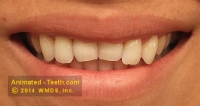
Dental crowns could be used to improve the appearance of this smile.
Capping isn’t necessarily a good idea.
Neither the crown nor the tooth’s improved appearance can be expected to last a lifetime. Here’s why. And as a result, the crowning process will likely need to be repeated multiple times over the remainder of the person’s life.
Dental crowns only make the best choice for making cosmetic changes in situations where they simultaneously serve other purposes, such as restoring teeth to their original shape or strengthening them. If those applications aren’t needed, then it’s best to at least consider alternative approaches first.
You should always consider the alternatives.
As a general rule, a crown shouldn’t be placed solely to improve the appearance of a tooth if there is some alternative procedure that could just as well achieve the same end result. That’s because during the crowning procedure a large percentage of the tooth is trimmed away. How much?
If a more conservative dental procedure (one that tends to preserve tooth structure, as opposed to sacrificing it) can equally improve a tooth’s appearance, such as a porcelain veneer Read topic., dental bonding Read topic., or even just teeth whitening (like at-home bleaching Read topic.), then it’s usually best to consider that treatment option first.
(Even though one of the above alternatives may only offer an improved, but not perfect, result, choosing it may offer substantial advantages over the long run. Here’s a link to our page that discusses the true costs of veneer placement. Overlooked consequences. In general, these same arguments apply to a set of crowns too.)
Other aspects of capping teeth we cover on our pages.
Besides the links we’ve referenced in our text above, there are several other pages on Animated-Teeth.com that visitors frequently seek.
One involves an explanation of some of the common problems people experience with crowns. Both permanent and temporary. This includes not only various types of pain and sensitivity but also what to do if you’ve lost What to do. or even swallowed one. What to do.
Due to the high price of gold, people are often interested in our page that discusses selling scrap dental restorations. How to. And then, as a brief overview, we’ve also composed a page titled: 6 things to consider when choosing what kind of dental crown to have made. A guide.
Page references sources:
Dean JA, et al. McDonald and Avery’s Dentistry for the Child and Adolescent. Chapter: Prosthodontic Treatment of the Adolescent Patient.
Rosenstiel SF, et al. Contemporary Fix Prosthodontics.
Shillingburg HT, et al. Fundamentals of Fixed Prosthodontics.
Wilson N, et al. Manual of Clinical Procedures in Dentistry. Chapter: Procedures in Prosthodontics.
All reference sources for topic Dental Crowns.