Looking for information about other Dental Topics?
Full Website Index• Animated-Teeth.com •

Dental crown alternatives. – What options do you have?
If your dentist recommends a dental crown, do you have any other options?
If your dentist has recommended a dental crown but there are reasons why you are hesitant to commit, you’ll need to know what possible alternatives exist for your tooth.
This guide explores the various treatment options you may have based on the condition of your tooth. Potential alternatives range from placing a near-crown equivalent to less robust restorations like a filling or veneer. In some cases, the best approach may be to stabilize your tooth until full treatment becomes feasible.
Ultimately, what constitutes a suitable option will depend on the specific circumstances of your case, as interpreted by your dentist. In preparation for having that conversation, our guide provides the insights you’ll need to ask the right questions.
Preventing the need for a crown.
While not a possibility for your tooth at hand, one of life’s luxuries would be to never to have to deal with this issue again. Toward that goal, we offer our page: Proactive steps you can take to reduce your chances of ever needing another crown. Jump
Possible dental crown alternatives.
Are there any exact or near-equivalents to a crown?
Yes and no.
No other type of dental restoration cups over and encases its tooth as extensively as a full dental crown. And for that reason, there is no perfectly equivalent substitute.
But other types of restorations do exist that can either help to reinforce/strengthen your tooth or improve its appearance. And in limited cases, the advantages associated with them may tend to make them a better choice.
The suitability of any alternative restoration or treatment approach simply depends on what needs to be accomplished for your tooth, and what your objections to a crown actually are.
Potential treatment alternatives typically include:
- Placing a near-crown equivalent (an onlay or 3/4 crown).
- In some situations, veneer placement may offer an alternative solution.
- Opting for a filling (tooth build-up) instead of a crown.
- Temporizing your tooth and postponing the placement of a crown.
- Choosing tooth extraction instead of crown placement.
Dental crown alternatives and alternative treatment approaches.
a) Onlays and 3/4 crowns.
These restorations are very similar to full crowns. They cup over and encase the tooth they are placed on, just less fully.
Possible full crown alternatives.
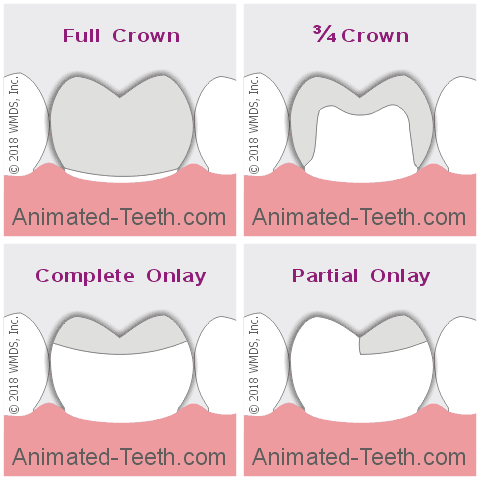
Definitions.
- Onlays just cover one or more of a tooth’s cusps. – A complete onlay covers its tooth’s entire chewing surface (all cusps, just like a full crown does), while a partial onlay only encases one or a few of them.
(Thus a partial onlay, in terms of guaranteeing a strengthening effect, really isn’t as true an alternative to a dental crown as a complete one is.)
- 3/4 crowns – These restorations encase all of a tooth’s cusps (just like a full crown), and all but one of the tooth’s sides.
Our animation illustrates the general differences in outline form between these different types of restorations. Keep in mind, from the standpoint of appearance, the restoration itself might either be all-metal (gold or silver in color) or all-ceramic (tooth-colored).
Despite these definitions, a lot of variability can exist.
Exactly just what constitutes an onlay vs. some type of partial crown vs. a full crown can be fairly arbitrary. For example:
- If the amount of damage that a tooth has sustained is substantial but not so extensive that a full crown is necessarily required, a complete onlay might be designed so it encompasses a greater extent of the tooth than is customary. For example, possibly the onlay might extend more fully over one side of the tooth than is common.
- But if this same type of extra extension is needed on most, or even possibly all, sides of the tooth (once again however, not to the same extent as is common with a full crown), whether the restoration should be classified as an onlay, 3/4 crown or full crown could easily be debated.
Inlay vs. Onlay: An issue of great importance.
Possibly one of the biggest concerns associated with defining restorations is that when you are sold an onlay for your tooth, that what is placed really is one. If it’s not, then your tooth won’t be getting the level of protection (strengthening effect) promised.
We ran across this document.
A position paper published by the American Association of Dental Consultants (AADC) points out that:
- A definition currently used by some dentists is one where inlays that have been designed to extend substantially onto one or more of the inclines of a tooth’s cusp(s) (but not actually cover over them) is miscategorized as an onlay.
- In comparison, an actual onlay entirely covers over and encases tooth cusps. A complete onlay (the design that’s a near-crown equivalent) would cover over all of the tooth’s cusps.
▲ Section references – AADC.org
The concern.
Our point here is simply this. An inlay is never considered to be a dental crown alternative. So if the all-ceramic “onlay” you’re being offered is really just an inlay, then that option isn’t acceptable.
The solution.
As a way of knowing if the restoration you are getting approaches the level of protection that a crown can provide, just ask: Will the all-ceramic onlay you’re getting fully (entirely) overlay (cover over, encase) all of the tooth’s cusps?
How equivalent are onlays and 3/4 crowns to full crowns?
As compared to dental crowns (generally meaning restorations that fully encase that portion of a tooth that lies at and above its gum line What are crowns?), complete onlays and 3/4 crowns can also help to reinforce the teeth they are placed on. So from that standpoint, they may serve as very suitable equivalents.
Resistance to cusp fracture.
The forces most likely to cause cusp fracture/damage are typically those associated with the act of closing your teeth together (chewing, teeth clenching, biting down on something hard, etc…).
Since full crowns, 3/4 crowns and complete onlays fully encase the chewing surface of the teeth on which they’re placed, they’re generally considered to be fairly equivalent in the level of protection (strengthening effect) that they can provide for tooth cusps (by way of redistributing the load that’s applied over a wider tooth surface area).
▲ Section references – Shillingburg
Resistance to root fracture.
We did notice a section in the textbook authored by Torabinejad that states that the use of a cervical ferrule (a design where the restoration’s edges circle and reinforce the tooth right at its gum line) is a key factor in preventing tooth (root) fracture. (As opposed to cusp fracture.)
It’s our assumption that the context here was in regard to teeth either known to have a root fracture, or considered to be at risk for developing this complication (like severely broken down teeth that have had root canal treatment and require post and core placement What is this?).
▲ Section references – Torabinejad
Advantages of onlays and 3/4 crowns over full crowns.
The primary advantage of placing one of these alternatives instead of a full crown is that less tooth structure must be sacrificed (trimmed away) when they are placed.
- In terms of dental philosophy, it should be the goal of every dentist to preserve as much natural tooth structure as is possible when repairing a tooth.
- Also, more aggressive tooth reduction (trimming) generally increases the potential for treatment complications. Like root canal.
- Since plaque may be more difficult to remove from around dental restoration margins (edges), trimming away less of the tooth and having them higher on its sides (like when an onlay is placed) tends to make it easier for a person to maintain the health of their gums.
Disadvantages.
- Generally speaking, the greater the degree to which a restoration covers over its tooth, the easier it is for a dentist to accomplish good restoration retention (how well it stays in place). So in some cases, a full crown might provide and advantage in this regard over an onlay or possibly even a 3/4 crown.
(Shillingburg)
- The material characteristics of a restoration must be considered. For example, will it be strong enough to provide a strengthening effect (not fracture)? Or if it shows, how will it look (will it be tooth-colored)?
The construction of crowns (full or 3/4’s) can be all-metal, all-ceramic or porcelain-fused-to-metal. Only all-metal or all-ceramic fabrication is common for onlays.
Each type of construction varies in its characteristics Pros / Cons. and these differences must be considered. Onlays probably offer the greatest challenge in making a choice because the kind that’s the strongest (all-metal, gold) is not the most aesthetic type, and ceramic onlays (which are tooth-colored restorations) are more prone to fracture. (While some types of ceramic do apparently offer enhance strength, they don’t yet have a long, well-established track record that documents this fact.)
(Stefanac)
▲ Section references – Shillingburg, Stefanac
In regard to cost, each of these alternatives (complete onlays, 3/4 crowns and full crowns) typically have a similar fee.
b) Preformed/shell crowns.
To the uninitiated, this type of restoration looks similar to a custom-made crown. But in reality, it has very few similarities to one at all (at least in terms of possessing favorable characteristics).
These crowns are prefabricated shells (metal, plastic or ceramic) that come in a range of sizes. The size best suited for your tooth is chosen. The tooth is then trimmed modestly, and the crown adjusted and adapted, until their fit with each other is acceptable.
This type of restoration can make a suitable choice for temporizing a tooth until its permanent crown can be made (an issue we discuss below). But generally, placing one makes a poor choice for any type of permanent application and therefore is not considered a reasonable alternative or substitute for a conventional crown. We explain why in greater detail here: Preformed/shell dental crowns.
c) Veneers.
A veneer is a type of restoration that’s used to cover over the visible surface of front teeth so to give them a renewed appearance. Because less tooth structure is trimmed away when placing one, a dentist should always recommend this procedure instead of a crown whenever appropriate.
Primarily due to their differing strength characteristics, if your dentist has recommended a crown for your tooth it’s unlikely that placing a veneer would provide a suitable alternative. (This page explains more about crowns vs. veneers. Appropriate applications for each.)
Other options and alternatives to the placement of a dental crown.
- Have a filling (tooth build-up) placed instead.
- Delay having the crown placed.
- Temporize the tooth, so the placement of the crown can be postponed.
- Ask about financial arrangements that make immediate treatment possible.
- Confirm the need for the crown with a second opinion.
- Have the tooth extracted.
Each of these alternatives are discussed below.
a) Have a filling placed instead of a crown.
Having your dentist place a dental filling instead of a crown can sometimes be a workable alternative. However, there are a number of factors that must be taken into consideration before selecting this option.
Big fillings don’t strengthen teeth like crowns do, therefore possibly leading to cusp fracture.
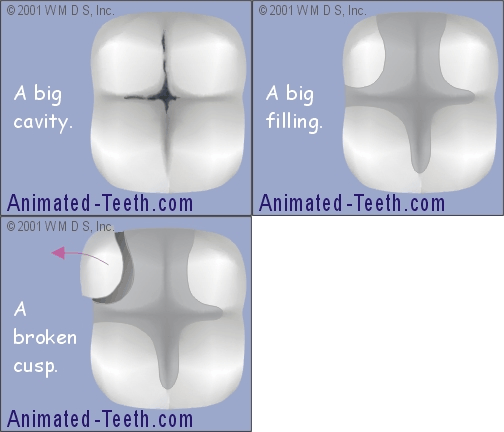
Fillings vs. Crowns.
- You can’t expect a filling to provide the same level of lasting service (filling Longevity reports. vs. crown. Longevity reports.)
- Or have a shape that’s as functionally perfect, due to the fact that a crown is designed and fabricated in a dental laboratory instead of on the fly directly in your mouth. What we mean.
- Possibly more of a concern, fillings don’t provide the same level of protection for a tooth from fracture Full discussion. | Examples., thus placing it at risk for cracking or breaking sometime in the future, sometimes irreparably. Possible outcomes.
(FYI: Most of the links on this page open to independent pages that discuss that issue at length.)
Having said that, it’s certainly not unheard of that a person’s choice for filling placement has worked out just fine for them.
Bottom line, based on their knowledge and experience it’s your dentist’s obligation to warn you of what may happen if a filling is placed instead of a crown, and the risks can be substantial. But no one can absolutely see the future outcome for any one person’s situation and at times a filling may work out to be an adequate alternative.
A crown can still be placed at a later date.
Having a filling placed now doesn’t mean that you can’t have a crown placed later. In fact, that’s a great thing to do.
- In some cases, so much tooth structure has been lost (from fracture, tooth decay, etc…) that a dentist will place a “dental core What is this?” as a replacement for it before the tooth’s crown is made. (This is often referred to as a “tooth build-up.”)
Doing so can help to improve the crown’s retention and stability. So the filling you have placed now, might serve as a build-up later on.
- If you have opted for a filling instead of a crown, going ahead and having one placed whenever circumstances (financial, time, etc…) finally permit makes the safest and most predictable plan.
This type of filling-first approach is common when a person’s treatment needs to be phased. (As in, phase 1 involves placing a filling in your tooth and also fixing up your other teeth that have immediate needs. Then, once all active issues have been stabilized, phase 2 involves placing more definitive restorations, like a crown for your tooth).
Advantages of this alternative.
There are some general advantages that placing a filling instead of a crown offers. They include:
- Less cost, possibly significantly so. (Related pages: Fees for fillings. Fees for crowns.)
- Less tooth structure is trimmed away when placing a filling vs. a crown.
- A crown usually takes two appointments to place, whereas a filling just requires one trip to your dentist’s office.
Beyond the simple convenience that offers, in uncertain times, like the 2020 Coronavirus (COVID-19) pandemic, your dentist may feel that placing a filling as a tooth’s emergency treatment (as compared to placing a temporary/disposable crown cemented with temporary cement) makes a more predictable, more firmly anchored restoration choice in light of not knowing when the completion of the tooth’s crowning procedure can even be scheduled.
Of course, none of these advantages really exist if choosing a filling leads to an event that causes further, possibly irreparable, damage to the tooth.
b) Delay having the crown placed.
Delaying placement of a crown can provide an appropriate alternative in some situations. With others however, doing so might make the absolute worst choice. For this reason, you should never choose this option without the advice and concurring opinion of your dentist.
- Many times a tooth’s need for a crown is diagnosed during a routine dental exam when the dentist first notices that a filling has begun to deteriorate.
In the case where it is “serviceable although less than ideal,” postponing the placement of a crown may make a reasonable choice.
- But in cases where decay is already present or the tooth has broken, delaying your treatment could very well lead to more serious complications or even tooth loss.
Advantages of this alternative.
Delaying treatment really doesn’t offer any advantages for your tooth. Your finances or schedule may make postponing your procedure a necessity. But keep in mind that in the meantime your tooth remains at some level of risk.
c) Temporize the tooth so its crown placement can be delayed.
Some teeth that require a crown have some type of immediate issue that needs to be addressed. This might be tooth decay, missing portions or a fragile state.
In some cases it might be possible for the dentist to temporize the tooth (phase 1), thus providing a somewhat extended time frame before its permanent restoration (phase 2) must be placed.
Examples:
1) Temporary fillings.
If a tooth has an area of decay, it might be possible for the dentist to stabilize it by removing the cavity and then placing some type of temporary filling.
- Some temporary restoratives have a very short effective lifespan (in terms of the seal they create, resistance to wear, or the protection they provide such as resistance to fracture), and therefore only offer a short-term solution.
- Others, including dental amalgam (a “silver” filling) or dental composite (a “white” filling), might be used to create a “semi-permanent” temporary restoration that the dentist feels is durable enough to provide interim service for several months or even longer.
2) Temporary crowns.
If a substantial portion of the tooth is missing, a dentist might go ahead and place a temporary crown Crown procedure steps. so it receives some protection. The crowning process could then be resumed at a later date.
A literature review by Schwass reported that:
- The typical “chairside” temporary (one made by a dentist during the patient’s appointment) can be expected to provide service for up to 3 months.
- Laboratory fabricated ones (made from heat-cured plastics) can last as long as 1 year.
▲ Section references – Schwass
Advantages of these alternatives.
While either of these approaches may provide an adequate solution, neither would be considered “ideal” treatment. The temporary nature of these kinds of restorations places your tooth at some level of risk.
If this alternative is chosen, you should ask over what time frame it would be expected that your tooth’s temporization should remain stable. You’ll also need to ask what precautions you should take during this period.
d) Ask if financial arrangements can be made.
For many people, it’s the cost of the crown Fees. that creates the barrier to having their work performed.
Since this is such a common obstacle, it’s likely that your dentist will have some type of financial arrangements or credit plan available so your crown can be placed now and paid for over time.
Advantages of this alternative.
Arranging so your dental work can be performed now offers a great solution for your tooth but may be hard on your pocketbook. Financing dental work is a type of “unsecured” consumer debt. As such, it’s usually a comparatively expensive source of funds.
e) Confirm the need for the crown with a second opinion.
Different dentists have different training and clinical experiences, as well as different skills and abilities. Conferring with a second dentist may offer varying views or insights as to what might be considered usual and appropriate treatment for your tooth.
There isn’t always just one right solution to every problem. Hear each dentist out and see whose approach makes the most sense to you.
f) Have the tooth extracted.
Tooth extraction vs. crown placement.
This seemingly cheapest and simplest alternative may in some cases ultimately end up making the worst and most expensive choice. However, in some instances it actually might make a perfectly reasonable alternative.
Potential problems and complications.
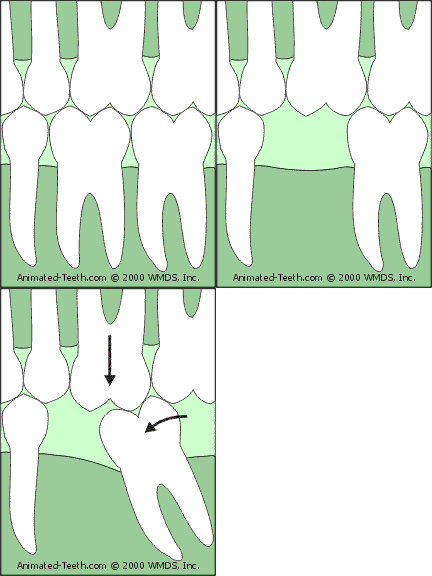
Losing a single tooth can trigger widespread changes with your bite.
Occlusal stability.
Speech and appearance.
Little really needs to be said about how losing a tooth that plays an important role with either of these functions might affect a person’s self-esteem and life.
Some teeth really may not be all that valuable.
It’s possible that the loss of some teeth might not be expected to lead to any substantial changes for the person, either now or in the future. (This is typically due to the tooth’s location in the mouth and its lack of significant relationship to other teeth.) If so, having an extraction might offer a reasonable choice.
- Considering all of the potential factors involved, it seems unlikely that a person could come to a qualified decision about the appropriateness of this option without their dentist’s guidance.
It makes far more sense to make an educated choice, rather than a poor one that ultimately ends up being problematic to correct.
- Even if the tooth serves no obvious function, its presence in the jaw does help to prevent bone atrophy (loss) Here’s why., and thus might be retained for that reason.
- Since little would be lost if the tooth’s reconstruction failed (it would be extracted either way), placing a filling rather than a crown might prove to be a reasonable approach.
Can’t any tooth that’s extracted just be replaced?
▲ Section references – Stefanac
Last reviewed: February 02, 2025
Author: Paul Cotner, DMD — retired dentist.
Published by: WMDS, Inc. — owner of Animated-Teeth.com.
Educational information only — not a substitute for professional dental care.
Page references sources:
AADC.org Defining and Differentiating Inlays and Onlays. Position statement.
Shillingburg HT, et al. Fundamentals of Fixed Prosthodontics. Chapter: Preparations for Intracoronal Restorations.
Schwass DR, et al. How long will it last? The expected longevity of prosthodontic and restorative treatment.
Stefanac SJ, et al. Diagnosis and Treatment Planning in Dentistry. Chapter: Definitive Phase Treatment.
Torabinejad M, et al. Endodontics. Principles and Practice. Chapter: Preparation for restoration.
Comments.
This section contains comments submitted in previous years. Many have been edited so to limit their scope to subjects discussed on this page.
Comment –
Crown versus onlay for damaged molar.
Lots of helpful information, but please include something about onlays versus crowns for damaged teeth, as one dentist recommends an Emax onlay (made in-house) and the other a PFM crown (outsourced locally) for a #15 molar that just lost a chunk of old amalgam and a bit of tooth. Thank you.
Jacquelin S.
Reply –
The advantage of the onlay is that less sound tooth structure is trimmed away. (As compared when a crown is placed, a greater portion of your original tooth still exists.)
That’s an advantage (the usual goal of dentistry is to preserve natural tooth structure to the greatest extent possible), the trade-off however is that retention (keeping the restoration in place) may be a problem. (Fully covering over a tooth [like a crown does] usually aids restoration retention.)
In your case, an eMax restoration can be cemented adhesively (bonded) or conventionally (like your PFM probably would be). Either way there’s no real reason to expect that retention will be a problem. It’s just that as compared to a crown there is more potential for it. The possibility of adhesive cementation makes the point of retention less of an issue for the onlay.
There could be strength concerns (fracture) with an all ceramic onlay (with a gold onlay there wouldn’t be). Once again, there doesn’t have to be, but as compared to a PFM crown there is more potential for it. (The link above is for all-ceramic crowns but applies to onlays too. Read points #2, #3 and #4. Note, monolithic ceramic construction is the strongest. Also notice that Zirconia is the strongest type of synthetic ceramic.)
Philosophically, assuming that conditions are correct for the onlay (no exceptionally heavy chewing forces, no teeth grinding habit, preferably monolithic construction), the onlay is probably more in line with what will be practiced as dentistry 10 years from now.
Staff Dentist
Comment –
Onlay or crown: % of molar visible for successful onlay?
Thank you for your reply. What is still unclear to me is how much damage a tooth can sustain before a crown is a better solution than an onlay, and I cannot find details about this on your site? With one dentist recommending an onlay (Lithium delicate), which I’d prefer because less tooth is removed, and the other a crown (PFM w/ high noble metal) and possible root canal (outsourced), depending on what lies beneath the remaining amalgam and decay once removed, it’s hard to know if dentist 1 is optimistic (onlay) and dentist 2 greedy (crown), or if both proposal would work well and for as long? FYI, a cusp is gone and the amalgam filling was big and well over 10 years old before the 2 pieces broke off separately last month (a small piece of amalgam with tooth chip first, a big chunk of amalgam w/ no tooth weeks later). This was a first visit to new dentists (acquaintance recommendations), and dentist 1 (onlay) offered his proposal after bite-wings and a visual, and dentist 2 after an intraoral-periapical x-ray and visual (plus a glance at the bite-wings I brought on a digital key); the hole is large and the bite-chewing molar (#15) is missing a cusp. Again, thanks for any illumination to help decide which dentist to make an appointment with (!).
Jacquelin S.
Reply –
>>What is still unclear to me is how much damage a tooth can sustain before a crown is a better solution than an onlay …
The questions you ask are essentially the value of going to dental school and then “practicing” dentistry (as in gaining experience by treating patients). And overall, you’re simply not going to find an adequate answer via the web because treating teeth is a clinical science, and as such involves multiple variables that require direct inspection.
We understand your dilemma but there’s little of value that we can add. What contributes to our difficulty is knowing the exact extent of the “onlay” that has been suggested. (See inlay vs. onlay definition discussion above. Note, you have described it as an in-house, all-ceramic restoration).
Generally speaking, the direction dentistry is headed in is one of adhesive dentistry and minimizing the extent of restorations. But whether this makes the best solution for your current situation would be impossible for us provide valid input about. You’ll either need to query your dentists, or other dentists, further, or defer to the judgment of the one you have the most confidence in.
Staff Dentist
Comment –
Crown vs extraction in 97 year old.
My 97 year old father who has dementia, has been told by his dentist that he needs a crown on a back tooth used for chewing (I don’t know which one it is). My sister wants to just have the tooth pulled. In your experience have seniors done well with tooth extraction instead of a crown?
Faith
Reply –
We’re not going to be able to answer that question for you. But hopefully we can give you some suggestions as to issues to consider.
Extraction is a surgical procedure where as crown placement is not. Are there any medical reasons why an extraction would want to be avoided if possible?
You don’t mention how many teeth your father has (many or just a very few), and how vital the one in question is to his eating ability. Or if it serves some important function such as anchoring a partial denture. Not being able to maintain a proper diet without the tooth could conceivably be an issue.
With your mention of your father’s condition, assuming the tooth was extracted and then found sorely missed, one would guess he would have limited ability to learn how to use a new appliance (such as the case where a partial denture might be made to replace it).
It’s your father’s dentist’s professional obligation to explain all aspects of his case to whomever is designated as his caretaker, so you should ask them for a more thorough explanation. Once you have all of the details, and have had all possible options explained, the decision may be easier to make.
Staff Dentist