Looking for information about other Dental Topics?
Full Website Index• Animated-Teeth.com •

How long do porcelain veneers last?
This page covers the subject of porcelain veneer (dental laminate) longevity, divided into these topics.
- How long do conventional porcelain veneers last? – Based on the findings of research studies.
We also include in this section a list of things that tend to go wrong, thus causing the need for veneer replacement.
- How long do ultra-thin porcelain veneers (Lumineers®) last?
- Tips and pointers that can help to extend the lifespan of your veneers.
- Instead of veneer placement, what other dental procedures might be considered?.
FYI: If you’re currently experiencing an emergency, visit this page: What to do if you’ve had a veneer come off or break.
How long do (conventional) porcelain veneers last?
The consensus of research studies seems to be that porcelain veneer longevity (survival) typically lies in the range of 90 to 95% after 10 years of service. With longer-term studies suggesting a restoration survival rate of over 80% after 20 years.
This includes veneer failures of all types, ranging from mechanical (breaking, chipping, debonding, etc…) to aesthetic deficiencies (the appearance of the veneered tooth has deteriorated and is no longer satisfactory).
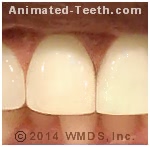
A veneered tooth.
Does that mean that porcelain veneers make a good choice for the long term?
Additional FAQ about veneer longevity.
(Our answers here are brief. We explain these issues in greater detail following these questions.)
If veneers can last 10 years, what happens during the next 10?
Nothing necessarily. There’s no looming “expiration” point you have to be worried about. And if your veneers have been trouble-free initially, that’s certainly a good sign.
But as their years of providing service continue, the materials from which they’re made (porcelain, dental bonding) will continue to age, wear, and fatigue. And with a longer timeframe also comes more chances for experiencing random events that may result in damage.
So, after 10 years of reliable service, you don’t have to expect that problems will immediately start to occur. But it’s not realistic to assume that you’ll get by without them indefinitely.
Can porcelain veneers last for 25 or 30 years? Can they last forever?
Achieving an extended lifespan may be possible. But reaching each successive milestone should be considered increasingly unlikely.
The longest-lasting cases typically involve veneers that are: 1) Bonded primarily to tooth enamel alone (as opposed to a combination of enamel and dentin, which may result in a weaker attachment). 2) Have a design that minimizes their exposure to extreme forces. 3) Are worn by patients for whom minor cosmetic imperfections (like those that tend to result from gum recession or minor cement staining at the edges of veneers) aren’t such a giant concern.
After 10 years, should you just go ahead and have your porcelain veneers replaced?
No, that doesn’t make a very good plan. Here’s a primary reason why …
Tooth enamel (the absolute most reliable substrate for bonding veneers) can never be replaced. And each time the veneering process is repeated, a little more will most likely be trimmed away. Replacing veneers without good reason (like arbitrarily every 10 years) may result in a point later on where a suboptimal amount of enamel now exists for this procedure.
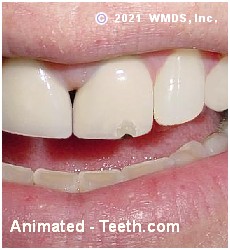
A chipped porcelain veneer.
How do you know when your veneers need replacing?
Some problems will be immediately obvious like if you have a veneer chip, break, or come off. In other cases, it may take you a while to finally decide that replacement is indicated. (For example, cosmetic deficiencies, like those due to gum recession or stain build-up at visible veneer edges, may be very gradual events).
You might be oblivious to other problems. For example, decay formation or partial veneer debonding might only be detected during a dental examination by your dentist.
Do veneers eventually break or fall off?
No, not necessarily. A veneer’s bond to its underlying tooth can be astoundingly strong (especially if that surface is enamel). And if a veneer has been designed so the level of forces it’s exposed to are minimal, mechanical failure (chipping, breaking, debonding) may never occur.
Can you go back to normal teeth after veneers?
No, that’s not the norm. In most cases, once veneered, a tooth will always require another veneer or, as a next step a dental crown, to look and feel like a normal tooth.
In theory, a “no-prep” veneer might be trimmed off its tooth, thus returning it to its original (misshapen or blemished) form. From a practical standpoint, however, actually opting for or achieving this outcome is probably pretty rare.
How much does it cost to replace a veneer?
Expect to pay the same as what your dentist currently charges for initial veneer placement. And keep in mind, this may be substantially different from what you paid many years ago when yours were originally placed.
When making replacement veneer(s), your dentist’s expenses (the amount of appointment time they need to set aside, the laboratory bill they incur when your restorations are made) are pretty much the same as for an initial veneer placement case. As such, they will need to charge accordingly.
Is it painful to replace veneers?
What you experience during the replacement process will probably be similar to what you experienced your first time around. So, if you required a dental anesthetic then, that may make the right choice for your replacement work too.
With replacement veneers, one would expect that the level of actual tooth preparation (trimming) needed would be very minimal and therefore not cause significant pain. (More likely, whatever drilling is performed will be mostly confined to removing the previous veneer). However, the gum tissue surrounding your tooth may need to be manipulated (like when taking the impression), and therefore an anesthetic needed to keep that process from hurting.
Do e.Max (“Emax”) and Zirconia veneers last longer?
The main benefit of using these materials for veneer fabrication is that they are substantially stronger than traditional dental ceramics (i.e. porcelain).
As such, one would expect that the restoration’s likelihood of breakage or chipping would be reduced. However, it’s important to point out that in many cases a veneer can be designed where its exposure to extreme forces can be minimized.
(A reason not to choose these materials is that using traditional ceramics may result in better veneer esthetics. Ask your dentist for their opinion about your case.)
Dental research that’s evaluated porcelain veneer longevity.
To give you an idea of what’s been published, here’s a sampling of research studies and literature reviews that have reported on the subject of how long porcelain veneers can last and what are the common causes of case failure.
1) Layton (2007)
This study evaluated 304 porcelain veneers (100 individual patients) that had all been placed by the same dentist over the course of 16 years.
Findings.
The restoration survival rates reported were: 96% at 5 to 6 years, 93% at 10 to 11 years, 91% at 12 to 13 years, and 73% at 15 to 16 years.
(The paper stated that the rate reported for the 15-to-16-year group (the longest timeframe followed) was likely skewed to the downside because one person in that group, which was already only composed of a small number of restorations, was no longer available for participation in the study.)
Reasons for failure.
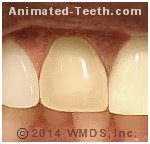
A debonded (lost) porcelain veneer.
2) Beier (2012)
This study evaluated 318 porcelain veneers (84 individual patients) that had been placed over a 22-year period.
Findings.
The survival rates reported were: 95% at 5 years, 94% at 10 years, and 83% at 20 years.
Reasons for failure.
3) Land (2010)
This paper reviewed the findings of 50 published research articles (including our Layton reference above) that studied the subject of how long porcelain veneers can last.
So, what level of longevity should you expect?
According to the studies cited above, it’s easy enough to anticipate that:
- Most porcelain veneers should be able to last for a period of at least 10 years (95% survival rate).
- Beyond that, failure rates do increase but not overwhelmingly or drastically so.
Is getting veneers really worth it?
While the expected lifespan/survival rate of porcelain veneers is high (around 95% at 10 years), it’s not 100%.
And that places a patient considering this procedure in a position where they must decide if that’s high enough to have what’s usually considered elective dental work performed. Especially when reasonably equivalent, although admittedly usually less perfect, alternative procedures might be explored first.
How long will ultra-thin (Lumineers®) veneers last?
Studies suggest that ultra-thin porcelain veneers can be expected to have a lifespan that’s on par with conventional ones.
Several studies have shown that the lifespan of a Lumineer® (a brand of ultra-thin veneers) can easily exceed ten years. One study found a 94% success rate at 20 years. (Ciancio)
No-drill placement.
In terms of restoration survival, placing ultra-thin veneers using a no-drill protocol has the advantage that (in most cases) they are bonded entirely to enamel. In comparison, when any degree of tooth-preparation is involved, there’s always the possibility that some amount of dentin will be exposed (the layer underneath enamel).
Studies have unquestionably documented that the bond strength with tooth enamel is the strongest one dentistry has to offer (Ozturk). And while some amount of dentin exposure in preparations is perfectly permissible without unduly affecting case longevity, the use of a no-drill technique (typically) avoids this issue entirely.
What happens if problems occur?
▲ Section references – Ciancio, Ozturk
Can’t ultra-thin veneers just be removed?
Because some tooth trimming is involved, teeth that have had a conventional porcelain veneer placed on them will, from that point on, always require some type of dental restoration (veneer or crown) in order to have a satisfactory appearance.
And you may wonder if this same general statement applies similarly to ultra-thin veneers (like Lumineers®) when a no-drilling protocol has been used to place them.
The reality.
The idea that ultra-thin veneers are “reversible” (can simply be taken off and left off) may help to create public demand for this procedure. But it seems true mostly in theory only. Yes, they can be ground off. But it’s not necessarily a quick and easy process, nor is it likely that your tooth will be returned to its initial pristine condition.
The bond that’s been created during the placement process is very strong and the cement that’s been used typically remains stubbornly attached to the tooth’s surface.
It can be trimmed and buffed off. But that’s not necessarily an easy task, especially when a number of teeth are involved. And it has to be expected that the surface of the tooth’s enamel will be shaved and scuffed up at least somewhat during the process.
How does the expected lifespan of porcelain veneers compare to other types of dental restorations?
a) How does porcelain veneer longevity compare to dental crowns?
The expected lifespan of veneers compares favorably with the reported survival rate of dental crowns placed in locations where their cosmetic appearance is important (i.e. front teeth).
A paper by Jacobson states that otherwise serviceable crowns are frequently replaced at an interval of 7 to 10 years due to deteriorated appearance. Studies suggest that porcelain veneers (also a strictly cosmetic dental procedure) can be expected to meet and exceed those numbers.
b) How does porcelain veneer longevity compare to composite veneers?
▲ Section references – Jacobson, Wakiaga
You must anticipate that your veneers will need to be replaced at some point during your lifetime.
You can’t realistically expect any type of dental restoration to last forever. This is especially true in those cases where its appearance is a critical factor (such as a veneer on a front tooth).
That means that beyond your initial expenses for your work, there will be others. And depending on your age, you may encounter these additional costs more than once.
We discuss this topic in greater detail on our page: What is the true cost of having porcelain veneers placed? This is an important read if you’re considering having them placed as an elective procedure. Alternative procedures should always be considered too.
Tips (care and precautions) that can help your veneers last longer.
What can you do to make your veneers last longer?
The lifespan of your porcelain veneers will be affected by the way you take care of and use them. That includes how well and frequently you perform oral home care (which helps to prevent both tooth decay and gum recession). And avoiding situations and minimizing habits that expose your veneers to excessive forces, temperature extremes, and staining influences.
Here are some suggestions that can help to extend the life of your veneers.
A) Practice good oral home care.
Around 6% of veneers that fail do so related to the formation of tooth decay. And about 13% are due to complications with gum disease. (Bona)
Since a veneer’s edge lies right at the gum line, just a little gum recession can spoil its tooth’s appearance.
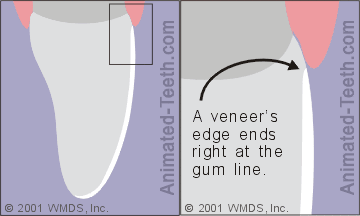
Gum recession.
Recession can be caused by not brushing well enough, brushing too vigorously, or even a habit of clenching and grinding your teeth. Your dentist should be able to help you monitor what’s going on in your case.
B) Avoid excessive forces.
While durable, porcelain veneers are not strong. They’re not able to withstand extreme forces.
That means you should avoid activities that direct forces onto them. This would include things such as biting your fingernails, hairpins, pencils, ice, or any other hard objects. Biting into hard foods, like raw carrots, could be a concern too. If you engage in sporting events, you should wear an athletic mouthguard.
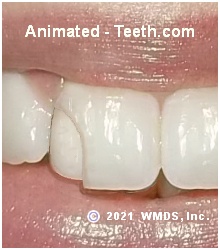
A broken porcelain veneer.
Avoid clenching and grinding your teeth.
▲ Section references – Beier
What happens if a problem occurs?
If you have a porcelain veneer come off or break, you’ll most likely find that your dentist will tell you that a new one must be made. There is no simple DIY fix.
The cement layer that lies between a veneer and its tooth has the potential to stain.
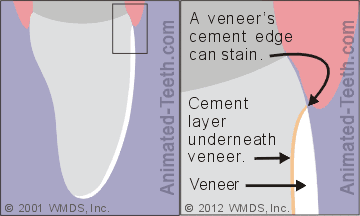
C) Minimize staining influences.
▲ Section references – Beier
D) Minimize temperature extremes.
A veneer that’s been placed is a sandwiched affair. In its entirety, the restoration is composed of porcelain, cement, and the surface of a tooth’s enamel.
Each of these materials will expand and contract at different rates when exposed to the same temperature variations. And after many years, a point may finally be reached where restoration fatigue results in it cracking or breaking.
How veneering technique plays a vital role in porcelain veneer longevity.
As one final point, we think it’s important to explain that when it comes to long-term success, the placement of porcelain veneers is a technique-sensitive procedure.
When placed in accordance with accepted tooth preparation and adhesive guidelines, they can be expected to provide the level of service mentioned above. But if not, a reduction in longevity can be expected.
a) Operator skill.
Your dentist’s experience and skills can play a significant role. As an example of what degree of variability might be involved:
- A literature review by Swift cites a study that found the failure rate for porcelain veneers placed by dental students to be almost 80% higher than those placed by dentists on their faculty.
The ideal situation is one where the tooth surface a porcelain veneer is bonded to is 100% enamel.
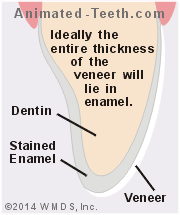
b) Is the veneer bonded primarily to dentin or enamel?
- The strongest bond possible (veneer-to-tooth) is created when the entire surface of the tooth’s preparation is enamel.
- A bond can be created with dentin (the tooth layer underneath a tooth’s outer enamel surface) but doing so is far less strong and predictable.
▲ Section references – DiMatteo
Background.
When porcelain veneers were first introduced in the 1980s, the protocol used to place them primarily involved bonding them onto tooth enamel. And due to that, it’s easy to explain the high success rates reported in many long-term studies (like those cited above).
Nowadays.
More recent trends in tooth preparation for laminates include greater (deeper) tooth reduction. And as a result, many veneer preparations nowadays contain large regions of tooth dentin, a situation that will likely negatively impact the high success rates previously reported.
At least a part of this trend is due to an (inappropriate) expansion of the applications for this procedure. Ones that require extensive tooth trimming so to be able to either:
- Realign severely misaligned teeth (“instant orthodontics”).
- Mask the color of very dark teeth.
(With either of these applications, dental crown placement would be expected to make the more suitable type of restoration.)
What does research say about deeper veneer preparations?
The issue of how the current trend of greater tooth reduction (and therefore more dentin exposure) may affect veneer survival was the subject of a literature review performed by Burke.
- This paper cited one study that concluded that roughly 25% of the cases they evaluated were “over-prepared” (involved tooth dentin) when compared to the original protocol for this technique. (Thus demonstrating that the suggested change in trends is occurring.)
- It also mentioned that for at least one dental liability insurer in the UK, claims against dentists involving porcelain veneers doubled between 2005 and 2010. (Suggesting that current trends are affecting veneer success rates.)
- Of the 24 studies evaluated, 1/3 specifically related veneer failure to excessive exposure of dentin in the tooth’s preparation, thus resulting in a conclusion by the reviewer that there is “reasonable evidence that a veneer preparation into dentin adversely affects survival.”
- “Recent reports of 50% failure at six years and 34% fracture are disturbing when compared with 93% to 100% success rates of 15 years observation in the 1980s.”
- “Recent UK data indicates a success rate for veneers placed within the General Dental Services in England and Wales of just over 50% at 10 years.”
▲ Section references – Newsome
What should you do?
We understand that it’s beyond the scope of the average patient to know if their case makes a reasonable application for the placement of porcelain veneers (in terms of the amount of tooth reduction needed). But it is easy enough to ask your dentist simple questions using terms that directly address this issue.
- The primary question at hand is simply if the veneer’s entire preparation will lie solely in enamel.
- If not, will at least the margins (edges) of the veneer be bonded to enamel?
If the answer to either question is no, you have reason to ask your dentist to elaborate. There is no question that some degree of dentin exposure in the preparation is permissible, it’s simply a question of how much and where.
Your dentist will need to explain the specifics of your case and how far from the ideal it lies. As well as to what degree this can be expected to affect longevity.
On their answer, you’ll need to decide if the increased risk involved makes choosing veneers, especially as an elective procedure, a reasonable choice for you.
What alternatives are there to placing veneers?
Now that you know a lot about what can go wrong with porcelain veneer restorations and how long they can be expected to last, you may wonder, what other choices are available?
Well, depending on your situation, there are a number of other dental procedures that may possibly be able to provide you with a reasonably similar esthetic outcome. They include the following:
- Teeth whitening treatments.
- Microabrasion technique.
- Orthodontic treatment.
- Esthetic tooth recontouring.
- Dental bonding / Composite veneers.
These may not be exact equivalents.
We’re not suggesting that these substitutes can absolutely give the exact same type of picture-perfect look that a set of veneers frequently can.
But settling for a slightly less than perfect result, when combined with advantages such as lower initial cost, lower long-term maintenance costs, less tooth structure loss, or providing a treatment outcome that has greater longevity, may make one of these alternatives look quite attractive.
Other dental procedures that might be considered in lieu of placing porcelain veneers –
1) Tooth-bleaching treatments.
Whitening treatments can be performed by your dentist in their office or else on your own at home. Either method can be expected to create a similar end result.
Disadvantages
1) This approach will only provide a color change for your teeth, so if their alignment or shape isn’t already pleasing, it’s not a solution.
2) Bleaching results can be unpredictable and they take time and effort to achieve (especially if you’re performing treatments on your own).
[Even when the outcome is uncertain or disappointing, veneer cases can typically benefit from whatever whitening effect has been achieved. A need to create a smaller color shift typically allows for more lifelike (translucent) veneer construction.]
3) The whitening results you get will tend to relapse over time and will need to be renewed.
Advantages
This is the most conservative way to remove tooth discolorations (the integrity/structure of your teeth remains unchanged). Long-term maintenance (touch-up treatment) is simple.
Cost Comparison
Whitening treatments should provide substantial savings over veneers initially. There is the question of how frequently touch-up work will be required. But especially in the case where an at-home method is used, even with this cost factored in this approach can be expected to be far less expensive.
2) Microabrasion.
- It involves the use of a coarse polishing compound (e.g. pumice or silicon-carbide particles) mixed with an acidic solution (e.g. 5 to 18% hydrochloric acid solution or 37% phosphoric acid gel).
- The tooth’s surface is buffed with the slurry (not unlike when your teeth are polished during cleanings) for a brief duration (usually a minute or less). The slurry is then thoroughly washed off.
- Upon completion of the process, fluoride is usually applied to the tooth to help protect its treated surface.
▲ Section references – Sundfeld, Alvarez
Disadvantages
The results obtained can be unpredictable since there’s no way to know beforehand how deep in the enamel the blemishes lie.
In those cases where it’s not totally successful, the tooth’s appearance should at least be improved. Whitening treatments can then sometimes be used to help blend in the residual blemish with the remainder of the tooth.
Advantages
Since the offending portion of the enamel has been removed, the results are permanent. The physical structure of your teeth is only minimally changed. In cases where a rough enamel surface existed initially, it will be smoothed. No long-term maintenance is required.
Cost Comparison
The use of this method should provide substantial savings over placing veneers. An estimated fee for treating a single tooth would run on the order of $50 to $100.
3) Orthodontic treatment.
Orthodontic treatment can provide a wonderful alternative to veneers. Especially in light of the fact that there are so many ways to have it (many of which are much less noticeable and more convenient than traditional metal braces).
Of course, certain pre-existing conditions need to exist.
1) Your teeth must have a generally pleasing shape and outline form, although minor shape changes can usually be made quite easily after treatment has been completed (see below).
2) Your teeth need to have a pleasing color (or you’ll need to include tooth whitening in your overall treatment plan).
When it will provide an acceptable solution, dentists typically consider using an orthodontic approach to be “ideal” treatment.
Disadvantages
The main drawbacks of this approach are: 1) The amount of time needed for treatment (months, or more likely, one or two years). 2) The inconvenience of having treatment (although with removable systems like Invisalign this is less of a factor).
Advantages
The physical structure of your teeth remains unchanged. Long-term maintenance simply involves wearing a retainer.
Cost Comparison
It’s likely that the cost of orthodontic treatment will be on par with placing a set of veneers (six or so).
4) Esthetic tooth recontouring.
It’s sometimes possible for a dentist to substantially improve a smile simply by trimming and recontouring the shape of its teeth.
This just involves rounding off corners, evening out biting edges, and shaving back prominent areas. Only portions of enamel that don’t affect the health and welfare of the teeth are trimmed off.
Disadvantages
Some tooth structure is sacrificed (but just minimally so).
Advantages
This procedure is simple and quick. No anesthetic should be required. No long-term maintenance is needed.
Cost Comparison
While it’s hard to know exactly what a dentist might charge for this service (for just 1 or 2 teeth, probably little or nothing). Of all of the alternatives we discuss on this page, this should be the least expensive one by far.
5) Dental bonding.
Bonding can provide an alternative to porcelain veneers in two ways.
a) Localized application of dental composite.
With this technique, dental composite (white filling material) is used to mask individual cosmetic imperfections like chips, divots, and stains.
A big advantage of using this method is that the bonding is only placed in those areas where the problem actually exists. In comparison, with veneering technique, the entire front side of a tooth is resurfaced.
Advantages
While improved, the tooth remains as minimally altered as possible. (This method makes the best choice for teeth that have small, isolated blemishes or defects.)
Disadvantages
Bonding isn’t as lasting as porcelain. But at that point when its appearance needs rejuvenating, it’s usually relatively easy and inexpensive to fix or replace.
[This page discusses bonding vs. porcelain veneers in greater detail.]
Cost Comparison
The fee for this service will vary by way of the extent to which it’s needed for each tooth. But in all cases, you can expect that your initial costs will be substantially less than if porcelain veneers are placed.
Long-term maintenance is the unknown issue here. But if the areas of bonding are small, you can still expect this to be the more cost-effective approach.
b) Composite veneers
Veneers made out of tooth bonding can be considered to be a true alternative to porcelain ones, in the sense that they serve the exact same purpose. Other than that they are very different (composite veneer placement vs. porcelain veneer placement).
Advantages
These veneers are cheaper, take fewer appointments to place, and can be easily repaired if needed.
Composite veneers are sometimes placed as diagnostic restorations, thus allowing the patient to evaluate proposed changes before committing to porcelain veneer placement.
Disadvantages
They may be able to provide a result that’s similar to porcelain veneers. But this is very dependent upon the dentist’s skills, and even then they may have a less-natural look because of the nature of dental composite itself. (Use the link above to learn more about the differences between bonded and porcelain restorations.)
In general, most people typically prefer porcelain veneers. A study by Wakiaga reported “patient satisfaction” rates of 93% for porcelain vs. 67% for composite veneers (based on a survey of 200 restorations over a time period of 2.5 years).
▲ Section references – Wakiaga
Cost Comparison
The cost savings of this approach might be on the order of 30%. But in regard to long-term maintenance, it’s debatable if this approach is more cost-effective than porcelain veneers.
[Related page: Costs for bonded restorations.]
Last reviewed: August 08, 2022
Author: Paul Cotner, DMD — retired dentist.
Published by: WMDS, Inc. — owner of Animated-Teeth.com.
Educational information only — not a substitute for professional dental care.
Page references sources:
Alvarez JA, et al. Dental fluorosis: Exposure, prevention and management.
Bona AD, et al. The clinical success of all-ceramic restorations.
Beier US, et al. Clinical Performance of Porcelain Laminate Veneers for Up to 20 Years.
Burke FJT. Survival Rates for Porcelain Laminate Veneers with Special Reference to the Effect of Preparation in Dentin: A literature Review.
Ciancio S. Evidence-Based Veneers: Lumineers.
Dimatteo AM. Prep vs no prep: the evolution of veneers.
Jacobson N, et al. The myth of instant orthodontics. An ethical quandary.
Land MF, et al. Survival rates of all-ceramic systems differ by clinical indication and fabrication method.
Layton D, et al. An up to 16-year prospective study of 304 porcelain veneers.
Newsome P, et al. Longevity of ceramic veneers in general dental practice.
Ozturk E, et al. Shear bond strength of porcelain laminate veneers to enamel, dentine and enamel-dentine complex bonded with different adhesive luting systems.
Sundfeld D, et al. Microabrasion in tooth enamel discoloration defects: three cases with long-term follow-ups.
Swift EJ, et al. Critical Appraisal. Porcelain veneer outcomes, Part I.
Wakiaga J, et al. Direct versus indirect veneer restorations for intrinsic dental stains.
Comments.
This section contains comments submitted in previous years. Many have been edited so to limit their scope to subjects discussed on this page.
Comment –
10 years and counting. I’ve
10 years and counting. I’ve had some recession of the gums but it doesn’t show very much. One came off about 6 years ago but has stayed put since. I’m glad I did it.
Bet M
Comment –
Veneers
I’ve had my porcelain veneers for over 30 years, and they were life-changing for me. I believe they should only be affixed to the enamel layer, placing them on the deeper part of the tooth requires removal of the enamel, the one veneer that was placed on a tooth where the enamel had been removed was the first to fall off, and it literally broke off nearly all of the original tooth, and appears to have rotted under the veneer
Christina C W
Reply –
Your comment reveals an important aspect of case planning for veneers, and how when ideal conditions don’t exist, placing them may make a very poor choice. In hindsight, your dentist should have placed a crown instead of a veneer on the problematic tooth. That would have given the exact same cosmetic outcome, without placing the tooth at risk.
Staff Dentist
Comment –
Coerced and cheated to believe?
I have strong, healthy teeth – something my family dentist used to tell me every time I came in. I took pride in this and take care of my teeth with a raw, vegan diet, and good oral care.
A year back, I went in for a routine check-up, after years of being on the road as a traveler. I was told that I “brux” (grind/clench my teeth) and that they’re worn down in the front “like an old person”, and that I’m at risk for dental complications further down the line if I don’t do something about it immediately.
I didn’t think they were “that bad” and couldn’t recall my family dentist saying anything about brux, but I attested this new issue to my years of travel and excessive stress levels associated with it. So I asked the new dentist what their recommendation was and they replied, “veneers”.
As they told me what it was and how beautiful my smile would be – “not like an old person’s smile” – I started to fall for it.
They didn’t share details about the procedure, but kept it general, telling me that this would be best and would repair the “damage” caused by clenching and grinding.
I had temporaries placed on for some time, while the veneers were made. And when I finally came into the office for the full procedure, I voiced a concern that I had – “Is it true that my teeth, underneath will rot?”
The response from the dentist and his assistant was a nervous and evasive one. I didn’t get my answer, but I was naive and trusted them far too quickly.
It was then that they gave me some shots to anesthetize/numb and began to grind my teeth down. I recall feeling highly sensitive and that it was a very painful procedure for me, even with the multiple rounds of shots.
But, the veneers went on and, so, a new smile was formed – “not like an old person’s”.
It has been less than a full year since the procedure and one of my veneers fell off – intact. The sensitivity of my dentin makes it unbearable to not wear my veneer, so as to have some kind of protective cover, even though it’s not on properly and comes off in my mouth at night.
I’ve struggled with feeling coerced and scammed by this dental office over time, and, with my veneer falling of and revealing a deeper lingering sensitivity, I am very concerned that I’ve made a horrible decision that has impacted the health of my otherwise strong, healthy teeth.
And as I read through these highly informative pages on traditional veneers vs. modern trends in drilling away the enamel, I’m beginning to get the sense that I’ve been cheated.
I am scared that I may not be able to afford further costs of veneer repair, at this rate, and may have even lost my enamel for good. I don’t know what to do, or who to go to, whom I can trust.
DEW
Comment –
Not for me!
I would never do veneer. My sister did her teeth and they look freaky white. Veneers are like boob jobs for teeth. They might look ok but usually you can tell.
Sandy