Looking for information about other Dental Topics?
Full Website Index• Animated-Teeth.com •

Details about performing tray-based whitening treatments.
Details about performing tray-based whitening treatments.
How often / How long do you wear your trays?
We can’t give you a precise answer to these questions because we have no way of knowing what product you’ll be using. You can’t assume that all whiteners have the same instructions because they don’t.
What’s typical?
Systems that utilize a 10% carbamide peroxide whitening gel and custom-made bleaching trays (the type of system typically dispensed by dentists, and the one referred to on our pages) typically call for:
- Once-a-day treatments.
- With each session lasting 2 to 4 hours or else overnight.
How long will the entire process take?
The total time frame that will be needed for your treatments will depend on several factors. Chief among them are: 1) The concentration of peroxide in the whitener you’re using. 2) The type of tooth staining that you have.
What’s typical?
An average case might involve teeth that have yellowed or darkened due to their long-term exposure to dark beverages (coffee, colas, wine).
With these types of cases (when utilizing a 10% carbamide peroxide bleaching gel, with once-daily sessions lasting at least 1 hour), studies have shown (Strassler 2006):
- The first 2 weeks of treatment will usually produce about 90% of the total whitening effect that you ultimately achieve.
- The bleaching endpoint (that point at which no further lightening effect is produced) is typically reached after 6 weeks of treatment.
▲ Section references – Strassler
Is there a quicker way to get results?
- Using a higher-concentration whitener. – Most manufacturers make their products in a range of concentrations. We’ve seen carbamide peroxide products ranging from 10 to 44%.
- Maximizing the length of your treatment sessions. – If your whitener suggests 2 to 4-hour sessions, take advantage of the full 4.
You need to read this.
- The trade-off for speed is that utilizing either of the above methods (higher concentration whitener or longer sessions) will tend to increase your risk of experiencing side effects.
- Assuming both methods (a faster or slower one) are used to their clinical endpoint both will create the same whitening effect. (Leonard 1998 / Matis 2000 / Dietschi 2006)
FYI –Our Dietschi reference evaluated the effect of 10, 15, 16 and 20% carbamide peroxide whiteners in a laboratory setting.
It concluded that after a point of 20 applications had been reached, the use of a higher concentration gel did not prove to be significantly more effective.
So, yes, a higher concentration product will produce results sooner but does not create a greater whitening effect. Its use is more likely to cause side effects.
▲ Section references – Leonard, Matis, Dietschi
Adjust the duration of your sessions to your comfort level.
While you must always stay within a system’s maximum guidelines, you do have the option of bleaching less. And doing so can be a way of helping to control the level of side effects you experience.
- Lessening your exposure to the whitener (by shortening treatment times or even skipping some days’ sessions entirely) means that your whitening process will take longer.
But if this reduction means that the side effects that you experience will be less troublesome, then it only makes sense to do so.
- When you first begin to perform treatments, it’s a good idea to time your first few sessions a little bit short.
This way you can slowly ease into the whitening process and get an idea of how your mouth will respond. You can then adjust the length of your sessions accordingly.
When should you perform your treatments?
Your whitening sessions can be performed during the day, at night or some combination of both. When trying to decide, here are some of the issues you should consider.
a) Daytime bleaching.
- Even though whitening trays are clear, they may still be visible to others. Additionally, wearing them may affect the way that you speak. (This problem can usually be overcome with just a little bit of practice.)
For these reasons, some people will have trouble finding a time when they can, or want to, perform daytime treatments.
- Due to the duties of life, it can be hard to find time for full-length daytime sessions.
Shorter sessions achieve less whitening and therefore a greater number of treatments will be needed. They also tend to waste whitener because it’s discarded before its full effectiveness has been used up.
- As an advantage, when daytime sessions are performed, adding a dab of fresh gel in your trays every hour or so can help to speed up the whitening process.
b) Nighttime bleaching.
Wearing your trays while you sleep has some advantages.
- By nature, nighttime sessions tend to be longer than their daytime counterparts. That helps to reduce the total number of treatments that you’ll need.
- Each quantity of whitener dispensed will remain in the tray long enough to deliver its maximum effect.
- As you sleep, the amount of saliva you produce diminishes. This reduced flow helps to minimize the dilution of the whitener inside your trays.
- Overnight treatments can be especially beneficial for those cases where the type of tooth staining being treated is especially stubborn.
Bleaching at night is probably more cost-effective.
In general, whitening your teeth while you sleep tends to deliver the greatest “bang for the buck.” That’s because each whitener application remains in your trays to its point of exhaustion.
In comparison, daytime sessions tend to get interrupted and therefore cut short before the full usefulness of the dispensed amount of bleaching gel has been reached. Due to this, ultimately a greater quantity of product will need to be used to reach the same whitening endpoint.
The whitener’s formulation plays a role.
Some bleaching gels have a formulation that allows them to remain active for even up to 8 hours after being dispensed into your trays. These products would, therefore, be very suited to longer application times, such as those sessions performed overnight.
In comparison, shorter-acting gels would be more suited to waking-hour treatments. Times when the duties of life often dictate that a session must be kept relatively short.
This isn’t to imply that “nighttime” gels can’t be used during the day and vice versa. But, at least in theory, some may be better suited for one or the other. If this is the case for the product you are using, you can expect it’s instructions to state so.
Do you need to abstain from consuming dark foods and beverages during your treatment process?
Chromogenic agents, like coffee, tea, colas, red wine and dark-colored fruits, are known to cause tooth discoloration over time. So, always minimizing the consumption of these kinds of items is generally a good idea.
However, as a separate question: Do you need to abstain from consuming dark foodstuffs during the days and weeks while performing your whitening treatments? Studies suggest that doing so isn’t detrimental to the results you will get. We explain here: Is maintaining a “white” diet necessary during bleaching treatments?
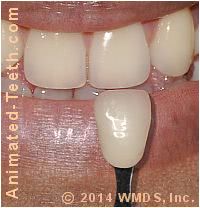
Your dentist will monitor your bleaching progress.
Ending your treatments.
- A pleasing, natural-looking shade has been reached. (Some suggest trying to match your teeth to the shade of the whites of your eyes.)
- No more whitening effect seems to occur.
An advantage of having your dentist involved in your bleaching process is that they can help you determine when either of these stopping points (especially the latter) has been reached.
Monitoring with a shade guide.
If you don’t have your dentist’s assistance, some OTC products come with a tooth shade guide. These are a graduated assortment of shades of white that you match to the current color of your teeth as they undergo the whitening process.
As you monitor, you may find that a point is finally reached where your teeth won’t lighten any further. (This may or may not be the lightest color on the guide.)
Some relapse is expected.
Once you’ve terminated your whitening process, there’s typically a period of 2 weeks or so during which the shade of your teeth may relapse slightly before stabilizing.
When can new dental work be scheduled?
Once the above-mentioned stabilization has occurred, you and your dentist can make plans to begin the process of replacing your existing dental work so it matches the new shade of your teeth. If white fillings are involved, a wait-period of 2 to 3 weeks is indicated.
FYI –Whitening to the point where your teeth match the whites of your eyes seems a little extreme to us, especially the older you are.
Just go to Google Images and search “1960’s smiles” (a time before the current whitening craze was in vogue).
Don’t be disappointed about relapse. All whitening methods experience it. In fact, it’s usually less dramatic with tray whitening than with in-office treatments.
Should you whiten just one arch or two?
Dentists usually charge for tray-based teeth whitening by the “arch.” An arch is a dental term used to refer to either the upper or lower teeth. A person’s complete set of teeth is composed of two arches.
This means you do have the option of treating just your upper or lower teeth. There can be several reasons why you might choose to do so.
- In general, whitening just one arch should cost about half of what you would pay to bleach both.
- Your upper front teeth may be the only ones that show very prominently when you smile.
- You may want to see how successful this technique is for you before financially committing to the treatment of both arches.
You can always treat your other teeth at any time, even weeks or months later.
How long will your whitening results last?
- The improvement that you’ve made can last somewhat indefinitely. But for most people, a “satisfactory” result is typically found to last on the order of 1 to 3 years. (Haywood 2000)
- Leonard (1998) found that 42% of subjects who had performed tray-based whitening treatments were still satisfied with the shade of their teeth 7 years later.
- Possibly more importantly, no one in the study, including those who weren’t happy with their current tooth shade, felt that their teeth had regressed all of the way back to their original pre-bleaching color.
- Haywood (1996) reported that that point at which significant relapse had taken place ran on the order of 26% at 18 months for tray-whitening technique.
▲ Section references – Leonard, Haywood, Haywood
FYI –You have to expect that color relapse will occur over time. But that’s true for all whitening methods.
Based on the tray-based studies we’ve read through, it seems that they often start to evaluate for relapse at 3, 6 and 12-month intervals, and then multiple years.
Most seem to be able to document some level of fading as early as 3 to 6 months (more likely 6) after the original treatment. But patient satisfaction (which is an entirely different metric) seems to last much longer (12 months and more).
In regard to very long-term patient satisfaction, some papers include before-and-after pictures of study participants. Usually, the relapse they show seems quite obvious when the pictures are side by side. But since the metric evaluated is patient satisfaction, the cases are reported as a success (which evidently they are).
Touch-up treatments.
At that point when the color of your teeth has faded enough that you find it objectionable, touch-up treatments can be performed.
How often will they be needed?
There are numerous factors that can cause teeth to discolor. And even though your teeth have been lightened, these same processes will continue to occur.
For example, people who have continued exposure to coffee, colas and tobacco products can expect that the luster of their original treatments will fade faster than those who don’t.
Of course, an advantage of an at-home system, like tray whitening, means that you can perform touch-ups on your own at whatever interval you find necessary.
People who are quite conscious of their teeth may want to perform touch-ups every 6 months or so. For others, once a year, or even every 2 years, may keep them looking the way they want. (See studies above.)
What’s involved with retreatment?

Additional syringes of tooth-whitening gel.
- You may have some leftover from your initial treatments. Gels frequently have a 1-year shelf life, so check the expiration date on yours. (They’re best stored in a cool, dark environment like a refrigerator.)
- If you got your original kit from your dentist, they’ll probably be happy to sell additional amounts of whitener to you on a per-syringe basis.
- If you purchased a kit on your own, that same brand will probably sell “refill” kits.
If you don’t have these sources, you can look in your local store or online to see if you can’t find the exact same product you used before, or at least an equivalent one.
When looking for an equivalent:
- Look for one that has the exact same active ingredient (usually carbamide peroxide or possibly hydrogen peroxide), at the exact same concentration. Of course, it always makes sense to choose a brand that you recognize and trust.
- There are a number of brands that are sold directly to dentists for use with their patients. Our search identified these:
BriteSmile, Discus Dental, Lumibrite, Nite White, Opalescence, Pola, Ultradent and Zoom.
Last reviewed: December 17, 2020
Author: Paul Cotner, DMD — retired dentist.
Published by: WMDS, Inc. — owner of Animated-Teeth.com.
Educational information only — not a substitute for professional dental care.
Page references sources:
Dietschi D, et al. In vitro colorimetric evaluation of the efficacy of various bleaching methods and products.
Haywood VB. Achieving, maintaining and recovering successful tooth bleaching.
Haywood VB. Current status of nightguard vital bleaching.
Leonard R. Efficacy, Longevity, Side Effects, and Patient Perceptions of Nightguard Vital Bleaching.
Matis BA, et al. Clinical evaluation of bleaching agents of different concentrations.
Strassler HE. Vital Tooth Bleaching: An Update.