Looking for information about other Dental Topics?
Full Website Index• Animated-Teeth.com •

Fillings for back teeth: dental composite vs. amalgam
White vs. silver fillings.
Dental composite (the white plastic compound utilized with tooth-bonding technique) is routinely used to make fillings for back teeth.
But based on its physical properties, and the stringent demands of the technique needed to place it, it’s questionable that it makes a better choice than dental amalgam (the metal used to make “silver” fillings). It’s better said that a composite restoration can make a good choice, for some types of applications.
How to choose between the two.
The top half of this page outlines the issues your dentist must consider when deciding which of the two makes the more appropriate choice for your tooth.
The middle portion then outlines the specific advantages and disadvantages of one type of filling over the other.
We then wrap up with a section citing statistics from dental research explaining how long each type of filling can be expected to last.
Composite vs. Silver (amalgam) fillings –
Issues to consider when placed on back teeth.
Amalgam or Composite?

For comparatively larger restorations, amalgam fillings tend to show a lower failure rate than composite ones.
A) Filling size.
Large fillings.
However, we will state that one that did find a low failure rate for composite fillings (Opdam 2010) specifically stated that when comparatively larger restorations are considered, amalgam ones demonstrate better survival. [page references]
Smaller fillings.
As you might expect, the physical demands placed on comparatively smaller fillings, especially those not located on portions of a tooth subject to heavy chewing forces, are reduced as compared to larger ones. And that means that either composite or amalgam can make a good choice for these types of applications.
B) Exposure to excessive forces.
One of the main causes of bonded filling failure is their fracture. And that means that dental composite doesn’t make a good choice for restorations that are routinely be exposed to excessive forces. As an example, an amalgam filling would likely make a better choice for a patient who had a habit of clenching and grinding their teeth.
(Beck [2015] reported that fracture was the most common cause of composite restoration failure.)
C) Patients with a high decay rate.
Dentists use the term “recurrent” decay to refer to cavities that form adjacent to existing fillings. And this is more likely to occur if there’s some type of nook or cranny in which dental plaque can accumulate, like a tiny gap between a tooth and its filling.
Amalgam vs. composite.
- By nature, a dental amalgam filling is self-sealing. Changes take place with the metal itself over time that tend to fill in any micro spaces that exists between it and its tooth.
- Bonded restorations shrink slightly when they are cured. And that means even if composite has been snugly packed against tooth structure, as the dentist sets it it will tend to shrink back, possibly resulting in a micro gap.
(Beck [2015] reported that recurrent decay was the second most common cause of composite restoration failure.)
Due to this difference, a dental amalgam filling may make a better, or at least more predictable, choice for people who have an active decay rate.
D) How visible is the filling?
White vs. silver.
Dental composite comes in a range of tooth-colored shades, whereas dental amalgam is silver.
There is no question that most patients much prefer white fillings. And in situations where either type of restoration could suffice, its color is often the deciding factor.
This amalgam filling shows prominently.
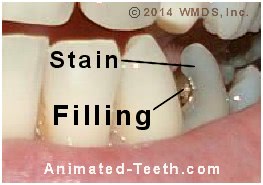
As an added disadvantage, it has caused staining of its tooth (the grey halo around the restoration).
Silver fillings tend to stain teeth.
- The tint of the metal is frequently visible through the tooth structure that surrounds it.
- This effect may become more pronounced over time as the restoration ages.
With many back teeth, this may not be much of a concern. But it certainly can be an issue with upper and lower premolars (bicuspids) and even some upper molars.
E) Does the patient want to avoid the use of amalgam?
Concerns about mercury.
One of the components of dental amalgam is mercury. And over the past few decades, there has been some debate (more so in the popular press than in dental literature) as to its ill effects on a person’s health.
In defense of amalgam, we would like to bring to your attention that it has been in widespread use in dentistry for more than 150 years. And during this time period, literally billions of amalgam fillings have been placed.
One would expect that if a significant problem did exist that by now there would be a substantial amount of research documenting it. To the contrary however, there is not.
Organizations that support the use of dental amalgam.
Several national and international health organizations (U.S. Public Health Service, The American Dental Association, Food and Drug Administration, World Health Organization, FDI World Dental Federation) have gone on record as stating that they have reviewed the scientific literature and see no health concerns.
Despite this, there are people who have decided that they do not want to have their teeth restored with dental amalgam. If so, then a composite filling may be their only cost-effective choice.
F) Metal allergies.
While rare, people can have an allergic reaction to the metals contained in dental amalgam. So in these cases, a dental composite restoration may be the only reasonable choice. (In dental literature, there are fewer than 100 documented cases of localized allergic reactions associated with the use of dental amalgam.)
Advantages and disadvantages of composite fillings as compared to amalgam ones.
1) Advantages of composite fillings for back teeth.
A) Reduced thermal sensitivity.
Since dental amalgam is a metal, it’s a good thermal conductor. And when it’s used to make fillings (especially relatively large ones) it’s not uncommon that a person will experience some degree of thermal sensitivity with their tooth when it’s exposed to hot and cold foods and beverages.
In most cases, this sensitivity will subside as days and weeks pass. But for some people it will persist and be a nuisance, especially when very cold items (like ice cream) are consumed.
Since dental composite is a plastic and therefore a comparatively poor thermal conductor, when it is used as the filling material this issue is much less of a concern.
B) Composite fillings can be used immediately.
Once placed, a dental amalgam filling requires several hours of hardening before it is ready to be put into service.
In comparison, a bonded filling is fully cured (set) during its placement process. That means once a person’s procedure has been completed, the tooth and its new filling are ready for use.
C) Repair may be possible with bonded fillings.
Composite
If a defect is found in a dental composite restoration, it may be possible for the dentist to just make a repair rather than replace the whole thing. That’s because the newly added composite is able to create a bond with both the tooth and its existing filling.
(Rho [2013] considered the early detection and repair of defects in composite fillings to be a vitally important factor in raising their expected longevity to one approaching that of amalgam.)
Amalgam
Dental amalgam is a different story. A new restoration will not fuse with an existing one. That means it’s always better to take an old filling out and replace it with an entirely new one.
Because each time a filling is replaced the hole in the tooth becomes larger, the possibility of repair is an attractive feature of composite restorations.
D) Composite fillings are white.
Beyond the situation where a silver filling might be easily seen, some people feel that color is an important issue even for teeth all of the way in the back of their mouth. If so, dental composite offers this advantage.
Scenario: Two fillings used to repair identical cavities.

The overall size of the composite filling can be smaller than its amalgam equivalent.
E) Bonded fillings tend to be smaller.
1) Cavity preparation for amalgam.
Meeting these design needs usually means that the size of the hole in the tooth will need to extend beyond where its problem (cavity, etc…) actually lies.
2) Cavity preparation for dental composite.
With bonded fillings, the rules about restoration shape are less rigid. Certain design considerations still need to be followed but to a great degree, the restoration can just be placed in that local area where the tooth’s problem lies (referred to as a “minimal intervention” approach).
This means that a white filling can typically be smaller, possibly very much so, than its amalgam equivalent.
F) Tooth reinforcement.
With a silver filling, it’s the shape of the hole it fills that keeps it in place. In comparison, with dental composite the filling itself actually creates a bond with the tooth. Knowing this difference, one might conclude that placing a bonded restoration actually helps to strengthen its tooth.
What does research say?
There seems to be some evidence for this (Soares 2008, Herrmann 2010). Although the dentist’s ability to actually create this strengthening effect may be fairly technique sensitive, not just routine.
Even in cases where this argument might tip the scales in favor of choosing dental composite over amalgam, if a tooth requires a substantial level of strengthening a dental crown would probably make the better, more predictable choice.
2) Disadvantages of white fillings vs. dental amalgam.
A) Amalgam is less expensive.
The cost of a silver filling is usually about 25 to 30% less than that for a comparable dental composite one.
This difference reflects: 1) The relative cost of the materials involved and 2) The relatively greater amount of time that it takes the dentist to place a white filling.
Cost-effectiveness.
In terms of lifetime expense, Schwass (2013) cites a study that concluded that dental composite restorations were 1.7 to 3.5 times more expensive to place than amalgams (higher fee, more frequent replacement).
Admittedly, this was a 1999 study (a time period when bonded restorations were shown to have a higher failure rate than amalgam ones). Nowadays, the survival rate of the two is possibly closer, at least over the shorter-term.
But this study does bring home that any differences in placement cost and failure rate between the two do affect their overall cost-effectiveness. And it can be expected that the use of amalgam retains at least some advantage in this regard.
Possible insurance considerations.
If you’re covered by a dental insurance plan you should be sure to ask your dentist’s staff about the specific details of your policy. Some plans will only cover the bonded filling’s fee up to the cost of an equivalent amalgam restoration. You, the dental patient, pay the difference.
B) Bonded restorations take longer to place.
The process of placing a composite filling is much more technique intense than placing a silver one. And because of this, they take longer to place.
The amount of time difference involved will depend on several factors but as a ballpark estimate it might take your dentist only about half as long to place a dental amalgam restoration.
C) Placing bonding is more technique sensitive.
As compared to dental amalgam, the process of placing composite fillings is much more technique sensitive. For example, there are steps that can only be completed while the tooth is kept saliva-free (moisture free).
There can be areas on a tooth (like at and below the gum line) or locations in the mouth where being able to meet this requirement is essentially impossible. In these cases, a serviceable dental amalgam restoration can often be placed whereas a composite one simply cannot be.
D) Post-operative sensitivity.
People who have bonded fillings placed sometimes experience post-operative tooth sensitivity. While the exact cause is often impossible to determine, it’s frequently attributed to clinician error (inappropriate selection of materials, failure to comply strictly with placement protocol).
This issue seems to be less of a factor with more modern techniques and materials. While this type of sensitivity should always be evaluated by a dentist, it usually disappears over time.
E) White fillings will tend to discolor.
It’s the nature of dental composite to stain over time. However, how much of a concern this would be with a back tooth would be debatable. And of course, it’s unlikely that one would ever become as dark as a silver filling.
F) Amalgam fillings likely last longer than dental composite ones.
See the next section.
Restoration longevity – Dental composite vs. amalgam.
How long does each type of filling last?
There have been a number of studies that have evaluated the relative longevity of different types of dental fillings placed in back teeth.
a) Studies that favor amalgam.
1) A study by Van Nieuwenhuysen (2003) evaluated more than 100 dental composite and 700 dental amalgam restorations. It found an average life span of 12.8 years for the amalgams and 7.8 years for the composites.
2) A study by Forss (2001) calculated an average life span of 12 years for amalgam fillings and about 5 years for composite ones.
3) Bogacki (2002) evaluated an insurance claims database and based on this information concluded that composite restorations in back teeth fail at a higher rate than their metal counterparts.
4) Just in passing, we’ll mention that Schwass (2013) cites a 2005 study that reported a mean survival time for amalgam restorations of 22.5 years. While that number seems to be an outlier, we’re unaware of any study that has ever even remotely reported a number that high in regard to dental composite longevity.
b) More recent studies.
The findings of more recent studies and literature reviews, including those that have included larger-sized fillings, are more varied.
1) Some still report greater longevity for dental amalgam restorations: Bernardo 2007 (94% amalgam vs. 86% composite, as far out as 7 years), Antony 2008 (a literature review, determined longer longevity for amalgam), Rho 2013 (8.7 years amalgam vs. 5 years composite).
2) Others have found the longevity of both types of fillings to be essentially the same: Heintze 2012 (90% at 10 years), Kim 2013 (amalgam 11.8 years vs. composite 11.0 years), Opdam 2007 (92% survival at 5 years, 82% at 10 yr. for composite vs. 90% 5 yr. and 79% 10 yr. for amalgam).
3) One recent study, Opdam (2010) seems to give dental composite the edge (24% failure for amalgam vs. 15% for composite at 12 years). However, this study specifically stated that for larger-sized fillings or high-risk patients, amalgam shows better survival.
Trends.
As compared to previous studies, modern research evaluating the longevity of bonded restorations for back teeth tends to place a greater amount of emphasis on:
- Case selection. – Was the composite restoration placed for an application for which it was well suited? (Smaller vs. larger filling, heavy vs. minimal chewing forces.)
- The protocol used. – Did the clinician place the restoration using accepted standards and technique? (Placing bonded restorations is very technique sensitive.)
- Type of restorative. – How does the success of the restoration correlate to the specific type or brand of dental material used?
Especially if the type of dental composite and associated bonding materials used are key factors in determining restoration success (which is likely), one could reasonably conclude that in the years to come, the longevity of composite fillings will only continue to improve.
FYI –We might point out that the topic of longevity is essentially always posed in terms of: Will a composite restoration last as long as a dental amalgam one? (Not the reverse.)
Amalgam is the standard to which newer filling materials are compared. And it seems fair to say that it’s just recently that dental composite has possibly begun to come close, which suggests that in terms of longevity, amalgam currently makes the more predictable (tested) choice.
One difficulty with evaluating composite fillings is that the materials and placement protocol involved are constantly evolving.
That means that long-term studies, by definition, only evaluate outdated methods. It also means that the evaluation of more modern techniques must be based on relatively shorter-termed studies, which usually overestimate their longevity (Antony 2008).
More to know about choosing composite over amalgam.
- The longevity of dental amalgam was superior to composite when measured from the point of initial placement. (8.7 years vs. 5.0 years).
- But in terms of working restorations (fillings that had already survived in the oral environment past an initial period), the survival rate for both was the same.
- Any new composite filling should be placed on a schedule where it receives regular periodic examination (such as every time you get your teeth cleaned) so repair, if needed, can be made in a timely fashion.
(This need is confirmed by Beck [2015] who found a linear correlation between the length of time between checks and restoration failure rate.)
- Statistically speaking, your tooth should require less overall attention if amalgam is chosen initially. But if having a white restoration in a back tooth is important to you, dental composite can make a reasonable choice.
Last reviewed: September 21, 2019
Author: Paul Cotner, DMD — retired dentist.
Published by: WMDS, Inc. — owner of Animated-Teeth.com.
Educational information only — not a substitute for professional dental care.
Page references sources: