Looking for information about other Dental Topics?
Full Website Index• Animated-Teeth.com •

Basic details about Teeth Whitening Strips – Like Crest White Strips®
Guide to teeth whitening strips.
Teeth whitening strips, like Crest WhiteStrips®, offer a convenient at-home solution for brightening your smile without the need for bleaching trays. Since their introduction some decades ago, these products have become immensely popular due to their ease of use and effectiveness.
This guide outlines the details you need to know about whitening strips—including what they’re made of, how they work, their whitener concentration, how they’re used, and their overall pros and cons—to help you decide if this teeth whitening method is right for you.
What are teeth whitening strips?
Whitening strips are a type of at-home teeth bleaching product. They were first introduced in 2000 by Proctor & Gamble under the brand name Crest Whitestrips®. Since then, multiple companies have developed their own similar, essentially equivalent, products.
a) Main advantage of using whitening strips.
The primary selling point of this method is that it provides a way for a person to perform comparatively effective whitening treatments, at home and on their own, without having to use bleaching trays.
(Compared to the convenience, ease, and simplicity of using whitening strips, the process of performing tray bleaching treatments is generally considered to be a messier, more inconvenient, and more noticeable when worn process.)
b) Advantages of a “strip” design.
- The flexible nature of a strip readily conforms to the shape and alignment of your teeth. And that means it won’t cause mechanical irritation to soft tissues like bleaching trays can.
- Because only one side of the strip is coated with the bleaching agent, it acts as a barrier that helps to both prevent the dilution of the whitener and minimize its contact with opposing soft tissues.
This helps to increase effectiveness and decrease the user’s potential for side effects.
- Since the whitener is applied by the manufacturer (and not the end-user), the dosing you receive is very controlled and consistent.
This helps to ensure predictable whitening results. And aids with product safety and reduces your potential for side effects by way of minimizing the quantity of whitener that’s used during each treatment.
- As compared to all other (reasonably effective) at-home methods, this is probably the simplest, least-messy way to whiten your teeth.
▲ Section references – Gerlach
What are whitening strips made out of?
The strips themselves are clear, thin, flexible pieces of plastic (polyethylene) that have been uniformly coated on one side with a thin film that contains hydrogen peroxide (of varying concentration depending on the product, see list below).
▲ Section references – Gerlach, Crest
This page’s highlights as a video –
Subscribe to our YouTube channel.
Whitestrips are made out of thin clear flexible plastic.
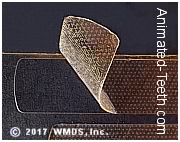
The whitener is on the side that faces the strip’s stiff plastic carrier.
What type of whitener is used? / What’s its concentration?
- Most strip products (including Crest Whitestrips®) are coated with a hydrogen peroxide-based whitener.
- Nowadays, the usual “entry-level” strip product is coated with a 10% hydrogen peroxide (H2O2) agent.
- Overall, the Whitestrips® brand offers products whose whitener ranges from around 6% up to 14% H2O2 (see table below).
Trends in whitener concentration and application times have changed.
In years past, “introductory” products featured strips coated with a 6% hydrogen peroxide whitener (for example Whitestrips® Classic). And their instructions typically called for performing 30-minute treatments twice per day.
Nowadays, entry-level products tend to be coated with a 10% H2O2 concentration whitener (Crest Whitestrips® Vivid and Advanced Vivid). The difference is that these more potent products are only used for 30-minute treatments once a day.
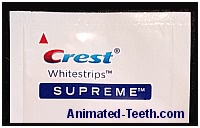
Crest Whitestrips Supreme is formulated with the highest concentration whitener.
Whitestrips® whitener concentrations.
We’ve collected this information from research papers, retailer/distributor information, and Crest® publications we’ve seen over the years. We can’t be certain that it is (or still is) correct but presume that the values shown are accurate.
Comparison of the hydrogen peroxide concentration of Whitestrips®.
| Whitestrips® Product | Ingredient Concentration |
|---|---|
| Name | Hydrogen Peroxide (H2O2) |
| Classic | 6% |
| Gentle Routine | 6% |
| Advanced Vivid | 9.5% |
| Luxe Glamorous White | 9.5% |
| Vivid | 10% |
| Professional Effects | 10% |
| 1 Hour Express | 10% |
| Supreme | 14% |
Whitener “load.”
The peroxide concentration of a strip’s whitener really only tells half of the story. That’s because the total amount of gel that’s placed on each strip (its thickness) will also be a factor in calculating the total amount of peroxide that your teeth are exposed to.
This total is important because teeth bleaching is a direct cause and effect equation.
Greater peroxide exposure = Greater, more rapid whitening effect.
(To the extent of the tooth’s ability to be lightened.)
The paradox.
That means it’s possible for a strip that has a lower-concentration bleaching agent to deliver a greater dosing of peroxide if it has a thicker layer of whitener.
The inherent uncertainty.
That conundrum means that it’s essentially impossible for anyone who doesn’t share in a manufacturer’s proprietary product details (which includes pretty much all of us) to be able to estimate with certainty the potential effectiveness of different brands of strips, or even the individual members of a single brand’s product line.
That’s because without this basic information (whitener thickness and peroxide concentration) it’s not possible to actually calculate the total “load” of the active ingredient the strip contains and therefore your teeth are exposed to.
How does the whitener work?
While not entirely the whole story, it can be said that whitening-strip science generally involves a process where the hydrogen peroxide component of the whitener permeates into the tooth’s hard tissues (enamel and dentin).
Once inside these tissues, the peroxide ultimately breaks down into very reactive molecules referred to as “free radicals.” These agents in turn break down the molecules found within the tooth’s tissues that have caused its discoloration (they are referred to as “chromophore molecules”).
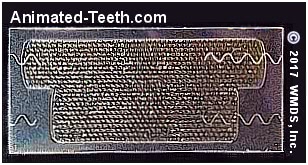
One pair of Crest Whitestrips (upper/lower, the lower strip is the shorter one) as they come on their carrier.
Thin-film chemistry.
An advantage of using strips.
Whitening-strip technique takes this concept of thin-film chemistry to an extreme.
The coating of whitener applied may be as little as 0.2 millimeters in thickness (the thickness of a piece of paper is usually around 0.1 millimeter). (The exact thickness placed varies from product to product.)
▲ Section references – Gerlach
What additional ingredients are found in Whitestrips®?
As you might guess, beyond just hydrogen peroxide (the whitener’s active ingredient), a whitening strip’s gel coating contains a number of additional ingredients that are used to enhance its characteristics. Some of them serve multiple functions.
Thickeners and agents that aid in strip adhesion.
This category seems to include most of a strip’s added ingredients: Glycerin, Carbomer, Polyvinylpyrrolidone (PVP), PEG, Acrylates Copolymer.
Moisturizing agents.
Water, PEG, and Glycerin are included in the gel’s formulation to help keep the user’s teeth properly hydrated during the bleaching process.
Taste modifiers.
Sodium Saccharin (an artificial sweetener).
pH balancer.
Sodium Hydroxide.
How are whitening strips used?
In a nutshell, a strip is positioned over your teeth and then gently pressed into place. At the end of your session, the strip is simply peeled off and discarded.
(Instructions for using Crest Whitestrips® products.)
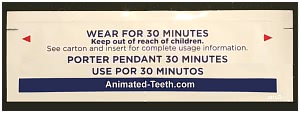
Many Whitestrips products are worn for 30 minutes. Check the instructions that come with your product to be sure.
How long are the strips worn?
Directions about application times, how many days strips should be worn, and how many kits may be used all vary with different products (primarily based on its whitener’s peroxide concentration). These manufacturer recommendations should be adhered to for best results and to avoid side effects and complications.
(We discuss application times for Crest Whitestrips® products on this page.)
It’s OK to quit early.
Of course, if a person has already achieved the whitening results they desire before they’ve used the entire contents of their box of strips, or if the side effects they experience become significant, treatments may (and should) be terminated at any time.
(Here are details about how to manage side effects by adjusting your treatment sessions.)
How effective is using whitening strips?
There’s no question that this technique can make a good initial choice. And for most users, it will produce the whitening results they seek.
- Studies suggest that choosing strips is more effective than using a brush-on whitener (whitening pen) or whitening toothpaste.
- And under certain conditions, strips can give results equal to those obtained via the use of an at-home tray-based system (10% carbamide peroxide). But when both are used with a protocol that maximizes their effectiveness, using a tray system seems to hold the advantage.
Below on this page, we cite findings from research studies to back up the above statements Jump to section.
How long will the whitening effects achieved by using strips last?
It’s normal and expected that the lightening effect produced by any and all types of teeth-whitening methods, including whitening strips, will fade over time. So, after performing your treatments, some level of touch-up treatment will be needed at some point down the road.
We discuss what you can expect on our “Whitening strips / Touch-up treatments” page.
What does dental research report about the effectiveness of using whitening strips?
The most studied brand is Crest WhiteStrips®.
Since they were first introduced as the original strips-based whitening product (around two decades ago), Crest WhiteStrips® has always been the market leader in this field. And as such, this is the brand that most researchers have evaluated when investigating the effectiveness of whitening strips technique.
For this reason, that’s why it’s the predominant (and really only) brand mentioned on this page.
How do other brands compare?
It would be impossible to state with any certainty that the level of effectiveness documented for one brand holds true for others.
But in broad terms, we feel comfortable enough in suggesting that the findings reported about WhiteStrips® should generally hold true for equivalent products too. (Meaning similarly designed strips that have a similar hydrogen peroxide concentration whitener made by reputable manufacturers.)
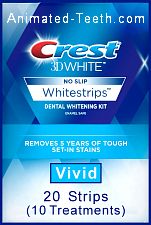
A standard “introductory” Whitestrips® product.
Some of the original WhiteStrips® products studied have been replaced with newer versions.
The current equivalent.
So, what level of effectiveness does research show for whitening strips?
As you read through the study findings we discuss below, it should be easy enough to notice that they suggest the following points.
a) Whitening strips vs. tray-based systems.
When similar treatment time periods are involved, the use of an “introductory” kit of whitening strips can be expected to produce results similar to those created by an “introductory” at-home tray-based system (10% carbamide peroxide whitener).
Although, when each is used for maximum effect (8 hours of treatment daily for trays vs. 1 hour for strips), a tray-based system can be expected to create a larger whitening effect.
b) Strips vs. other at-home methods.
As compared to using paint-on whiteners (whitening pens) or whitening toothpaste, using strips can be expected to produce noticeably better results.
c) In-office bleaching vs. whitening strips.
The in-office bleaching techniques that your dentist has to offer, especially when multiple treatments are involved, can be expected to produce a greater whitening effect than just using an introductory kit of strips.
FYI: For a person in the know about whitening teeth (like your dentist or dental hygienist), we can’t imagine that any of the statements above would be considered controversial.
Rules of thumb about choosing whitening strips as a bleaching method.
Based on the above conclusions, which are supported by the research studies discussed below, it’s easy enough to suggest that in regard to effectiveness:
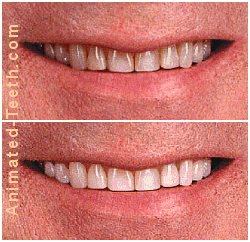
Using whitening strips usually makes a good choice.
a) Teeth whitening strips usually make a good initial (introductory) choice.
b) Using strips is probably the most convenient of the more-effective at-home whitening methods.
Tray-whitening technique is generally considered to be the unofficial standard for at-home teeth bleaching, and the method to which all others are compared. And in terms of effectiveness, when optimal (extended) treatment periods are used, this method seems to hold an advantage over using strips.
But in light of how easy they are to use and the short application times they require, the trade-off of possibly being a less effective vs. a more convenient method may be an easy compromise for many people to make.
c) If using strips hasn’t proven to be as effective as you had hoped …
There’s no way to know precisely what level of results any teeth-bleaching method will create for any one individual. There are simply too many variables involved (such as type of tooth staining, user compliance with directions, etc…).
So, if after trying a whitening-strips approach you feel that you haven’t achieved the level of results that you’re seeking, you should discuss matters with your dentist. In light of your recent bleaching experiences:
- The possibility of extending your whitening strips treatment might be considered.
- They might suggest that a tray-based system should be used. This often makes the best next step with comparatively more difficult to treat cases.
- In-office (professional) whitening might be suggested if quicker results, or an inability to find time for treatments, are overriding issues.
Research studies that have investigated the effectiveness of using whitening strips.
This section discusses the findings of individual research studies on which we’ve based our statements above.
A teeth whitening strip.
Hanning (2007)
Study parameters –
This investigation compared the use of WhiteStrips® (6% hydrogen peroxide, twice daily, 30 minutes each application, 2 weeks duration) to a tray-based system (10% carbamide peroxide, one daily application, 60 minutes, 2 weeks duration).
Study findings –
The authors determined that “both WS (WhiteStrips®) and VS (the tray method) demonstrated significant and comparable levels of tooth color improvement after 2 weeks.”
Our take –
▲ Section references – Hanning
Ferrari (2007)
Study parameters –
This study compared using whitening strips (6% hydrogen peroxide) versus a tray-based system (10% carbamide peroxide) under head-to-head testing conditions (twice daily applications, 30 minutes each, for 2 weeks).
Study findings –
The researchers determined that using strips under these conditions was more effective than trays.
They stated that the whitening strip treatments “yielded (a) significant reduction in yellowness compared to the custom tray, at both end-of-treatment and posttreatment monitoring” (measurements taken 1 month following treatment completion).
Our take –
▲ Section references – Ferrari
Gerlach (2000)
Study parameters –
This investigation evaluated the level of results achieved using an early version of WhiteStrips® (just 5.3% hydrogen peroxide, 1 hour per day, 14 days) versus tray-whitening systems utilizing 10%, 15%, and 20% carbamide peroxide whitener (2 hours per day, 14 days).
Note: The cumulative exposure time to the whitener via trays was twice as long as for strips (28 vs. 14 hours).
Study findings –
The strips treatment created whitening results on-par with the 10% tray system, and within 80% of the levels measured for the 15% tray whitener.
Our take –
Just as with the other two studies, this one showed that the effectiveness of “introductory” strips and tray-based systems (10% carbamide peroxide) can be considered fairly equivalent. (Although less treatment time was needed for the strips.)
▲ Section references – Gerlach
This next group of studies investigated the effectiveness of using strips versus other whitening methods (both at-home and in-office).
Bizhang (2009)
Study parameters –
This study compared the level of results achieved using whitening strips (6% hydrogen peroxide, twice
a day, 30 minutes each application, for two weeks), a tray-whitening system (10% carbamide peroxide, overnight (8hr) applications, for 14 nights) and having in-office teeth bleaching treatments (15% hydrogen peroxide, 45-minute applications, 1 per week X 3 weeks).
Study findings –
The authors concluded that the use of the at-home tray and in-office systems “revealed a bleaching effect superior to WhiteStrips®.”
Our take –
Different than any of the studies discussed above, this one utilized tray-whitening protocol in its most effective form (around 8 hours of treatment time daily) and determined that tray whitening was more effective than using strips. Considering the difference in whitener exposure (8 hours vs. just 1 hour daily), we doubt that any dentist would be surprised by these findings.
In practice, one would simply need to decide what’s more important to them. Using a more convenient and reasonably effective strips method (that under dentist supervision could involve the use of extended treatments so to improve the level of results). Or the more effective, although more demanding, tray-system regimen.
▲ Section references – Bizhang
Yudhira (2007)
Study parameters –
This study evaluated the use of WhiteStrips® (6% hydrogen peroxide, twice daily, 30 minutes each application, 2 weeks duration) to whitening toothpaste (twice or more daily use over a 3-month time frame). Two different kinds of toothpaste were tested.
Study findings –
It was concluded that “whitening strips yielded superior whitening initially and over time compared to either of the whitening dentifrices.”
Our take –
▲ Section references – Yudhira
Xu (2007)
Study parameters –
This study evaluated the use of WhiteStrips® to a brush-on (paint-on) whitener.
Study findings –
It was determined that “7 days use of a 6% hydrogen peroxide strip-based bleaching system provided superior and meaningful whitening compared to 14-day use of a 5.9% hydrogen peroxide” (brush-on product).
Our take –
▲ Section references – Xu
General disadvantages of using teeth whitening strips.
A) They can’t be used to whiten side or back teeth.
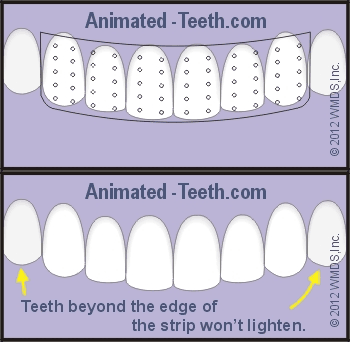
Whitening strips don’t always whiten all of your teeth that show.
(This issue is not a concern with tray whitening technique.)
What can you expect?
Most people will find that their whitening strips reach at least from eyetooth to eyetooth. But how much further beyond, and how much further beyond would be ideal, will vary.
Some strips are designed with this problem in mind. For example, Crest Whitestrips® Professional Effects has a longer strip for lower teeth. Competing brands frequently mention a longer length as one of their selling points.
B) Crooked teeth may not whiten uniformly.
To be effective, a whitening strip must lie in contact with a tooth’s surface. And in the case where your teeth have an especially irregular alignment (a prominent tooth or two, rotated teeth, etc…), it may not be possible to create the needed tooth-to-strip contact for each one.
If not, individual teeth or tooth portions will have a different level of exposure to the strip’s whitener, which can result in uneven whitening.
C) Handling whitening strips can be difficult.
A general disadvantage of performing whitening treatments using strips is that they can be tedious to deal with.
- Strips are sticky and relatively flimsy and therefore can be difficult to manipulate and easy to spoil.
- When applying them, you must touch them. This may cause skin irritation. Or you may inadvertently transfer whitener to other objects, which may mar or damage them.
- During treatments, strips need to be monitored to make sure that they’re still in place. (Although, with the newer, more adherent styles of strips this has become less of an issue.)
As compared to tray whitening technique …
Some people consider using whitening strips to be more of a struggle than using bleaching trays.
▲ Section references – Da Costa
Different strips have different characteristics.
It’s both a strip’s shape and the tackiness of its whitener that helps to hold it in place.
And the specific strip design and whitener formulation used with different products do vary. And this can make some easier to wear than others.
If you’ve used strips in the past (especially in the distant past) and had difficulties, the general trend nowadays (with newer versions of products) seems to be the use of a much tackier, more adhesive-like, whitener (see link above). So, you may find trying again may be a better experience.
D) Other at-home approaches may be more effective.
As discussed above on this page, published research has found whitening strips to be a very effective at-home whitening method. But we would anticipate that most dentists would consider tray whitening to have a slight edge on this issue. But when you factor in convenience, strips frequently make an attractive choice.
E) The whitening effect will fade.
This point isn’t a disadvantage that’s unique to just strips. The whitening effect created by any and all bleaching methods will tend to fade over time.
This is usually more of an inconvenience than a big problem. We discuss touch-up frequencies and options that are common with whitening strips here.
F) There’s no professional supervision.
Once again, this isn’t a criticism that’s unique to just whitening strips. All over-the-counter systems suffer from the disadvantage that the user’s dentist frequently isn’t consulted about their bleaching activities.
But just because you can perform treatments entirely on your own doesn’t mean that you have to or should. It’s always the right choice to discuss your whitening plans with your dentist. And ideally, before you begin. Their knowledge can help to improve both the effectiveness and safety of your efforts.
Last reviewed: January 07, 2025
Author: Paul Cotner, DMD — retired dentist.
Published by: WMDS, Inc. — owner of Animated-Teeth.com.
Educational information only — not a substitute for professional dental care.
Page references sources:
Bizhang M, et al. Comparative clinical study of the effectiveness of three different bleaching methods.
Crest website. What are the Ingredients in Crest 3D White Whitestrips?
Da Costa, J. Comparison of Two At-home Whitening Products of Similar Peroxide Concentration and Different Delivery Methods.
Ferrari M, et al. Daytime use of a custom bleaching tray or whitening strips: initial and sustained color improvement.
Gerlach RW, et al. Professional vital bleaching using a thin and concentrated peroxide gel on whitening strips: an integrated clinical summary.
Gerlach RW, et al. A randomized clinical trial comparing a novel 5.3% hydrogen peroxide whitening strip to 10%, 15%, and 20% carbamide peroxide tray-based bleaching systems.
Hannig C, et al. Efficacy and tolerability of two home bleaching systems having different peroxide delivery.
Kwon SR, et al. Review of the Mechanism of Tooth Whitening.
Xu X, et al. Randomized clinical trial comparing whitening strips, paint-on gel and negative control.
Yudhira R, et al. Clinical trial of tooth whitening with 6% hydrogen peroxide whitening strips and two whitening dentifrices.
Video transcription.
Welcome to Animated Teeth.com and the portion of our website that covers whitening teeth using strips, like Crest’s Whitestrips.
This video takes highlights from our site’s introductory page that explains things like what whitening strips are, how they’re used, what kind and concentration of whitener they contain, as well as details about their effectiveness and the general pros and cons of using them.
The first whitening strip product, Crest Whitestrips, was introduced over two decades ago. But rewinding the clock even further, the widespread availability of at-home whitening kits really started about a decade before, back in the 1990s.
Even though these first at-home systems were popular, they were messy and cumbersome to use. The person had to wear a bleaching tray filled with whitening gel. Performing treatments was a bit of a production.
Crest developed Whitestrips as a simpler, less messy, less noticeable alternative. Their strip system replaced the traditional bleaching tray with a thin prepackaged flexible plastic strip that had a premeasured amount of hydrogen peroxide whitener already applied.
Using pre-packaged strips greatly simplifies the whitening process. You just open their foil pouch and apply them to your teeth, typically for a 30-minute treatment. After that, you just pull them off and dispose of them. There’s minimal preparation or cleanup needed.
Early versions of Whitestrips didn’t always stay in place so well but that’s been significantly improved. And since they stay put, wearing them only minimally interferes with speech and, overall, wearing them is fairly unnoticeable to others. So, performing your treatments, even when out in public like when running errands, usually works out OK.
As rosy as all of that sounds, as a drawback, anyone comparing the fit of a bleaching tray over your teeth versus a whitening strip will notice the two are quite different. A custom bleaching tray has a design that insures that the whitener is held against your teeth while avoiding your gum tissue. That feature maximizes effectiveness and minimizes side effects.
In comparison, the fit of a whitening strip is much more haphazard. The strips are never long enough to treat all of your teeth. In some areas, portions of the strip will lie on your gum tissue. And on some teeth, the strip will not cover 100% of its front surface. So what gives? How can a sloppy fit like this produce acceptable results?
Well, as it turns out, the irregular fit of a strip doesn’t cause all that much of an issue for most cases. Everything tends to turn out OK anyway. Front teeth end up whitening effectively and evenly enough. Gum irritation caused by the peroxide whitener usually doesn’t create a significant issue. And the back teeth where the strip doesn’t reach probably don’t show that much when you smile anyway.
We will say that most dentists probably consider using a tray-based system a better choice for more difficult cases, like people with comparatively darker teeth, significant gum sensitivity issues, or have back teeth that show. And overall, most would probably agree that a tray-based technique using a custom bleaching tray is the gold standard for at-home teeth whitening.
But for run-of-the-mill cases, which are the ones that drug-store products are intended to treat, whitening strips tend to do just fine. We cite several studies on this video’s associated web page that document this opinion.
As far as whitener concentration goes, the first version of Crest Whitestrips had a pre-applied 6% hydrogen peroxide film. You wore the strips twice a day, 30 minutes each time, until you used up all of the kit’s strips, which usually amounted to around two weeks of treatments.
Nowadays, 10% hydrogen peroxide whitening strips are more the norm, although you’re typically instructed to just wear them once a day, for the usual 30 minutes.
FYI, peroxide teeth bleaching is simply a cause-and-effect phenomenon. That means that wearing 6% strips for two 30-minute sessions each day or 10% strips for just one 30-minute treatment can be expected to produce pretty much the same daily effect because both routines wind up exposing your teeth to a similar total amount of peroxide.
By the way, just to make sure you know, any one person’s teeth will have an endpoint beyond which they simply won’t whiten any further. Continuing on with treatments just results in wasting product and may lead you into the realm of whitener abuse.
On the other side of the coin, if you’ve reached the level of whiteness you desire before you’ve used up all of your strips, it’s OK to end your treatments early. As a tip, don’t store your extra strips in your hot steamy bathroom. Instead, put your kit in the cool confines of your refrigerator where their peroxide whitener won’t degrade as fast. And, FYI, all teeth whitening results tend to fade over time. So, any extra strips you have left over can be used for touchup work.
That should be enough details to give you an idea if using whitening strips might be the right method for you. Of course, our associated web page provides a lot more information so be sure to give it a read. Also, our website has a section that covers tray teeth whitening if you’d like to know more about that. Goodbye.