Is using whitening strips bad for your teeth? – Common side effects and how to manage them. | Safety issues.
A) Dealing with side effects caused by whitening strips.
1) The most common problems.
By far, the two most frequently experienced side effects encountered when using whitening strips (like Crest Whitestrips®) are:
This page explains why those complications tend to occur, what level of symptoms is common to experience, and outlines remedies for both conditions.
Less frequently, a person may experience throat irritation, sore throat, or even stomach upset. This page discusses remedies for these side effects too.
(Some people may notice uneven whitening or white spot formation on their teeth following treatments. We now discuss these issues on this page.)
2) Side effect avoidance.
Rather than just waiting for problems to develop, there are some basic guidelines you can implement that can help to minimize your risk of experiencing side effects altogether. Or, get them under control more quickly once they have started to appear. This section explains what to do.
B) Are whitening strips safe to use? | Will they damage your teeth?
If you’re concerned about safety considerations associated with using teeth whitening strips, this portion of this page can help to put your mind at ease. We cover these issues.
- Are whitening strips bad for your teeth? Does the whitener damage teeth or tooth enamel?
- Are there safety issues associated with a person’s exposure to the strips’ whitener?
- What to do if you’ve swallowed a whitening strip. (Now covered on its own page.)
A) Whitening strip side effects and remedies –
1) Tooth sensitivity.
▲ Section references – Gerlach
Whitestrips Supreme has the highest concentration whitener.
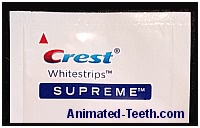
Using a lower concentration strip can help to reduce side effects.
a) Why does it occur?
b) What’s the pain like?
In most cases, the sensitivity that’s noticed is a heightened reaction of your teeth to hot and cold items, such as foods and beverages. Dentists call this “thermal sensitivity.”
How much pain can you expect? When?
Especially in the case where you’re using a strip product that’s been coated with a comparatively lower-concentration whitener (here are examples of Whitestrips® products and their hydrogen peroxide concentration), the sensitivity usually just comes on gradually.
It may be persistent, possibly increasing a little each day with each treatment. Or just be noticeable for those first few hours following a bleaching session. With more potent strips, you may notice the sensitivity immediately upon the completion of even your first treatment.
Effects on activities.
Since the amount of sensitivity that results is usually relatively minor and setting it off fairly easy to avoid, experiencing it typically doesn’t cause great disruption in a person’s life. Or even necessarily interfere with their bleaching schedule.
▲ Section references – Gerlach
c) Remedies for tooth sensitivity caused by using whitening strips.
1) Some improvement should occur naturally.
In the majority of cases, a person should notice that their thermal sensitivity begins to fade, a little each day, once they have completed their bleaching treatments.
Performing whitening sessions less frequently or using a lower concentration strip (such as Whitestrips® Gentle Routine) can help to speed this process along. – More information.
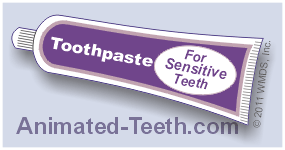
Using desensitizing toothpaste, before or after problems occur, can help.
2) Try using desensitizing toothpaste.
Many manufacturers make an anti-sensitivity version of their regular paste. These products are often labeled with the phrase “toothpaste for sensitive teeth.” Their active ingredient is frequently potassium nitrate or fluoride.
(Related page: The best toothpastes for treating tooth sensitivity.)
Obtaining relief may take some time. – The idea is that you use the toothpaste in place of your regular one, for some days and weeks, as it gradually produces its effect.
(Prescription-strength fluoride toothpaste or gel prescribed or dispensed by your dentist can also be used in a similar fashion.)
3) Preventing tooth sensitivity.
As a way of helping their patients reduce their risk of experiencing thermal irritation, many dentists recommend that they begin using desensitizing toothpaste two weeks prior to initiating the use of their whitening strips.
2) Gum irritation.
▲ Section references – Gerlach
a) Why does it occur?
Gum irritation is caused by the caustic nature of the peroxide found in a strip’s whitener. In general, the higher its concentration, the greater the likelihood that this side effect will be noticed. (Once again, a reason why the “strongest” or “quickest working” type of strip doesn’t necessarily make a good choice.)
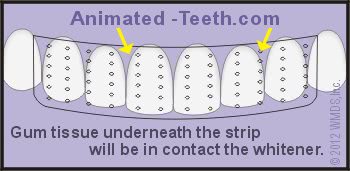
The cause of whitening strip gum irritation.
1) The shape of the strips is part of the problem.
And this means that when it is positioned over the user’s teeth, some of its full-strength whitener will be in direct contact with their gums.
2) Residual whitener can be the cause too.
Gum irritation can also result from deposits of whitener that are left behind after a whitening strip has been removed.
For this reason, you should always rinse, wipe and/or gently brush your teeth and surrounding gum tissue after every bleaching treatment. Be sure to wash your hands and toothbrush off afterward.
b) How much discomfort can you expect?
In most cases, the level of gum irritation that a person experiences is just mild. It usually doesn’t interfere with their daily activities or even their bleaching schedule.
c) Remedies for gum irritation.
In the typical case, whitening strip gum irritation will gradually disappear over the next few days after the person’s bleaching treatments have been completed.
Don’t brush first.
You might be surprised to learn that Crest® does not recommend that you brush your teeth before applying Whitestrips®. Brushing tends to remove the protective microfilm that accumulates on gum tissue. Use that link to learn more about this effect.
Choose a different type of strip.
Performing sessions less frequently or using a lower concentration strip product (Crest Whitestrips® Gentle Routine) can help to keep this side effect in check. – More information.
d) The whitener may irritate your fingers.
Besides just your gums, a strip’s whitener can also irritate your skin. We discuss this phenomenon in greater detail here.
3) Throat irritation.
Just like with any peroxide-based system, if the whitener from a strip is swallowed, throat irritation may occur.
▲ Section references – crestwhitesmile.com
Preventing sore-throat side effects.
As a general rule of thumb, anything foreign that’s placed in your mouth will tend to trigger increased salivation. So when strips are worn, especially during your first several sessions, you may notice this effect.
The accumulating saliva will tend to pick up some of the peroxide whitener that’s leached from your strips. And if you swallow it, it will tend to cause throat irritation. So the solution is to avoid swallowing, at least to the extent that’s possible. Instead, always spit fluids out.
Of course, despite your best efforts you will still end up swallowing some peroxide. But if you can keep this to just a minimum, the hope is that it won’t be enough to cause throat or stomach irritation.
How using strips might help to lower your potential for throat irritation.
When whitening strips are made, a very measured amount of peroxide is placed on each one. That’s in stark contrast to other at-home bleaching systems where it’s the end-user who dispenses the amount of whitener.
In the latter case, like when using bleaching trays, the amount of agent that’s dispensed, and therefore ultimately consumed, may be fairly significant. So by choosing to use strips instead, you may substantially reduce your potential for soft tissue irritation because you have less peroxide exposure.
Remedies for whitener-induced sore throats.
If the source of your throat soreness is the simple cause and effect we describe above, you’ll usually find that your condition is self-limiting (which means that as hours pass you should notice ever-decreasing irritation).
And as mentioned above, if experiencing this side effect becomes a reoccurring issue for you, you can probably lower your risk by choosing a kit that comes with lower-concentration strips. Wearing your strips less frequently (like every other day) may help too.
Also, be sure to remove any residual whitener from your teeth after treatments (using a wet toothbrush is a good method) and rinse out thoroughly.
Guidelines for managing side effects.
a) If you notice side effects, stop your whitening treatments.
If side effects start to show up, it only makes sense to stop performing whitening treatments (right now, immediately).
There’s absolutely no reason not to.
Bleaching teeth with peroxide is simply a function of whitener concentration and total treatment time (session length X number of sessions).
Interrupting the process for a few days, as you evaluate your side effects and allow them to subside, will not compromise your results (assuming that at some point you are finally able to finish using all of your strips).
b) Re-evaluating your whitening approach.
Once your side effects have subsided, you’ll need to make a decision. Should you resume your treatments, or have the side effects you’ve experienced put you off on the whole idea of whitening your teeth.
If you do decide to continue on, you now have experience with what doesn’t work. So, what you need to do is come up with a plan that can help to reduce the chances that your side effects will return.
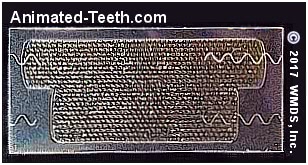
One pair of Crest Whitestrips (upper/lower).
1) Try wearing your whitening strips less frequently.
You’ll simply have to experiment to see what regimen works best. For example, if wearing them every other day still triggers side effects, try every 3rd day. Or whiten on consecutive days until symptoms start to occur, and then back off on treatments for a while.
And don’t worry, as we discussed above, performing sessions less frequently won’t interfere with the bleaching process, it will only slow it down. Assuming that you still use all of your strips, you’ll reach the same lightening endpoint.
2) Try using a lower-concentration strip.
Another solution involves using strips that are coated with a lower concentration whitener. For example, instead of using one of Crest®’s standard 10% hydrogen peroxide strips, try using their 6% one (Crest Whitestrips® Gentle Routine).
Different than with our example above, however, by using a lower concentration strip your total exposure to bleaching agent will be less. If so, you’ll achieve less whitening success.
3) Which approach is better?
- Crest Whitestrips® Professional Effects (10% hydrogen peroxide whitener, 30-minute application, 20 sessions) – 10 hours of total exposure to a 10% product.
- Crest Whitestrips® Gentle Routine (6% hydrogen peroxide whitener, 5-minute application, 28 sessions) – 2.3 hours of total exposure of a (roughly half as strong) 6% product.
Clearly, these two products couldn’t possibly be expected to produce the same whitening outcome.
So, in the case where side effects have become a problem for you, you’ll need to decide:
- If your teeth just need a little improvement, the Whitestrips® Gentle Routine product would probably make a good choice.
- But if your teeth need a lot of improvement, you might either use Whitestrips® Professional Effects but spread out over a longer time frame. Or consider ultimately using more than one box of the Gentle Routine strips.
Evaluating your risk for side effects.
Start out slowly.
A smart way to test your potential for experiencing side effects is to ease into the use of your product.
For example, if their directions recommend daily treatments, do an initial one and then skip a day. If you notice even a hint of problems developing, continue on with this routine (or less) as you figure out to what degree they’ll become an issue.
Faster and whiter isn’t better.
If you’re trying out teeth whitening strips for the first time, choosing a product that boasts that it gives faster and brighter results may not make the best choice, at least in terms of avoiding side effects.
These types of products tend to be ones that have a higher concentration whitener or are intended to be worn for extended time frames (possibly even an hour or more). Both of these characteristics tend to make experiencing side effects more likely.
As a less risky alternative, look for a standard “introductory” type of product that’s made by a well-known manufacturer.
B) Is using whitening strips bad for your teeth?
When used as directed, strip products (like Crest Whitestrips®) have not been shown to be bad for teeth or to damage them.
- Clinical research and trials have not identified any significant harmful effects associated with using them (even when used outside of normal recommendations, discussed below).
- Their roughly two decades of use by the general public has not demonstrated any serious long-term or irreversible adverse effects on teeth, gums, or tooth nerve tissue.
- They contain the same whitening ingredient (hydrogen peroxide) as the professional whiteners dentist routinely use.
That’s not to say that using strips can’t cause side effects (like those discussed above), because they do for some people. But that’s a separate issue than causing harm to or damaging teeth.
Research studies that have investigated the possible harmful or damaging effect of whitening strips on teeth.
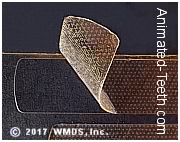
A Crest Whitestrip®.
Study – Duschner (2006)
The tooth samples were: 1) Evaluated for changes in enamel surface hardness. 2) Evaluated for structural changes using an electron microscope. 3) Tested for changes in their chemical composition. No deleterious effects were identified.
Study – Gotz (2007)
Title: Effects of elevated hydrogen peroxide ‘strip’ bleaching on surface and subsurface enamel including subsurface histomorphology, micro-chemical composition, and fluorescence changes.
This study investigated how 13 and 15% hydrogen peroxide strips affected tooth enamel. (At the time, the product used was a prototype. The exposure time used was 28 hours, which is roughly 3 times the level recommended for this type of strip when it finally came to market.)
The same testing carried out with the Duschner paper above was performed for this study too. No deleterious effects were found.
Study – White (2003)
Title: Effects of Crest Whitestrips bleaching on surface morphology and fracture susceptibility of teeth in vitro.
This study examined the effects of using 5.3% and 6.5% Whitestrips® hydrogen peroxide gels on tooth enamel using exposure times up to 5 times longer than normally recommended (14 vs. 70 total hours).
The samples were evaluated for changes in surface morphology, microhardness and fracture susceptibility. No changes or deleterious effects were identified, even under these excessive conditions.
Study – White (2002)
Title: Peroxide interactions with hard tissues: Effects on surface hardness and surface/subsurface ultrastructural properties.
This previous study by White (2002) also evaluated 5.3% and 6.5% H2O2 Whitestrips® whiteners, at exposure times ranging from 14 to 70 hours (5 times the normal treatment time).
▲ Section references – Duschner, Gotz, White, White
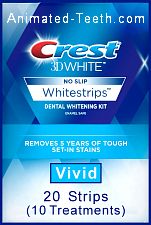
A standard “introductory” Whitestrips® product.
Interpreting the above findings in light of today’s products.
Twice the concentration. Half the treatment time.
That means the 6% studies mentioned above are still valid in reference to today’s products and suggest that strips use is neither damaging nor otherwise bad for your teeth. This is confirmed by the Gotz study (mentioned above) that found that using a higher concentration strip poses no special concerns for tooth safety.
Whitestrips® health and safety concerns.
Using strips provides a consistent, controlled dosing of whitener.
As far as teeth bleaching methods go, whitening strips are unique in the fact that the user receives a very precise exposure to the whitening agent.
That’s because it’s applied to the strip by the manufacturer when they are made. In comparison, when a tray system or whitening pen is used, the user often ends up applying significantly more than is recommended.
And in light of the unsupervised nature of the use of over-the-counter products and potential safety concerns, this is a comforting feature.
An example of whitener dosing – Strips vs. trays.
It’s been estimated that a session utilizing a 6% hydrogen peroxide whitening strip (which is comparable to how today’s 10% strips are used) involves the use of one-half to one-fifth as much total peroxide as a comparable treatment utilizing a tray-based system with a 10% carbamide peroxide bleaching gel. (FYI: Both systems should provide similar whitening results.)
Safety concerns associated with peroxide whiteners.
We already have a page that details the safety concerns associated with the use of peroxide tooth whiteners.
It primarily discusses this issue from a standpoint of using a tray-bleaching technique. But since the whitening science for both methods is the same, that information applies to the use of strips too.
Remember, strips deliver a lower dose.
When reading that information, keep in mind that your dosing of peroxide when using strips can be expected to be substantially less than when trays are used, which helps to make your experience that much safer.
Our take on the safety of using whitening strips.
We would have little concern about safety issues associated with the use of strips technique as a method for whitening teeth. That, of course, implies that the product is used within its manufacturer’s guidelines, or if at any level beyond that, under the supervision of a dentist.
Whitening product abuse.
We’re familiar with a class of end-users who adopt an attitude that using whitening strips is totally benign, and therefore use them at their whim, for indefinite periods of time (either continuous or intermittently), and characteristically under circumstances where the treatments performed have essentially no potential benefit toward providing added whitening effect.
Why the indiscriminate use of peroxide whiteners is never appropriate.
For people contemplating this type of behavior, we’ll point out the following study.
Study – Del Rel Garcia (2019)
Title: In vivo evaluation of the genotoxicity and oxidative damage in individuals exposed to 10% hydrogen peroxide whitening strips.
In a nutshell, this study looked for evidence that using whitening strips coated with a 10% hydrogen peroxide whitener (which nowadays is the standard “introductory” strip product) causes DNA damage in the cells of soft tissues of the mouth (cheek linings, gum tissue).
▲ Section references – Del Rel Garcia
► So if you think that the indiscriminate use of whitening strips (or really any at-home bleaching method) is unquestionably benign and without any potential concern, we would disagree and would base that opinion on the findings of this study.
Additional takes on this study’s findings.
Having stated the above, here are some replies we would have to possible reader questions.
Do we think this single study is the end-all authority on this subject? – No.
Is there anything about these findings especially unique to using whitening strips? – No. One would assume that similar findings would be found for any at-home bleaching method that creates a similar exposure to hydrogen peroxide.
Does this study indicate that using whitening strips is dangerous? – For us, it would come down to a risk/reward calculation. In cases where whitening results can be expected (the case for most people when initially using this type of product), we personally would perform treatments and accept the associated risks.
But in cases where the person’s activities could be categorized as whitener abuse (like described above), we think this study points out why that habit makes such an inappropriate choice.
Is it harmful to swallow a whitening strip?
The consequences of this type of event occurring are usually just minor and transient in nature. We explain why, and what factors are the major determinants, on our “What happens if you’ve swallowed a whitening strip?” page.
Is it harmful to use an expired WhiteStrips® kit?
The primary problem associated with using expired strips is generally one of ineffectiveness as opposed to safety.
The expectation would be that the concentration of the hydrogen peroxide in its whitener (its active ingredient) would be degraded or depleted, thus rendering the strips less effective.
Storing unused kits or strips in your refrigerator (not freezer) is a good way of extending their marked shelf life.
Will whitening strips damage dental work?
Yes, strips can be considered safe to use with existing dental work, in the sense that the chemical process involved (peroxide teeth whitening) won’t damage them. But beyond that specific point, there are some issues of which you should be aware.
Whitening strips will not lighten existing dental restorations.
- As a general rule, using strips will not lighten white dental fillings, veneers, dental crowns (caps), or dentures.
- If you do perform treatments, because your natural teeth will respond and your restorations won’t, you may actually make the appearance of your smile worse (less uniform in color).
This is an important issue to keep in mind because if this complication occurs, the only solution will be to replace your existing dental work (which is often a very expensive proposition).
Dental treatment plan considerations.
In the case that you have teeth or existing restorations that require attention, you must discuss with your dentist how your whitening plans should fit in with your overall treatment plan.
Performing treatments could aggravate compromised teeth, or teeth with compromised restorations. And some types of dental restorations should only be placed after a post-whitening waiting period.
There’s more to know.
If any of these issues seem to apply to your situation, to be on the safe side you should educate yourself further. We discuss concerns associated with dental restorations and peroxide teeth whitening on this page.
Page references sources:
crestwhitesmile.com – Whitestrips FAQ
Da Costa J. Comparison of Two At-home Whitening Products of Similar Peroxide Concentration and Different Delivery Methods.
Del Real Garcia JF, et al. In vivo evaluation of the genotoxicity and oxidative damage in individuals exposed to 10% hydrogen peroxide whitening strips.
Duschner H, et al. Effects of hydrogen peroxide bleaching strips on tooth surface color, surface microhardness, surface and subsurface ultrastructure, and microchemical (Raman spectroscopic) composition.
Gerlach RW, et al. Vital bleaching with whitening strips: summary of clinical research on effectiveness and tolerability.
Gokay O, et al. Peroxide penetration into the pulp from whitening strips.
Gotz H, et al. Effects of elevated hydrogen peroxide ‘strip’ bleaching on surface and subsurface enamel including subsurface histomorphology, micro-chemical composition and fluorescence changes.
White DJ, et al. Effects of Crest Whitestrips bleaching on surface morphology and fracture susceptibility of teeth in vitro.
White DJ, et al. Peroxide interactions with hard tissues: Effects on surface hardness and surface/subsurface ultrastructural properties.
All reference sources for topic Teeth Whitening Strips.