Looking for information about other Dental Topics?
Full Website Index• Animated-Teeth.com •

Guide to Baby Teeth (Deciduous Teeth) Eruption and Exfoliation
Primary teeth play a big role in the dental development of a child.
Baby teeth, also referred to as deciduous or primary teeth, play an essential role in a child’s early development.
They help with chewing, speech, and appearance, while also serving as placeholders for the permanent teeth that will replace them. And although these teeth are just temporary, their formation, eruption and loss are part of a carefully coordinated process that begins before birth and continues throughout childhood.
This page explains → Key aspects of the primary dentition, including how many teeth there are, the different types, and provides timetables outlining when they can be expected to come in and fall out.
It also details → The biological processes associated with tooth eruption and shedding, and explains common problems and complications that can occur, as well as the treatment solutions for them.
Understanding these basics can help parents and patients recognize what’s normal, what’s not, and when a dental evaluation is needed. (Check out this page’s Table of Contents for a complete list of its topics.)
What are Deciduous Teeth?
baby teeth.
exfoliation.
During their lifetime, a person will have two sets of teeth. An initial set that serves them during childhood, and then another that will hopefully last them for the remainder of their life.
This first set is often referred to as baby or milk teeth. More formally, they are termed the Primary or Deciduous dentition. (Dentition = “set of teeth.”)
- A child’s baby teeth usually begin to come in (erupt) at around age 6 months.
- And by age 12, usually all of them have fallen out (exfoliated) and have been replaced by members of the person’s second set of teeth. (Their permanent or adult teeth, or more formally, their Secondary or Permanent dentition.)
(See the tables below for more precise age time frames about both events, eruption and exfoliation.)
FYI: Where does the word “deciduous” come from?
The word “deciduous” stems from the Latin root “decidere,” which means to fall down or off. Similar to the fact that deciduous leaves fall off their tree, deciduous teeth fall out as they are replaced by their permanent successors.
How many baby teeth does a child have?
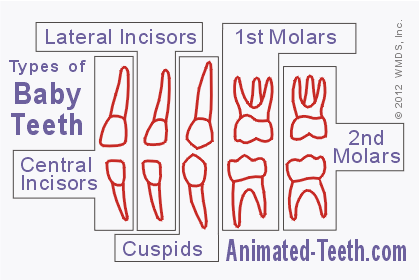
The 5 types of baby (deciduous) teeth: Central and Lateral incisors, Canines, First and Second molars.
- A complete set of deciduous (primary) teeth is composed of 20 individual teeth.
- The 20 teeth are equally divided between the child’s upper and lower arches (jaws) (10 uppers and 10 lowers).
- That means each mouth quadrant (1/4th of the mouth, as in upper left, lower left, upper right, and lower right) contains 5 teeth.
(Our graphic here shows two quadrants, the upper left and lower left.)
FYI – If you’d like, you can learn about and test your knowledge about the subject of baby teeth and baby tooth identification by taking one of our quizzes. They’re free and intended for students of all ages.
What are the different kinds of baby teeth?
As a set, a person’s 20 baby teeth are composed of the following tooth types:
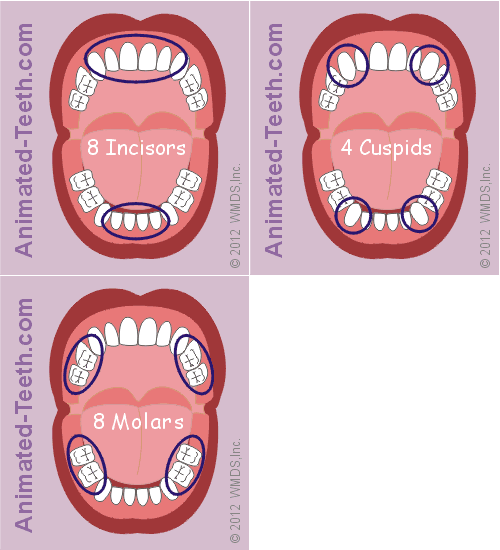
A child has 20 baby teeth total, composed of 8 Incisors, 4 Canines, 8 Molars.
- 8 Incisors (4 upper / 4 lower) – The center two front teeth are termed central incisors. The teeth positioned just to their sides are referred to as lateral incisors.
- 4 Cuspids (2 upper / 2 lower) – These teeth, also sometimes referred to as canines or eyeteeth, lie next in line behind the incisors.
- 8 Molars (4 upper / 4 lower) – The molars lie furthest to the rear. A person has a first followed by a second, molar.
Teeth display bilateral symmetry.
A person’s left vs. right teeth are generally mirror images of each other, meaning they are identical in number, and usually in size and shape too.
This general rule of “bilateral symmetry” is true for all sets of teeth, both primary (baby) and secondary (the permanent teeth).
FYI – Deciduous teeth are pretty similar to permanent ones.
While baby tooth anatomy (size and shape) is different from their adult counterparts, milk teeth are otherwise very similar in nature to permanent ones.
Confusingly, when a deciduous tooth has finally fallen out, it typically looks rootless and possibly even hollow. But during the bulk of its years of service, each tooth does have one or even multiple roots and contains live nerve tissue in its center, just like permanent teeth do.
Tooth eruption – When do a child’s deciduous teeth come in? In what order?
Although a child’s primary set of teeth begin to calcify in utero (meaning before the child is born), they typically don’t start to come in until around age 6 months. Then, by age 2 to 2 1/2 years, usually all have erupted and are fully in place.
Primary dentition eruption timetable.
| Baby teeth eruption time frames and order. | ||
|---|---|---|
| Tooth type | Lower arch | Upper arch |
| Central incisors | 6 months | 7 1/2 months |
| Lateral incisors | 7 months | 9 months |
| Cuspids | 16 months | 18 months |
| First molars | 12 months | 14 months |
| Second molars | 20 months | 24 months |
Variations in eruption timing.
The precise age at which a child’s baby teeth come in can vary. Some children get their teeth relatively early, others comparatively later.
- These variances frequently follow along family lines, in the sense that what a child experiences is similar to that which took place with one of their siblings or parents.
- A 6-month variation (plus or minus) in the time of eruption of a tooth is considered normal. (Dean)
- Usually, the corresponding teeth on each side of the jaw come in during a similar time frame. (A continuation of nature’s bilateral symmetry theme.)
Tooth exfoliation – When does a child lose their primary teeth? In what order?
Baby teeth exfoliate (fall out on their own) as their permanent replacements come in. The table below gives the typical age range for this event for each type of tooth, as well as the kind of permanent tooth that replaces it. Generally, by age 12 all of a child’s deciduous teeth have been replaced by their corresponding “adult” ones.
Primary dentition exfoliation timetable.
| Baby teeth shedding/loss time frames and order. | |||
|---|---|---|---|
| Tooth type | Lower arch | Upper arch | Permanent replacement tooth. |
| Central incisors | 6 – 7 years | 7 – 8 years | Central incisor |
| Lateral incisors | 7 – 8 years | 8 – 9 years | Lateral incisor |
| Cuspids | 9 to 10 years | 11 to 12 years | Canine |
| First molars | 10 to 12 years | 10 to 11 years | First premolar |
| Second molars | 11 to 12 years | 10 to 12 years | Second premolar |
▲ Section references – Dean
Variations in the timing of deciduous tooth exfoliation.
Just as with tooth eruption, the precise age at which a deciduous tooth is lost can vary, often by months or years (as evidenced by the ranges in the table above). However, even beyond these ranges, a time frame of plus or minus 6 months is not uncommon. (Dean)
Once eruption has occurred on one side (left or right), it can be expected that the corresponding tooth on the other side will make its appearance soon. (Suri)
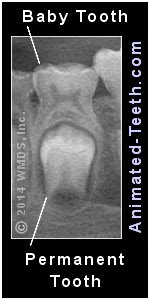
An early stage of permanent tooth formation and baby tooth exfoliation.
Exfoliation timing is dependent on the permanent tooth underneath.
General rules of thumb.
- The eruption process will initiate at that point when the permanent tooth’s crown portion (its non-root part) has completed calcification (has fully formed). (See graphic.)
- But typically one-half to two-thirds of the tooth’s root must have formed before it will finally emerge from the jawbone and into proper position among the other teeth.
- FYI: A tooth’s root will not fully finish forming until some years after its eruption has taken place. (In the neighborhood of at least two years.)
▲ Section references – Nowak, Dean, Suri
And that’s why tooth eruption ages vary.
For example, if the progress of a child’s dental development is comparatively but naturally slow, expect that the age when they lose each of their baby teeth may be delayed, by multiple months or possibly longer.
What causes baby teeth to fall out?
It may seem strange that baby teeth stay firmly anchored for years on end and then, right on schedule, simply fall out. But actually, there’s a simple explanation for this phenomenon.
A process termed “root resorption” is involved.
Despite the way a baby tooth looks after it has fallen out (often just a hollow shell), for most of its lifespan it did have a substantial root complex. (One or even multiple roots, depending on the type of tooth, see diagrams above.)
What takes place.
As the permanent tooth underneath a deciduous tooth begins its process of eruption, its presence triggers the formation of osteoclasts. (A type of cell that can break down bone tissue as well as tooth dentin and enamel, the two hard tissues that make up teeth.)
Baby teeth fall out because their root finally gets too short to anchor them.
- As osteoclasts resorb (dissolve away) the deciduous tooth’s tissues, its roots become shorter and shorter. (This process also creates a pathway of least resistance that the emerging tooth tends to follow.)
- Finally, a point is reached where what’s left of the baby tooth is no longer substantial enough to keep it anchored, and it is easily dislodged. (Hello Tooth Fairy.)
What should you do if your child’s baby teeth don’t come in or fall out on schedule?
If your child’s primary teeth don’t come in or aren’t lost as expected, it will take an evaluation by your dentist to determine what type of attention, if any, is required. This exam will almost certainly require taking one or more X-rays.
Possible problems & issues and their treatment solutions.
A) Missing teeth.
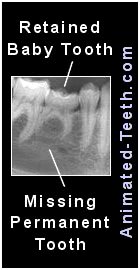
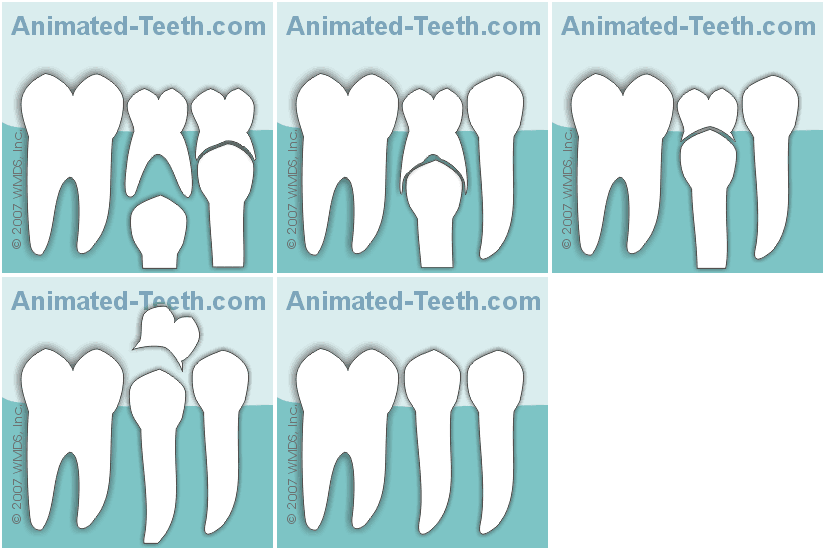
This baby tooth doesn’t have a permanent tooth replacement.
Teeth that have never formed, of course, can never come in.
- Having missing teeth can disrupt the normal development of a child’s primary or secondary dentition, or both. Situations may involve only one, just a few, or possibly even several tooth locations.
- In the case of missing permanent teeth, the primary teeth they were intended to replace will not fall out as expected.
A retained deciduous tooth can’t be expected to last a lifetime and therefore a plan for its eventual replacement should be made.
B) Tooth crowding / misalignment.
Abnormalities with baby tooth exfoliation may be due to issues associated with poor tooth orientation or alignment.
After an evaluation, the child’s dentist can explain what treatment approaches might be used (either immediately, or in stages as the child continues to develop) so to help make room for and guide the permanent teeth into place.
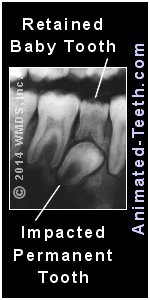
This baby tooth’s replacement is impacted and thus can’t erupt.
Examples
- Crowded baby teeth may call for the use of “serial extractions.”
This is a process where selected baby teeth are removed a little bit ahead of time to facilitate the eruption of the permanent teeth underneath.
- Some severely misoriented permanent teeth may be impacted (unable to erupt because the errant path on which they’re headed is blocked by another tooth, see picture). If so, their corresponding baby tooth will be retained.
In some cases, the deciduous tooth may need to be extracted and the impacted permanent tooth surgically exposed so an orthodontic device can be attached to it, so to guide it into its proper place.
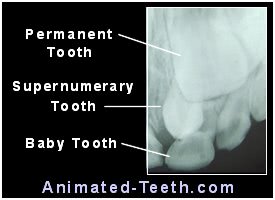
This supernumerary (extra) tooth is interfering with the eruption of the neighboring permanent tooth.
C) Extra teeth.
Supernumerary (extra) permanent teeth may block or otherwise interfere with the normal eruption process of the teeth adjacent to them, thus resulting in baby tooth retention.
- One solution is to remove the supernumerary and retained baby teeth, and hope that the permanent teeth will then just erupt into the proper position on their own.
- In some cases, the teeth may be reluctant to proceed with eruption, or their final positioning may be found to be less than ideal. If so, orthodontic intervention will be required.
[A mesiodens is a supernumerary tooth that’s located between a person’s center two teeth (their central incisors). We discuss the topic of mesiodentes in detail (diagnosis, pictures, complications, treatment) on this page.]
D) Normal abnormalities.
Sometimes what a parent interprets as being a problem, while not exactly ordinary, is something that can be expected to either resolve on its own or only require minor dental treatment (such as extracting the offending baby tooth).
These types of situations might include:
- Permanent teeth that erupt slightly off target, thus resulting in the situation where one or more baby teeth never loosen up enough to fall out on their own.
- Permanent incisors that have come in on the backside of the baby teeth, resulting in a “double row” of teeth.
- Eruption complications associated with fused baby teeth.
E) Medical syndromes.
A number of medical conditions are known to be associated with either the premature or delayed loss of baby teeth.
- Premature loss – Fibrous dysplasia, Juvenile diabetes, Histiocytosis, Cyclic neutropenia, Hypophosphatasia, Chediak-higashi syndrome, Vitamin D-resistant rickets.
- Delayed loss – Cleidocranial dysplasia, Sclerosteosis, Gardner’s syndrome, Vitamin D resistant Rickets, Down syndrome, Hypopituitarism, Hypothyroidism.
Immediate action may not be required but a general plan for managing the child’s dental situation should be made.
F) Other factors associated with delayed eruption.
Beyond what we’ve mentioned above, there are of course additional factors that may affect the eruption process of teeth.
They can include: tooth ankylosis (tooth to bone fusion), complications associated with tooth trauma or dental disease, premature loss of the associated baby tooth, the density of the overlying gum tissue, skeletal considerations, and a host of additional systemic conditions and issues.
As a patient or parent, you simply need to appoint with your dentist so they can perform an evaluation and then recommend a course of action.
▲ Section references – Suri, Nowak, Dean
Looking for more information?
Without question, if you’re interested in knowing about baby teeth you should also be aware of the kinds of problems that can occur if your child loses one prematurely, like from decay or an accident. We recommend that you read this page: Complications (and solutions) associated with early baby tooth loss.
Another subject that’s important for a parent to know about in maintaining their child’s dental health is this topic: Dental Sealants – How they prevent tooth decay.
Last reviewed: April 17, 2026
Author: Paul Cotner, DMD — retired dentist.
Published by: WMDS, Inc. — owner of Animated-Teeth.com.
Educational information only — not a substitute for professional dental care.
Page references sources:
Dean JA, et al. McDonald and Avery’s Dentistry for the Child and Adolescent. Chapter: Eruption of the Teeth: Local, Systemic, and Congenital Factors That Influence the Process
Nanci A. Ten Cate’s Oral Histology. Chapter: Physiologic Tooth Movement. Eruption and Shedding.
Nowak AJ, et al. Pediatric Dentistry: Infancy through Adolescence. Chapter: The Dynamics of
Change.
Suri L, et al. Delayed tooth eruption: pathogenesis, diagnosis, and treatment. A literature review.