Looking for information about other Dental Topics?
Full Website Index• Animated-Teeth.com •

A Guide to Dental Sealants and How They Protect Teeth From Decay.
Dental Sealants: How They Work and Why They Matter.
Dental sealants offer a simple yet highly effective way to protect teeth from cavities, especially for children and adolescents. These thin, protective coatings are applied to the grooves of teeth to prevent decay by blocks the accumulation of bacteria and debris.
Whether you’re a parent considering sealants for your child or an adult exploring preventive dental care, understanding how sealants work, their benefits, and what to expect during the procedure is essential. This guide provides a comprehensive look at dental sealants, covering everything from their effectiveness and cost to potential risks and maintenance tips.
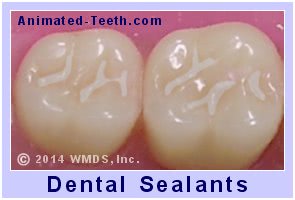
A dental sealant’s thin plastic coating fills in the grooves (pits and fissures) of teeth.
1) What is a dental sealant?
A dental sealant is a thin, protective coating that’s bonded into the grooves of teeth to prevent cavities.
The formal term for this preventive measure is “pit and fissure sealants.”
Additional details to know about sealants.
- Sealants fill in the grooves, nooks, and crannies of a tooth so food and bacteria can’t accumulate in them and possibly cause a cavity.
- Sealants are most frequently placed on the chewing surface of teeth (because that’s where most of a tooth’s grooves lie). But they can also extend onto the cheek or tongue sides of a tooth (either as a continuous or separate application) depending on the nature of the pits and fissures found there.
- The most commonly used sealant material is clear or white plastic resin.
How long have tooth sealants been around?
There’s nothing new about using sealants as a protective shield for teeth. Dentists have been placing them since the late 1960s. (That’s the decade when the science of bonding dental materials to tooth enamel first became widely implemented in dentistry.)
2) How do dental sealants work?
How do they prevent teeth from getting cavities?
Dental sealant placement modifies a tooth’s surface in a way that makes it harder for tooth decay to start. Here’s the whole story explained:
1) Background.
- Cavities are caused by bacteria that live in dental plaque (the white film that forms on teeth).
(If you’re interested, here’s a link to our page that provides more in-depth information about how and why cavities form.)
- Brushing your teeth helps to prevent decay by scrubbing dental plaque and associated debris off tooth surfaces.
2) The problem: Deep tooth grooves can be hard to brush clean.
As you no doubt know, the chewing surfaces of the back teeth (molars and bicuspids/premolars) have multiple grooves (termed pits and fissures). And debris that accumulates in these grooves can be difficult to brush away.
Additionally, in some cases a tooth’s grooves are especially deep and narrow. And if they are, even if a person brushes their teeth as effectively as they can some of the dental plaque and food debris that has accumulated in these deep crevices will be left behind.
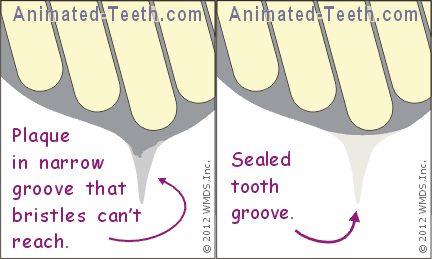
Grooves that are too narrow for a toothbrush’s bristles to clean should be sealed.
That’s because the individual bristles of a person’s toothbrush may be physically too large to reach into the depths of the pits and fissures found on their teeth (as illustrated in our graphic). And because some amount of plaque will be left behind (deep down in the grooves), the tooth will remain at risk for cavity formation.
3) How the protective coating of a tooth sealant solves this problem.
By bonding a dental sealant into the grooves of a tooth, a dentist makes its surface more cleansable.
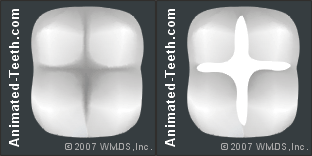
The dental sealant fills in the grooves of a tooth.
- The sealant fills in the depths of the tooth’s grooves so there is no longer any location where the person’s toothbrush bristles can’t reach and clean.
- After sealant placement the surface of the tooth is smoother, which means there are fewer nooks and crannies that might harbor dental plaque and debris.
4) A side benefit of sealing a tooth.
Another difficulty associated with teeth that have deep pits and fissures is that the thickness of the enamel at their base may be comparatively thin.
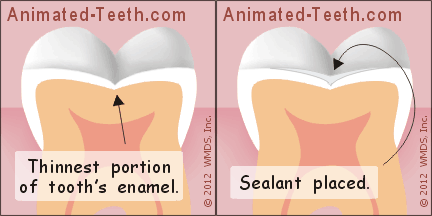
Sealants can help to protect vulnerable tooth locations.
That means, not only does the presence of a groove that traps debris make it more likely that decay may form but if it does, it will have an easier time penetrating into the interior of the tooth because the enamel’s thickness is so thin.
Placing the protective covering of a dental sealant in time can prevent this scenario from occurring.
5) Some sealants release fluoride.
As another benefit, some sealant formulations include fluoride. Its release, right at a tooth’s surface, can be especially helpful in lowering a tooth’s risk for developing decay.
6) Statistics that reveal what a clever idea tooth sealants are.
To emphasize what an elegant solution sealants are, a paper by Fiegal (titled: The Use of Pit and Fissure Sealants ) shares the following statistics.
- It’s estimated that 88% of tooth decay in school-age children occurs in pits and fissures.
- These locations, however, only make up about 13% of an at-risk tooth’s total surface area.
- By protecting this small percentage of a tooth’s total surface area with a sealant, you can lower a child’s overall risk for cavity formation substantially.
3) Who qualifies as a candidate for tooth sealants?
a) Kids vs. Adults – General considerations.
Most sealants are placed on the teeth of children. However, any person who has a tooth that could benefit from this kind of protection, no matter what their age, can and should consider getting one.
The bottom line: It’s a tooth’s susceptibility to decay and not the age of the patient that should be the primary consideration.
b) Should everyone and all their teeth have sealants placed?
No, not all people or teeth require the protection that dental sealants provide.
The recommendation of the American Dental Association’s Council on Scientific Affairs is that sealants should not be viewed as a universal “standard of care” (meaning they should be applied to all potential candidate teeth). Instead, they should be regarded as a valuable option that’s considered on a case-by-case and tooth-by-tooth basis.
The bottom line: After performing their examination, your dentist can report to you if they feel the procedure is indicated.
4) When should dental sealants be placed? – Common guidelines.
We’ve divided our coverage of sealant guidelines into the following sections.
- Risk factors dentists look for.
- Age-related factors that may influence placement.
- Sealant recommendations according to tooth type (molars, premolars, other teeth).
- Tooth conditions that might prevent sealant placement.
a) Factors that make teeth more susceptible to cavities and justify sealant placement.
1) Teeth that have deep, narrow pits and fissures.
Any tooth that has pronounced pits and fissures prone to debris accumulation is a candidate for a sealant. This group also includes teeth that have anatomical anomalies that function as debris traps.
Teeth with deep, narrow grooves are at high risk for decay formation and have a more urgent need for sealant placement. In contrast, teeth with shallow, rounded grooves are less susceptible.
Narrow, unbrushable tooth grooves place a tooth at increased risk for cavity formation.
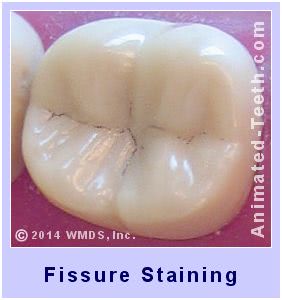
Deep grooves tend to accumulate stain and debris.
2) Back teeth (premolars and molars).
Back teeth typically have the greatest number of pits and fissures as well as the deepest ones. Additionally, their location in the rear of the mouth makes them comparatively harder to clean. For these reasons, premolars, and especially molars, are the teeth most commonly sealed.
3) Patient factors that must be evaluated.
Beyond tooth anatomy, a dentist will evaluate the patient’s habits to assess their risk of developing pit and fissure decay.
- Oral home care habits – Brushing frequency and effectiveness play a vital role in cavity prevention. Patients who have poor oral hygiene habits will be in greater need of the protection that sealants can provide.
- Dietary habits – Consuming sugary foods frequently, especially sticky ones, and especially without brushing afterward, can significantly increase a person’s risk of developing pit and fissure decay. Sealants can be especially beneficial for these cases.
- Individual decay rate – People who have a history of struggling with tooth decay frequently continue to experience problems. In these cases, sealants can serve as a valuable preventive measure.
- Fluoride exposure – People with insufficient fluoride exposure are more likely to develop cavities and therefore may benefit greatly from sealants.
(Using an fluoride toothpaste regulary can help in maintaining an adequate exposure.)
Case Study: Sealants not needed for a low-risk child.
The parents of an 8-year-old girl visit the dentist expecting that sealants will be recommended for her 6-year molars (first permanent molars). Upon examination, the dentist determines that sealants are unnecessary for several reasons.
The child’s molars have shallow, rounded grooves that are easy to clean and not prone to harboring dental plaque and food particles. Her oral hygiene is adequate to good with no signs of decay or enamel demineralization even though the molars have been fully erupted for two years.
Considering the family’s lack of insurance coverage and the child’s low cavity risk, the dentist reassures the parents that sealants are not needed at this time. However, the dentist reinforces the need for continued good oral home care and regular dental check-ups.
b) Age-related factors that may affect when sealants can be placed.
While a dental sealant can be placed on any tooth at any age, most are placed on the teeth of children. And when permanent teeth are involved, preferably fairly soon after they have first erupted. With that in mind, however, certain rules need to apply.
Age-related factors to consider when placing sealants.
- While this procedure is simple and quick, the patient must be mature enough to provide a minimal level of cooperation for it to be carried out.
- A tooth must be kept dry during sealant application. That means the portion of the tooth receiving treatment (typically its occlusal/chewing surface) must have erupted through its surrounding gum tissue enough to allow this.
The specific age at which this combination of events occurs will vary from one tooth or child to another. It’s typically left up to the dentist to recommend when any specific tooth should be sealed.
Case Study: A successful second attempt at sealant placement.
A 6-year-old boy scheduled for dental sealant placement struggled to tolerate the procedure. As a result, the procedure was postponed. Now, at age 7, the procedure has been rescheduled even though the boy remains apprehensive.
To reassure him:
- The dentist explained that since he is now older, and with the improved “big boy” cooperation that usually comes with that, he can expect to find this second attempt much easier.
- He also explained to the boy that the further growth and development of his teeth and mouth since last time should allow for better access and easier tooth isolation, thus simplifying the placement.
With patience and encouragement, the boy successfully completed his procedure, gaining a positive dental experience and valuable cavity protection.
c) Specific guidelines for placing sealants according to tooth type.1) Permanent first molars (6-year molars)
These teeth usually erupt between ages 6 and 7 years. At this age, most children are cooperative enough to undergo this procedure. Therefore, as soon as the molar has penetrated through its gum tissue far enough to allow sealing, the procedure can be scheduled.
Common recommendations: First molars are probably the most frequently sealed teeth and it’s easy to understand why. While they are intended to serve a child for their entire lifetime, they come in at an age when their dietary and brushing habits are typically lax. In fact, molars are the kind of tooth most likely to experience decay.
Most dentists probably prefer to err in favor of recommending sealant placement for first molars rather than risk leaving them unprotected. A properly placed and maintained dental sealant has no potential to cause harm, whereas not placing one may have consequences.
2) Permanent second molars (12-year molars)
These teeth typically come in between the ages of 11 and 13 years of age. With early-teen patients, there should be little concern about their ability to provide adequate cooperation. Therefore, as soon as the tooth has erupted far enough through the gums to allow sealing, the procedure should be scheduled.
Common recommendations: As compared to a 6-year-old patient, by age 12 the dentist should have a clearer picture of their patient’s risk for cavities.
For children who display good dietary and oral hygiene habits, have no history of decay, and whose families are concerned about dental costs, a dentist might not feel strongly about placing sealants on the child’s second molars.
In comparison, for families where finances are not a concern, protecting molars with sealants may be considered a worthwhile expenditure. Statistically, molars are the kind of teeth most likely to experience decay. And in light of this fact, placing sealants may make a reasonable option for added protection.
3) Other kinds of permanent teeth.
A recommendation for sealant placement on other types of permanent teeth is typically made on a case-by-case basis.
- Premolars (bicuspids) – These teeth may display the same deep groove anatomy as their neighboring molars. If so, sealants should be placed to prevent decay. After molars, bicuspids are the teeth most likely to receive a sealant.
- Incisors – While comparatively uncommon, front teeth may need the protection of a sealant. For example, upper incisors occasionally have a deep pit on their lingual surface (backside) that accumulates plaque.
4) Baby teeth (deciduous teeth)
While there is no question that baby teeth are important (for example, they hold space for their permanent replacements). However, recommendations for protecting them tend to vary.
Beyond just pit and fissure depth, other factors must also be considered too. These factors include patient cooperation and the time until the tooth naturally falls out. It is essential to seek your dentist’s recommendation on a tooth-by-tooth basis.
5) Teeth of adult patients
Any permanent tooth can be sealed, at any time.
Common recommendations: Finding a need for sealant placement on an adult is fairly uncommon.
In most cases, it would be expected that a tooth with deep pits and fissures and therefore is at great risk for cavity formation would have already developed decay by adulthood. However, there can be exceptions. Each tooth must be evaluated on a case-by-case basis.
Case Study: Sealants recommended for an adult due to increased cavity risk.
A 32-year-old patient visits their dentist for a routine check-up. They have a history of performing good oral hygiene, however, they recently began taking medication for a medical condition that causes dry mouth. The resulting decrease in saliva flow, along with the loss of its protective properties, places them at increased risk of cavity formation.
When performing their examination, the dentist notices deep grooves in the patient’s molars. They advise applying sealants to these vulnerable teeth in light of the patient’s new circumstances. The patient schedules the work because they realize that sealants are a cost-effective preventive measure.
d) Sealant placement factors based on the current condition of the tooth.
Sealants are a preventive measure, not a corrective one. In comparison, filling placement is typically a corrective measure. As such, the surface of the tooth that will be sealed must be one where little or no pathology has yet formed.
Tooth decay considerations.
A tooth that has developed incipient decay (the earliest stage of cavity formation) often still is a candidate for a sealant. Placing a sealant at this stage may help avoid the need for a filling later on. However, if a full-fledged cavity has already formed, it is too late to consider this procedure.
Previous restorative work.
Another factor that might rule out sealant placement is if the tooth already has a filling in the area where the sealant would be applied. The philosophy usually associated with filling design is “extension for prevention.” This means the outline of the filling is extended to incorporate vulnerable aspects of the tooth.
a) Ideal conditions for sealant placement.
The most predictable scenario for the use of a sealant is one where it is placed before any sign of a cavity has had a chance to form.
For this reason, once a need has been identified, it is recommended to have a tooth sealed at the earliest reasonable opportunity.
b) Acceptable conditions for placement.
Even if early signs of cavity formation have started to appear (referred to as incipient or non-cavitated decay), a dentist may determine that it is still appropriate for a sealant to be placed. This must be evaluated on a case-by-case basis.
The general idea associated with this plan is that the tight seal of the sealant over the bacterial colony responsible for forming the lesion will cut off its food supply, thereby slowing or halting the decay process.
A study by Heller evaluated sealant placement over incipient decay over a 5-year period.
- Only 11% of teeth that received sealants developed cavities. These cases represent instances where the sealant inhibited rather than fully arrested the decay.
- In comparison, 52% of teeth that did not receive a sealant developed cavities.
Case study: Choosing a “wait and see” approach for sealants.
A dentist was asked to evaluate a 13-year-old girl who had never had dental sealants placed.
The dentist found no evidence of decay in her mouth (past or present). The child’s oral home care appeared good, and her parents stated that her eating and brushing habits were favorable. Further discussion revealed that the family did not have dental insurance, and finances were a concern.
Following a discussion with the parents, the dentist decided not to place sealants at this time. A plan was established for the dentist to monitor for signs of cavity formation during future checkups. If incipient decay is identified, sealants will be applied promptly to protect the teeth and prevent further progression.
Case Study: An example of when dental sealants should not be placed.
A 9-year-old child visited their dentist for a check-up and sealants were initially considered for their molars. Upon further evaluation, including bitewing X-ray examination, the dentist discovered that several molars had decalcified grooves and developing cavities. As a result, these teeth were deemed unsuitable for sealant placement. The child is scheduled for restorative work.
5) How effective are sealants in preventing cavities? – Research findings.
Numerous studies have documented the effectiveness of dental sealants in preventing cavities. Here’s a sampling:
► American Academy of Pediatric Dentistry (2002)
Paper title: Pit and Fissure Sealants—A Comprehensive Review.
Findings: This organization released a paper in conjunction with their Pediatric Restorative Dentistry Consensus Conference. Nine randomized controlled trials involving permanent molars and 2 to 3-year follow-up periods were evaluated. Collectively they documented a 76% reduction in occlusal cavities for sealed teeth. (Cvikl)
► Bravo (2005)
Paper title: Sealant and fluoride varnish in caries: A randomized trial.
Findings: This study evaluated 36 children aged six to eight over a nine-year period. During the clinical phase of the study, the children had sealants placed on their permanent 1st molars. Then, during the following 3 years, periodic checkups and needed repairs were conducted. After this phase, the study did not include any additional follow-ups or repairs.
At nine years, 27% of the sealed teeth had developed occlusal decay, compared to 77% of the first molars in the control (unsealed) group. This represents a comparative reduction of 65% in decay for sealed versus unsealed teeth.
► Jodkowska (2008)
Paper title: Efficacy of pit and fissure sealing: Long-term clinical observations.
Findings: This study tracked the dental histories of 360 children aged seven to eight over a 15-year period. Sealing all of a child’s first molars resulted in a 36% reduction in the total number of cavities they experienced. When all posterior teeth (molars and premolars) were sealed, the overall reduction in cavities was 54%.
► Canga (2021)
Paper title: Effectiveness of Sealants Treatment in Permanent Molars.
Findings: This study determined that children treated with sealants developed cavities in only 21.3% of cases, compared to 64.2% in the unsealed control group, demonstrating the effectiveness of sealants in preventing tooth decay.
► Wnuk (2023)
Findings: This study evaluated published dental research and identified 15 studies (published between 2008 and 2021) that met its selective inclusion criteria. Collectively, these studies documented odds ratios (OR) for caries occurrence ranging from 0.06 to 0.28, indicating a 72% to 94% reduction in cavity risk when sealants were applied.
► Konstandt (2024)
Paper title: Dental sealants: Quick poll results on attitudes and usage.
Findings: This survey revealed that 96% of dental practitioners agreed that sealants are effective in preventing pit and fissure caries in children and adolescents, demonstrating widespread professional agreement on their efficacy.
6) How are dental sealants placed?
Dental sealant placement is a simple and quick process. For any one tooth, its treatment can be completed in just a minute or two. The procedure is painless, with no anesthesia is required.
Note: For a more detailed description, use this link: Dental sealant placement The steps. | Illustrations.
The steps of dental sealant placement.
- As an initial step, the tooth that will receive the sealant is isolated either by way of placing a rubber dam or using cotton rolls.
- Next, the tooth’s surface is thoroughly cleaned, typically using a small spinning brush and pumice, to eliminate plaque, debris, and stains. Afterward, the tooth is washed and dried.
- The areas on the tooth that will be sealed are prepared using an etching gel that contains phosphoric acid (etch time – 13 to 30 seconds). This etching process creates a microscopically roughened enamel surface that enables sealant adhesion.
- The tooth is then washed and dried and is now ready to receive its sealant coating.
- Liquid sealant is applied to the tooth’s surface. A small brush or applicator tool is used to work it into the tooth’s grooves.
- Once positioned properly, the sealant is set (hardened) using a curing light (curing time – 30 seconds or so). Some sealants are self-curing.
- The cured sealant is then evaluated for completeness, integrity, and to confirm it does not interfere with the patient’s bite.
There’s no wait time needed afterward. The sealant is set and ready to be used.
7) How long do dental sealants last?
Sealant loss.
A dentist would probably consider any sealant that remained intact for 3 to 5 years to be a success. However, those that require replacement or repair sooner should not necessarily be considered failures. Any length of time that one remains in place provides protection for its tooth.
- Feigal’s review of published dental literature titled “The use of pit and fissure sealants.” estimated an annual sealant loss rate, including partial loss, of 5% to 10%.
- Dorantes’ study “Assessment of Retention Rates and Clinical Benefits of a Community Sealant Program.” came to similar conclusions. At one year, sealant retention was found to be 72%, with declines of approximately 10% occurring annually over the next 3 years.
- A study by Jodkowska titled “Efficacy of pit and fissure sealing: Long-term clinical observations.” evaluated sealant loss rates over a 15-year period. It determined that after 15 years, 22% of teeth retained complete sealants, while 35% showed partial retention.
As confirmed by this last study, it’s somewhat common that a dentist will see evidence of sealants placed during childhood still intact on an adult patient’s teeth.
Sealant wear.
Sealant wear doesn’t necessarily equate with a loss of protection. Even when it occurs, much of the plastic usually remains in the depths of the tooth’s grooves, thus still providing its preventative function. Possibly even 100% of it’s orginal protection.
8) Aftercare and maintenance.
1) Dental sealants must be monitored and maintained.
A dental sealant can only provide optimal protection if it’s fully intact.
- If you notice that any portion, or even all, of a sealant has come off, you should let your dentist know. This isn’t usually considered a dental emergency but should be given prompt attention. After all, the tooth is not fully protected if the sealant is missing or damaged.
- During each of your regular dental check-ups, your dentist will evaluate the integrity of your sealants and let you know if any of them require repair.
A second try may be more successful.
One reason why a sealant might come off is that the dentist was unable to keep the tooth dry during its placement. This can certainly occur if a child patient was uncooperative, whether intentionally or not.
As the child grows older and more mature, even by several months or a year, a second attempt to seal the tooth may be more successful.
FYI –There’s a bit of awkwardness with this aspect of sealing teeth. Generally, it’s better to place one sooner rather than later. However, if an attempt is made too early, the dentist may struggle due to a lack of full cooperation from the patient.
This can increase the likelihood of sealant loss (partial or full). On the other hand, leaving a tooth unprotected for too long may allow decay to form.
This quandary is simply something you’ll need to discuss with your dentist. One important question to ask is about the costs involved with sealants that fail prematurely (like during the first few months or year following the first attempt). Will the dentist simply replace it at no cost, or will a new second fee apply?
2) How important is sealant maintenance?
- A study by Mertz-Fairhurst titled “A comparative clinical study of two pit and fissure sealants: 7-year results” concluded that the decay rate for molars with partially retained sealants was essentially the same as those that never received one.
- However, our above-mentioned study by Jodkowska (involving 360 children followed over a 15-year period) found that only 15% of teeth with partially retained sealants developed cavities whereas 31% of teeth with complete sealant loss did.
This implies that even poorly maintained sealants provide more benefits for teeth than never placing them at all. (FYI: 7% of teeth maintaining complete sealant retention developed decay.)
- Griffin designed a study (titled Caries risk in formerly sealed teeth.) whose purpose was to specifically evaluate the consequences associated with partially and fully lost sealants. Its conclusions were: “Teeth with fully or partially lost sealant were not at a higher risk of developing caries than were teeth that had never been sealed.”
It’s important to note that each of these studies confirms the benefit of periodic evaluation, with repairs made as needed to keep the patient’s sealants fully intact.
3) How often should sealants be examined?
The Jodkowska study referenced above used checkup intervals of every six months for the first two years, followed by evaluations once every 12 months.
4) What should you do if you have a dental sealant come off?
It’s hard to imagine a scenario where having a sealant come off would constitute a dental emergency. In fact, in the majority of cases, a dentist would probably find it surprising that a patient even knows it has dislodged. (Most lost sealants are probably discovered during dental checkups.)
If its sealant has come off, your tooth is no longer protected so it’s in your best interest to simply contact your dentist’s office and schedule to have it replaced whenever is reasonably convenient.
9) Possible risks and side effects.
Potential health concerns with the plastics used for dental sealants.
The issue of patient bisphenol A (BPA) exposure from resin-based dental sealants, as well as “white” fillings (dental composite fillings), has been a topic of investigation and debate in dentistry, especially over the last two decades. This concern is most significant for children and pregnant patients.
What do studies suggest?
The general consensus of scientific research seems to be that, yes, increased patient BPA levels can be detected during the first hours or day following the placement of sealants. This increase correlates with the number of sealants placed. Over the following weeks, BPA levels typically return to baseline.
There is significant debate about the clinical importance of these findings. Without question, more investigation is warranted.
Precautions – Recommendations.
The article “Once Resin Composites and Dental Sealants Release Bisphenol-A, How Might This Affect Our Clinical Management?-A Systematic Review.” contains a fairly recent (2019) examination of this topic.
It includes an outline of steps a dentist can take to help reduce their patient’s exposure to BPA. (See the paper’s Conclusions section.) We would think that any dentist knowledgeable about this topic and the potential concerns it raises would at least be aware of these recommendations.
Alergic reactions to sealant materials.
In rare instances, individuals may develop an allergic reaction to dental sealants. This is often triggered by compounds such as Bisphenol-A (BPA) or its derivatives.
10) How much do dental sealants cost?
Here’s an estimate of what you might pay to have a sealant placed on your, or your child’s, tooth.
$32.00 – $77.00
Small city or town. ◄…► Metropolitan area.
How we calculate our cost estimates for procedures.
Note: The fee range shown is per tooth.
What’s included in the price?
1) Sealing the tooth.
Different than with fillings, the cost of sealing a tooth is calculated on a per-tooth basis, no matter how many separate locations or sides are treated.
It would cost the same to seal each of these molars.
For example, the two teeth in our picture above have each had a different number of individual areas sealed. Despite this difference, however, the fee charged for each tooth would be the same.
Also different than with fillings, sealants typically cost the same whether they are placed on baby teeth or permanent ones.
2) Is maintenance included? / Replacements.
It’s important for dental sealants to be evaluated regularly and repaired as needed.
For your information, you should ask your dentist about their policy regarding fees for repairing or replacing lost or deficient sealants. For example, they may not charge for repairs made within a certain time period after the original placement date.
3) An examination may be required.
If you don’t have an established relationship with a dental office, it’s unlikely that you’ll find one willing to place tooth sealants without examining the patient first.
During this exam, the dentist can confirm that the teeth in question are proper candidates for this procedure. The exam may need to include a set of bite-wing X-rays (the type of X-rays dentists use to check for tooth decay on back teeth) but this is not always necessary. (School-based sealant programs often rely solely on a clinical examination of the teeth being treated.)
Are sealants covered by dental insurance?
Many dental plans and insurance policies do cover tooth sealants.
This makes sense since dental sealants are an effective way to reduce tooth decay and therefore the need for fillings. Insurance companies recognize that providing coverage can save them money in the long run.
Possible policy limitations.
If you are covered by a plan that does provide coverage, there may be conditions and limitations involved.
- The policy may only provide coverage for certain teeth. It’s common for first and second permanent molars to be covered. It’s much less likely for a policy to provide benefits for primary (baby) teeth or permanent bicuspids (premolars).
- Coverage for individual teeth may be limited to a specific age range. Age 16 years is a common cutoff point.
- There may be limitations about the frequency with which a tooth may be sealed.
For example, a plan may only provide benefits for sealing a tooth once. Or, the limitation may be a time interval such as once every 3 or 5 years. This type of stipulation may present a problem if a sealant requires repair.
- The policy’s deductible may or may not be involved. Some plans provide full benefits for this procedure even before the policy’s deductible has been met. Others aren’t as generous.
Tooth sealant programs.
Some organizations or agencies run tooth-sealant clinics that your child may be eligible for. You’ll simply have to check and see what programs exist in your area. In some cases, this service might be provided free of charge.
Where to get information.
Here are some suggestions for where you might find information about the availability of these kinds of programs.
- Your state’s Medicaid office. (Medicaid programs frequently cover this procedure.)
- Your child’s school.
- Your child’s pediatrician.
- Your county’s health department.
- Your state’s Dental Board.
- Your state’s dental association.
FYI –Many sealant programs are school-based, so your child’s school nurse would be a good place to start your inquiry. Your county’s health department should also be knowledgeable about what’s available in your area.
These programs frequently focus on serving populations that are less likely to receive dental care from private sources. They often target the same students that are eligible for school lunch programs.
11) How cost-effective is dental sealant placement?
This is a very difficult question to answer and one for which we don’t have a precise answer. But we can say:
- On the surface, a comparison of the cost of a sealant vs. a filling (around $50 vs. $120 or so, possibly more) is easy enough to make. However, there is no guarantee that the tooth in question absolutely would have developed a cavity.
- It’s easier to demonstrate a cost-benefit for teeth where incipient decay (the earliest stage of cavity formation) has already begun. In these cases, placing a sealant (which should arrest the decay process) is cheaper than a filling.
- One shouldn’t overlook the fact that no dental restoration lasts forever. And that means that the filling that’s needed because the tooth was not sealed will most likely require replacement repeatedly over the child’s lifetime.
Beyond just the time and cost involved with this repair work, each time a replacement is made, a little bit more of the tooth’s structure will be lost, possibly to the point of compromising its structural integrity.
- You should take note of the fact that many dental insurance companies do provide coverage for this procedure. It’s unlikely that they would do so unless they felt that it will save them money in the long run.
Information from research.
Here’s an interesting point from a study that sheds some light on the cost-effectiveness of placing dental sealants.
A study by Bravo titled “Sealant and fluoride varnish in caries: A randomized trial.” determined that placing sealants in the grooves of a child’s teeth resulted in a fivefold decay rate reduction on smooth tooth surfaces too (like in between teeth). (It’s suggested that once sealants have been placed, the kinds of bacteria that cause cavities have a reduced foothold in the mouth and therefore are less able to seed additional cavity-causing colonies.)
So, the cost of placing a sealant doesn’t just help to prevent the need for a filling in the location where it is actually placed (in a tooth’s pits and fissures). It also results in a phenomenon where it helps to protect the smooth surfaces of teeth too. That’s a big benefit and savings, both now and over the remainder of the child’s life.
What’s next?
Our next page Dental Sealant Placement is an illustrated guide that outlines the steps of this procedure.
Or, if you’re looking for other information about dental sealants or cavity prevention, scroll on down a few lines to view our ‘What’s Next?’ menu. Thanks for visiting.
Last reviewed: January 10, 2025
Author: Paul Cotner, DMD — retired dentist.
Published by: WMDS, Inc. — owner of Animated-Teeth.com.
Educational information only — not a substitute for professional dental care.
Page references sources:
Beauchamp J, et al. Evidence-based clinical recommendations for the use of pit-and-fissure sealants: a report of the American Dental Association Council on Scientific Affairs.
Bravo M, et al. Sealant and fluoride varnish in caries: A randomized trial.
Canga M, et al. Effectiveness of Sealants Treatment in Permanent Molars. A Longitudinal Study.
Cvikl B, et al. Pit and Fissure Sealants—A Comprehensive Review.
Dorantes C, et al. “Assessment of Retention Rates and Clinical Benefits of a Community Sealant Program.”
Feigal RJ, et al. The use of pit and fissure sealants.
Griffin SO, et al. Caries risk in formerly sealed teeth.
Heller KE, et al. Longitudinal evaluation of sealing molars with and without incipient dental caries in a public health program.
Jodkowska E. Efficacy of pit and fissure sealing: Long-term clinical observations.
Konstandt D, et al. Dental sealants: Quick poll results on attitudes and usage.
Mertz-Fairhurst E, et al. A comparative clinical study of two pit and fissure sealants: 7-year results in Augusta, GA
Paula AB, et al. Once Resin Composites and Dental Sealants Release Bisphenol-A, How Might This Affect Our Clinical Management?-A Systematic Review.
Comments.
These archived comments reflect the experiences and questions posted by visitors in previous years. They have been retained for their informational value.
Comment –
No good.
Beware of having this. My sister’s child had a sealing on a bottom molar and it got a cavity inside the tooth anyway. It went until it killed the nerve. The dentist took no responsibility.
Barb B.
Reply –
While we don’t doubt that what you state is factual, placing dental sealants is a valuable preventive tool. In defense of this procedure, we would like to explain the following points.
In regard to creating tooth protection, placing a sealant is the first step. The second step (as discussed above on this page) is monitoring its integrity during regular checkups over the following months and years.
The hope is that through regular monitoring the dentist will be able to detect any deficiency [sealant loss (whole or partial), leakage] early on before any decay has started. If instead decay is discovered, then a filling is promptly placed. With regular checkups, having a cavity get so out of hand that a deep cavity has formed that has affected the tooth’s nerve could only be considered to be a rare exception.
As a second line of defense, even if periodic evaluation of the sealant’s surface didn’t reveal problems developing underneath, routine x-ray evaluation (via taking bitewing X-rays) should detect any cavity formation long before it gets out of hand.
[Having sealants doesn’t negate the need for periodic X-rays. That’s because x-rays are used to detect cavities in additional areas that sealants don’t protect (primarily those tooth surfaces that touch adjacent teeth, use the bitewing link above for examples).]
Finally, in regard to the dentist’s position, if regular checkups and x-rays weren’t involved then they weren’t given the opportunity for monitoring that’s needed. Beyond that, it’s difficult to know how much responsibility they should have taken.
Generally, it seems even with sealant failure of some sort (partial or full loss) the tooth isn’t at greater risk for decay than it would have been if one had never been placed. (See studies discussed above regarding both of these points.)
While obviously, we don’t know the details of your nephew/niece’s case, it seems easy to state that what has occurred seems far from the norm. And while a tragedy for the child and tooth, it would be a disservice to others to suggest that this isn’t a safe and reliable form of cavity prevention. In the vast majority of cases, it is and it provides a valuable service that can’t be duplicated by any other type of dental treatment.
Staff Dentist
Comment –
Sealant Replacement
Replacement was an issue with my child. She had sealants placed on her 4 six-year molars and at the next check-up it was discovered that two had come off.
Our long-time family dentist stated that teeth that have just come through the gums are still at a level where it is hard to keep them dry during the sealing. She replaced them for free, in just a couple of minutes. Very commendable.
Debbie S.
Reply –
That’s right. A dentist is usually eager to protect newly erupted teeth but their current position in the jaw (how far through the gums they have yet penetrated) can pose challenges, especially in keeping them dry during the procedure.
It sounds like you have a good dentist. They did their best at the time. And when in hindsight it seems the procedure was attempted too soon, they stepped up and made good on their services. That is commendable.
Staff Dentist
Comment –
Are sealants really necessary?
Sealants are an added expense. Are they really necessary? Are they worth the money?
M Tanner
Reply –
No, they’re not a “mandatory” procedure like filling placement is. But keep in mind, in cases where a cavity does form because the tooth was not sealed, that tooth will then require a lifetime of repeated repair (no filling lasts forever).
The fact that so many dental insurance policies do cover sealants hints at the cost savings those companies associate with their placement.
So if your dentist finds a good reason to place them, then it is usually money well spent, and quite the bargain.
Staff Dentist