Home-remedy treatments for dry sockets. –
Self-care for dry sockets.
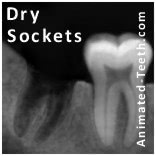
While the most effective treatment for a dry socket comes from your dentist, there are some home remedies that can be helpful in managing your pain.
The one that comes closest to mimicking the care your dentist provides involves the use of clove oil. But alternative remedies, like utilizing honey, black tea, tea tree oil, temperature therapy, or saltwater rinses may be helpful too.
We place most of the emphasis on this page on those home remedies we feel are most likely to provide pain relief. We cover:
- a) The use of oil of cloves as a home remedy. (Dentists and pharmacists refer to this compound as eugenol.)
- b) Using honey (the food) as a cure.
- c) We also discuss the role of using OTC analgesics (over-the-counter pain medications) in providing relief from dry socket discomfort.
- Additionally, we explain the concepts associated with home remedies involving temperature therapy (hot/cold applications), saltwater rinses, tea tree oil, and black tea bags.
Table of contents –- Self-treating dry sockets.
- At-home treatment methods.
- Eugenol (oil of cloves) applications.
- Background and instructions.
- Precautions, tips, and pointers.
- How about using over-the-counter or homemade dry socket paste?
- Honey applications.
- Over-the-counter (OTC) pain medications.
- Additional home remedies – Temperature therapy (hot/cold applications), saltwater rinses, tea tree oil, and black tea bags.
- Other ways to learn.
- Our Dry Sockets Treatment quiz. – It covers the important points you need to know.
- Related page:
- Eugenol (oil of cloves) applications.
- Background and instructions.
- Precautions, tips, and pointers.
- How about using over-the-counter or homemade dry socket paste?
- Honey applications.
- Over-the-counter (OTC) pain medications.
- Additional home remedies – Temperature therapy (hot/cold applications), saltwater rinses, tea tree oil, and black tea bags.
- Our Dry Sockets Treatment quiz. – It covers the important points you need to know.
Background information you should know –
What has caused your dry socket?
Dry sockets form when the blood clot that normally fills in an extracted tooth’s socket either fails to form or has formed but then is subsequently lost. This loss of the clot means that the internal aspect of your tooth’s socket that normally is covered over and protected is instead exposed, resulting in the irritation of the bone tissue and its associated nerve fibers.
Details about - Risk factors for dry sockets.
Symptoms of a dry socket typically include:
- Severe throbbing pain that may radiate beyond just your jaw to your ear, eye, temple, or neck.
- Characteristically, dry socket pain doesn’t first appear until a few days following your procedure.
- An unpleasant taste in your mouth and/or bad breath.
- Visibly being able to see the exposed inside bony surface of your tooth’s empty socket.
More details about - Dry socket signs and symptoms.
When does a self-care approach make a reasonable plan?
As we explain below, self-treatment for a dry socket only makes sense as a first-aid, last-resort type of solution. The kind of step you take when other, more suitable options don’t exist.
The preferred plan.
The most comprehensive and effective treatment can only be provided by a dentist. Here’s what they do. And we will point out that it’s the obligation of the dentist who extracted your tooth to provide you with whatever postoperative care you require.
The self-treatment option.
In lieu of physically presenting to your dentist’s office, this page explains some basic home remedies that are used with dry sockets. But keep in mind that this information is still best used in conjunction with your dentist’s direct advice (phone contact) since they are the one most knowledgeable about your case specifics and therefore how the information we provide applies to your situation. Self-treatment on your own, whenever avoidable, never makes the best plan.
Dry Sockets Treatment quiz – A quick way to learn the important points from this page.
Self-care – Methods of treating a dry socket on your own.
Note: Using self-remedies can’t fully duplicate the level of care that a dentist can provide (see discussion below). They should only be considered to be first aid treatment and appropriate for situations where the attention of a dental professional is not possible.
A dry socket.
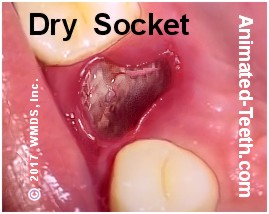
Dry socket treatment usually includes the placement of a eugenol dressing in the opening of the wound.
a) Using clove oil for dry sockets.
Eugenol (clove oil) dressings.
Background.
What is Eugenol?
Eugenol is an oily amber liquid that’s also referred to as “oil of cloves.” It creates the spicy-sweet smell that you typically associate with a dental office. (Not just because your dentist treats a lot of dry sockets. It’s used for other dental purposes too.)
- It can be purchased on an over-the-counter basis (without a prescription). Ask your pharmacist about suitable products and availability.
- If you’d like more background about eugenol, including information about its therapeutic uses, here’s a link to the National Institutes of Health web page that discusses it.
Self-care – How to treat a dry socket using clove oil (eugenol).
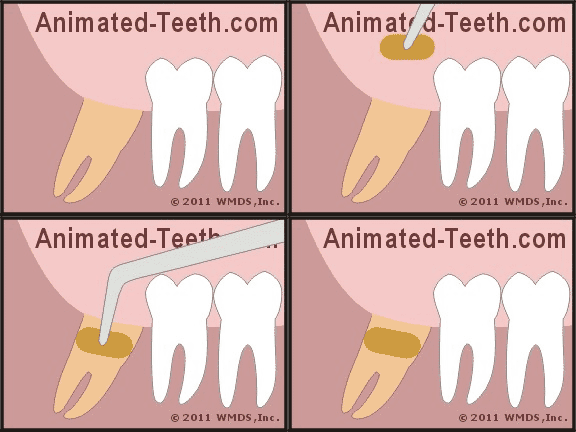
The eugenol dressing is placed in the opening of the tooth’s socket.
- The tooth’s socket should first be cleaned by rinsing it very gently with lukewarm water or saline solution.
The idea is that the liquid should gently lift and carry away whatever loose debris is present. Spit out the liquid when finished.
- Prepare a dressing by placing 1 drop of eugenol (oil of cloves) on a carrier, such as a piece of cotton or gauze that’s been shaped into a 1/4-inch ball or cube.
The specific dimensions of the carrier should be tailored to the size of your wound. It needs to be small enough that it fits into the socket’s opening but also large enough that it helps to prevent food debris from accumulating.
It must also be large enough that it can be easily grasped and recovered when it’s time for it to be removed.
In terms of density (sponginess), the carrier should be soft enough that it easily slides into the socket. But also dense enough that the wetness of the eugenol or oral liquids doesn’t utterly collapse it. As another consideration, it must also be dense enough that it can be expected to retain the applied eugenol.
- Using tweezers, briefly and lightly drag the dressing across a cloth to draw away excess eugenol from it.
(You want the eugenol only applied inside your tooth’s socket. You don’t want it to flow into your mouth. Nor do you want any of it to drip off the dressing onto soft oral tissues when transporting it. See eugenol precautions discussed below.)
- Once prepared, gently insert the completed dressing down into the opening of your extraction site’s empty tooth socket (loosely placed, not compacted). It’s expected that the top of the dressing will lie at a level just below the gum line. The treatment of your dry socket using eugenol has now begun.
- Dressing changes – The dressing is removed, discarded, and then replaced with a fresh one (using this same set of instructions) every 24 hours until the dry socket’s pain has subsided.
- Management of the dressing is an important consideration. Your body considers it a “foreign body” and as such it interferes with the healing process. (The trade-off with treatment is that pain relief is obtained at the expense of delaying healing slightly.)
- In all cases, your treatment needs to cease and any dressing removed once your symptoms have subsided sufficiently (like at that point when the use of an over-the-counter pain reliever is able to keep you comfortable). This point should be reached within 4 to 5 days.
- At any point when the attention of a dentist or other healthcare provider becomes available, you should report to them what steps you have taken, cease performing further self-treatments, and follow their instructions.
▲ Section references – Bowe, Menon, NWCG
Precautions you should be aware of with eugenol.
While the use of eugenol in the treatment of dry sockets is common and routine, it’s not a very bio-friendly medication.
- Due to its cytotoxic effects (effects harmful to living cells), it can cause soft tissue irritation or outright tissue damage. You should take precautions that the eugenol you apply inside your socket does not come into contact with oral soft tissues.
- It’s possible for eugenol to cause bone necrosis. This is typically associated with its use in high concentrations (large amounts), or for extended periods of time (weeks).
▲ Section references – Navas, Sarrami, Jovanovic
The potential for these side effects is why the instructions above include the step of removing excess eugenol from the carrier before inserting it into the socket. And generally why this technique should only be used as a last resort and just for those very few days until your dentist’s services become available and they can take over your dry socket’s management.
Additional things to know about treating dry sockets with eugenol.
- In most cases, the clove oil will begin to provide pain relief within the hour, possibly even within minutes.
- You may still find it necessary to use an over-the-counter pain reliever for additional pain relief.
Common choices are ibuprofen (Motrin®) or acetaminophen (Tylenol®). (Read your product’s directions and stay within its guidelines.)
- As mentioned above, make sure to go light with the amount/concentration of eugenol placed on the carrier. If some of this liquid comes into contact (drips off, touches) other parts of your mouth (soft tissues, tongue) as the dressing is being inserted, it will sting or burn. You may also find its taste unpleasant.
How about using an over-the-counter dry socket paste product?
Most dentists probably do choose a commercially prepared dry socket paste for use with their patients (as opposed to using straight oil of cloves/eugenol like described above). And we have seen these types of products for sale online (over-the-counter availability).
Upon inspection, one is most likely to find that the product they have bought is an eugenol-based preparation. (You could confirm this by smelling it.) And as such, a standard dry socket paste could be used, in the fashion we describe above, in place of oil of cloves liquid. (That’s exactly what dentists do.)
Precautions and issues associated with using OTC dry socket pastes.
- Some commercial preparations come with instructions that state that the product can be placed directly into the tooth’s socket, left alone, and, subsequently, it will dissolve away or become displaced on its own over time.
However, in cases where residual debris instead remains (especially fibrous strands that some products contain) complications can develop.
- It’s important to understand that the sole purpose of using dry socket paste is to alleviate the symptoms of a dry socket (primarily pain). It is not a preventative and therefore should not be used in cases where one does not exist.
Can you make homemade dry socket paste?
In dentistry, there is a history of dentists using oil of cloves liquid, on its own, as we outline above, to treat dry sockets. The idea of using some type of homemade concoction to mimic the performance of something that has a proven track record seems imprudent to us.
b) Treating dry sockets with honey.Background.
Most people don’t associate honey (the common foodstuff) with having therapeutic properties. However, it has a long history of being used as a medicine over the ages. And in recent decades the medical community has begun to rediscover its potential in treating wounds.
Recent dental studies.
1) Ayub et al. (2013) –
Title: Effect of the Honey of Post Extraction Soft Tissue Healing of the Socket.
This paper evaluated the use of honey as an aid in extraction site healing. And while we realize that this topic is a different one from treating dry sockets per se, we are going to mention that this study concluded that:
- While its effect on hastening socket healing could not be definitively determined, no detrimental side effects were identified.
We think that confirmation of that point is important.
2) Singh et al. (2014) –
Title: Honey a sweet approach to alveolar osteitis: A study.
This study specifically evaluated the use of honey in treating dry sockets. The dressing used was sterile gauze soaked with honey, removed and replaced daily until the subject’s pain symptoms had subsided.
The paper stated that this treatment resulted in:
- A significant reduction of inflammation, hyperemia (increased blood flow to the region of the socket), edema (swelling), and exudation (fluid oozing from the wound) …
- … and these reductions led to the creation of a soothing effect and a reduction in the patient’s level of pain and discomfort.
- No comparison was made in regard to the effectiveness of honey vs. eugenol-based dressings.
- No side effects of using honey were identified.
Except for the potential of an allergic reaction (which would also be a consideration for any other compound too), the authors concluded that the use of honey could be considered a viable alternative in the management of dry sockets.
3) Soni et al. (2016)
Title: Effects of honey in the management of alveolar osteitis: A study.
Like the previous study, this one also evaluated the use of honey specifically in the treatment of dry sockets. In this case, the group of test subjects numbered 50.
The dressing involved was simply pure honey on a carrier of sterile cotton. The dressing was placed in the socket and changed daily for the first two days, then every other day.
The study’s findings included:
- A reduction in patient pain over the course of treatment. – Collectively, the study subjects rated their level of pain initially as 7.3 (out of 10). Followed by 4.7 on day 2, 2.2 on day 3, and .7 on day 5.
- A decrease in the level of swelling. – A reduction of 25% on day 2, 63% on day 3, and 89% by day 5.
- A significant reduction in blood CRP levels pre vs. post-treatment. – The study used c-reactive protein (CRP) levels in their subjects’ blood as a measure of inflammation and therefore evidence of the effectiveness of the honey treatment.
- Visual inspection of the subject’s dry sockets showed evidence of the formation of granulation tissue over the exposed bone (a sign of the resumption of the healing process) in about 1 week.
▲ Section references – Ayub, Singh, Soni
Should you use the honey method?
Cons
At this point in time, it’s easy enough to state that few dental professionals in the USA use honey to treat dry sockets. The current standard seems to be that of using eugenol (clove oil)-based dressings.
We’d have to assume that this choice is made due to its comparative effectiveness. However, it may be that it’s not used more simply because dentists are unaware of it or are waiting until it has been further evaluated.
Pros
The main advantages of using honey seem to be its simplicity, availability, and less potential for creating side effects.
Self-care – How to treat a dry socket using honey.
The honey dressing is placed in the opening of the tooth’s socket.
- The tooth’s socket should be cleansed by rinsing it very gently with water or saline solution.
The idea is that the liquid should gently lift and carry away whatever loose debris is present. Spit out the liquid when finished.
- Create a carrier by shaping a piece of cotton or gauze into a 1/4-inch ball or cube. Using tweezers, saturate the carrier by dipping it into honey.
- Using tweezers, insert the dressing (the carrier saturated with honey) into the opening of your extraction site’s empty tooth socket (loosely placed, not compacted). It’s expected that the top of the dressing will lie at a level just below the gum line. The treatment of your dry socket with honey has now begun.
- Dressing changes – The dressing is removed, discarded, and then replaced with a fresh one (using this same set of instructions) every 24 hours until the dry socket’s pain has subsided.
Once the attention of a dentist or other healthcare provider becomes available, you should report to them what steps you have taken, cease performing further self-treatments, and follow their instructions.
c) Self-care – Using oral over-the-counter (OTC) pain medications to relieve dry socket pain.
Depending on the severity of your pain, OTC oral analgesics (pain pills) alone may be able to control the discomfort caused by your dry socket.
Note: Always keep in mind that pain pills are meant to be swallowed. Placing one on, or in the region of, your dry socket will not be effective and will result in extraction site irritation.
- Ibuprofen (Motrin®, Advil®) or aspirin are frequently recommended by dentists to address dry socket pain. These medications are members of a group referred to as nonsteroidal anti-inflammatory drugs (NSAIDs). Of course, you’ll need to read your chosen product’s directions and stay within its guidelines.
- In the case where the use of an NSAID isn’t appropriate for a patient, acetaminophen (Tylenol®) might be used as an alternative. Once again, you’ll need to read your chosen product’s directions and stay within its guidelines.
- It’s quite possible that with severe cases you’ll find that your level of pain is simply too intense and OTC pain relievers are unable to provide a satisfactory level of relief. (With intense pain cases, prescription pain medications on their own may be ineffective too).
- Keep in mind that oral analgesics are typically considered an adjunct in providing dry socket pain relief. As discussed elsewhere on this page, the most effective treatment involves placing a medicated dressing in your extraction site and when possible, preferably by your dentist.
d) Additional self-care remedies for dry sockets.
The following group of home remedies may be able to provide some level of relief for a dry socket.
Temperature therapy.
The use of external hot and cold applications (applications applied to the face) is a routine part of tooth extraction aftercare. Cycles of cold application are initially used to help minimize the amount of post-operative swelling that forms. Cycles of heat applications can then be used to speed up the rate at which that swelling will resolve.
As a side effect, cold applications do numb tissues. And heat applications may produce a soothing effect. You may find that one or the other helps to alleviate some of the discomfort caused by your dry socket.
With temperature therapy, there is always the concern of overheating or over-cooling tissues. Our Postoperative Swelling page explains how appropriate cycles of temperature therapy can be performed.
Saltwater rinses.
It’s not expected that the use of saltwater rinses will significantly reduce the amount of discomfort you experience from your dry socket. But their use can help to promote a positive healing environment.
Rinsing gently so as not to irritate your socket or disrupt its healing progress is the key. The idea is for the rinse to float away any accumulated debris harbored in your tooth’s socket. Debris that might inhibit its healing process or even promote the formation of a secondary infection.
Use this page Extraction Site Rinsing for details about how appropriate rinsing is performed.
Black tea bags.
Black tea contains tannic acid, a compound that can assist blood clot formation. For that reason, it is commonplace that tea bags are used as an adjunct in helping to control post-tooth extraction bleeding.
Tannic acid also has anti-inflammatory, antimicrobial, and analgesic properties and as such may provide some benefit as a dry socket remedy. During treatments, a moistened black tea bag is placed over the socket for 15 minutes.
Tea tree oil.
Tea tree oil has anti-inflammatory properties and as such can help to soothe irritated tissues. During treatments, a drop of the oil is placed on gauze that is then placed on top of the socket. Look for 100% tea tree oil products.
Why self-treatment for a dry socket doesn’t make the best choice.
A home-remedy approach can’t duplicate your dentist’s care. Here’s why:
- As with any type of post-extraction complication, it’s always best to have a dentist’s evaluation. Just because you think you have a dry socket [alveolar osteitis] doesn’t mean that you actually do.
Drawing on their expertise, your dentist can determine what the most likely cause of your problem is and how it should be treated. For example, while not a usual step in the treatment of dry sockets, your dentist may identify a reason why the use of oral antibiotics is indicated for your case.
- They’ll have all of the tools and equipment needed to properly visualize your wound and perform your treatment as effectively and quickly as possible.
For example, ineffectual cleansing of debris from the tooth socket could aid in the formation of a secondary infection. Failing to remove the gauze or cotton carrier as described above could do the same, or result in other complications.
- The dressing that your dentist places will almost certainly contain a number of additional ingredients (anesthetic, antimicrobial agents, etc…) that, collectively, are more beneficial and effective than just a home remedy alone.
Times when self-care may make sense.
One situation where a dentist might recommend self-treatment is when it’s used to supplement the level of care they can provide. Doing so might allow you to obtain relief during those times when they’re not available (after hours, weekends).
In this type of situation, the medication that’s used might be eugenol (as outlined in our home remedy above). More likely, your dentist will dispense to you a small amount of the medicated dressing they use when providing care in their office.
◄ Our previous page discusses how dentists treat dry sockets.
Page references sources:
Ayub et al. Effect of the Honey of Post Extraction Soft Tissue Healing of the Socket.
Bowe DC, et al. The management of dry socket/alveolar osteitis.
Jovanovic G, et al. Maxillary osteonecrosis caused by toxic effect of zinc-oxide-eugenol paste.
Menon A, et al. Dental Working Group Meeting Summary Report
Navas RMA, et al. Case Report: Late Complication of a Dry Socket Treatment
NWCG. Clinical Treatment Guidelines for Wildland Fire Medical Units.
Sarrami N, et al. Adverse reactions associated with the use of eugenol in dentistry.
Singh et al. Honey a sweet approach to alveolar osteitis: A study.
Soni et al. Effects of honey in the management of alveolar osteitis: A study.
All reference sources for topic Dry Sockets.