Looking for information about other Dental Topics?
Full Website Index• Animated-Teeth.com •

What are wisdom teeth? / What are impacted wisdom teeth?
Wisdom Teeth & Impaction Types: A Complete Guide
Wisdom teeth, also known as third molars, are the last teeth to emerge in the mouth, typically making their appearance in late adolescence or early adulthood. While they can serve as functional members of a person’s dentition, their emergence doesn’t always follow a predictable path—some erupt normally, while others become misaligned or impacted.

Full-mouth X-ray showing four impacted wisdom teeth.
Understanding these variations is key to understanding when intervention might be necessary. The aim of this guide is to clarify the definitions and terminology your dentist will use when discussing these details with you.
A) What are wisdom teeth?
► “Wisdom teeth” are a type of molar. Molars are the large chewing teeth found furthest back in a person’s mouth.
► Most people have 1st, 2nd and 3rd molars. A person’s third molars are their wisdom teeth.
► Dentists routinely use the terms third molar and wisdom tooth interchangeably.
How many wisdom teeth does a person have?
People usually have four: upper left, upper right, lower left, and lower right.
Wisdom teeth = 3rd molars.
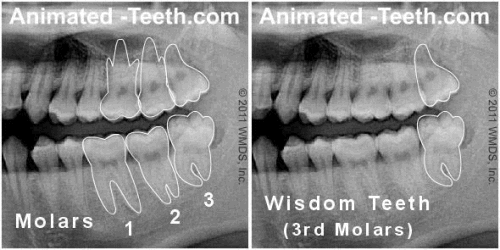
◄ Front of mouth.|Rear of mouth. ►
Is this always the case?
Some people have more.
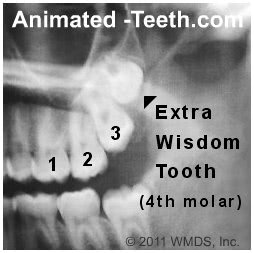
When do wisdom teeth come in?
What ages?
The most common time frame for the eruption process is 18 to 24 years (Faculty).
- The average age for completed eruption is 20 years, with some cases not reaching completion until as late as age 25 (Hupp).
- A person’s third molars are the last members of their set of teeth to come in.
▲ Section references – Faculty, Hupp, Shahzad
B) What are “impacted” wisdom teeth?
In dental terminology, an “impacted” tooth refers to one that has failed to erupt into its expected position in the mouth, within the expected time frame. This failure may be related to:
- A lack of jawbone space to accommodate the tooth. (A mismatch between the total “arch” length needed for the person’s teeth vs. the available arch length provided by their jawbone.)
- The tooth’s eruption has been prevented by some type of physical barrier, such as neighboring teeth, dense overlying bone or excessive soft tissue.
Examples.
▲ Section references – Koerner
Types of impactions / Impaction classifications.
Dentists use a number of terms, in combination, to describe the positioning of impacted teeth.
Impaction classifications –
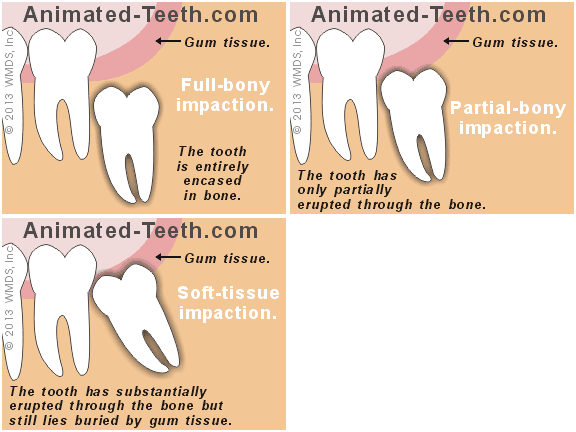
- Full-bony, partial-bony and soft-tissue. – These terms describe the type of tissue that lies over the tooth (just gum tissue, or some combination of gum and bone tissue).
- Mesial, distal, horizontal and vertical. – These terms describe the orientation (tilt) of the impacted tooth.
How these individual classifications are used.
To fully describe a tooth’s situation, a term will be chosen from both of the above groups. For example, a “full-bony mesial impaction” indicates a tooth that …
- Lies fully encased in bone. (The tooth has not yet erupted to the point of penetrating the surface of the jawbone.)
- And has a forward (towards the front of the mouth) tilt.
Our pictures and animations below provide examples of impaction types.
a) Mesial, vertical, horizontal and distal impactions.
These terms are used to describe the angulation of the impacted tooth as compared to what would be considered normal and expected. (The angulation of the adjacent 2nd molar is used as the basis of comparison.) (Koerner)
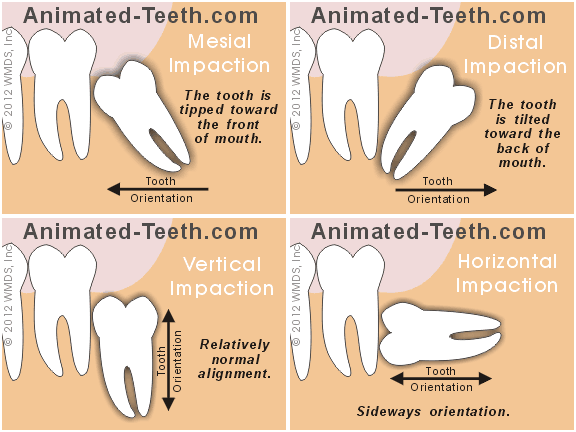
Mesial, distal, vertical and horizontal wisdom tooth impactions.
- The term “Mesial” (also stated as mesio-angular) indicates that the tooth is angled forward, toward the front of the mouth. This is the most common type of wisdom tooth impaction.
- Vertical impactions have a relatively normal orientation. (Upright or down-facing, depending on which jaw holds the tooth.)
- Horizontal (also traverse) impactions have an alignment where the tooth is lying on its side.
- A Distal (also disto-angular) impaction has an angulation that is generally directed towards the rear of the mouth.
Frequency.
Wisdom teeth having a mesio-angular or vertical angulation are the most common types of impactions, making up roughly 40% of cases each.
▲ Section references – Koerner, Hupp
FYI – When making their preoperative assessment of the expected level of difficulty of an extraction Governing factors., the dentist will pay particular attention to the angulation of the tooth because that’s a significant factor, and readily observed on pre-op x-rays.
It’s interesting to note that the same general orientation poses the opposite level of challenge with teeth in the upper vs. lower jaw.
For example, a disto-angular (facing backward) orientation typically favors removal with upper wisdom teeth but makes the task more challenging for lower ones. (Koerner)
Examples
Here’s an x-ray of a single individual whose four wisdom teeth can generally be categorized as each of the four classifications of impactions.
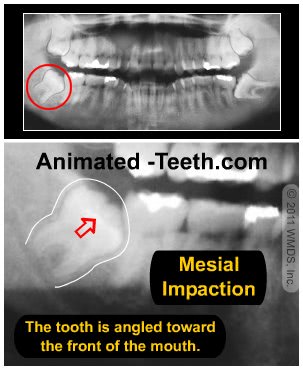
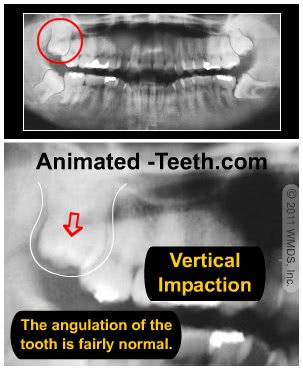
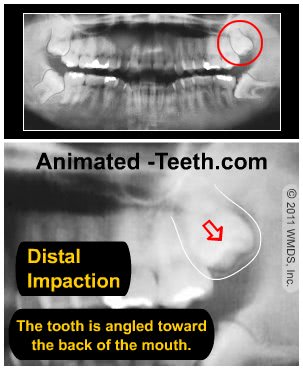
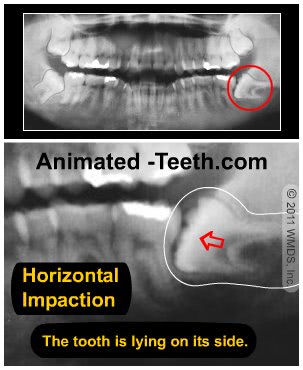
Full-bony, partial-bony and soft-tissue impactions.
b) Soft-tissue and bony wisdom tooth impactions.
- A “soft tissue” impaction is one where the upper portion of a wisdom tooth (the tooth’s crown) has penetrated through the bone but has not yet fully erupted through the gum tissue.
If the tooth has penetrated through the gum tissue to any degree, it’s also appropriate to refer to it as being a partially-erupted tooth.
- The term “bony” or “hard tissue” impaction indicates that the tooth still lies primarily within the jawbone.
A full-bony (complete) impaction is entirely encased by bone tissue, whereas a partial-bony one has erupted through it somewhat.
FYI – The cost Fee estimates. to remove an impacted wisdom tooth is typically based on its soft-tissue/bony classification.
And as you might expect, within this group soft-tissue impactions are typically the easiest to perform, followed by partial and then full-bony.
C) How likely is it that your wisdom teeth will be impacted?
Studies suggest that the incidence rate of having at least one impacted third molar runs on the order of 65 to 72% for populations under the age of 30. (Faculty)
▲ Section references – Faculty
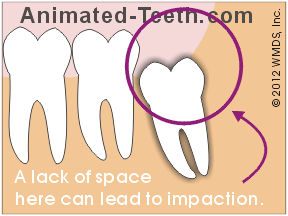
Inadequate jawbone space leads to impaction.
D) What causes wisdom tooth impaction?
Why this lack of space exists is not fully understood. There does, however, seem to be a correlation between large tooth size and/or the presence of generalized tooth crowding and having impacted wisdom teeth.
The human diet has changed.
The dietary changes adopted by modern man have been theorized as playing a role in the incidence of 3rd molar impaction.
The coarse nature of stone-age man’s diet had the effect of producing extensive tooth wear (not just on the chewing surface of the teeth but also in between, where neighboring teeth touch against each other).
When this type of wear takes place, it tends to reduce the “length” of the teeth (as a set), thus creating additional jawbone space to accommodate the wisdom teeth by the time they erupt. In comparison, the diet of modern man does not usually cause a significant amount of this type of wear.
It has also been argued that the coarse nature of stone-age man’s diet, as compared to modern man’s relatively soft diet, probably required more chewing muscle activity. This activity could have stimulated greater jawbone growth, thus providing more space for wisdom teeth.
Additionally, the harsh world of the caveman no doubt often led to the occurrence of broken teeth and tooth loss. Once a tooth (or a portion of it) is missing the teeth behind it have a tendency to shift forward. This type of movement would make more jawbone space available for wisdom teeth. In comparison, with the advent of modern dentistry, there are relatively few reasons why a tooth should remain unrepaired or be lost.
Last reviewed: February 16, 2025
Author: Paul Cotner, DMD — retired dentist.
Published by: WMDS, Inc. — owner of Animated-Teeth.com.
Educational information only — not a substitute for professional dental care.
Page references sources:
Faculty of Dental Surgery of The Royal College of Surgeons of England. Current Clinical Practice and Parameters of Care. The Management of Patients with Third Molar (syn:Wisdom) Teeth.
Hupp J, et al. Contemporary Oral and Maxillofacial Surgery. Chapter: Principles of Management of Impacted Teeth.
Koerner KR. Manual of Minor Oral Surgery for the General Dentist. Chapter: Surgical Management of Impacted Third Molar Teeth.
Shahzad KM, et al. Prevalence and management of fourth molars: a retrospective study and literature review.