Sonicare brushing modes, timers, features – (What does each do? | Which do you really need?)
If you’ve read through our review of the Sonicare toothbrush lineup, you know that different models have different combinations of features. They include:
► Brushing modes – Clean, White, Deep Clean, Gum Care, Sensitive, Massage, Refresh, TongueCare
► Brushing intensity settings – High, Medium, Low, Easy-Start
► Brushing timers – Smartimer, QuadPacer, BrushPacer, KidTimer and KidPacer.
► Features – Brushing pressure indicators, Smartphone brushing app.
This page contains information about each, so to help you decide which are important for you.
Sonicare brushing modes. – Which ones do you need?
For the average consumer, this is a big question. With so many models to choose from, with each having their own different combination of brushing modes, which ones are important to have on the brush you buy?
And for us, since the focus of our Best Sonicares page is picking out models that have as few unneeded options as possible (like extra brushing modes), we needed to figure this issue out for ourselves too.
How we came up with an answer.
Towards figuring things out, we studied the user manuals for each of the current Sonicare models that offer multiple brushing settings. And using that information, came to some conclusions. Here’s what we determined …
A) Clean mode.
This is the default full-power setting on a Sonicare toothbrush. And derived from the information found in user manuals and Sonicare promotional materials, on this page we’ll make the case that for the vast majority of people, this is the (only) brushing mode they should be using.
62,000 brush-movements-per-minute is the key.
The unique cleaning action that Sonicare toothbrushes deliver is based on the rapid rate at which their brush heads vibrate. And on their good models, that number is 62,000 brush-MOVEMENTS-per-minute.
Movements?
Yes, movements. From the inception of the Sonicare brand up until just a few years ago (2016 or so), promotional materials for their toothbrushes always referred to their brushing action as 31,000 brush-STROKES-per-minute.
So if you’ve owned Sonicares before, you might remember that number and think that this “62,000” thing is something new and improved.
Well, it’s not.
As it turns out, this is just a play on terminology. Here’s what’s actually going on. Using their revised math:
- 1 brush STROKE (an up and down motion) = 2 brush MOVEMENTS (one up, one down)
And that means …
- 31,000 brush-STROKES-per-minute = 62,000 brush-MOVEMENTS-per-minute. They describe the same rate of speed (frequency).
So, there’s nothing new and improved here. Both brushing action descriptions are equivalents. (Nice try Sonicare marketing department.)
So, what makes using Clean mode so special?
It’s the way a Sonicare vibrates that makes it special.
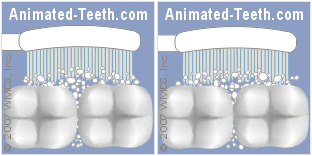
It can clean beyond where its bristles touch.
A Sonicare’s cleaning ability is actually due to two mechanisms:
- The more important of the two is the one that’s obvious. It’s the action of the toothbrush’s bristles scrubbing against your teeth that does most of the plaque-removing work.
Of course, this is how every toothbrush works (sonic or not). But with a Sonicare, it’s high rate of motion creates a very effective and efficient scrubbing action.
- But different than other kinds of brushes, a sonic toothbrush’s vibratory motion also creates what is referred to as “fluid dynamics.”
This is a phenomenon where the liquids surrounding your teeth (water, saliva) are agitated to the extent that they’re able to disrupt dental plaque colonies beyond where the bristles of the brush actually touch.
Only a toothbrush operating at a high enough frequency can make this claim. This effect is an interesting phenomenon, you can read more about it on our page that explains how sonic toothbrushes work.
Which Sonicare models have the full-power, 62,000 brush-movements-per-minute setting?
Gosh, we wish we knew.
It used to be easy to report which Sonicare models had their good brushing action and which ones didn’t. It was as simple as saying …
- All current Sonicare models do …
- … with the exception of the PowerUp product line that doesn’t.
Nowadays, who knows what’s going on?
When revising our pages in late 2019, we discovered that what the Sonicare website (USA version) reported about the frequency of the brushing action of some models was entirely different than what had been previously stated literally for years on end. (We rant about this issue here.)
What we can tell you is this.
- Prestige
- Diamond Clean Smart
- Diamond Clean
- FlexCare Platinum Connected
- FlexCare Platinum
- FlexCare+
- ExpertClean
- HealthyWhite+
- HealthyWhite
- ProtectiveClean
- For Kids
And these are the only Sonicare lines we review on our website.
And the others?
We’d have some question about these models.
In previous years, the 2 Series plaque control, 3 Series gum health, Essence, EasyClean and DailyClean toothbrushes were all reported as having Sonicare’s hallmark brushing action (31,000 brush-strokes/per-minute | 62,000 brush-movements/minute). But as mentioned above, at the time of doing the research needed for the rewrite of our pages, they were not. So, we simply don’t know if they do or don’t.
In regard to choosing a Sonicare, taking these models out of consideration isn’t that much of a loss. Our list above includes some other inexpensive models that will serve you well. (If you need some help with your decision-making process, check out our Best-value Sonicares page.)
This model clearly does not.
The Phillips One does not feature Sonicare’s top brushing action.
Why do we think that just using Clean mode makes the best choice?
You don’t have to just take our word on this.
a) Clean mode descriptions.
- Clean mode is “the Ultimate in plaque removal.” – The DiamondClean (2016), HealthyWhite+ (2015)
- Clean mode is the “standard mode for superior teeth cleaning.” – FlexCare Platinum Connected (2016)
- Clean mode “gives you a thorough and complete clean.” – The DiamondClean Smart (2017)
- Clean mode provides “complete whole mouth cleaning.” – FlexCare+ (2013)
b) Additional excerpts about Clean mode.
When studies that evaluate the effectiveness of Sonicare products are performed, Philips Sonicare wants it known that they expect their products to be used in their most effective setting. And to that point, here’s what the user manuals of various models state:
- “When the Sonicare is used in clinical studies, the default 2-minute Clean mode must be selected.” – The FlexCare+ (2013)
- “When the Philips Sonicare is used in clinical studies, the default 2-minute Clean mode with high intensity must be selected.” – The FlexCare Platinum Connected (2016) and HealthyWhite+ (2015)
- “When the Philips Sonicare is used in clinical studies, it must be used in the default 2-minute Clean mode or in the Deep Clean mode” – The DiamondClean (2016)
- “When the Philips Sonicare is used in clinical studies, it must be used at high intensity in the Clean mode, in White+ mode, in GumHealth mode, or in unconnected DeepClean+ mode to achieve the efficacy in plaque removal, stain removal, gum health or superiority (respectively).” – The DiamondClean Smart (2017)
Surely you noticed …
1) The DiamondClean line.
We’ll concede that the statement from the DiamondClean user manual implies that the effectiveness of Clean and Deep Clean modes are equivalent, so that one can be considered a draw. We do find it interesting however that there’s no mention of this point for the FlexCare Platinum Connected which also has Deep Clean mode.
We’ll also mention that Deep Clean mode on these brushes is a 3-minute routine that combines alternating periods of cleaning and massaging.
So we’re comfortable holding the opinion that if you would simply brush using Clean mode for a full 3 minutes (instead of its regular 2, which would bring using it to a full apples-to-apples comparison with the Deep Clean), in terms of brushing effectiveness and efficiency you would come out ahead.
2) The DiamondClean Smart line.
In regard to the mention of Clean mode in this line’s manual, we think we understand the meaning of the awkward phrase “achieve the efficacy in plaque removal.” But we’re not so clear on the meaning of the equivalent phrase carved out of the manual pertaining to the DeepClean+: “achieve the efficacy in superiority.”
Also, and like above, we will point out that with this brush a direct comparison between the Clean and DeepClean+ modes may not be a true apples-to-apples one. The DeepClean+ routine runs for either 2 or 3 minutes (depending on whether or not the brush is in “connected” mode), while the Clean mode is a 2-minute timed event.
And because of this, we once again have no problem holding the opinion that if both were used for the same total duration that Clean mode could be expected to provide brushing effectiveness on par or better than the Deep Clean.
c) One final piece of evidence – The Prestige toothbrush.
Sonicare’s newest brush is their Prestige 9900 Toothbrush Review.
Something different about this brush as compared to all other Sonicare models that feature multiple brushing modes is that this one does not provide any method for switching between modes on the brush handle. Instead, the active mode can only be changed via the brush’s Smartphone app. We’ll also mention that the default setting for the Prestige is its “Clean” setting.
So, to reiterate, Sonicare has designed a brush whose default brushing mode is “Clean.” And they have made it cumbersome/inconvenient to switch the brush to any other one. Isn’t that pretty much the same as saying “We think you should use this brush in Clean mode all of the time”?
How to find the “Clean” mode setting on your toothbrush.
- On brushes that feature multiple brushing modes, Clean is typically the standard or default setting.
- On Sonicares that only have a single brushing speed, it’s Clean mode.
- If the brush has intensity settings, choose Clean mode and the High-intensity setting.
B) Sensitive mode.
Some Sonicare models offer a reduced-power or “sensitive” brushing setting. And besides Clean, this is the only additional mode that we feel might be needed. And even then, only for a special subset of users.
[As opposed to offering a specific “sensitive” brushing setting, some models (see below) feature different brush intensity settings (High/Low or High/Medium/Low).]
What’s the purpose of this feature?
Some people may find that the standard, full-power brushing action of their brush is too vigorous or intense. And if so, they may not use it because it’s:
- Uncomfortable to their teeth or gums.
- Generally too overwhelming. (This is sometimes a problem for medically debilitated or elderly persons.)
- “Tickles” too much.
For those encountering these problems, using their brush in a reduced-power mode may offer a solution.
The trade-off of using Sensitive mode.
When a lower-power setting is selected, a Sonicare will vibrate with less intensity, thus making its brushing session less efficient and effective.
That makes choosing this setting a make-do solution, rather than a first choice. Whenever possible, the user is always better served by using their Sonicare in its full-power (Clean) mode.
Which Sonicare lines have a sensitive setting?
We’ve noticed this mode on brushes included in the following Sonicare lines. However, you’ll need to check the details of the specific model you plan to purchase for confirmation.
- Have Sensitive mode: DiamondClean, FlexCare+, HealthyWhite.
- These lines don’t have a Sensitive mode per se but have an brushing intensity setting that could be used to mimic it: DiamondClean Smart, FlexCare Platinum Connected, FlexCare Platinum, ExpertClean, HealthyWhite+, Protective Clean, Sonicare for Kids
C) The Easy-start feature.
As just discussed, some people may find the full-power setting of their new sonic toothbrush too uncomfortable or foreign to want to use.
In these instances, it may be that the person simply needs a break-in period. One during which they can gradually get accustomed to using their new brush.
As a way of providing for this type of transition, Philips Sonicare has developed a feature they call Easy-start.
When this option is selected, a routine is begun where the brush will automatically and gradually raise the power (intensity) of its brushing action step-by-step over the user’s next twelve to fourteen brushing events (depending on the model).
How does Easy-start help?
- Most people probably use this option as a way of getting used to the tickling sensation they notice when using their new brush.
- For others, the current ill-health of their gum tissue may lie at the root of their problem.
If so, the Easy-start function provides a period over which a user’s sensitive, inflamed gums have a chance to heal (due to improved brushing with their new brush) in tandem with the gradual speed-up of their brush to full power.
Which brushes have the Easy-start feature?
We’re under the impression that all Sonicare models offer this option, with the exception of the PowerUps.
Just so you know.
- Once the Easy-start function has been initiated, your toothbrush needs to remain a “one user” brush over its next twelve to fourteen uses as it slowly ramps up in power.
- Each brushing session must be at least one minute in duration for the Easy-Start feature to work properly.
- This feature does not work with tongue cleaning modes.
Our affiliate links can be used to shop for Sonicare toothbrushes. We participate with both Amazon.com and Walmart.com programs.
Disclosure: Sales stemming from our affiliate links earn a commission for our website, although without any additional cost to you.
D) Novelty brushing modes.
The higher-end Sonicare models come with multiple brushing modes or routines. And generally speaking, we’re not such big fans of them.
We feel we’ve made the case above that with all things being equal (like total brushing duration), just using Clean mode will serve the vast majority of people best.
And for those few who can’t tolerate its vigorous brushing action, Sensitive mode would be our backup choice.
Details about Sonicare’s additional brushing modes.
For your information, here’s how Philips Sonicare has chosen to describe their novelty modes and routines in the user manuals of their products.
a) White / White+ mode.
Which models have this mode? – We’ve noticed this mode on brushes included in the following Sonicare lines. However, you’ll need to check the details of the specific model you plan to purchase for confirmation.
DiamondClean Smart (White+), DiamondClean, FlexCare Platinum Connected, FlexCare Platinum, HealthyWhite+, HealthyWhite (Clean and White), ProtectiveClean
Example descriptions from user manuals:
- DiamondClean Smart – “White+ is a 2-minute 40-seconds mode, recommended to be used with intensity level 3.” (2017)
- DiamondClean – “2 minutes to remove surface stains and 30 seconds to brighten and polish your front teeth.” (2016)
- FlexCare Platinum Connected – “2 minutes of alternating between White and Massage, with an additional 40 seconds to polish your visible front teeth.” (2016)
- HealthyWhite+ – “White mode lasts for 2.5 minutes and includes four 30-second Quadpacer intervals and two additional 15-second Quadpacer intervals to focus on your visible front teeth.” (2015)
Our comments. / Things you should know about whitening teeth.
- A toothbrush on its own cannot change the intrinsic color of teeth. For example, if the color of your tooth enamel is naturally yellow, using a toothbrush will not change that fact.
- Toothbrush usage can inhibit extrinsic tooth staining (surface stain). It can either prevent it from building up, or help to remove it once it has formed.
- That which ultimately transforms into surface stain begins as soft debris accumulation on your teeth (dental plaque, etc…). If it is not allowed to accumulate (by way of effective brushing and flossing), no surface staining will form.
Now consider these points …
Above, we make the case that Clean mode on a Sonicare is usually it’s best (most efficient, most effective) brushing mode. That means it’s the mode most capable of removing the debris that ultimately transforms into staining.
So in regard to inhibiting stain, we fail to understand how a brushing motion that combines Sonicare’s best brushing action (Clean mode) with other motions (which the White modes do) could be more effective than just using Clean mode alone.
A pair of Sonicare’s own studies document this exact point.
The articles we’re referring to are:
- Evaluation of tooth shade change following stain induction and Sonicare HealthyWhite use. – Putt M, Milleman J, Jenkins W, Wei J, Schmitt P, Strate J. Data on file, 2007.
- Evaluation of tooth shade change following stain induction and Sonicare FlexCare use. – Putt M, Milleman J, Jenkins W, Wei J, Schmitt P, Strate J. Data on file, 2007.
The findings of both of these studies, each of which evaluated a different Sonicare model, drew the exact same conclusion. In fact, both studies used the exact same text:
- The FlexCare/HealthyWhite (depending on which study you’re reading) …
- “was shown to be effective in removing commonly observed extrinsic stain-forming pigments from tooth surfaces. An improvement of 2 Vitapan Classical shades was seen following 2, 3 and 6 weeks of product use.”
What we’re saying here is that both of these models were stated to produce the same level of whitening improvement. But at the time of the study, the FlexCare product line didn’t offer a Clean & White (or White) option. Full-power (Clean) mode was it’s “top” speed, suggesting that its use was just as effective.
What is special about White mode?
If you’ll notice above, the White mode routine runs longer than Clean (on the order of 25% depending on the model). And generally speaking, if a person brushes longer they’ll end up being more effective (that’s the whole premise of brushing timers). So from that standpoint using White mode has a potential advantage.
But it would be our belief, per the information just explained, that if you would instead brush 25% longer with Clean mode you would duplicate or exceed the effect created by White mode.
b) Refresh mode.
Which models have this mode? – We’ve noticed this mode on brushes included in the following Sonicare line. However, you’ll need to check the details of the specific model you plan to purchase for confirmation.
FlexCare+
Description from the user manual: 1 minute touch-up for a quick clean.
Our comments: We see absolutely no reason to encourage people to brush for a shorter period of time.
Every dentist has patients who say they brush an excessive number of times per day, yet still have poor oral hygiene. It’s because they never brush long enough to be thorough and effective.
c) Gum Care mode.
Which models have this mode? – We’ve noticed this mode on brushes included in the following Sonicare lines. However, you’ll need to check the details of the specific model you plan to purchase for confirmation.
DiamondClean Smart (Gum Health), DiamondClean, FlexCare+, ExpertClean, ProtectiveClean.
Example descriptions from the user manuals:
- DiamondClean Smart – “a 3-minute 20-seconds mode, recommended to be used with intensity level 3.”
- DiamondClean – “Complete whole mouth cleaning (2 minutes) plus gentle cleaning for problem areas and along the gumline (1 minute).”
- FlexCare+ – “Complete whole mouth cleaning (2 minutes) plus gentle cleaning for problem areas and along the gumline (1 minute).”
Our comments:
If you want healthy gums you need to thoroughly clean your teeth (and around them) above, at and below the gum line. And the only way you can accomplish this is by brushing and flossing.
Since using Gum Care mode is a 3 minute-plus routine, we’d suggest that a person would come out ahead by doing either one of the following instead:
- Brushing with clean mode for 2 minutes and flossing 1 minute longer.
- Brushing using Clean mode for the equivalent 3 minute-plus duration.
d) Massage mode.
Which models have this mode? – We’ve noticed this mode on brushes included in the following Sonicare line. However, you’ll need to check the details of the specific model you plan to purchase for confirmation.
FlexCare+
Description from user manual: “Gentle gum stimulation (2 minutes).”
Our comments: We’d expect that anyone’s dentist would agree that you’d gain more benefit from flossing for an extra two minutes as opposed to using this mode.
e) DeepClean mode.
Which models have this mode? – We’ve noticed this mode on brushes included in the following Sonicare lines. However, you’ll need to check the details of the specific model you plan to purchase for confirmation.
DiamondClean Smart (Deep Clean+), DiamondClean, FlexCare Platinum Connected, FlexCare Platinum, ExpertClean (Deep Clean+)
Example descriptions from user manuals:
- DiamondClean Smart – The manual gives limited information other than this is a 2 or 3-minute brushing routine depending on how your brush is configured.
- DiamondClean – “Provides an invigorating 3 minutes of alternating cleaning and massaging to deliver an exceptionally clean experience.”
- FlexCare Platinum Connected – “Provides an invigorating of deep massage to deliver an exceptionally clean experience.”
Our comments: As we discussed above, we’ll concede that using this mode is probably as effective, or possibly more so (DiamondClean Smart models), as using a brush’s Clean setting.
Having said that, we anticipate that much of the benefit derived from the use of Deep Clean stems from the fact that it’s a 3-minute mode rather than just two. And by using Clean mode for a full 3 minutes you would ultimately come out ahead.
f) TongueCare mode.
Which models have this mode? – We’ve noticed this mode on brushes included in the following Sonicare lines. However, you’ll need to check the details of the specific model you plan to purchase for confirmation.
DiamondClean Smart
This setting is designed for use with Sonicare’s silicone-bristled TongueCare+ brush head for tongue surface cleaning.
Description from user manual:
- “TongueCare is a 20-second mode.”
- Sonicare recommends that a brush’s High intensity setting is selected when this mode is utilized.
Our comments: We would be hesitant to recommend going to the expense of buying a pricey DiamondClean Smart model just to get this feature.
We discuss the issue of tongue cleaning here and would anticipate that the methods described there would be equally effective, if not more so, than the use of this brushing mode.
E) The Smartimer feature.
Sonicare’s Smartimer function is a simple brushing timer. This feature takes the general recommendation from dental professionals that a person should brush for at least two minutes literally.
The Smartimer starts when the toothbrush is turned on. It then automatically shuts the brush off after two minutes of use. (With some models this brushing cycle can be extended to 2 1/2 or 3 minutes.) This is a built-in feature and cannot be deactivated.
It’s OK to brush longer.
It seems to us that the Smartimer feature tacitly implies to a user that brushing for just two minutes is enough. As any dentist will tell you, that may or may not be the case.
Of course, some people (possibly most) need all the help they can get just to brush for a full two minutes. So for them, it’s great that this feature exists. For anyone who wants to brush longer, it’s a nuisance.
Using the Smartimer.
You’ll need to read your brush’s manual for specific details but generally …
- While running, if you hold your brush’s Off switch down for 2 seconds, when you turn it back on the Smartimer picks up where it left off.
- If you return your brush to its recharger, the Smartimer resets.
- As we stated above, there is no way to permanently turn off this feature, which is a shame.
F) The QuadPacer feature.
The Sonicare QuadPacer function is a pause-and-beep indicator that signals when one-fourth of the Smartimer brushing cycle has elapsed. (With some models, there are variations to this basic theme.)
The idea associated with using this feature is that it helps to ensure that you’ve cleaned all areas of your mouth equally and thoroughly:
- The user needs to think of their mouth in terms of 4 sections (upper teeth outside, upper teeth inside, lower teeth outside, lower teeth inside).
- The QuadPacer indicator signals when they should move on to cleaning the next section of their mouth.
- Somewhere during the 4 cycles, the person obviously needs to make sure they’ve included cleaning the chewing surfaces of their back teeth too.
Notes:
This feature could be especially beneficial for the uninterested or uncooperative brusher. And in general, it seems that many users enjoy using it and consider it to be an important aspect of their brushing routine.
If the QuadPacer does not appeal to you, some models of the FlexCare line (FlexCare+) and also the HealthyWhite+ allow you to deactivate it.
G) The BrushPacer feature.
The BrushPacer function is essentially the same as the QuadPacer. It’s a beep-and-pause signal that comes from the brush handle. What’s different about it is that it divides your timed brushing event into 6 divisions (back upper right, upper front, back upper left, etc…) instead of just 4 quadrants.
Notes:
While it can be used on its own (just like the QuadPacer is with other brushes), it’s intended that you use the BrushPacer function in conjunction with the Sonicare smartphone brushing app (Prestige, DiamondClean Smart and FlexCare Platinum Connected models, see next section). This feature can be deactivated on FlexCare Platinum Connected models.
H) The Sonicare smartphone brushing app.
This feature is only available with specially designed models. (Our Sonicare Toothbrush Lines page includes this information.)
It’s important to note that the level of sophistication of the app varies according to toothbrush line too. For example, with high-end Sonicares the app provides real-time mouth-mapping, so to help you identify areas you have missed. Low-end brushes don’t offer this high level of integration. (This type of difference between models is also noted on our Toothbrush Lines page.)
General features.
- As you clean your teeth, the app shows both where you have brushed and currently are brushing.
- It also registers if you have brushed each section of your mouth for long enough to have been effective. (The idea is to use the app in conjunction with the BrushPacer’s signals and advance to the next section of your mouth every time it beeps.)
If it determines that a region has been underserved, it prompts you to return to that area and brush longer.
- The app can signal if the brush’s scrubbing sensors have detected that your technique involves too much of that type of motion.
- Based on brushing duration and pressure information, the app can calculate when and signal if when your current brush head should be replaced.
- The app provides historical information about your brushing sessions so you can review and learn from them.
Our opinion about the need for a brushing app:
We’ll agree that In many ways the Sonicare brushing app is impressive. And it’s also easy enough to see how it could be beneficial for uninterested or uncooperative brushers by way of adding a degree of discipline to their routine, or by simply making the act of brushing more fun. Also, people who enjoy high-tech toys will enjoy using the app.
But for those people who already know what’s important to accomplish when brushing and simply need a brush that will help them do that, there seems little reason to go to the expense of purchasing a model that has this capability.
Traveling with a “connected” Sonicare model on airplanes.
As described above, some Sonicare models have Bluetooth capability so a connection can be made with your smartphone.
Airlines differ in their restrictions on the use of wireless devices on flights. Some airlines ban them, others restrict the types of devices that can be used and/or when they may be turned on.
- When your Sonicare is switched off its wireless transmitter is turned off too, so it poses no conflict with existing rules.
- When your toothbrush is on, its wireless transmitter activates too. And in this state its use may or may not be permitted during your flight, depending on your airline’s rules.
- Some Sonicare manuals imply that the brush’s Bluetooth signals can be turned off: “If you wish to use the toothbrush in an unconnected mode, the toothbrush will still function.” (Some Oral-b models do this.)
We spent time trying to figure out how to do this but couldn’t. Possibly we misinterpreted the quoted line above.
We spent a long time with Sonicare “chat” support regarding this issue only to be given the answer that this could not be done. The representative we conversed with (4/30/2017) stated that if the brush is on, it emits signals.
I) The KidTimer and KidPacer functions.
The Sonicare For Kids toothbrush offers some variations on the standard Smartimer and QuadPacer functions.
The KidTimer, similar to the Smartimer, is a two-minute brushing timer. However, at the end of its cycle, it plays a “congratulatory sound sequence” before it turns the brush off.
Additionally, when this brush is set to its lower brushing speed, the KidTimer slowly increases in duration from 1 to 2 minutes, over the course of 90 days. The idea is that this slow change helps young children learn how to brush for a full two minutes.
The KidPacer feature signals (with a “short series of tones”) for the user to move on to brushing the next quadrant of their mouth as each 1/4th of the brush’s brushing cycle elapses.
Both of these are built-in features and cannot be turned off or switched to silent mode.
J) Excessive brushing pressure sensor.
Sonicare models don’t always have an excessive brushing pressure indicator (like Oral-b electrics tend to). But their brushing action will stall out when too much pressure is applied.
Studies have shown that neither brand (Sonicare [McCracken 2009] or Oral-b [Rosema 2014]) places the user at risk of gum recession [page references]. And for that reason, we don’t favor one brand/design over the other when it comes to this issue.
▲ Section references – McCracken, Rosema
Which models have a specific excessive pressure indicator? – We’ve noticed this mode on brushes included in the following Sonicare lines. However, you’ll need to check the details of the specific model you plan to purchase for confirmation.
DiamondClean Smart, FlexCare Platinum Connected, FlexCare Platinum, ExpertClean, ProtectiveClean
Examples of how this feature works on Sonicares.
- FlexCare Platinum Connected – The brush handle gently pulsates when too much brushing pressure is detected. (On this model the feature can be deactivated if you like.)
- DiamondClean Smart – This brush has pressure signaling features similar to the FlexCare Platinum Connected. Also, the butt end of this brush’s handle has a lighted ring that illuminates. Feature deactivation is possible.
- When a brush is being used in conjunction with the brushing app, pressure and scrubbing sensors transmit a warning to your phone’s screen that you’re brushing too hard or with too much scrubbing motion.
[Philips and Sonicare are registered trademarks of Koninklijke Philips Electronics N.V. Easy-start and QuadPacer are registered trademarks of Philips Oral HealthCare, Inc.]
Our affiliate links can be used to shop for Sonicare toothbrushes. We participate with both Amazon.com and Walmart.com programs.
Disclosure: Sales stemming from our affiliate links earn a commission for our website, although without any additional cost to you.
Page references sources:
McCracken GI, et al. The impact of powered and manual toothbrushing on incipient gingival recession.
Rosema NA, et al. Gingival abrasion and recession in manual and oscillating-rotating power brush users.
All reference sources for topic Electric Toothbrushes.