How do Sonicare toothbrushes work?
A unique type of electric toothbrush design is the “sonic” brush. It was first introduced to the marketplace in 1992 under the brand name Sonicare.
(While other powered toothbrush manufacturers have piggybacked on their original research and technology, Sonicare is still regarded as a preeminent product line representing this type of toothbrush capability.)
What’s special about sonic toothbrushes?
The advantage that brushing with a toothbrush that has sonic capabilities offers is that it cleans teeth via two different methods.
- Beyond just conventional tooth scrubbing (the way all toothbrushes work), it also creates a secondary cleansing action that helps to disrupt dental plaque beyond where the tips of its bristles actually touch.
▲ Section references – van der Mei
Sonic technology = High vibrational speed.
By definition, a sonic toothbrush (yes, the word “sonic,” as in sound) vibrates at a speed that lies within the range of frequencies that humans hear (20 to 20,000 Hz).
Sonicare products.
As an example, full-power mode on a Sonicare toothbrush generates 31,000 brush-strokes-per-minute.
At first glance, that number may seem higher than the range we just stated above but it’s not. The paragraph below explains the math.
[Frequency is measured in Hertz (Hz) and it’s units are cycles per second. One brush stroke (either up or down) equals 1/2 cycle, so the number above must be divided by 2. And then, of course, there are 60 seconds per minute, so the number above also needs to be divided by 60.]
Just as a point of interest, this same frequency in musical terms (the hum the brush makes) is about Middle C on the piano (261.63 Hz).
As a point of comparison, conventional powered toothbrushes typically have a brushing mechanism that generates on the order of 2,500 to 7,500 strokes-per-minute.
How does a Sonicare toothbrush work?
The tooth-cleansing ability of any sonic toothbrush is due to two separate mechanisms.
- Mechanical scrubbing. – Just like with other brushes, the biggest part of a sonic’s ability to remove dental plaque is due to the action of its bristles as they scour the surface of the user’s teeth.
The effectiveness of this type of cleansing generally has to do with the amplitude of the brush head (the distance, up or down, it travels on each stroke) and also its frequency (number of strokes per minute). Sonic toothbrushes characteristically are very efficient tooth scrubbers (see below).
- Fluid dynamics. –This is considered only a secondary cleaning action but it’s what makes sonic toothbrushes special.
Fluid dynamics refers to the process where the intense vibrational speed of the brush’s sonically oscillating bristles agitate the fluids (water, saliva) that surround the user’s teeth, to the degree that they’re able to disrupt dental plaque colonies even beyond where the bristles of the brush actually touch.
How toothbrush fluid dynamics create non-contact brushing.
In a nutshell, it can be said that the level of forces and transfer of energy associated with the fluid dynamics generated by a sonic toothbrush can be strong enough to dislodge biofilms (dental plaque, microorganisms) from the surfaces of teeth. (Yes, we said “can be,” see below.)
In research papers, this form of plaque disruption is typically termed “non-contact” brushing.
- Studies have shown (discussed below) that this effect can take place at a distance of up to 4 millimeters (slightly more than 1/8th inch) beyond where the bristles of a sonic brush actually touch.
- And in a reduced capacity (that diminishes as a function of distance), possibly as far away as 6mm.
▲ Section references – Busscher
Our affiliate links can be used to shop for Sonicare toothbrushes on Amazon.com
Tip: All of the Sonicare models mentioned on our pages (except the PowerUps) can create the level of vibrational intensity needed to create non-contact sonic cleaning.
How toothbrush fluid dynamics work.
Research papers that have investigated this subject have typically pointed to the following phenomena.
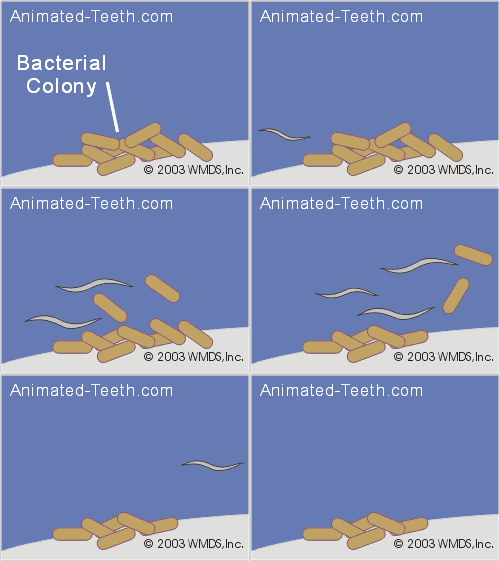
The fluid dynamics created by a sonic toothbrush disrupt dental plaque.
a) Pressure waves.
- As the high-speed oscillating action of the brush’s bristles pumps back and forth, they forcefully propel the fluids that surround the teeth.
- When they come into contact with plaque, they can have the effect of dislodging or breaking it apart.
(Fully or just partially. Either way, the cozy, progressing growth of the biofilm is interrupted to some extent, which is what tooth brushing is all about.)
The pulsations of a sonic toothbrush creates tooth-cleansing “fluid dynamics.”
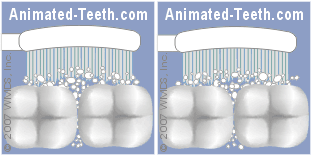
They allow the brush to clean beyond where its bristles actually touch.
b) Bubble formation.
- The disruption of the biofilm may be due to the motion of the bubbles as they’re propelled forcefully away from the brush and against tooth surfaces.
- Or due to a cavitation effect. (The plaque is disrupted by energy released from the microbubbles as they burst.)
c) Characteristics of the biofilm are a factor too.
Beyond just the level of effects created by the toothbrush, the strength of the adhesive forces that bind oral biofilms together, as well as to tooth surfaces, plays a role too.
▲ Section references – Verkaik, van der Mei, Busscher, Hope
How effective is sonic non-contact brushing?
It’s important to understand that the fluid-dynamics cleaning action of a sonic brush (the cleaning effect that occurs beyond where the tips of its bristles actually touch) is not 100% effective in removing dental plaque.
The general idea is that the fluid dynamics mechanisms discussed above result in the transfer of energy to the biofilm and it is absorbed. As it is, the biofilm expands.
- If the level of energy absorbed is enough that it expands the plaque beyond its yield point, biofilm removal occurs.
- If not, the film remains expanded and disrupted.
▲ Section references – Busscher
That doesn’t mean that non-contact brushing doesn’t provide a benefit. Consider these points:
a) Biofilm disruption.
Dental plaque contains colonies of bacteria. And when left undisturbed, there’s a general trend over time (days and weeks) where the types of microorganisms that live in these colonies tend to shift from relatively less harmful ones to more damaging strains.
The act of tooth brushing helps to disrupt the progress of this population shift. (That’s why your dentist encourages you to brush and floss frequently.)
So in a similar vein, any additional amount of colony disruption that using a sonic toothbrush can create (especially in regions beyond where a conventional toothbrush can reach) is thought to help to impede this population shift too.
b) Biofilm penetration.
▲ Section references – He, Busscher
When you consider the long-term use of a sonic toothbrush over years and decades, it only makes sense that the additional non-contact cleaning effect it creates may be significant (as compared to conventional electric or manual toothbrushes which don’t provide this benefit).
However, it has to be stated that as much sense as this seems to make, at this point in time it’s only conjecture. There has been no definitive study that has conclusively proven the long-term benefit of using a sonic toothbrush over the effective use of other types of brushes.
What has research-documented about sonic non-contact brushing?
One of the relatively early research studies to investigate the capabilities of sonic toothbrushes was Stanford (1997).
This paper evaluated the effectiveness of both contact (mechanical scrubbing) and non-contact (fluid dynamics) cleaning created by Sonicare toothbrushes under different circumstances.
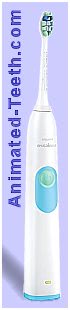
Sonicare Toothbrush
How the testing was performed.
- Tooth enamel samples were allowed to accumulate a film of dental plaque.
- These samples were then exposed to the brushing action of either a Sonicare toothbrush or else a conventional (non-sonic) electric.
- After the brushing period, the enamel samples were evaluated for cleanliness by way of viewing them under a scanning electron microscope.
- It should be pointed out that all of this testing was performed in a laboratory environment (in vitro) as opposed to in a subject’s actual mouth (in vivo testing).
While this can be considered a criticism (it’s not a real-life test), it seems obvious that there’s no other way this study really could have been conducted.
Test #1: The Sonicare toothbrush was held in direct contact with the enamel sample.
Purpose of the test.
This measured the scrubbing action (contact cleansing) effectiveness of brushing with a sonic toothbrush.
Test results – 95 to 100% effective.
95% of the dental plaque harbored on the enamel samples was removed if the contact between the sonic toothbrush and the enamel surface was for a duration of at least 5 seconds. If the contact time was 10 seconds or longer, essentially all of the dental plaque was removed.
[This finding suggests that if you’re brushing with a sonic (or probably any type of powered brush) you should slow your movements down, so each tooth is brushed for a prolonged period of time.]
Test #2: The Sonicare toothbrush was held 2mm from the surface of the enamel sample.
Purpose of the test.
This was a measurement of the non-contact (fluid dynamics) cleansing ability of a sonic toothbrush at a distance of about 1/16th of an inch.
Test results – 65% effective.
65% of the dental plaque originally covering the enamel sample was removed by the fluid forces generated by the sonic toothbrush when it was held at this distance for at least 5 seconds.
[When brushing with a sonic, here’s a second reason not to move your brush around too quickly.]
Test #3: The Sonicare toothbrush was held 3mm from the surface of the enamel sample.
Purpose of the test.
This was a measurement of sonic non-contact tooth brushing at a distance of around 1/8th of an inch.
Test results – 58 to 76% effective (depending on the time frame).
The fluid forces that were generated by the sonic toothbrush were able to produce the following cleaning effects in the listed time frames. 58% plaque reduction at 5 seconds, 63% plaque reduction at 10 seconds, 76% plaque reduction at 15 seconds.
[This is really pretty amazing. At 1/8 of an inch, via a non-contact phenomenon, over 1/2 of the dental plaque was removed after just 5 seconds. And although the study didn’t mention it, you’d have to assume that there is at least some level of effect at distances that are even further.]
Test #4: The conventional electric toothbrush was held 3mm from the surface of the enamel sample.
Purpose of the test.
To test the non-contact brushing effect created by a conventional electric toothbrush (non-sonic type, one generating 4,200 brush strokes per minute) at a distance of about 1/8th inch.
Test results – 0% effective.
No significant dental plaque removal was observed.
[Take note, conventional electrics don’t create a non-contact cleansing effect.]
Test #5: The conventional electric toothbrush was held in direct contact with the enamel sample.
Purpose of the test.
This tested the direct-contact scrubbing action of a conventional electric toothbrush (non-sonic, one generating 4,200 brush strokes per minute).
Test results – Probably 95 to 100% effective.
Actually, this study did not perform this test. However, one would have to assume that when in direct contact with the surface of a tooth that most modern conventional electric toothbrushes are very effective plaque removers. (There are plenty of studies that have suggested this.)
What this study doesn’t necessarily prove.
As mentioned above, this was only a laboratory study. And because of that, one would have to assume that its conditions were relatively ideal as opposed to what may exist in the mouth. And for that reason, the same level of results may not take place in the oral environment.
▲ Section references – Stanford
Comparing the scrubbing action of sonic toothbrushes.
As mentioned previously, the biggest part of a sonic toothbrush’s cleaning action is conventional. It’s produced by the scrubbing action of its bristles on the surface of the user’s teeth.
Consider these comparisons.
- Sonicare toothbrushes are capable of producing more than 30,000 brush-strokes-per-minute.
- Compare that number to the number of strokes created by brushing by hand, which is generally considered to be in the neighborhood of 300 per-minute.
[The Sonicare website makes a comparison by saying their brushes “deliver more brush strokes in 2 minutes than a manual brush could in a month.”]
- Conventional (non-sonic) electric toothbrushes typically run on the order of 2,500 to 7,500 brush-strokes-per-minute.
These numbers don’t mean that you can’t be just as effective in removing plaque with either a manual or conventional toothbrush. But due to their high rate of speed, it’s easy to see why sonics make a good, efficient brushing choice.
Which toothbrushes can create sonic cleaning?
It’s usually not too hard to figure out which electric toothbrushes vibrate at a speed that creates brushing fluid dynamics.
▲ Section references – Busscher
Our affiliate links can be used to shop for Sonicare toothbrushes on Amazon.com
Tip: The only reason we shy away from suggesting high-end Sonicares is because of their price, otherwise they are great toothbrushes. It’s our opinion that the mid-price models HealthyWhite+ and ProtectiveClean 6100 make a good best-value purchase.
Page references sources:
Busscher HJ, et al. Energy transfer, volumetric expansion, and removal of oral biofilms by non-contact brushing.
He Y, et al. Antimicrobial penetration in a dual-species oral biofilm after noncontact brushing: an in vitro study.
Hope CK, et al. Effects of dynamic fluid activity from an electric toothbrush on in vitro oral biofilms.
Stanford CM, et al. Efficacy of the Sonicare Toothbrush Fluid Dynamic Action on Removal of Human Supragingival Plaque.
van der Mei HC, et al. Sequence of oral bacterial co-adhesion and non-contact brushing.
Verkaik MJ, et al. Oral biofilm models for mechanical plaque removal.
Warren PR, et al. A review of the clinical efficacy of the Oral-B oscillating/rotating power toothbrush and the Philips Sonicare toothbrush in normal subject populations.
All reference sources for topic Electric Toothbrushes.