Looking for information about other Dental Topics?
Full Website Index• Animated-Teeth.com •

(Cheap and Effective) Homemade Denture Cleaners/Soaks.
Guide to Homemade Denture Cleaners

You don’t have to buy a commercial soaking product to clean and disinfect your dentures. Homemade cleaners—made from inexpensive household items—can be just as effective.
This guide contains directions for making and using bleach, vinegar, and baking soda-based denture cleaners. We also discuss the use of mouthwash as a denture soak.
Keep in mind, chemical cleansing (soaking) is only the second half of effective denture care. Best practices always include mechanical cleansing (especially brushing) first.
Homemade Denture Cleansers/Soaks Made From Natural and Household Items
Use these links for instructions on how to make and use denture cleaners based on the following common household items.
FYI: Beyond using just one of these solutions, you might consider using an multi-soak approach.
1) Bleach-based denture soaking solution.
The most common homemade denture cleanser is a diluted bleach solution.
- It’s effective for cleaning and, in particular, disinfecting false teeth.
- It’s also useful in removing stains caused by chromogenic agents such as coffee, cola, tea, and tobacco products.
Important considerations!
Despite its popularity, there are concerns about using bleach-based soaks. Specifically, higher concentration solutions or extended soaking periods may tend to damage dentures (complete or partial appliances). We cover what research documents about these issues in our “Precautions” section below.
a) Preparation and use.
There are several variations in how to prepare and use a homemade bleach-based denture cleanser. Based on information we’ve gathered from the studies and case reports cited below, we feel the following directions represent a reasonable approach.
Keep in mind, however, no one knows more about your dentures and the materials they’re made of than your dentist. So it’s always best to discuss your cleaning plans with them beforehand.
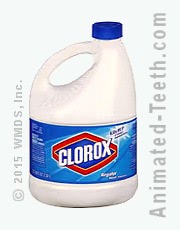
Denture cleaner can be made using household bleach.
i) Making bleach-based soaking solution.
- A denture soaking solution can be made by taking 1 part household bleach (5.25% sodium hypochlorite) and diluting it with 10 parts water. The result is roughly a 0.5% sodium hypochlorite solution.
[Some household bleach products have sodium hypochlorite concentrations other than 5.25% (check your bottle’s label). If yours does, simply adjust your dilution accordingly. For 6% products, add an extra 2 parts of water. For 8.25% ones, use a 1 to 16 ratio.]
- It’s best to mix the soaking solution fresh at the time of use. Doing so ensures maximum effectiveness.
If you prefer preparing a quantity of solution a few days ahead of time, it should be stored in a cool environment in a dark location or opaque container.
ii) Using bleach-based soaking solution.
- To start, film and loose debris should be removed from your denture’s surface by way of scrubbing it with a brush. (See link above for a discussion about denture brushing.)
- The soak can be used once a day for a duration of 3 to 10 minutes. Longer soaks, especially overnight, don’t make the best choice. (We discuss duration-of-use issues in detail below.)
- It’s important to thoroughly rinse your denture off with cool tap water before inserting it back into your mouth. Bleach-based solutions have the potential to irritate oral tissues.
- If your denture is not returned to your mouth, it should be stored fully immersed in water.
- [As discussed below, bleach-based solutions should not be used with dentures that have metal components, and possibly those that have certain types of relining materials.]
Why just 3 to 10 minutes daily?
- A study by de Sousa Porta evaluated the use of this soak for 3 minutes daily over the course of 90 days.
 It was found to be effective in reducing the numbers of microorganisms found on dentures, including Candida (a common oral fungus).
 - This recommendation stays within the guidelines of the American College of Prosthodontists (ACP, an organization whose members are dentists who specialize in making dentures). They recommend that exposing false teeth to sodium hypochlorite solution for longer than 10 minutes should be avoided (for reasons discussed below in the “Precautions” section).
More from the ACP’s guidelines about denture cleansers.
- The guidelines stated that, as compared to other alternative denture-immersion methods (soaking), using a bleach-based solution probably makes the most effective choice.
- They also considered bleach-based products to be the most effective type of commercial cleanser too, suggesting that, overall, using this method typically makes a best-choice.
b) How to make homemade bleach-based denture soak more effective.
While bleach-based denture cleaner makes a good stain remover and disinfectant, it’s not especially effective in helping to remove mineral deposits (tartar) that have built up on false teeth.
- You can give your soak added tartar-removing capability by adding one teaspoon of Calgon® water softener (Calgon the calcium-chelating agent, not Calgon the soap or bath oil) per glassful of the homemade solution above.
- After soaking, brush your denture a second time. Some mineral deposits and associated stain may still remain but have softened up enough that they can be brushed off.
c) Precautions / concerns with bleach-based denture cleaners.
[The issue of bleach-based soak safety is discussed here.]
Get your dentist’s OK.
Over the past decades, a number of studies have investigated how the plastics used in denture fabrication may be affected by different types of denture cleaners, including the homemade ones we discuss on this page.
And while what we report here does apply to standard denture materials (and therefore most people) your appliances, or the materials they have since been repaired or relined with, may be exceptions.
For this reason, the choice of any denture cleanser, homemade or commercial, should be approved by your dentist.
i) Color fading.
Bleach-based cleaners can cause the pink coloration of denture plastic to fade (the “gums” portion of your appliance). Two factors that are important with this phenomenon are the concentration of the solution that’s used, and the duration/frequency of the soaking period.
- A study by Gulfema evaluated the color changes that took place with various brands of denture acrylics (plastics) when exposed to 4 solutions, one of which was “dilute sodium hypochlorite 0.5%” (the homemade cleaner we describe above).
- After 15 days of exposure to the solution (the cumulative equivalent of almost 6 years of daily 10-minute soaks), tests showed that some color change had taken place. But the amount of change was “below the limit of visual perceptibility” (it couldn’t be detected by the human eye).
A more recent study by de Sousa Porta (linked above) evaluated the use of 0.5% sodium hypochlorite solution (our mixture above) for 3 minute soaks over the course of 90 days and found no significant color changes.
These same general findings were also reported by Salles. This study simulated the use of a 0.5% solution for 20 minutes a day for 5 years and found no significant alteration of denture acrylic color.
Why soaking overnight doesn’t make the best choice.
A study by Paranhos found that a simulation of 180 days of soaking overnight (8-hour immersions in a 0.5% sodium hypochlorite solution) did create a noticeable color change.
Hence our recommendation above of just short daily soaks as opposed to overnight.
ii) Surface roughness.
Some research suggests that the use of bleach-based soaks may tend to roughen the plastic surface of false teeth.
The concern here is that it’s been shown that an increase in surface roughness increases the ease with which microorganisms are able to adhere to denture surfaces. (Verran)
- de Sousa Porta (linked above) evaluated the use of 0.5% sodium hypochlorite solution (our mixture above) for 3 minute soaks over the course of 90 days and found no significant changes in surface roughness.
- Salles (linked above) simulated the use of 0.5% solution for 20 minutes a day over a 5-year span and found no significant change in denture surface roughness.
Take note.
One study that did identify surface roughness changes is Paranhos (linked above). It simulated the use of diluted-bleach cleaner (0.5% sodium hypochlorite, our homemade dilution above) with overnight (8 hour) soaks, over the course of 180 days (almost 50 times the exposure created by the daily 10 minute treatments recommended above).
This regimen resulted in a change of surface roughness of just 0.195 microns. That number is important because a study by Quirynen determined that changes up to 0.2 microns didn’t significantly increase the ability of microbes to adhere to denture surfaces.
So, in a technical sense, a change in roughness was identified. But on a practical level, it wasn’t great enough to be a major concern.
iii) Denture strength.
There are studies that have suggested that the use of bleach-based soaks may affect the flexural strength of denture plastics.
In fact, the American College of Prosthodontists’ guidelines for denture cleaning that we refer to above mention this point. This seems to be their reason for suggesting that the use of bleach-based soaks should be limited to 10 minutes.
While the publication date of their blanket recommendation (no specific bleach concentration is mentioned) is fairly recent (2011), it seems to be based on a reference that reviewed related dental literature published between 1936 and 1983.
At this point in time …
A paper by Rodrigues, which included the evaluation of 0.5% sodium hypochlorite denture cleaner (our homemade mixture above), stated that
- “There is no consensus in the literature regarding how chemical cleaning agents might affect the mechanical properties of rigid reline materials and conventional thermoacrylic resin.”
(Meaning the pink plastic typically used in the construction of false teeth and the hard plastics used to reline them, as needed.)
One of the studies we refer to above, Paranhos, found no changes in the flexural strength of denture resins (plastics) when exposed to a simulated 180 days of overnight (8-hour) soakings in 0.5% sodium hypochlorite cleaner (roughly 50 times our recommended soaking time above).
The same can be said for Salles (linked above). This study simulated the use of a 0.5% solution for 20 minutes a day for 5 years and found no significant changes in denture flexural strength.
Overall, we’re not so sure that this issue isn’t overblown. But staying within the guidelines we’ve outlined above, for the specific reasons we’ve discussed, seems both an appropriate and effective method for cleaning dentures.
v) Metal corrosion.
! An important consideration in some cases.
Studies have shown that bleach-based soaking solutions do tend to tarnish and spot corrode metal (cobalt-chromium alloy) components of full and partial dentures. (Felipucci)
The extent to which this effect will take place is likely a function of bleach concentration, soak duration and the composition of the metal involved. (The cobalt-chromium alloy mentioned above is frequently used in partial denture construction.)
It’s possible that this effect is avoided when soaking sessions are limited to 10 minutes or less. But before employing this tactic you should consult with your dentist.
vi) Affects on denture reline materials.
! An important consideration in some cases.
The information we discuss above generally applies to false teeth made by a dental laboratory (high-quality materials, optimal fabrication process under ideal conditions).
The world of dental relines is entirely different. With relines, the process used to place them varies widely (chairside vs. laboratory), as does the type of material used (some have superior physical properties while others don’t, some set hard while others remain soft). And due to this variability, some relines hold up to certain types of cleansers better than others.
That means, at the time of your reline, it’s always best to ask your dentist if it’s compatible with the denture cleaner you currently use (homemade or not).
2) Vinegar-based soaks.
Household vinegar can be used to make a natural denture cleanser that’s effective for both disinfecting and, especially, removing tartar.
i) Disinfection.
- Vinegar-based soaking solutions have been shown to be effective in killing microorganisms that reside on the surface of false teeth. However, possibly less so than the homemade bleach solution described above.
- Some studies (but not all) have concluded that vinegar disinfection is the method of choice for Candida albicans (a common oral fungus).
ii) Tartar removal.
The acidic nature of vinegar makes it especially effective in removing tartar (built-up mineral deposits and associated stain). These deposits, which often have a tan to brown coloration, frequently build up in denture crevices. (These locations are frequently only accessible to chemical cleansing.)
- Smaller deposits may dissolve away entirely. Thicker buildup may only soften up but can then be brushed off.
- It may take repeated cycles of soaking and brushing to remove especially heavy deposits.
Vinegar can be used to make denture cleaner.
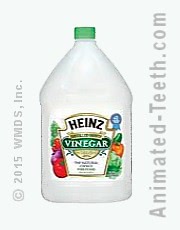
(Regular white vinegar, like you use in your kitchen.)
a) How to prepare and use vinegar-based soak.
- Prior to soaking, false teeth should be brushed (inside and out) to remove any soft or loose debris (see link above).
- A soaking solution can be made using white (household) vinegar. (The kind of vinegar found in most kitchens.) The following studies used the concentrations and soaking durations shown below.
a) Infrequent / periodic cleanings –
Soaking duration: 10 minutes. Vinegar concentration 100% (full-strength) to 50% (equal dilution with tap water). Evaluated in papers by Johnston
and Yildirim-BicerSoaking duration: 30 minutes. Vinegar concentration 50% (equal dilution with tap water). Evaluated in a paper by Yadav
b) Daily use – Soaking duration: Up to 8 hours. 10% vinegar (a 1 to 9 dilution with tap water). Evaluated in a paper by Pinto
- With infrequent or periodic cleaning, brushing your denture again after soaking may remove stubborn mineral deposits and staining that still remain but have softened up.
- When finished, thoroughly rinse your denture with cool tap water.
- If your denture is not returned to your mouth, you should store it fully immersed in water.
b) Precautions / concerns with vinegar-based denture cleaners.
While there’s nothing new about using vinegar as a natural tartar remover and disinfectant for false teeth, it certainly seems to be less studied than other homemade alternatives. The following is all we have to report.
i) Color and strength changes.
Different than with bleach-based denture cleaners (see above), we did not encounter any studies that brought up the issue of color or flexural strength changes in denture plastics due to the use of a vinegar soak.
ii) Surface roughness.
Once again, different than with bleach soaks, we found little discussion about an increase in denture surface roughness due to the use of vinegar solution.
A study by Yildirim-Bicer (linked above) evaluated the use of both 100 and 50% vinegar solutions for the disinfection of false teeth using a 10-minute soak. And this paper did make mention of the issue of denture surface roughness. But it made no mention of problematic effects created by using these soaks.
Our Pinto reference mentioned above that evaluated the use of a 10% vinegar solution, 8 hours a day for a period of 45 days unfortunately did not make mention of this topic.
At a minimum, periodic/infrequent use of a vinegar soak seems to be a reasonable choice (like for periodic tartar removal). There are probably no concerns with the use of low-concentration vinegar solutions over the long-term, although shorter soaks as opposed to overnight might make the better choice until more information becomes available.
iii) Metal corrosion.
We spent quite a bit of time researching this subject. It seems that it’s bleach-based soaks (see above) as opposed to vinegar ones that tend to tarnish the metal components of partial dentures (Nassif).
This effect (or lack thereof) may be dependent on the type of metal (alloy) used. So it only makes sense to confirm the use of a vinegar soak with your dentist.
iv) Affects on denture reline materials.
! An important consideration in some cases.
As discussed above for bleach-based soaks, the materials used to reline false teeth aren’t always as durable as the plastic originally used to fabricate them. For this reason, after having a reline you should confirm your choice of denture cleaner with your dentist.
3) Sodium bicarbonate-based soaks (baking soda).
Baking soda is yet another household item that can be used to create a denture-soaking solution. It’s effective in neutralizing odors and removing stains, but is less effective at disinfecting dentures than other homemade solutions.
Baking soda must be used properly.
Brushing vs. Soaking
The safest use of sodium bicarbonate is fully dissolved in water to form a soaking solution. Brushing dentures with baking soda powder—especially as a dry paste—is too abrasive and can scratch and damage denture plastic.
a) How to make baking soda-based denture soak.
- Stir 1–2 teaspoons of baking soda into a cup of warm water—preparing additional cups of the solution as needed to fully cover and submerge your dentures.
b) How to use baking soda denture soak.
- Prior to soaking, your dentures should be brushed inside and out to remove any soft or loose debris (see link above) and then rinsed in cool water.
- Soak your dentures fully covered by the solution for 15 to 30 minutes.
- When finished, thoroughly rinse your dentures with cool tap water.
- If your dentures aren’t returned to your mouth, you should store them fully immersed in water.
c) Considerations when using baking soda denture soak.
Sodium bicarbonate soaks are considered to be gentler on denture acrylic and the metal components of partial dentures than other types of soaking solutions. (Madeswaran) But other types of soaks provide a greater level of microbial disinfection.
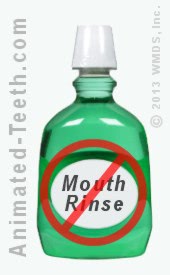
There are better choices for denture cleaning than mouthwash.
4) Using mouthwash as a denture cleaner.
- Mouthwash usually has a pleasant flavor and odor.
- Some mouthwashes make antibacterial claims.
There are better choices.
Mouthwash has not been shown to be especially effective against the types of microorganisms that typically inhabit denture surfaces. This is true even for those oral rinses that make an antimicrobial claim. As an example, a study by Buergers found it ineffective in denture disinfection.
The other types of cleaning solutions discussed on our pages (either homemade or store-bought) tend to make a much better choice.
Don’t dentists use mouthwash to clean false teeth?
You may have noticed that after your dentist’s office has finished cleaning your dentures they taste like mouthwash was used.
In actuality, they’ve probably used a professional cleaner, most of which have a pretty bad taste. As a last step, they’ve had their dental staff place your false teeth in a glass of mouthwash and water (50:50), just so there’s no question that they’ll taste pleasant.
So yes, after a professional cleaning your dentures may have a mouthwash taste. But don’t confuse that issue with thinking that that’s what has been used to actually clean them.
5) Consider using a multi-solution approach.
Because different soaking solutions excel at different aspects of dental appliance cleaning, you’ll get the best results by using a combination approach that rotates through the soaking solutions outlined on this page, especially these.
- A bleach-based solution combined with enzymatic dishwasher soap (Cascade). – Instructions given above.
- A vinegar-based soak. – Instructions given above.
- A sodium bicarbonate solution – One teaspoon of baking soda dissolved in eight ounces of water, 30-minute soak, rinse thoroughly afterward. (Use this technique instead of brushing with baking soda, here’s why.)
While it’s not expected that anyone would use all three soaks each and every day, doing so on selected days could be a good choice. As another alternative, one might rotate through the solutions, using a different one each time they soak their dentures. Or a person might primarily rely on the use of a bleach-based soak, alternating it with one of the other soaks from time to time.
Best practices for denture cleaning.
Due to the wide range of materials that are used in denture fabrication, you should …
a) Always discuss your plans with your dentist.
Your dentist occupies an especially unique position. Not only do they know precisely what materials have been used in making your false teeth but they get to see how they hold up to the various cleaning methods their other patients use. Make sure you tap into their knowledge.
b) Always test before you soak.
The plastics used to make false teeth are chosen, in part, because they tend not to absorb tastes and flavors. And this fact makes it unlikely that cleaning solutions that have a bad taste (i.e. bleach, vinegar) will create a problem.
But because it’s such a simple step to take, you should always perform short trial soaks with any new cleanser, just to make sure. This is especially true for appliances that have been relined.
c) General rules.
- Don’t expose your dentures to elevated temperatures. Doing so may cause dimensional distortion, thus affecting their fit. Soaking and rinsing should be done in room temperature solutions.
- Always keep your dentures wet. That means in your mouth or fully immersed in their soaking solution or just plain water. If they dry out, their fit may change. (Related content: Maximum temperatures for denture plastics.)

Last reviewed: August 09, 2025
Author: Paul Cotner, DMD — retired dentist.
Published by: WMDS, Inc. — owner of Animated-Teeth.com.
Educational information only — not a substitute for professional dental care.
Page references sources:
Buergers R, et al. Efficacy of denture disinfection methods in controlling Candida albicans colonization in vitro.
de Sousa Porta SR, et al. Evaluation of sodium hypochlorite as a denture cleanser: a clinical study.
Felipucci D, et al. Effect of Different Cleansers on the Surface of Removable Partial Dentures.
Felton D, et al. Evidence-based guidelines for the care and maintenance of complete dentures.
Gulfema E, et al. Colour stability of denture base materials after soaked in different aging solutions.
Jafari AA, et al. Vinegar as a Removing Agent of Candida albicans From Acrylic Resin Plates.
Johnston C, et al. Vinegar: Medicinal Uses and Antiglycemic Effect.
Madeswaran S, et al. Sodium Bicarbonate: A Review and its Uses in Dentistry.
Nassif J. Instructions for patients — a positive factor in removable partial denture service.
Paranhos H, et al. Color Stability, Surface Roughness and Flexural Strength of an Acrylic Resin Submitted to Simulated Overnight Immersion in Denture Cleansers.
Pinto T, et al. Vinegar as an Antimicrobial Agent for Control of Candida in Complete Denture Wearers.
Quirynen M, et al. The influence of surface free energy and surface roughness on early plaque formation. An in vivo study in man.
Rodrigues S, et al. Effect of chemical cleaning agents on the flexural strength of acrylic and hard denture line resins.
Salles MM, et al. Antimicrobial activity of complete denture cleanser solutions based on sodium hypochlorite and Ricinus communis – a randomized clinical study.
Ural C. Effect of Different Denture Cleansers on Surface Roughness of Denture Base Materials.
Verran J, et al. The effect of dentifrice abrasion on denture topography and the subsequent retention of microorganisms on abraded surfaces.
Yadav R, et al. Effectiveness of different denture cleansing methods on removal of biofilms formed in vivo.
Yildirim-Bicer AZ, et al. In vitro antifungal evaluation of seven different disinfectants on acrylic resins.