Denture breath: Causes, testing for it, cures.
To cure denture breath, you need to clean both your mouth and dentures.
Keeping the oral bacteria that cause bad breath in check How to. is a never-ending battle. And that’s true whether you have all of your natural teeth, or at the other extreme, wear complete dentures.
Beyond that similarity however, denture breath is a special situation. That’s because the steps needed to prevent and cure it must address multiple factors. Some of these are entirely unique to denture wearers (either partial or complete), while the others are the same general ones that apply to anyone who’s suffering from halitosis.
What’s the cure for denture breath?
Research studies have shown what it takes to cure breath problems associated with wearing dentures. And as mentioned above, it must involve a two-pronged approach.
- One step is that the person must clean and disinfect their dentures more effectively.
- The other is that they must also clean their mouth more thoroughly, especially those areas where the types of bacteria that cause bad breath tend to accumulate.
In the case of denture wearers, this includes both the tissues their appliances rest on, and especially the posterior region of their tongue.
▲ Section references – Nalcaci, Garrett
The remainder of this page explains how to implement these steps. But keep in mind, the two-pronged approach is always needed. If you just focus on one factor or the other (denture or mouth), your efforts won’t be totally successful.
Background –
How can you tell if you have denture breath? – Testing.
a) How to check your dentures.
Here’s a simple test you can use to see what odors are associated with your dentures, either full or partial.
- Take your appliances out and place them in a plastic bag (baggie), then close it.
- Let them sit for several minutes.
- Open the bag and take a sniff inside.
▲ Section references – Nalcaci
b) Evaluating your mouth.
In most cases, a person’s denture breath problems stem from a combination of both their dentures and their mouth. And in the mouth, it’s usually a person’s tongue that harbors the greatest number of odor-producing bacteria.
It’s easy to test how your mouth smells to others, including your tongue. But rather than rehash a subject we cover elsewhere in great detail, use this link: “Self-testing for halitosis 6 methods. Ways you can accurately (objectively) smell your own breath.”
The smell you get from each test might be different.
It seems that at least in theory, the malodor you notice with each test might be different in subtle ways.
That’s because each of the different environments (your denture vs. your tongue) have different characteristics (have different surface texture, are exposed to different levels of salivary flow, are associated with different nutrient concentrations, etc…). And due to these differences, each may serve as a home for different types of microorganisms.
What does denture breath smell like?
As compared to the frank foulness of “regular” bad breath, denture breath is sometimes described as “sweet but offensive.”
Why does denture breath occur?
The underlying cause of essentially all cases of halitosis stemming from the oral cavity are bacteria and the smelly waste products they create. The only thing different with denture breath is that there are unique additional circumstances under which these bacteria may accumulate.
Addressing both these routine and unique issues are the key to curing denture halitosis. Here’s an explanation of what that entails.
a) A person’s dentures may not be removed often enough.
It should be easy to understand how wearing dentures creates some pretty unique, and challenging, situations for the mouth.
Increased living space for bacteria.
The space that exists between a removable prosthesis and the gum tissue it rests on can be an ideal environment for the types of microorganisms that cause bad breath.
This space is protected, thus allowing biofilm (bacterial colony) formation to advance undisturbed. Yet the space is not sealed off to the extent that nutrients can’t seep into it and provide a perpetual food supply for the bacteria that live there.
Changes with skin processes.
The normal course of events in the mouth is that its skin tissue lining shed cells. And due to this constant process of surface renewal, oral biofilms (plaque) have a hard time attaching to them and they remain generally plaque-free.
▲ Section references – Verran
To make matters worse, the trapped skin cells can be utilized as a protein source for the types of bacteria that cause bad breath. Their preferred meal.
Correlations.
While there can be additional factors involved with not removing your dentures often or for long enough (like never cleaning them properly either, discussed next), a study by Nalcaci found that having denture breath significantly correlated with a routine of overnight denture wear.
At minimum (even if no additional cleaning takes place, which would be a shame), nighttime removal disrupts the progress of colonizing bacteria underneath a denture. And during nighttime hours, normal skin cell shedding has an opportunity to occur.
▲ Section references – Nalcaci
Solutions / Remedies.
As a way of stifling the growth of halitosis-causing bacterial colonies that inhabit the space underneath a denture …
- Dentures (complete or partial) should always be removed after every meal for cleansing.
- They should be brushed both inside and out.
- Any denture adhesive that is present should be removed from both the appliance and skin tissue and then replaced with new.
- The tissue areas covered over by a denture should be wiped with a washcloth or gently brushed with a soft-bristled toothbrush.
Instead, can I just use mouthwash?
There’s no harm in using a rinse, just don’t expect it to be effective in performing any of the above tasks.
What’s explained above is the use of mechanical methods (scrubbing, wiping, brushing) to cleanse denture and gum tissue surfaces. In comparison, the act of just rinsing your mouth or soaking your appliances with mouthwash is far, far less effective in dislodging bacteria and debris.
We explain more about the use of mouthwash with dentures and in treating denture breath here.
b) Many people don’t clean their dentures well enough.
While seemingly highly polished and smooth, on a microscopic level the plastic surface of a denture is scratched and rough. And as such, it offers innumerable locations for the types of bacteria that cause denture breath to call home.
Research evidence.
A significant percentage of the kinds of bacteria that cause halitosis fall under the category of Gram-negative anaerobes Known species..
A study by Goldberg determined that the prevalence of once such bacterium (Enterobacteriaceae) was significantly higher in the mouths of denture wearers (48% of subjects vs. 16% for the control group).
▲ Section references – Goldberg
Details about cleaning your dentures.
Since we cover the subject of denture cleaning rather extensively elsewhere on our website, in this section we’ll just mention some of the issues we feel are important to know about, and link out to the pages of our site that discuss them in detail.
a) Just denture brushing alone is never enough.
While all denture cleaning activities should start with a thorough brushing How to., the problem with just doing it alone is that the diameter of any brush’s bristles is far larger in size than the microscopic denture pores in which odor-producing bacteria live.
As such, and despite a person’s best efforts, this type of mechanical cleansing alone is never as effective as you might expect or hope.
b) Using an ultrasonic unit can be a nice adjunct to your brushing efforts.
One aid that can help to improve the level of mechanical cleansing you’re able to accomplish is to use an ultrasonic denture-cleaning unit.
The vibratory motion generated by one of these units dislodges debris at a microscopic level. And due to this additional effect, brushing in combination with the use of one of these units is more effective than just brushing alone.
FYI: Here’s more information about ultrasonic denture cleaning units. Benefits.| Features.
c) Chemical denture cleansing and disinfecting are always needed.
After mechanically (brushing, ultrasonic) cleansing, a denture should be further cleansed and disinfected chemically.
As you know, the bacteria that cause denture breath live in microscopic porosities on a denture’s surface. And chemical cleansing offers a way to get at and have an effect on them. When performed appropriately, chemical cleansing can be very effective.
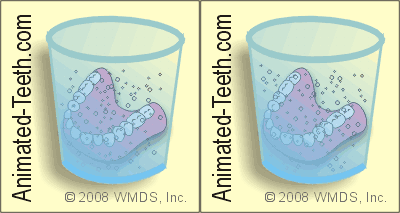
Cleaning a denture in an effervescent denture cleaner.
Can I use mouthwash as a soaking solution for my dentures?
Much of the confusion on this point likely comes from the pleasant flavorings usually included in the formulations of rinses that then makes them seem to be an obvious choice for this purpose. However, actual disinfection of your appliance is what’s needed as the cure for denture odors. After soaking however, you might then dip them in mouthwash for the pleasant taste.
We explain more about the use of mouthwash with dentures and in treating denture breath here.
c) Additional factors that may promote denture halitosis.
1) Dry mouth.
A lack of oral moisture is always a factor that heightens the severity of a person’s breath odors, whether they wear dentures or not. And as a person ages, experiencing a lower level of moisture in the mouth is common. (At an extreme, this condition is termed xerostomia.)
We begin our discussion about mouth dryness as a co-factor for halitosis The problem. | Solutions. on this page.
2) Soft denture liners.
As opposed to hard denture plastics, soft denture lining materials have a spongy surface that’s chocked full of indentations and porosities that are perfect for colonization by the types of bacteria that cause bad breath.
▲ Section references – Verran
Remember, cleaning your dentures is only half the battle.
Why tongue cleaning is so important in curing denture breath.
It’s a simple fact, it’s essentially impossible to cure a person’s halitosis without adding a regimen of effective tongue cleaning to their regular oral home care routine. That’s because the dorsum (top side) of the tongue is usually the largest accumulation of the types of bacteria that cause bad breath in a person’s mouth.
In the case of denture wearers, it might be impossible to actually quantify whether their prosthesis or their tongue harbored a greater number of offending bacteria. But it’s easy enough to say that in the vast majority of cases, the coating on the person’s tongue is a substantial contributor to their denture breath.
Because of this, if you just focus on making improvements in denture care but don’t add effective tongue cleaning to your regimen too, you’ll have a cleaner denture (which is great) but you’ll still have denture breath too.
Research evidence.
Nalcaci conducted a study involving 105 subjects wearing complete dentures. One of the evaluations made was to measure “tongue coating scores” (TCS). (This is a determination of the extent of the white film covering the top surface of the tongue.) Breath malodor levels were measured using a Halimeter. How it works.
- Halimeter measurements taken at the beginning of the study showed a significant relationship between TCS and breath odor.
- Following tongue-care maintenance instructions and a change in the practice of overnight removal of their dentures, the subject’s oral malodor levels and TCS measurements decreased significantly.
FYI: How to clean your tongue using a brush, scraper or spoon. Directions.
▲ Section references – Nalcaci
How about just using mouthwash to cure denture breath?
Expecting that the use of mouthwash will be a solution for your denture breath suggests that you don’t have a full grasp of what’s really required to overcome it.
- For anyone with bad breath (denture wearer or not), just using mouthwash alone is seldom an effective cure. Here’s why. What’s really needed is more effective cleansing of your mouth. Here’s why.
For denture wearers, that means cleaning both the gum tissue your dentures rest on (via gently brushing or wiping it), and especially your tongue. Directions.
- You’ll also need to ensure that your dentures are thoroughly cleaned on a regular basis. Soaks can play an important role in accomplishing this but using mouthwash as one makes an ineffective choice. Why.
All of the this discussion isn’t meant to imply that the use of mouthwash is never appropriate for denture breath cases. It can be but its role is only of that of an adjunct. It’s never a cure entirely on its own. These pages explain.
- 6 research-proven mouthwash ingredients for treating halitosis. Compounds to look for.
- Four effective (research-proven) mouthwashes for treating bad breath. Brands to look for.
If you have denture breath, you could probably benefit from knowing more about bad breath in general. Our page that explains “What causes bad breath? Factors. makes a good starting point for more information.
Page references sources:
Garrett NR. Poor oral hygiene, wearing dentures at night, perceptions of mouth dryness and burning, and lower educational level may be related to oral malodor in denture wearers.
Goldberg S, et al. Isolation of Enterobacteriaceae from the mouth and potential association with malodor.
Nalcaci R, et al. Oral malodor and removable complete dentures in the elderly.
Verran J. Malodour in denture wearers: an ill-defined problem.
All reference sources for topic Bad Breath.