Looking for information about other Dental Topics?
Full Website Index• Animated-Teeth.com •

How to smell your own breath - 6 self-tests for bad breath.
Self-testing for halitosis. – 6 ways to determine if you have bad breath.
Evaluating your own breath can be tricky because the body quickly adapts to persistent odors, making bad breath hard to detect.
This guide provides step-by-step instructions for six self-tests designed to help you objectively assess your breath and uncover potential odor issues. From basic methods like the wrist or spoon test to simple suggestions about enlisting a friend’s or, better yet, a young child’s opinion, these techniques can give you an accurate understanding of how your breath is perceived by others.
The challenge – Evaluating the odor of your own breath can be difficult.
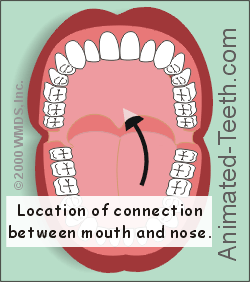
Odors from your mouth escape to your nose, thus desensitizing its ability to detect them.
Why can’t you smell your own breath?
- A person’s mouth is connected to their nasal cavity via an opening behind their soft palate (see picture). And this connection provides a direct passageway for smells that originate in the mouth straight up to their nose.
- But due to a process termed “adaptation,” a person’s sense of smell becomes accustomed to odors that are constantly present. And after a while, they simply aren’t noticed anymore.
- That means it’s quite possible, and even likely, that a person who has halitosis simply doesn’t know it because they literally can no longer smell their own breath odor. They can’t just do a simple sniff test because they’ve already become accustomed to what they smell like. Nothing will stand out.
▼ Reference sources for the self-testing methods outlined below. – Aydin, Schumacher, Aylikci, Winkel
How to tell if you have halitosis – 6 bad breath self-tests.
Ways to accurately smell and judge your own breath odor. (Self-testing)
The solution that’s needed for self-testing is to devise a way where you can evaluate your breath indirectly. You need to transfer its odor to another object, and then smell it. Here are some ways that you can do that:
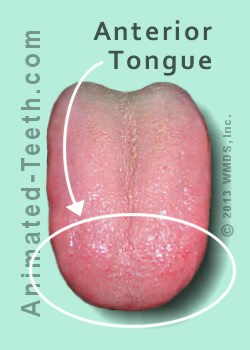
The tip of the tongue is fairly self-cleansing.
Bad breath test #1 - The wrist test.
- With this evaluation, you start off by first licking your wrist with your tongue.
- You then need to wait about 5 to 10 seconds so the saliva dries a little.
- Now, do a sniff test. Smell your wrist from a distance of about an inch or so.
What did you find out?
Interpreting your findings.
And that’s the catch with this test. What you determine may not be totally accurate because the anterior portion of the tongue is relatively self-cleansing. Here’s why. And as a result, it may under-report cases of halitosis. But if you do get a stinky smell, take heed.
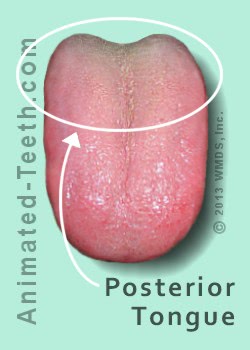
The back part of the tongue usually harbors debris which is the primary cause of bad breath.
Bad breath test #2 - The spoon test.
The “spoon” self-test for bad breath.
- Select a small spoon from your silverware drawer.
Any metal or plastic spoon will do. Choosing a comparatively smaller-sized one (teaspoon, iced tea spoon) usually makes the better choice.
- Turn the spoon upside down, place it at the very back of your tongue, and then draw it forward.
- Be deliberate but gentle. (Don’t be surprised if this test triggers your gag reflex a little bit.)
- Now, do a sniff test. Take a smell of the goo your spoon has scraped off. The odor of this foul-looking gunk is precisely what your breath smells like to others.
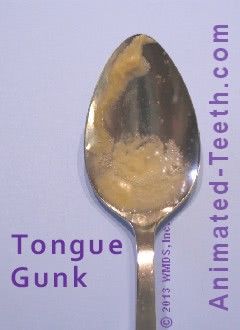
Smelly debris scraped off the back part of a person’s tongue.
Color.
Smell.
Taking the test one step further.
If you want to get an even better idea of what the goo you’ve scraped off of the back part of your tongue smells like, do the following:
The baggie test – Dump the scrapings inside a baggie, close it up, and then put it somewhere warm (around body temperature is good). For example, you might place it in a location that has strong sunlight shining on it.
After about 10 to 15 minutes of warming it up, open the baggie and take a whiff. The odor from the scrapings should be amplified several levels by the treatment.
Hopefully what your sniff test found out wasn’t too bad. But don’t be too surprised if you find out differently. The spoon test with baggie-treatment amplification is a pretty good evaluation.
So now you know, that’s what you smell like to others.
It’s this odor, as opposed to the sampling from the anterior portion of your tongue in test #1, that’s probably the way your breath smells to other people. And if you haven’t been cleaning the back portion of your tongue, it’s probably pretty foul.
(FYI: The 3 places in a person’s mouth most likely to be the origin of their bad breath. Locations.)
By the way, now you also know why you have bad breath.
It just so happens that this second test reveals why most people have breath odor. The most common underlying cause of halitosis is the whitish coating that covers the surface of the posterior portion of a person’s tongue.
(Hint: Why tongue cleaning How to. is the only bad breath cure that most people need.)
Additional ways to smell and self-check your breath.
The remainder of this page explains some additional self-testing methods that you can use to evaluate the quality of your breath.
Similar to the ones above, the goal of their protocol is to create a specimen from your mouth that can then be reintroduced to your nose as a (fresh, new, independent) sample that will therefore be judged relatively objectively by it.
FYI: Beyond the use of the smell/sniff testing methods outlined on this page, this link explains advanced scientific methods/equipment for testing for halitosis. Dentists use these devices to search for traces of the specific “volatile sulfur compounds” (hydrogen sulfide, dimethyl sulfide, methyl mercaptan) that are known to cause bad breath.
Bad breath test #3 - The gauze test.
Here’s a variation on the way you can run the spoon test described above. It’s not better, just different. Dentists sometimes use this method in their offices.
- Get a 2 by 2-inch square of medical gauze, the kind used for bandages.
[You should be able to find it at any pharmacy. Get just normal gauze (it looks and feels like very loosely woven cloth), not the ouch-less, non-stick variety. Anything larger than 2 by 2 inches is fine too, just cut it down so it fits in your mouth.]
- Stick your tongue out and look for any coating on it. Expect it to be on the furthest back portion.
- Take the gauze, and starting from the rear and working forward, wipe the surface of your tongue where the buildup is heaviest a couple of times.
Inspect the gauze.
Once you’re done, take a look at, and smell, the gunk you’ve wiped off.
- It likely has a yellow to brown color.
- When you smell it, it probably won’t be all that pleasant.
[If you’re having trouble getting a whiff, you can amplify the odor by using the baggie trick described above.]
Whatever the results (good or bad), that’s pretty much how your breath smells to others.
Bad breath test #4 - The airbag test.
An obvious way of self-testing is to simply exhale into an odorless plastic bag, and then smell what’s there. This sniff test method is sometimes used in scientific studies.
- In practice, one difficulty involved is finding a truly odorless bag. A gallon-sized food storage bag is an option.
- Another obstacle is that with each of the above tests, some of the debris from which the malodor emanates is included in the sample, thus helping to perpetuate its smell.
And as described in our baggie test above, allowing this kind of sample to incubate at body temperature for some minutes can help to accentuate its odor so it is more easily identified.
In comparison, samples of expired breath have been shown to contain very few microorganisms. So a bag containing just the gases may be more difficult to evaluate.
Bad breath test #5 - The floss test.
This evaluation is different from the other self-testing methods outlined on this page. And as such, it can be a very valuable source of information.
It tests for bad breath whose point of origin is from between your teeth. (FYI: This is the second most likely source of bad breath. Statistics. And an especially common one with older individuals.)
Other important pages –
How to perform the test.
- Dispense a new piece of dental floss for flossing your teeth.
- A length of unwaxed floss generally makes the best choice. Its loose individual strands will be the most effective in trapping debris.
As an alternative, other types of floss can work. Although, due to their solid, one-piece nature (this includes stranded waxed floss), they’ll tend to trap less debris.
Also, whatever type of floss you choose, make sure it is an unflavored kind.
- Use the floss to floss your teeth. Between your back teeth will probably tend to be the most fertile ground for detecting breath odors.
The flossing technique you use is important. Details. (The emphasis here is to floss subgingivally, which means to let the floss slide below the gum line as you clean.)
- Remove the floss and smell it from a distance of about an inch. (Especially make sure to smell any section that still retains a glob of debris.)
A tried and true way to tell if you have bad breath.
Bad breath test #6 - Get someone else’s opinion.
Another way to check your breath is an obvious one. Just ask someone else what they think.
Actually, this makes a very good plan and is generally regarded as a reliable way to confirm a chronic breath problem. So, even though the human nose tends to ignore persistent odors and therefore it’s hard for us to smell ourselves, others can, no problem.
Another good reason.
Beyond just not being able to detect our own malodor, there’s another reason why getting an opinion from someone else can be important.
There’s a bad breath classification termed pseudo-halitosis where the person suffering from it is under the impression that they have a breath problem but really don’t. Or at least not to the extent they think they do. (FYI: Classifying halitosis cases. Categories.)
So in cases such as these, asking someone else what they think can be very valuable in helping to lay to rest mistaken impressions and fears.
Who makes a good person to ask?
- Obviously, if you have a significant other, they make a good candidate. So do any relatives or close friends you feel comfortable enough with.
- You might ask your dentist or hygienist at your next appointment. After all, evaluating the status of your oral health is their job.
- If all of the above are too personal for you to consider, try asking a kid. Sometimes the least inhibited and most honest answers come from young children.
Our next page discusses the odors associated with bad breath. Sources / Locations After all, until you know where your halitosis originates, you won’t be able to cure it.
If instead, you’re interested in learning about the scientific side of evaluating halitosis, we have pages that explain:
- Methods and equipment dentists use to test patients for bad breath. Scientific testing.
- The classification system used to categorize halitosis cases. 5 Categories.
Last reviewed: January 27, 2025
Author: Paul Cotner, DMD — retired dentist.
Published by: WMDS, Inc. — owner of Animated-Teeth.com.
Educational information only — not a substitute for professional dental care.
Page references sources:
Aydin M, et al. Diagnostic value of halitosis examination methods.
Aylikci BU, et al. Halitosis: From diagnosis to management.
Schumacher MG, et al. Evaluation of a halitosis clinic over a period of eleven years.
Winkel EG, et al. Appropriate sample bags and syringes for preserving breath samples in breath odor research: a technical note.
Yaegaki K, et al. Examination, Classification, and Treatment of Halitosis; Clinical Perspectives.