The 5 Types / Classifications of Bad Breath – Genuine Halitosis (3 subcategories) | Pseudo Halitosis | Halitophobia
Before a dental professional initiates a patient’s treatment for halitosis, they must first make an assessment of the type of breath condition from which they are suffering.
This is an important step because the needed solution for different types of conditions varies significantly. The three major classifications of breath problems are:
The classification Genuine halitosis is further subdivided into the following three types: Pathologic (oral), Pathologic (extraoral), Physiologic.
A) Genuine Halitosis
Identification.
This category refers to cases where the person’s bad breath can be readily detected by:
- Organoleptic testing, which refers to the evaluation of the person’s breath by smelling it (although under controlled/objective conditions).
Related page: Self-testing- How to smell your own breath accurately. 6 methods.
- Or via the use of some type of testing apparatus that can detect the types of smelly compounds volatile sulfur compounds typically associated with bad breath.
Related page: 6 devices used to test for halitosis: Breath checkers, detectors, sensors, testing strips. How well do they work?
Symptoms.
The patient has an obvious malodor, it has an intensity that lies beyond what’s generally considered socially acceptable, and as such, it tends to affect their personal relationships.
The category of Genuine halitosis is further broken down into the subcategories: Pathologic and Physiologic halitosis.
B) Pseudo-halitosis
This classification refers to the situation where the patient does not have an actual breath odor problem (nothing can be detected by smell or scientific testing) but they are still certain that they do have bad breath. Since no real breath problem exists, treatment consists of counseling the patient about their misconception.
Pseudo-halitosis represents about 15% of cases.
▲ Section references – Quirynen
C) Halitophobia
This category refers to the situation where a patient’s perception of a breath problem continues to exist despite the successful treatment of their genuine halitosis condition, or in the case of pseudo-halitosis, after receiving counseling.
At this point, treatment for the patient’s condition needs to be referred to a medical professional who can provide appropriate psychological counseling.
The subcategories of Genuine Halitosis.
Medical professionals subdivide the genuine halitosis category (the situation where an actual breath odor problem can be detected by testing) into two further classifications, “physiologic” and “pathologic” halitosis.
1) Pathologic Halitosis
This condition refers to the situation where the person’s breath odor is a result of disease or other pathologic condition, or aggravated by it.
As detailed below, the category of Pathologic halitosis is further broken down into the subcategories: Oral and Extraoral halitosis.
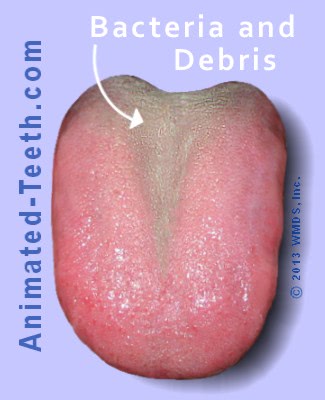
The most common cause of Genuine halitosis is debris on the posterior portion of the tongue.
2) Physiologic Halitosis
Treatment.
▲ Section references – Bartold
Related pages:
- The approach that’s able to cure just about everyone’s bad breath. It’s three simple goals.
- Why tongue cleaning (scraper, brush or even just a spoon) is the only bad breath cure that most people need. Our how-to guide.
The subcategories of Pathologic Halitosis.
The subdivisions of the pathologic halitosis category are based on the location of the disease process that’s associated with the patient’s breath problem.
1) Oral Pathologic Halitosis
This category includes situations where the person’s odor problems are caused or aggravated by a disease or other pathologic conditions associated with tissues inside the mouth.
As a primary example, a person’s malodor may be due to, or aggravated by, the presence of advanced gum disease. The role it plays. Additionally, co-factors (like dry mouth and smoking) See full list. can play a role in pathologic halitosis too.
2) Extraoral Pathologic Halitosis
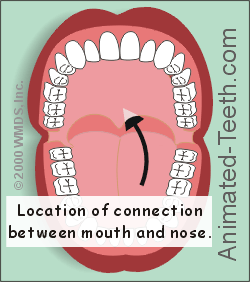
Sinus discharge can be the cause of breath odors.
- The nasal, paranasal or laryngeal areas (upper respiratory tract).
Possible associated conditions: postnasal drip, chronic sinusitis, acute viral or bacterial infection, tonsillitis, tonsilloliths, deep tonsillar crypts.
- The lower respiratory tract (lungs) or upper digestive tract.
Possible associated conditions: chronic bronchitis, bronchiectasis, hiatus hernia, Helicobacter pylori infection, malabsorption conditions.
- Disorders anywhere else in the body. In these cases, compounds produced by the disease process are bloodborne and a state of breath malodor is created when they are exhaled from the lungs.
Possible associated conditions: diabetes, liver cirrhosis, uremia, kidney insufficiency, menstrual cycle, internal bleeding.
Our next page explains what the odors you smell are and where they come from. Once you know that, you’ll know how to cure your problems.
Page references sources:
Bartold M. Update on Breath malodor.
Quirynen M, et al. Characteristics of 2000 patients who visited a halitosis clinic.
Yaegaki K, et al. Examination, Classification, and Treatment of Halitosis; Clinical Perspectives.
All reference sources for topic Bad Breath.