Looking for information about other Dental Topics?
Full Website Index• Animated-Teeth.com •

Options – The different types of dental braces (with pictures).
Overview: Kinds of dental braces / Orthodontic systems.
When it comes to having your teeth straightened, you don’t have to settle with just having traditional metal braces. There are other less obvious or better-looking kinds of orthodontic systems that your dentist or orthodontist can usually offer too.
This page will fill you in on the advantages and disadvantages of each kind. And shows pictures so you know what the various options look like.
Types of orthodontic systems.
a) Invisible braces (Removable braces) –
Brand names – Invisalign®, ClearCorrect®, Smile Direct Club®, Simpli 5®, etc…
With this type of system, you wear a series of removable clear plastic aligners that do the work of straightening your teeth.
Pros and cons.
In many ways, clear aligner therapy is a patient’s dream come true. They can have orthodontic treatment without the inconvenience of having “fixed” appliances bonded to their teeth. (The aligners are taken out when you eat, for special occasions if you want, and aren’t in the way when you brush and floss). And, of course, the aligners are invisible to boot.
Learn more / View pictures – Clear aligner orthodontic treatment.
b) Lingual braces (Backside braces) –
Brand names – Incognito®, In-Ovation®, Harmony®, iBraces®, etc…
Lingual braces look a lot like conventional ones, except that their brackets and wires are all mounted on the backside of your teeth where it’s hard to see them. It’s like braces in reverse.
Pros and cons.
In a lot of ways, this technique is an ideal system. Because it uses fixed brackets-and-wire appliances, your dentist gets the same high level of control over making tooth movements as with traditional (frontside) braces. And for you, your braces are out of sight on the backside of your teeth so nobody knows you’re having your teeth straightened.
Once again, however, nothing is ever quite as ideal as it may seem. Lingual braces can be difficult to get used to. (They’re especially tough on issues associated with your tongue.) And, of course, they’re in the way when you eat and clean your teeth.
Learn more / View pictures – Lingual appliance orthodontic treatment.
c) Ceramic braces (Clear braces) –
This orthodontic option is really just conventional dental braces (brackets bonded to your teeth with a wire running across them). However, instead of using brackets made out of stainless steel, they are made out of ceramic.
So, instead of silver, which contrasts with the color of your teeth, your braces blend in with your smile better because their brackets are white or clear. In some cases, a “frosted”/white archwire and white or clear elastics are used so your appliances blend in even better.
Pros and cons.
When ceramic brackets are used, your treatment is pretty much the same as with conventional silver braces, with some minor wrinkles. For example, ceramic brackets tend to be larger and sharper-edged than metal ones, so they may be more irritating to the soft tissues of your mouth. And they may be more prone to breakage, which can cause inconvenience or delays with your case.
Learn more / View pictures – Ceramic braces treatment.
d) Conventional metal braces –
These are the grandaddy of orthodontic techniques. And despite their metal-mouth appearance, they are the tried and true method for straightening teeth.
Pros and cons.
As for disadvantages, fixed appliances are a nuisance when it comes to eating and cleaning your teeth. And the brackets themselves can be irritating to soft oral tissues. But on the positive side, this is the go-to method for especially difficult cases and is usually your cheapest orthodontic option.
As far as their characteristic tin-grin look, that doesn’t have to be the case for you. There are several options and variations available (including gold brackets, fashion brackets, and personalized color schemes for your elastic bands) that can help to dress them up and make your braces unique or more esthetic.
Learn more / View pictures – Esthetic options for conventional braces.
The different types of braces systems …
a) Invisible braces (Invisalign®)
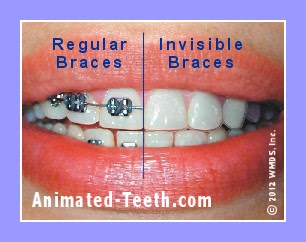
A comparison of invisible (i.e. Invisalign®) vs. conventional dental braces.
What are they?
Clear aligners vs. traditional braces.
Having your case treated using an aligner system like Invisalign® offers a number of conveniences over conventional dental braces.
- Since the aligners are made out of thin clear plastic, it’s hard for other people to tell that they’re being worn.
- And even though you’ll be expected to wear your aligners around the clock, 7 days a week Common guidelines., you’ll take them out when you eat or clean your teeth or for important events if you want, which helps to make the experience of having braces less of an ordeal.
Brand names associated with clear aligner therapy.
The dominant brand associated with this technique is Invisalign® (along with Invisalign® Express and Teen). Another prominent brand is ClearCorrect®. Other names include ClearPath®, eCligner®, and Simpli5®.
A recent development in this field is the option of purchasing a direct-to-consumer aligner system like that offered by the Smile Direct club®.
What do removable tooth aligners look like?
Using Invisalign® as an example, aligners are thin, vacuum-molded, clear plastic appliances formed to fit snugly over your teeth.
A picture of an Invisalign® aligner.
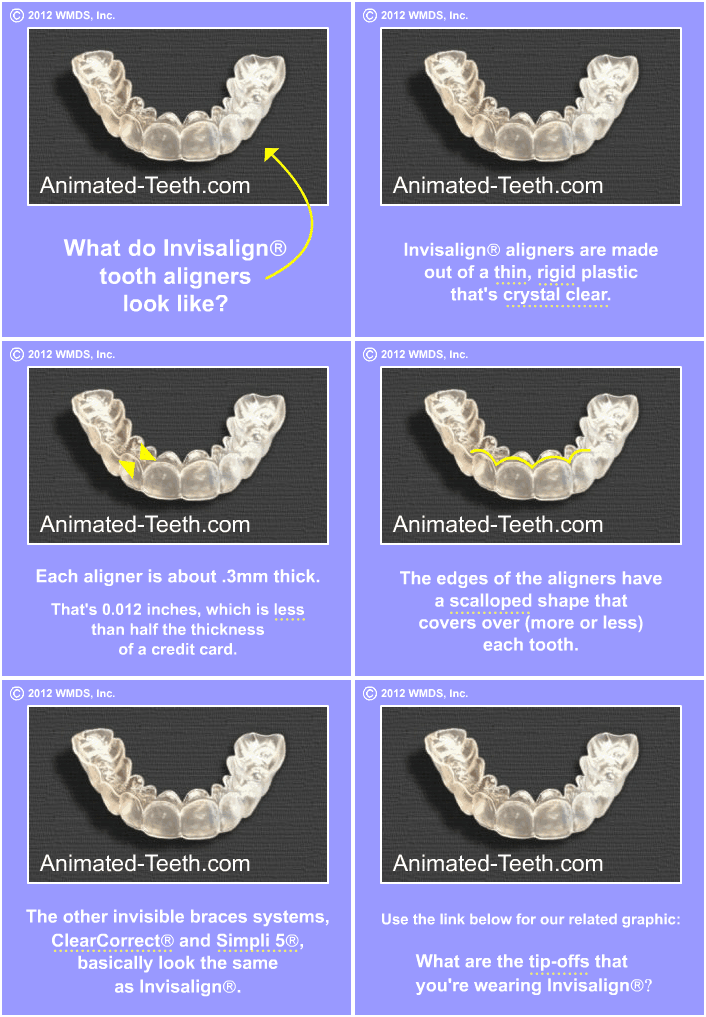
- They look a lot like bleaching trays (used with at-home teeth whitening systems).
However, orthodontic aligners are made out of a thinner, stiffer plastic (medical-grade polyurethane) that’s also more optically clear. This makes wearing them less obvious than whitening trays.
- They are also very similar, almost precisely so, to clear plastic, vacuum-molded orthodontic retainers Essix/Vivera® appliances.
Although, the plastic used to make tooth aligners is just a little bit thinner and usually trimmed in a more scalloped fashion where its edge follows the shape of your teeth and does not extend over onto surrounding gum tissue.
How do the aligners used with the ClearCorrect®, eCligner®, ClearPath®, and Simpli 5® systems compare?
For all practical purposes, the aligners worn with competing CAT systems look essentially the same as Invisalign®’s.
- With some brands, the aligners cover over the patient’s gums just slightly more so than Invisalign®’s design. (The companies feel this aids with aligner retention.)
- And with some systems, each individual step of the tooth movement process is accomplished using multiple sets of aligners, each one having a slightly greater thickness. (Said to help to minimize patient tooth-movement discomfort.)
Slideshow outlining the advantages of Invisalign® vs. conventional braces.
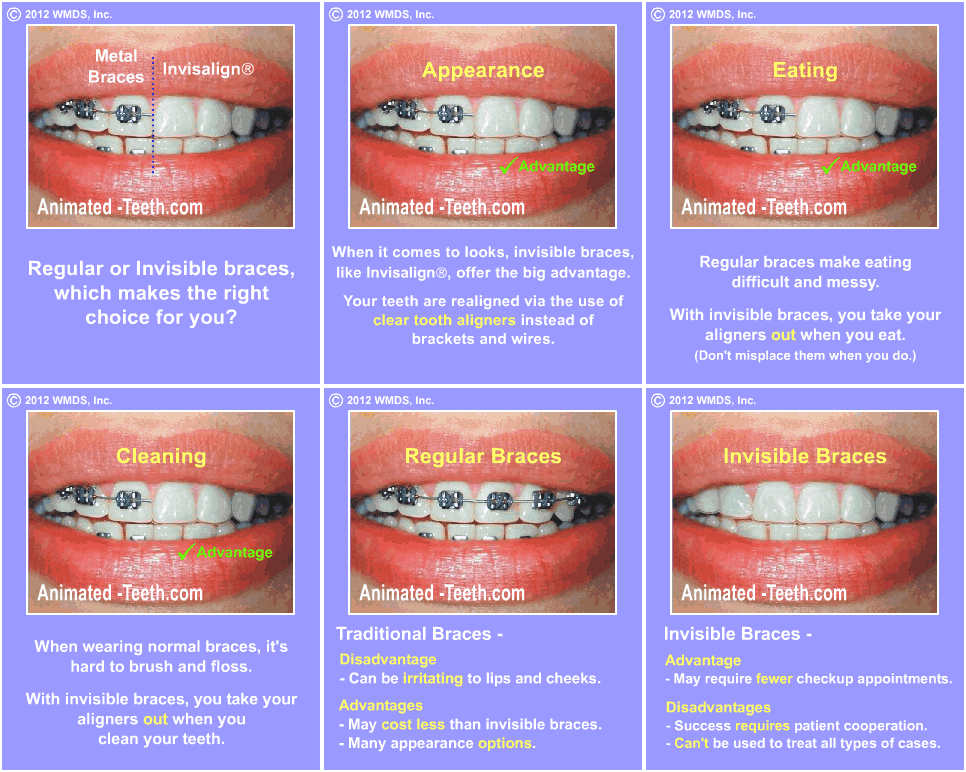
Advantages of Invisalign® (and similar systems) vs. conventional braces.
a) Eating food and cleaning your teeth are a lot easier.
b) The aligners are fairly invisible.
In comparison to having conventional stainless steel (silver) braces, there is no question that wearing clear plastic aligners is the less visible option.
Studies and statistics.
An investigation by Feu (2012) prepared pictures of a model wearing different types of orthodontic appliances. Test subjects were shown the images and then asked to give their opinion about the “attractiveness” of the model’s appearance.
- The highest-ranking braces system in terms of attractiveness was clear aligners (Invisalign®) with a score of 81.
- In comparison, the best-ranking conventional metal braces system only ranked 34.
- Of note is the fact that Invisalign® treatment that included the use of attachments only ranked 68.
(Beyond just the presence of attachments, there can be other tipoffs that may betray the fact that you’re wearing plastic aligners. This issue is discussed below.)
c) Aligners are less irritating to soft tissues.
A major complaint heard from patients who wear traditional braces is the way their brackets and wires irritate their lips, cheeks, and tongue. This can be especially true for ceramic orthodontic brackets (see below).
In comparison, the contours of plastic tooth aligners are usually rounded and smooth, so these complaints don’t typically come up. Or when they do, the objectionable edge can usually be trimmed down.
d) Virtual treatment planning.
Patient case planning with Invisalign® and some of the other advanced clear aligner systems involves digitizing the patient’s dental information and then creating an on-screen animation of their proposed treatment plan. This presentation can then be shared with the patient so they can see their expected outcome before committing to it.
Disadvantages of Invisalign® and similar removable systems.
a) Wearing your aligners may be more noticeable than you expected.
Attachments, or buttons and elastics, may be needed.
By nature, clear-aligner technique doesn’t give the dentist as much control over making some types of tooth movements as conventional braces. As a way of enhancing the ability of their system, some manufacturers, like Invisalign®, sometimes include the use of attachments or buttons What are these? in their patient’s treatment plan.
These devices that are bonded onto the surface of your teeth can be a nuisance to you as well as be visible to others Examples / Pictures. Overall, they can make your Invisalign® experience less comfortable and less invisible than you might have expected.
Interference with speech.
While usually just a transient problem until you learn to adapt, wearing your aligners may interfere with the way that you speak. And others may notice this change.
FYI: For more information about this issue, visit this page: How visible is wearing Invisalign®? Jump to page.
b) Your aligners must be worn to work.
With some patients, the very thing that makes having removable aligner treatment so convenient is also the single issue that will render it ineffective. To work, your aligners have to be worn as prescribed (usually on the order of 22 hours per day).
Patients who are unwilling to comply with their doctor’s instructions don’t make good candidates for this technique and would do better with “fixed” orthodontic appliances (like conventional or lingual braces) where compliance isn’t an issue.
c) Some malocclusions may not be treatable with removable aligners.
The plastic aligners used with removable braces technique can’t always create and direct the level of force needed to produce some types of tooth movements. Case selection guidelines. If not, a bracket and wire system (conventional or lingual braces) may need to be used.
However, without question, the capabilities of removable systems (especially Invisalign®) are constantly being expanded. (Like via the use of attachments or buttons/elastics as mentioned above.)
FYI: We have a number of pages that further explain the use of invisible braces systems like Invisalign®. To select, use this menu.
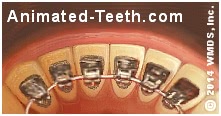
A picture of lingual braces mounted in place.
b) Lingual Braces (Incognito®)
What are they?
Lingual braces are a method of orthodontic treatment where all of the needed hardware (brackets, wires, and elastic bands) is mounted on the backside (tongue side) of your teeth.
Due to this reverse positioning, they’re sometimes called “inside” or “reverse” braces.
“Inside” vs. “Outside” dental braces.
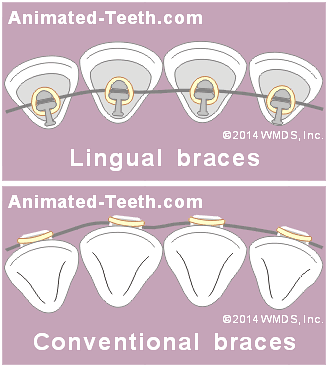
The location of the patient’s appliances is reversed.
Lingual vs. traditional braces.
Brand names of lingual braces systems.
Some of the brands associated with this technique are: Incognito® and iBraces® (by 3M), SureSmile® (by OraMetrix), and Harmony® (by American Orthodontics).
What are the advantages of having lingual braces?
a) Their positioning on your teeth makes them invisible.
With lingual technique, your braces are generally non-visible to others. If someone looks into your mouth they may catch a glimpse of your appliances (especially if you’re wearing them on your lower teeth). But otherwise, they’re not so easily detected.
And that may be an advantage over “invisible” (removable clear aligner) systems like Invisalign® where on close inspection the aligners can sometimes be seen or may give off a sheen that hints that they’re being worn. Also, the need for the placement of attachments for some cases (discussed above) can betray that a removable system is being worn.
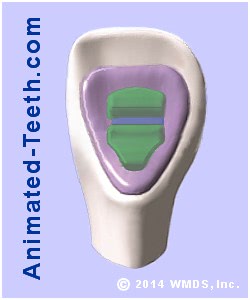
Custom brackets are computer-designed for each tooth.
b) System sophistication.
c) Precise control over tooth movements.
d) A shorter treatment period may be possible.
At least two studies (Saxe 2010, Sachdeva 2012) have reported that treatment involving SureSmile® (one of the most advanced lingual systems available) requires less time than conventional braces for case completion.
▲ Section references – Saxe, Sachdeva
Disadvantages of having lingual braces.
a) They can be difficult to get used to.
As a general rule, it’s more difficult and takes longer to get used to wearing lingual braces than it does conventional (front side) ones. Common complaints involve tongue irritation, difficulties with speech (especially with “S” and “T” sounds), awkwardness with eating, and difficulty with teeth cleaning.
Studies and statistics.
- A study by Fritz (2002) determined that 65% of patients reported experiencing some degree of tongue impairment (this included irritation, injury, and restricted functional space), making it the most common complication associated with wearing lingual braces. 24% of these subjects experienced speech difficulties.
97% of patients classified their impairment as being “slight to moderate.” With 82% stating that they had adapted to their initial difficulties within the first 1 to 3 weeks of wearing their appliances.
- Discussion in an article about lingual orthodontics by Slater (2011) references a 1997 survey that reported that 82% of patients felt that their ability to speak had returned to normal within one month of starting their treatment. The article points out however that this still leaves 18% of patients with some degree of speech impairment.
- Sanborn (2009) reported that eating, chewing and food collection each rated a functional impairment score of around 4 during the first three days after placement. (0 to 10 scale, with 10 being “as bad as you can imagine.”) After an eight-week period of adaptation, this rating had only fallen to a level of around 2 for each of these events.
Tongue and speech issues tend to be less of an issue with more modern lingual systems.
▲ Section references – Fritz, Slater, Sanborn
b) Your adjustment appointments may take longer.
Each of the individual office appointments you require during your treatment process will likely take longer than they would with front-side braces (just due to the more difficult to access location of your hardware). However, with some lingual systems fewer periodic appointments are needed.

Bite interference with a lingual bracket due to a deep vertical overbite.
c) Proper case selection is required.
d) Not all orthodontists offer lingual treatment.
There is a definite learning curve associated with providing lingual braces treatment, and sometimes additional coursework is required. And since there is less demand for this technique than conventional front-side braces, many providers simply may not be interested in undertaking this additional challenge.
Different kinds of options for conventional braces …
You can dress them up or blend them in.
Having traditional braces (brackets and wires on the front side of your teeth) doesn’t mean you have to put up with having an old-fashioned “tin grin.” Nowadays there are lots of attractive or unique variations you can opt for.
c) Ceramic braces.
A picture of a ceramic orthodontic bracket.
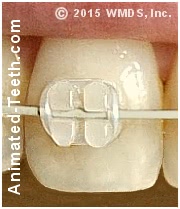
A white (frosted) archwire has been placed.
What are they?
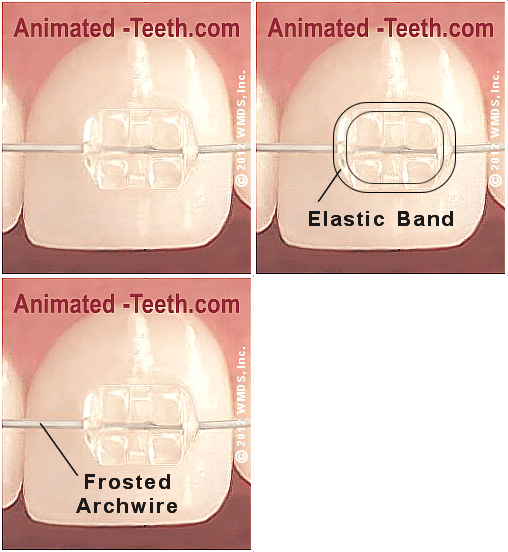
A picture of a clear ceramic orthodontic bracket.
Note: A metal archwire and elastic bands are still needed.
- Silver-colored archwires are frequently used. As a more esthetic, less-obvious alternative, “frosted” or “esthetic” (white) wires may be placed instead. (See picture.)
- At the patient’s discretion, white or clear elastic bands may be used to further blend in the appearance of their braces.
What are some of the brand names associated with ceramic braces?
Here’s a list of some of the companies that make ceramic orthodontic brackets and their products’ brand names.
ClassOne Orthodontics (Contour, Acclaim, Monarch), GAC International (Allure, Mystique), 3M Unitek (Clarity, Transcend), Ormco (Inspire ICE), Ortho-Byte (Integra), TP Orthodontics (InVu, MXi), Ortho Technology (Reflections, Encore!), American Orthodontics (Virage)
How do ceramic braces look compared to other types of orthodontic appliances?
Studies and statistics.
An investigation by Feu (2012) prepared pictures of a model wearing different types of orthodontic appliances. Test subjects were shown the images and then asked to give their opinion about the “attractiveness” of the model’s appearance.
- As one might expect, clear aligners (Invisalign®) without the presence of “attachments” (see mentions above) ranked highest with a score of 81.
- Ceramic braces (clear brackets, clear elastics, frosted archwire) tied for second along with clear aligner treatment involving the use of attachments, with scores of 69 and 68 respectively.
- 4th place was taken by ceramic braces (clear brackets, clear elastics) with the use of a standard silver archwire (score of 54).
- Following the pack was various versions of conventional-style metal braces.
▲ Section references – Feu
Disadvantages of using ceramic braces for your treatment.
a) Bracket strength concerns.
While the tensile strength of ceramic orthodontic brackets (resistance to breaking when stretched) is greater than with conventional stainless steel ones, this property causes them to be brittle. As such, ceramic brackets sometimes break during a patient’s treatment resulting in associated inconveniences (replacement, case delay, etc…).
▲ Section references – Waring
b) Your treatment may take longer when ceramic brackets are used.
The orthodontic methods and principles employed with ceramic braces are essentially the same as when metal ones are worn. But since they are more brittle/fragile in nature, some treatment modifications may be necessary.
Bracket failure.
As a way of minimizing the risk of bracket breakage, an orthodontist may feel that they need to use less aggressive treatment forces. Doing so, however, can mean that the patient’s teeth will move more slowly, thus increasing the overall treatment time needed for their case.
If a bracket does fail, it will have to be reattached or replaced. And this adds inconvenience and aggravation for all involved and slows down the patient’s treatment progress.
Bracket friction.
▲ Section references – Waring
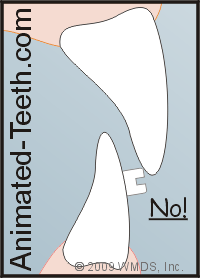
This ceramic bracket interferes with the patient’s bite.
c) Ceramics can’t always be placed on bottom teeth.
d) Ceramic brackets may be more irritating to soft tissues.
Ceramic brackets typically feel rougher against soft oral tissues (lips, cheeks) than metal ones. And while most patients learn to adapt (or at least tolerate) them, at first you may find their sharpness quite irritating.
e) Ceramic brackets tend to cost more than metal ones.
This link discusses the issue of costs for ceramic brackets Braces fees., as well as cost-cutting measures that are sometimes utilized with them.
f) Ceramic brackets tend to be larger.
Orthodontic brackets must be designed to be strong enough to withstand the forces needed to produce tooth movement. And since they tend to be more brittle/fragile than their metal counterparts, ceramic brackets tend to be slightly larger and bulkier.
g) Ceramics still require the use of an archwire.
As mentioned above, ceramic braces still require the use of a metal archwire (the wire that runs across the front side of your teeth through each of your brackets). And this wire will be visible to others.
Frosted (white) archwires.
As a way of minimizing the shiny look of your archwire, your orthodontist may offer to place a “frosted” or “coated” one. (See picture above.)
▲ Section references – Waring
h) You’ll still wear elastic bands.
The archwire that runs across your teeth will be bound to each bracket via the use of a “rubber” band.
You’ll probably choose bands that match your brackets.
Most orthodontists will have a variety of colors for their patients to choose from when their elastic bands are placed (or replaced). Patients with ceramic braces tend to choose tooth-colored or clear bands, so to match or blend in with the overall look of their appliances.
Light-colored elastics tend to stain.
Light elastic bands (especially clear or white) often look great at first but then, due to exposure to chromogenic foods and beverages, become stained and visually detracting.
Pretty much any consumable that has a strong color has the potential to stain a patient’s orthodontic bands. This includes: coffee, tea, cola, mustard, ketchup, curry, blueberries, and tobacco products.
There’s no real solution for this problem other than to minimize your consumption of whatever foods you find tend to cause staining the most. Of course, when your elastic bands are changed (usually every month or so) you’ll get a fresh, clean start.
i) Ceramic braces can make it harder to monitor oral home care.
Dental plaque accumulation around the base of tooth-colored or clear ceramic orthodontic brackets can be difficult to detect. And in cases where it is allowed to persist on tooth surfaces, the complication of dental white-spot lesions Causes | Solutions may develop.
If this problem is anticipated (like with a child or teenager who is expected to be an ineffective brusher), the color contrast created by placing conventional metal brackets may make monitoring plaque accumulation easier, and therefore the wiser choice.
d) Gold dental braces.
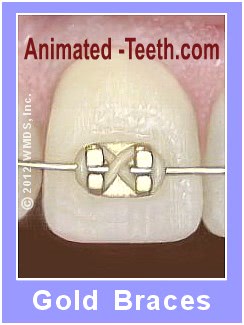
Closeup picture of gold braces (bracket and archwire).
What are they?
Are the braces really made out of gold?
Is your treatment any different when gold braces are used?
No, your orthodontic treatment using gold or stainless steel (silver) braces is the same.
What are the advantages of gold dental braces?
a) They give a different look.
Some people like the color gold because they feel it has a softer, warmer look than stainless steel, and thus helps their braces blend in better with their smile.
b) Sophistication.
c) Gold braces may make you look smarter.
Yes, we’re saying that with a straight face. And no, it’s not just our opinion. That statement is based on research (see below).
Closeup picture of gold dental braces.
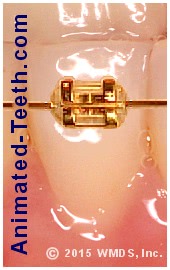
The color of these gold braces is very dark. (Compare to the picture above.)
Things to know.
1) Ask which color of gold.
2) Ask your dentist if gold archwires will be used.
- Some people choose gold braces because they want its color in their smile and for them, this will be an important point.
- However, since the archwire running across your teeth is thin, its color, silver or gold, may not really matter very much. And since gold-plated archwires tend to cost more, using silver ones may be a perfectly acceptable, lower-cost option.
Related content: Gold braces costs. Fees for braces page.
4) Research – Perceptions about gold braces.
We ran across two published papers that evaluated how gold dental braces are perceived by others.
Study #1: Jeremiah (2011)
In this study, 130 study participants were shown pictures of a subject wearing different types of orthodontic appliances and then asked for their impression of their appearance.
- Intellectual Ability – Higher perceived “intellectual ability” scores were associated with lingual (7.56), removable/Invisalign® (7.08), and gold dental braces (7.35), as compared to conventional/silver (6.67) and ceramic/clear (6.65) ones.
- Attractiveness – Better perceived “attractiveness” scores (lower = better) were associated with lingual (44.54), removable (53.33), and gold braces (71.38). Followed by silver braces (75.06) and then ceramic (80.02). (We’d be the first to agree that the very high score here for ceramic braces was different than we would have expected.)
Study #2: Feu (2012)
This study involving 252 subjects had a design similar to the Jeremiah one just discussed.
Attractiveness – After looking at pictures of a model wearing different types of orthodontic appliances, the test subjects were asked their opinion about the “attractiveness” of each.
- Clear aligners (Invisalign®, close to a no-appliance look) scored 81.
- Gold braces ranked least favorable of all treatment methods at 17.
- Gold’s score was even below the look of silver braces with colored elastics (29). Go figure.
Our conclusions about these studies.
The findings of this last study surprised us quite a bit. And the conclusions of the first one, the study that determined that gold braces were more pleasing than ceramic ones, seemed a bit strange to us too.
All we can conclude from this is that there’s clearly “no accounting for taste.” So our advice would be if the idea of gold appeals to you, why not just go ahead and do it?
Having said that, both studies included copies of the pictures test subjects were shown. And the color of gold appliances used was deep yellow. As mentioned above, there are different shades of gold. So ask to see which one your dentist has to offer. A paler coloration may be more universally acceptable and pleasing.
▲ Section references – Jeremiah, Feu
e) Color-coordinated Orthodontic Bands
Picture showing the individual components of conventional braces.
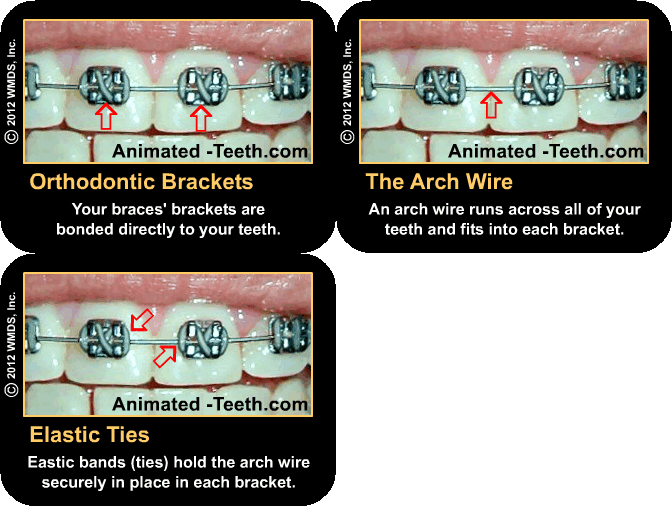
Each one (bracket, archwire, elastic) can be personalized.
Elastic orthodontic ties – You have a rainbow of colors to choose from.
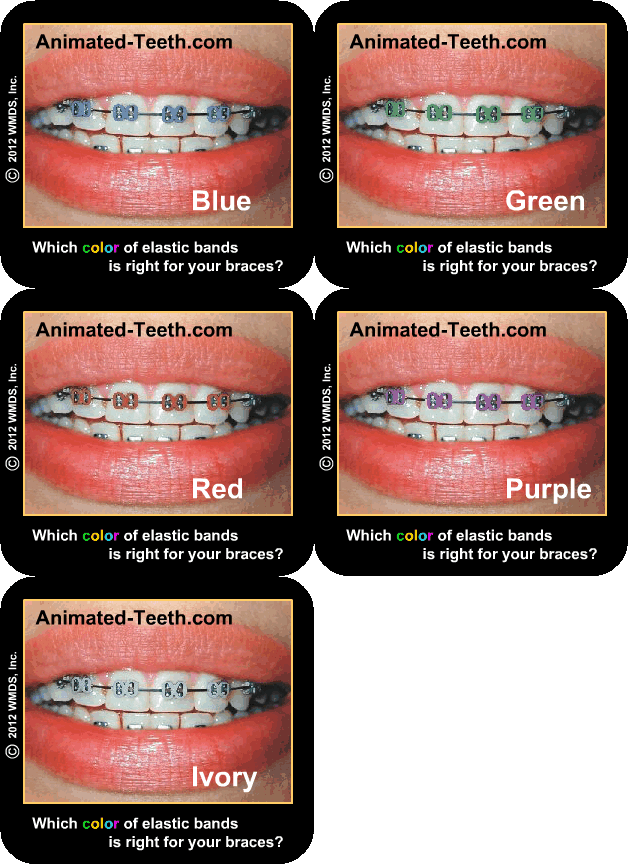
You can show off your personality with conventional braces by the color scheme you choose.
Tips to keep in mind.
- White or ivory bands can help to mask your braces. But depending on the types of things you eat and drink, they may tend to stain.
- Darker bands don’t stain but they don’t help to hide your braces either.
- Bold colors make a statement.
- Some people like to stick with choosing vibrant colors (pink, bright blue, or purple) because they won’t be mistaken for food or debris trapped around your braces.
- Just because you’ve chosen a scheme once doesn’t mean that you’re stuck with it. Elastic ties are usually replaced during each appointment (typically every few weeks).
Research studies about color preferences.
Believe it or not, dental researchers have actually studied which color of elastics people tend to find the most pleasing.
A study by Cordeiro de Oliveria (2012) determined that:
- Adults (ages 25 to 50 years) tended to prefer grey bands the most, followed by red and then green.
- Adolescents (ages 13 to 17 years) tended to prefer red the most, followed by grey and then green.
Another study (Feu 2012) found the same preference for grey over green elastics. All study subgroups (men, women, ages 17 to 26, and ages 27 to 63) preferred the look of grey elastics over green ones.
▲ Section references – Cordeiro de Oliveria, Feu
f) Fashion brackets – Orthodontic brackets that have unique shapes.
Another way patients can make the idea of having conventional braces special is by choosing brackets that have a unique or distinctive outline. Here are some of the shapes that we’ve seen available over the years:
- Stars, Hearts, Soccer balls, Footballs, Flowers, Diamonds, Clubs, and “Mickey”.
In most cases, these types of brackets are only placed on a patient’s upper center six or four front teeth. That’s because these are the only ones that really show very much when you smile and following this plan helps to keep costs down.
Is your treatment any different when fashion brackets are used?
No, with novelty brackets, your treatment is just the same as when conventional brackets are used.
Last reviewed: April 19, 2022
Author: Paul Cotner, DMD — retired dentist.
Published by: WMDS, Inc. — owner of Animated-Teeth.com.
Educational information only — not a substitute for professional dental care.
Page references sources:
Cordeiro de Oliveria S, et al. Impact of brackets on smile esthetics: Laypersons and orthodontists perceptions.
Feu D, et al. Esthetic perception and economic value of orthodontic appliances by lay Brazilian adults.
Fritz U, et al. Lingual Technique – Patients’ Characteristics, Motivation and Acceptance Interpretation of a Retrospective Survey.
Jeremiah HG, et al. Social perceptions of adults wearing orthodontic appliances: a cross-sectional study.
Sachdeva RC, et al. Treatment time: SureSmile vs conventional.
Sanborn RC. Physiologic adaptation to lingual appliances during the initial eight weeks of treatment.
Saxe AK, et al. Efficiency and effectiveness of SureSmile.
Slater R. The Rise of Lingual. More demand, fewer issues.
Waring D, et al. Invisible Orthodontics Part 3: Aesthetic Orthodontic Brackets.