Oral-B brushing modes explained
This page outlines the various brushing modes that Oral-B rechargeable toothbrushes offer. They include:
- Daily Clean, Deep Clean, Pro Clean, Sensitive, Whitening, Massage, and Tongue Cleaner modes.
In our discussion below, we outline what each of these different modes does. Which ones we feel are important to have. And explain the difference between Oral-B’s 2D vs. 3D brushing action, and why having 3D is better.
[Note: None of the information on this page applies to the (discontinued) Oral-B Pulsonic toothbrush.]
And then, to wrap this page up, we explain the brushing actions of two other notable rotary-style electric toothbrushes (Rotadent and Interplak).
Page Table of Contents.
- A) Oral-B’s 2D vs. 3D brushing motion.
- B) Oral-B iO Series brushing action – Oscillating / Rotating / Microvibrations.
- C) Standard Oral-B brushing modes/toothbrush settings.
- D) Other rotary toothbrush designs.
A) Oral-B’s 2D vs. 3D brushing motion.
When picking out an Oral-B rechargeable toothbrush model, probably the most important thing you need to understand is the difference between their 3D and 2D brushing action, and why it’s so important that your brush has the former.
We’ll start off by explaining the 2D movement.
Oral-B 2D brushing.
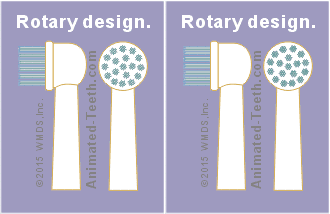
Oral-B’s 2D brushing action generates a back-and-forth oscillate-rotate motion.
a) 2D brushing action.
This is the more basic of the two brush head motions.- This is a simple “rotary” brushing action. One where the bristles of the brush alternate back and forth as they scrub the user’s teeth.
- The term “2D” is used because Oral-B categorizes this as an “oscillating-rotating” motion.
From the standpoint of removing dental plaque, this design is effective. But it can be improved upon.
Oral-b 3D brushing.
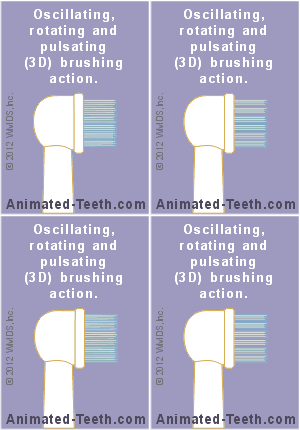
Oral-B’s 3D brushing action generates a back-and-forth oscillate-rotate, and also pulsating, brushing motion.
b) 3D brushing.
As an advancement in design, Oral-B engineers have incorporated a high-frequency “pulsing” action into their 2D brushing motion. They refer to this as “3D” movement (oscillating-rotating + pulsating).Why is 3D important?
The addition of a high-frequency (sonic) pulsing action is significant because it agitates the liquids that surround the user’s teeth and creates what’s termed a “non-contact” brushing effect. This is an effect where dental plaque is disrupted at distances beyond where the toothbrush’s bristles actually touch (yes, beyond).Adding a pulsing action isn’t really something new that Oral-B thought up. This is the same general idea that sonic toothbrushes brought to the marketplace in the early 1990s.[Non-contact (sonic) brushing is an interesting phenomenon and we describe how it works here.]
Sonic brushes were the first to introduce non-contact tooth cleaning.
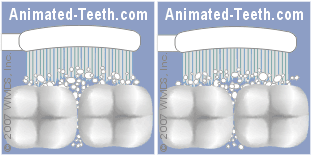
The effect is due to the way the brush head pulsates.
Non-contact brushing has its limitations.
It’s important to understand that the non-contact cleansing that a brush creates is only of secondary importance. Overall, the primary plaque-removing ability of both sonic and 3D Oral-B’s is due to the way their bristles directly scrub against tooth surfaces.And we must also point out that the clinical importance of this phenomenon is debated and still being investigated and understood.But we will point out that Oral-B evidently thought it was important enough to incorporate into their highest-end products. And overall, we think this is a significant feature to have and have made it one of the criteria for toothbrushes making our Best Oral-B toothbrushes list.
20,000 vs. 40,000 pulses per minute.
One last thing you need to know about Oral-B’s 3D brushing movement (oscillating-rotating + pulsating) is that some models can generate up to 40,000 pulses per minute, whereas others only 20,000. (In our all-models review we specifically state which type of action is created by which toothbrushes).
You can think of the latter as a lower power setting. And because at only 20,000 pulses per minute these brushes create less agitation of the fluids surrounding teeth, they produce less non-contact brushing effect.
For this reason, we think it’s best to only consider Oral-B 3D toothbrushes that can generate 40,000 pulses per minute. And, in fact, for our Best Oral-B’s list, this was exactly the criteria.
Sonic vs. pulsating-rotary brushes.
Since both high-frequency oscillating-pulsating powered brushes (Oral-B) and sonic toothbrushes Like Sonicare create a non-contact brushing effect, you might wonder which one makes the better choice.
- We’d be of the opinion that either can make an excellent selection.
- But we also think that due to their different designs, most people will tend to gravitate toward one more so over the other, in the sense that one just looks more like the type of brush they want to use.
(If that’s the case for you, go with your hunch. That will be the brush you’ll be more likely to continue to use over the long term.)
What does the research say?
We did find two research studies that compared both types of brushes.
- The first study (Verkaik 2010) evaluated the issue of non-contact brushing effectiveness. It found that “Non-contact removal was slightly more effective for the sonic than for the electric rotating brush.”
- The second study (Veeregowda 2011) evaluated an issue we had never encountered before.
It studied the effect of both types of brushes on the films that lubricate our mouths (make it easy for us to eat and speak, reduce friction between hard and/or soft tissues). In regard to this factor, they used the term “mouthfeel” (literally how the subject’s mouth felt after using their toothbrush).
The paper stated: “Volunteers reported a slightly preferred mouthfeel after sonic brushing as compared to powered rotating–oscillating brushing.”
We think it’s important to notice that the statements quoted from both studies each contain the word “slightly.”▲ Section references – Veeregowda, Verkaik
B) Oral-B’s latest brushing action.
The frictionless, smooth magnetic drive system.
In 2020, Oral-B introduced their iO Series toothbrush line Review. And with these models, they also introduced a new type of toothbrush motor. Their “frictionless, smooth magnetic drive system.”
Oral-B terminology has now changed.
Whereas with previous toothbrush models Oral-B has always made reference to their 2D or 3D brushing capability (described above), with the iO Series line and its new drive system, they no longer use these terms.
Oral-B still refers to the iO Series’ brushing motion as being “oscillating and rotating.” But instead of using the term “pulsations,” Oral-B has instead begun to use the term “microvibrations.”
What’s that mean?
Well, we’re not exactly sure how things are now different. But we are reasonably confident that it doesn’t much matter to you and me.
It’s inconceivable that Oral-B would introduce a new set of top-of-the-line toothbrushes (the high cost of the iO Series’ models seems to confirm that fact) and not give them a brushing action that didn’t equal or exceed that which came before.
So, while not technically correct, or well described, we think it’s reasonable to assume that everything stated above in regard to the best 3D brushing motion is matched or exceeded by this new drive system.
C) Oral-B brushing modes and settings.
a) Daily Clean – The most important brushing setting.
The default brushing mode on an Oral-B model is usually labeled “Daily Clean.” And we think those two points alone tell you quite a lot about it.
- As your brush’s default mode, you can assume that this is the one that Oral-B expects will be (should be) used the most.
- Its name alone implies that Oral-B thinks that this mode makes the right choice for the task of cleaning your teeth each day.
This is likely the only brushing mode you really need.
Daily Clean is the mode where everything we’ve discussed above comes together. This is the one where your brush just runs at full speed, creating the best brushing action it can (either 2D or 3D movement, depending on the model).And for this reason, it can be considered to be your brush’s most efficient and effective plaque-removing setting. And as such, for the vast majority of users, we think that Daily Clean makes the best (full-time) choice (to the extent that we don’t see much need for using any other mode).How Daily Clean varies by model.
As discussed above, not all Oral-B electrics have been created equal. Here’s a breakdown of the different variations of Daily Clean mode that are featured by different models:- Daily Clean – 3D brushing motion, 40,000 pulses per minute. This is the best brushing action that any Oral-B product has to offer. It’s found on what could be described as the mid-priced to high-end models (the 8000, 7000, 6000, 5000, and 3000 models in our all-models list).
- Daily Clean – 3D brushing motion, 20,000 pulses per minute. This is a lesser version of the above. The 1000 models in our list feature this brushing action.
- Daily Clean – 2D brushing motion (no pulses per minute). This is a primitive brushing action that’s only featured on Oral-B’s low-end models (the Vitality and Pro 500 brushes in our list). This motion creates no non-contact brushing effect, which is a big disadvantage.
As mentioned above, if your quest is simply to purchase the best Oral-B electric plaque remover possible, then you should only consider a 3D brushing motion/40,000 pulses-per-minute model.Additional brushing modes:
The Oral-B electrics that feature 3D brushing motion with 40,000 pulses per minute typically come with some assortment of the following brushing modes.
b) Deep Clean mode.
This brushing setting creates a brushing action that’s the exact equivalent of Daily Clean. The difference is that when your brush is set to Deep Clean the brush’s brushing/quadrant timer is lengthened to 3 minutes instead of just 2.
Since brushing for longer is generally a good thing, if you purchase a brush that features this setting, using it usually makes a good idea.
Do you really need this mode?
We don’t think we would buy a particular model just to get the Deep Clean feature. After all, anyone could duplicate it simply by using their brush in Daily Clean mode, and then once its 2-minute timer has signaled, just continuing on brushing (on their own, untimed) for an additional 1 minute.
c) Pro Clean mode.
Oral-B states that Pro Clean operates the toothbrush’s head at a faster rate (higher frequency), as compared to other brushing modes.
Do you really need this mode?
It seems logical to assume that faster brush head movement would create a somewhat superior brushing action. However, we can’t find any information on the Oral-B website or in their promotional materials that seem to promote or support this stance.
Since Oral-B evidently assigns no special value to Pro Clean, we won’t either. We wouldn’t buy a specific model just to get this mode. If the brush we were using had it, we would probably use it as a substitute for Daily Clean.
d) Sensitive mode.
This setting simulates the action of Daily Clean but at a lower overall speed.
This is not a mode created for optimal plaque removal. It’s a second-tier, reduced-power setting for those who can’t tolerate the action of their brush at its Daily Clean (or Deep Clean) setting. If you decide to use it, just realize you’re not getting the full benefit of using an Oral-B electric.
Do you really need this mode?
It depends. The Sensitive mode might be useful for people who need a “break-in” period of a week or two when they first get their brush. Aged or debilitated persons may find this is the only setting they can tolerate.
e) Whitening / 3D White mode.
In this setting, the toothbrush alternates its speed (cycles of faster, then slower), which Oral-B claims helps to polish off tooth surface staining.
Do you really need this mode?
This claim seems to suggest that using a brush in a mode that alternates between full power and a lower setting is substantially more effective than just using the brush continually at full power (Daily Clean).
We specifically searched for research on which this claim might be based (both on Oral-B websites and published dental literature in general). We didn’t come up with any information to share.
f) Massage mode.
On some models, this setting is called Gum Care. It’s another alternating speed mode. Oral-B says it’s designed to stimulate and massage the user’s gums.
Do you really need this mode?
If you’re going to use this mode in addition to brushing normally with Daily Clean and also flossing, then great. But using this mode as a replacement for either could easily be considered to be a poor oral health decision.
g) Tongue cleaner.
A brushing action that Oral-B feels is useful for brushing your tongue.Do you really need this mode?
Cleaning your tongue is important. However, we would think that you’d be better served by using the methods we discuss on this page.D) Other rotary electric toothbrush designs and brushing actions. – (Rota-dent, Interplak.)
The back-and-forth motion of rotary brushing action.
What do we mean by “rotary” toothbrushes?
While this category does encompass a wide range of individual designs, “rotary” electric toothbrushes are all similar in the fact that they have a set of rotating (oscillating) bristles.
Their configuration can either be:
- Bristles that are arranged in a circular pattern on a circular brush head. The entire head then oscillates back and forth. (Braun Oral-B utilizes this design.)
- A brush head that’s composed of a single tuft of bristles that rotates continuously in a single direction (as represented by the Rota-dent brand).
- A brush head that looks like a normal manual toothbrush. But featuring individual tufts of bristles that rotate back and forth independently (the Interplak toothbrush).
Above on this page, we’ve already explained details about Oral-B’s rotary brushing action and modes. To wrap up our coverage of this subject, the remainder of this page details the Rota-dent and Interplak brands and their brushing actions.
1) Single-tuft toothbrushes – Rota-dent.
Rota-dents have a unique design among rotary brushes.
- Their brush head has just a single tuft of bristles, which rotates at 1,350 revolutions per minute.
- The bristles themselves are referred to as “microfilaments,” implying that they are extremely fine and as a result can clean in nooks and crannies that other brushes can’t. (Rota-dent states that they’re 1/3 the diameter of conventional brush bristles.)
- The tuft contains roughly 4,500 individual bristles, making it more akin to a soft, stubby artist paintbrush than a standard toothbrush.
How you use the brush.
Brush heads come in either pointed or cup-shaped (hollow) form. The cup-shaped ones splay out over tooth surfaces, while the pointed ones are designed for use in between teeth or along the gum line.
A Rota-dent is generally used on, or around, one tooth at a time, not unlike the way during professional cleanings each tooth is polished individually. (Any single user might or might not find this method of brushing especially appealing.)
Due to the shape of its brush head and the length of its bristles, it’s easy to imagine how a Rota-dent could excel in cleaning in between teeth and other difficult-to-reach areas (such as underneath bridgework). And in this regard, there is no other type of powered brush like it.
2) Counter-rotational toothbrushes – Interplak.
Interplak electrics fall under the category of “counter-rotational” toothbrushes. This is the only brand of brush that we’re aware of that uses this design.
- The brush head generally looks like a normal toothbrush.
- But each of the 8 (possibly 10) individual tufts of bristles on it rotates back and forth, in an opposite direction as its neighbor (counter-rotation).
- The speed of this action is 4,200 rotations per minute.
This brush design is relatively older powered toothbrush technology, whose heyday was in the late 1980s and on into the early 1990s.
During that time frame, this brush was frequently included in research studies and its effectiveness was generally found to be superior to previous generations of electric toothbrushes.
Since then, this brush seems to have been eclipsed by newer (although more expensive) toothbrush designs. The last published research we could find that included it in its study was dated 2001. Purchasing an Interplak isn’t necessarily a bad choice, just a dated one.
[Braun Oral-B is a registered trademark of The Gillette Company. | Interplak is a registered trademark of The Conair Corporation. | Rota-dent is a registered trademark of Professional Dental Technologies, Inc. | Sonicare is a registered trademark of Koninklijke Philips Electronics N.V.]Page references sources:
Veeregowda DH, et al. Boundary lubrication by brushed salivary conditioning films and their degree of glycosylation.
Verkaik MJ, et al. Oral biofilm models for mechanical plaque removal.
All reference sources for topic Electric Toothbrushes.