Looking for information about other Dental Topics?
Full Website Index• Animated-Teeth.com •

Sonicare vs. Oral-b: Which brand is more effective? | Which brand’s toothbrushes are better at removing dental plaque and improving gum health?
Overview: Which electric toothbrush brand is more effective, Oral-b or Sonicare?
We’ve been reporting about electric toothbrushes on our website’s pages for over 15 years. And during that timeframe, we’ve read through scores of published research studies that have evaluated the brushing effectiveness of both Sonicare’s and Oral-b’s powered toothbrushes. (The two market leaders in this field.)
And while that may imply that we’ve seen a lot of impressive data, what we have to report is that we really haven’t. It’s our opinion that the quality of research associated with few topics in dentistry fails to impress to a greater degree (primarily from a standpoint of study design) than that of electric toothbrush studies.
Spoiler alert #1: We tend to feel that Oral-b brushes probably have the more effective design.
That’s right, the phrase “probably have” is about all the more committal we feel we can be about this subject.
For the reasons we explain below, it’s our opinion that the studies that have been published on this subject are generally unimpressive. And collectively, they fail to provide substantial evidence that one brand is significantly more effective than the other in improving or maintaining oral health.
Spoiler alert #2: We’d never buy a new brush without first considering each brand’s current models.
Now, this is a sentence we can feel strongly about. That’s because we think that there are a number of factors that need to be considered when selecting a powered toothbrush. And with proper model selection, we’re convinced that you can be similarly effective using either brand, Sonicare or Oral-b.
FYI: What else do you need to know when picking out an electric toothbrush? – We have several pages on our website that also discuss issues that we feel are important to understand when picking out the brand of electric toothbrush that seems best for you. They include:
- Are you aware of how the design of Sonicare and Oral-b toothbrushes differ? – How Sonicares work. | How Oral-b’s work. | Using one design may be naturally more intuitive for you than the other. And if so, that’s probably the better brand for you to own because you’ll be more likely to use that brush and use it effectively.
- Do you realize that not all Sonicare and Oral-b models create their company’s optimal brushing action? If not, you should read these pages: The best Sonicares. | The best Oral-b electrics.
Sonicare vs. Oral-b: Which brand is more effective? – Research evidence and comparison.
The remainder of this page cites several research studies that have been conducted over the last few years that have evaluated the effectiveness of Oral-b vs. Sonicare powered toothbrushes. As you read along, we’ll point out why we’re so underwhelmed with the evidence available on this subject.
Study #1 – Goyal (2021)
Study findings: This paper states …
“A significantly greater percentage of subjects in the O-R brush (Oral-b) group versus the sonic (Sonicare) brush group transitioned from ‘not healthy’ to ‘healthy’ gingivitis case status at week 24.”
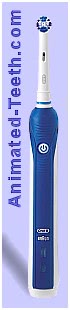
Oral-B Pro 3000
Study #2 – Adam (2020)
“The novel O-R electric toothbrush with micro-vibrations (Oral-b’s best brushing action) provided greater plaque and gingivitis reductions than the marketed premium sonic (Sonicare) toothbrush over 8 weeks.”
So, there you have it. Conclusive evidence that Oral-b makes more effective electric toothbrushes than Sonicare … Right?
Oh, did we mention that those studies were “sponsored” research?
What is sponsored research?
This term simply refers to the fact that some aspect of the study was paid for by an interested party, like a toothbrush manufacturer.
With the studies above, both papers clearly state (in their “conflict of interest” section) that some of the authors (people overseeing/conducting the research) are employees of The Proctor & Gamble Company. (That’s the maker of Oral-b toothbrushes.)
Is sponsored research necessarily bad or suspect?
No, sponsored studies can be well designed and objective, and therefore make a valid contribution to dental science.
However, we will point one thing out. Do you think these studies would have been submitted for publication if the Sonicare toothbrushes were found to provide superior results instead of Oral-b?
Only the authors can answer that question, or maybe just their bosses. And that kind of hints at how bias can be associated with sponsored research.

Sonicare Electric Brush
Let’s move on to some other studies …
Study #3 – Mirza (2019)

Study #4 – Starke (2017)
Study findings: This paper’s conclusions state …
“Philips Sonicare DiamondClean with Premium plaque control brush head (SPC) was statistically superior to the Oral-B 7000 with CrossAction brush head (OCA) in reducing gingival inflammation, gingival bleeding, and supragingival plaque following 14 and 42 days of home use.”
Ok, those two studies definitely came to different conclusions. So, maybe Sonicare is the better brand vs. Oral-b?
Oh, did we mention that these studies were “sponsored” too?
Yes, that’s right. Both of these studies clearly state that some of the authors are employees of Philips Oral Healthcare, the maker of Sonicare products.
???
As we stated above, there’s nothing inherently bad about research being sponsored. But in general, here’s our take on the current state of affairs in this field.
How studies get conducted.
Selling powered toothbrushes is a big business, really, a giant business. And (especially) the two dominant manufacturers in the field (the makers of Sonicare and Oral-b toothbrushes) are searching for any evidence they can present to consumers to sway them into thinking that their brand’s design is more effective than their competitors.
In their quest, these companies are eager to sponsor any study that has the potential to shed a favorable light on their products. And it’s our impression that this kind of research makes up the bulk of studies that wind up getting conducted.
What would you expect to see if one brand is clearly better?
It would be our conjecture that if one brand’s toothbrush design really is substantially more effective than the others that this fact would have become apparent a long time ago.
And a part of that evidence would be that it would be very difficult for the less effective brands to come up with a study design/premise that would be capable of showing their product in a favorable light. But as you’ve seen above, that’s not the case. Studies seem to demonstrate that both brands are the more effective one.
What we’d like to find in published research.
If/when some new/significant advancement in toothbrush design/effectiveness really has become evident, we’d expect that you would see a lot of independent researchers jumping in with their own studies, not just sponsored authors.
We’d expect to see excitement and interest throughout the whole dental community in documenting and promoting this new best thing for patients. And it’s our impression that that’s just not the case. This field seems dominated by interested players (toothbrush manufacturers), each constantly trying to shift the scrimmage line back and forth with each new study they fund.
As a final example, were going to mention this study.
Study #5 – Clark-Perry (2020)
This type of study is referred to as a “literature review.” For a review, the authors will:
Step 1 – Define an objective. In this case, that was:
“To compare the efficacy of rotating-oscillating heads (like Oral-b) VS sonic (like Sonicare) action heads powered toothbrushes on plaque accumulation and gingival inflammation.”
Step 2 – They’ll then sort through published research. In this case, only studies published from 2009 up to March 2019 were considered.
Step 3 – They will then select from all of the studies they’ve discovered only those that meet their inclusion criteria. (That includes issues like, does the study have a valid design? And, what level of bias is associated with the study?)
Here’s a surprise.
When performing this review, the authors only identified 12 studies that met their inclusion standards.
Note: In a span of a decade, only 12 studies were found to be worthy of consideration? That should give you an idea of the (poor) state of affairs of dental research evaluating the effectiveness of electric toothbrushes.
The review’s findings.
In conclusion, the paper stated this:
“There is some evidence to suggest that OR (oscillation-rotation, like Oral-b) powered toothbrushes might remove more plaque and reduce the number of bleedings sites (a measure of gum health) better than other powered toothbrushes, specifically, sonic action toothbrushes (like Sonicare).
Our conclusions about the compared effectiveness of Sonicare vs. Oral-b powered toothbrushes.
For us, the conclusions stated by this last study, the review, sums things up just fine for us too. We think that any evidence that suggests that Oral-b makes more effective toothbrushes than Sonicare is just marginal, although that may be the case.
But in that belief, and as mentioned above, we would let other factors (unit design, features, cost, availability, etc…) have equal weight in our decision in selecting a brush. That’s because, bottom line, we don’t think which brand you choose will matter significantly. Both Oral-b or Sonicare can make a good, effective choice.
Manual vs. powered toothbrushes – Is using an electric really better?
Possibly yes …
For a lot of people, performing effective tooth brushing just isn’t that easy of a task for them to accomplish.
Doing a good job takes time, effort, and skill. And for people who find themselves in a position where they come up short on any of these factors, using a powered brush may be a way for them to step up their oral home care a notch.
It’s just a tool …
But you shouldn’t buy an electric because you think it will accomplish something for you that most people couldn’t ultimately learn how to do on their own (given an interest in putting in the time and effort to do so), because the scientific evidence supporting the benefit of using a powered brush is probably less overwhelming than you think (discussed below).
Instead, you should think in terms of an electric as being just a tool, whose features may help you to rectify whatever brushing deficiencies you have. And if you determine that it can, then getting one makes a good idea.
How to decide.
Toward helping you figure out if getting a powered brush makes sense for your situation, we discuss the following topics below on this page:
- Are electric toothbrushes really superior to manual ones? – What does the research say?
- Reasons / applications where the use of an electric brush makes good sense.
Electric vs. manual toothbrushes.
What does dental research say?
This isn’t such an easy question to answer. And we’d be shortchanging you if we answered it by citing a few handpicked studies (the standard marketing tactic of electric toothbrush manufacturers).
Instead, we’re going to start by presenting information from a dental literature review published by the Cochrane Collaboration. (A respected non-profit organization noted for their reviews of health-related literature on numerous topics, in an attempt to come to conclusions about health issues based on research that meets rigorous standards.)
The paper itself is titled: “Powered versus manual tooth brushing for oral health.” (Yaacob 2014).
Evaluation criteria.
The types of studies sought for this review were as follows:
- Those that had compared manual vs. powered toothbrushes, as used in everyday life by people of any age …
- … that had reported findings about each type of brush’s ability to remove dental plaque, aid in gum health, minimize tooth staining and/or tartar formation …
- … and the study ran for at least 4 weeks of unsupervised use (meaning the subjects used their brushes at home on their own).
- And the study took the form of a randomized controlled trial. (Meaning that subjects were randomly assigned to study vs. control groups, such as the group that used the powered toothbrush vs. the manual one.)
How many publications were evaluated?
The reviewers identified 432 studies that were potentially on-target. Of these, just 51 were found to meet the review’s inclusion criteria.
(While only conjecture on our part, we take this as an indication of what we feel is the large amount of low-quality research that takes place in this field. Performed as a means of shoring up questionable manufacturer product claims.)
Evaluating study bias.
Beyond determining which studies were on-target, each was also assessed for risk of bias (high, low, or unclear).
Bias in a study can take various forms.
- One is “selective reporting,” such as the situation where a factor clearly investigated was omitted in a study’s report of findings.
The reviewers found this to be a minor issue with the group of trials evaluated, with only one, involving just a single factor (gingivitis measurement), demonstrating high bias.
- A more common source of bias involves ineffective blinding. For example, an investigator responsible for judging plaque removal effectiveness is aware of which type of brush (powered or manual) had been used.
- Evidence of randomization and allocation bias was also found in the 51 studies evaluated. This could include issues such as how, why, or to whom different types of brushes (manual vs. electric) were assigned.
- 5 were judged to be at the “high” level.
- Our estimate from viewing the table was that about 2/3rds of the studies were judged to have “low” bias.
- Our estimation was that the remaining, roughly 1/3rd of studies, were classified as having “unknown” bias.
Our conjecture about study bias.
With much of the available data about powered toothbrushes coming from (manufacturer) sponsored research or (manufacturer) “data on file” sources, we don’t wonder that in cases where the level of study bias is “unclear” that possibly those results couldn’t at least be suspected of documenting the use of electric brushes in a comparatively more-favorable light.
And if that’s true, that could suggest that the inclusion of these types of studies in this review’s findings might overestimate the benefit of using a powered brush over a manual one.
An example from this review.
The authors of this paper noted that a large amount of the data documenting the benefit of using electric brushes came from studies involving “rotation oscillation powered toothbrushes” (Oral-b products).
Yet of the 27 trials involved, only three were determined to be at low risk of bias, one at high risk, and 23 at unknown risk.
It’s important to say that just because their level of bias can’t be estimated doesn’t mean that these studies are of poor quality. But if so, it’s obvious how including this large number of “unknowns” could skew this review’s conclusions.
We won’t pretend that we know that our concerns constitute a significant issue. But we’re so jaded by how far manufacturers seem to go to have any claim that their brush is superior, that we’re wary of sponsored research in general, especially when an issue like its bias can’t be quantified.
Manual vs. Powered toothbrush – What did this review determine?
- “Powered toothbrushes reduce plaque and gingivitis more than manual tooth brushing in the short and long term.”
So yes, this study did determine that using an electric toothbrush was more effective than a manual one. (They considered the short term to be 1 to 3 months, and long-term periods those greater than 3 months in duration.)
Statistics for individual oral hygiene categories.
In regard to the subject of powered toothbrushes (all styles and designs*) versus manual ones, this review came to the following conclusions for the following oral health categories.
* Types of toothbrushes included in the evaluated studies: side to side (Sonicare), counter oscillation, rotation oscillation (Oral-b), circular, ultrasonic, and ionic.
a) Plaque reduction.
- moderate-quality evidence that powered toothbrushes provide a statistically significant benefit as compared to manual ones, over both short term (3 months or less) and long term (greater than 3 months) time frames.
- Electric brushes produced an 11% reduction in plaque over the short term and a 21% reduction over the long term.
Our conjecture.
We find it interesting and positive that a greater reduction in plaque is associated with the long-term use of a powered brush versus a manual one.
- Possibly this suggests that maintaining the needed level of diligence/effort required for effective manual brushing tends to fade over time (as the person tires of having to perform the task) …
- … and in comparison, since it’s the powered brush that creates the brushing action on its own, possibly it’s easier for the user to maintain their brushing effectiveness even though their interest in performing their duties fades.
b) Gingivitis reduction.
As compared to the use of a manual toothbrush, the reviewers concluded that:
- There was a greater reduction in gingivitis when powered toothbrushes were used, both short term (1-3 months) and long term (>3 months).
- A 6% reduction was seen over the short term, and 11% over the long term.
Discussion.
So what’s the answer? Is using an electric brush really better than a manual one?
Considering the marketing claims you see stated in electric toothbrush ads, we can see how someone might be surprised that the statistics associated with using one (as stated above) aren’t more impressive.
Having said that, any tool that can help increase your brushing effectiveness offers value. And if using an electric appeals to you, we think the information on this page makes the case that getting one can be expected to be beneficial.
But don’t feel that you have to buy a powered brush.
We’d be surprised if any dental professional wouldn’t say that a person couldn’t be just as effective using a manual toothbrush vs. an electric one, given the time and motivation to use it properly.
Of course, it’s the latter portion of that statement that’s the key. But if you’re the type of person who would do so, then getting an electric has little to offer you.
When does getting a powered brush make sense?
If you’re still on the fence about whether to get an electric toothbrush or not, here are some points and situations to consider.
a) Using an electric tends to be more efficient than brushing by hand.
A study (van der Weijden) compared the plaque-removing efficiency of three different electric toothbrushes vs. brushing by hand over various time periods ranging from 30 seconds up to 6 minutes.
- This study found that the use of all three electrics was more effective than brushing manually, for all of the time periods evaluated.
- It also determined that more dental plaque was dislodged by an electric toothbrush in 2 minutes than by a manual one used for 6.
That suggests that although you may be able to reach the same cleanliness endpoint with either method, when using an electric you’ll get there sooner.
▲ Section references – van der Weijden
b) Electric brushes do a lot of the work for you.
You can think of an electric toothbrush as being a tool, which, on its own, creates an effective brushing action.
In a sense, all that’s required from the user is the ability to move the brush around to various locations in their mouth (an activity that takes very little dexterity). Since the skill level that’s needed to brush properly is minimal, all a person must do is focus on brushing long enough.
In comparison, using a manual toothbrush requires a fair amount of dexterity and some diligence. And if either is in short supply, the person’s results will be subpar.
c) Using an electric may help you brush longer.
As you might guess, many humans simply aren’t self-disciplined enough to brush properly when they use a manual toothbrush.
As a general rule, most people should brush their teeth at least twice a day with each brushing period lasting at least two to three minutes. The fact of the matter is that many of us routinely fail to meet these guidelines.
You may not be brushing for as long as you think.
Actually, the statement that most people aren’t self-disciplined enough to brush properly is probably a little bit harsh. Research has found that there can be a major discrepancy between the amount of time that a person actually does brush versus the amount of time that they perceive they did.
- One study (Saxer) found that their test subjects, on average, brushed their teeth for 78 seconds (a little longer than a minute) when they actually thought they were brushing for 141 seconds (over two minutes, an adequate amount of time).
Useful applications for powered toothbrushes.
There are several situations where the use of an electric toothbrush can make it substantially easier to accomplish your bushing goals. They include:
- A) Dental braces.
- B) Impaired dexterity.
- C) Brushing motivation.
- D) Fighting gum disease.
- E) Tooth staining.
- F) Hard to brush locations.
(There are also some situations where using one probably won’t provide much benefit.)
a) Dental braces.
Clearly, having dental braces (orthodontic bands, brackets, and wires) makes it more difficult for a person to brush their teeth. And in those cases where proper oral home care isn’t maintained, that person will be at greater risk for the formation of the following problems during their treatment.
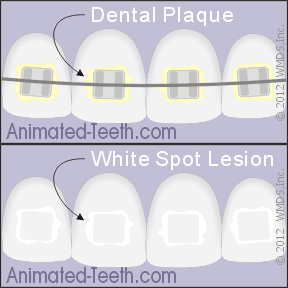
Post-orthodontic treatment white-spot lesions.
Even in those cases where these areas don’t transform into full-fledged cavities, once they have formed they can spoil the appearance of teeth.
Research – How using a powered brush can benefit people wearing braces.
In a study by Ho, patients who wore dental braces and had gum inflammation (gingivitis) were broken into two groups. One group continued to brush with a manual toothbrush and the other was given a sonic brush to use.
The group that switched to a sonic toothbrush showed substantial improvement in the health of their gums, as evidenced by the following parameters:
- A reduction in the amount of supragingival (above the gum line) plaque. (This plaque in a location that could cause white-spot lesions.)
- A reduction in the total gram-negative bacteria found in subgingival (below the gum line) plaque samples. (Gram-negative bacteria are a type of bacteria that are typically associated with gum disease.)
- A reduction of pocket depth. (A pocket is a space between the gums and tooth where the bacteria that cause gingivitis can live undisturbed.)
- A reduction in the number of locations that bled on probing. (Probing is a way of measuring and evaluating gum tissue health. Any bleeding which occurs during probing indicates the presence of gum inflammation.)
▲ Section references – Ho
b) Debilitated or impaired persons.
There can be good reasons why an elderly, medically compromised, or physically handicapped person might make a good candidate for the use of an electric brush.
- It may allow them to brush independently. – Since electrics create an effective brushing motion on their own, using one requires much less dexterity than a manual toothbrush. This can make them ideal for elderly persons or those who are physically disabled.
- It can assist their caregiver. – People who take care of individuals who are unable to brush on their own can certainly benefit from using an electric when performing the oral aspect of their duties.
It will tend to make their task easier, help them in providing more consistent results, and will likely prove to be more effective.
Testing with a ‘trial’ brush first is a good idea.
Before purchasing an electric brush for someone else, please beware that the sometimes vigorous brushing action of powered units may seem quite unwieldy to some people. This is especially true in situations where the person is at a point in their life where they are less adept at changing to new situations.
Before you spend money on a high-end powered toothbrush, you might purchase either a low-end or even disposable electric. Not necessarily for long-term use but as a test, to see if the potential for even using this type of unit exists.
Brushes with high and low settings.
We’ll also point out that higher-end electrics frequently have a standard and lower-power setting. The performance of the low-power brushing action will generally be substandard to the higher one. But choosing it may make using the brush tolerable, whereas in full-power mode the brush’s motion is too vigorous to be accepted. (These lists of Sonicare and Oral-b models contain information about brush settings.)
(Our electric toothbrushes for senior citizens page discusses many of the issues special to the members of this age group.)
c) Brushing motivation.
Some people simply lack the motivation to brush. If so, an electric might just be what they need.
1) Electrics can be fun to use.
There clearly is a novelty effect associated with using a powered brush. And we don’t mean just for kids. There can be an aspect of using one that is fun or different. And because of this, a person will sometimes brush longer, more frequently, or both.
- Biesbrock reported that the introduction of an electric toothbrush into the oral hygiene routine of adolescents and adults alike produced brushing behavior that lasted 1/3 longer than when these same study participants brushed manually.
2) You can often just feel the difference.
Problem brushers may take a greater interest in brushing if they see evidence that using their electric is creating better results.
Their teeth may feel slicker and cleaner than ever before, an improvement in the health of their gums may be evident, or possibly they will notice a reduction in the amount of staining that they see on their teeth.
3) People tend to continue to use their electric brushes.
A study by Stainacke evaluated responses from 120 persons who had purchased an electric toothbrush at some point during the previous three years.
- 62% of these owners reported that they used their brush daily.
- Only 3% of the respondents stated that they had ceased to use it totally.
▲ Section references – Biesbrock, Stainacke
That suggests that buying a powered toothbrush is usually money well spent.
d) Gum disease.
Another reason to consider getting an electric brush is because they’ve been shown to help improve the oral health of those persons who have periodontal disease (gum disease).
As an example, one study (Robinson) conducted a six-month evaluation of dental patients who had periodontitis (an advanced form of gum disease).
Two electric brushes were chosen for this study, one a sonic and the other a conventional rotary type. The effectiveness of these brushes was evaluated at 2, 4, and 6-month intervals.
- Each of these evaluations determined that the use of either type of brush produced significant reductions in the amount of dental plaque found on the surfaces of the participant’s teeth.
- The overall health of the participant’s gums improved over the course of the study with the use of either brush (as measured by reduction in gingival inflammation, probing depth scores, and probing attachment levels).
▲ Section references – Robinson
e) Tooth stain.
When you discuss a tooth’s coloration, there are two different aspects you need to take note of and evaluate separately.
- Teeth have a baseline shade. – This is the color the tooth would be if its surface was perfectly clean. The mechanical action of brushing one’s teeth will have no effect on a tooth’s intrinsic color.
- Surface staining also affects the color. – Extrinsic stain lies on the surface of a tooth. This is the type of discoloration your dentist polishes off during cleanings.
Using an electric toothbrush should be able to keep this type of stain from forming.
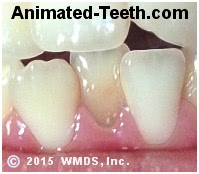
It may also be able to remove some of this type of staining too.
A powered toothbrush may be able to remove some surface stains.
Using an electric toothbrush may help to prevent surface stains from returning.
You may find that some of the staining that’s formed on your teeth is so heavy and stubborn that it can only be removed via a professional dental cleaning.
However, once it has been removed, using your electric brush diligently should help to prevent, or at least minimize, its return. And just like above, if you have a problem area, make sure you brush for an additional few moments in that region every time you brush.
f) Oral conditions that make effective brushing difficult.
Some people have unique situations that make effective brushing a challenge. If so, a powered toothbrush may be able to provide the assistance they need.
As an example, having crooked teeth can make it more difficult to brush effectively. So can dimples, pits, and fissures in the surfaces of teeth. Other difficulties include teeth with gum recession and some types of dental restorations (such as bridgework and dental implants).
Don’t bother buying an electric toothbrush for these purposes.
a) Bad breath.
Using an electric toothbrush probably isn’t going to cure your bad breath.
Yes, bad breath is caused by bacteria. And more effective tooth brushing will help to reduce the number of them in your mouth. But the vast majority of bacteria that cause bad breath live on a person’s tongue, in between their teeth, or below their gum line.
You’ll do far more to improve the quality of your breath by using a tongue scraper and dental floss than by just improving your tooth brushing effectiveness.
Also, electric toothbrushes have not been demonstrated to be more effective at tongue cleaning than manual toothbrushes, or the inexpensive tongue scrapers you see in your local store.
b) Teeth whitening.
As explained above, using an electric brush may be able to lighten your teeth by way of removing accumulated surface staining. But it will never be able to actually change the baseline color of your teeth. That can only be accomplished via the use of bleaching treatments (usually the application of some type of peroxide compound).
Last reviewed: January 11, 2025
Author: Paul Cotner, DMD — retired dentist.
Published by: WMDS, Inc. — owner of Animated-Teeth.com.
Educational information only — not a substitute for professional dental care.
Page references sources:
Adam R, et. al. Evaluation of an oscillating-rotating toothbrush with micro-vibrations versus a sonic toothbrush for the reduction of plaque and gingivitis: results from a randomized controlled trial.
Biesbrock AR, et al. The clinical effectiveness of a novel power toothbrush and its impact on oral health.
Clark-Perry D, et. al. Systematic review and meta-analysis of randomized controlled studies comparing oscillating-rotating and other powered toothbrushes.
Goyal CR, et. al. A 6-month randomized controlled trial evaluating a novel smart-connected oscillating-rotating toothbrush versus a smart-connected sonic toothbrush for the reduction of plaque and gingivitis.
Ho HP, et al. Effectiveness of the Sonicare sonic toothbrush on reduction of plaque, gingivitis, probing pocket depth and subgingival bacteria in adolescent orthodontic patients.
Mirza F, et. al. A Comparison of the Effect of Two Power Toothbrushes on the Reduction of Gingival Inflammation and Supragingival Plaque.
Robinson PJ, et al. A six month clinical comparison of the efficacy of the Sonicare and the Braun Oral-B electric toothbrushes on improving periodontal health in adlult periodontitis patients.
Saxer UP, et al. New studies on estimated and actual toothbrushing times and dentifrice use.
Stainacke K, et al. Compliance in the use of electric toothbrushes.
Starke M, et. al. A Comparison of the Effect of Two Power Toothbrushes on the Gingival Health and Plaque Status of Subjects with Moderate Gingivitis.
van der Weijden, et al. A comparative study of electric toothbrushes for the effectiveness of plaque removal in relation to toothbrushing duration.
Yaacob M, et al. Powered versus manual tooth brushing for oral health (Review).