Looking for information about other Dental Topics?
Full Website Index• Animated-Teeth.com •

Which are the best Sonicare toothbrushes models?
This page walks you through a process we’ve been using for a number of years now to compare and then single out those models in the Sonicare toothbrush lineup that seem to make a best-buy choice in terms of value (features and function vs. price).
(If you’re interested, we offer this same type of comparison process for Oral-B rechargeables.)
The method we use to pick the best Sonicares.
Step #1 – We take a look at all of the models that are currently available.
As you probably know, Sonicare has organized its toothbrushes into product lines (Prestige, DiamondClean, FlexCare, etc…). And in doing so, you’d expect that the member models of each line share a core set of basic features and capabilities.
In many instances, this is true. And often, the difference between two brushes having different model numbers is as minor as the color of the brush’s handle.
Unfortunately, with other lines (the ProtectiveCleans are especially egregious in this regard), the features and capabilities of individual models are so disparate that it’s hard to understand how they are related at all.
So, as an initial task, we look at the entire lineup of Sonicare models. Take note of what features each one has. And then, when considering the entire range of Sonicare toothbrushes, figure out where each fits in.
Where do we get our information?
The sole source we use for model information comes directly from Sonicare, via their (USA) website, promotional leaflets, user manuals, and support representatives (chat, email & telephone).
Related page ► A comparison of the features of the individual Sonicare toothbrush lines.
Step 2 – Once we know what features are available, we then form an opinion about them.
While we do have high regard for the Sonicare brand, we’re hardly Sonicare Kool-Aid drinkers.
- We are avid believers that some of the features that their toothbrushes offer do provide a credible benefit for the user and therefore are important to have.
- But the keyword in that statement is “some.” Because we feel just as strongly that others do not, and that just piling on additional (frivolous, superfluous) features doesn’t make a brush better, just more expensive.
So, after we’ve determined exactly what features are available, we look for reasons why we should feel that each one is important to have.
We also look through dental literature.
We actually do read through published research studies to see if we can find documentation of a feature’s benefit or worth. After all, if Sonicare’s in its advertising harps on end about a feature, we’d like to think that that hype is based on some level of actual scientific evidence.
It’s been our experience that it’s easy to document the importance of having a brush that offers Sonicare’s full-power hallmark brushing action (the Clean setting on most brushes). But beyond that, evidence documenting the benefit of other features is substantially more limited.
Dental instinct.
To fill in where we’ve found scientific documentation lacking, a lot of what we formulate our opinion on is simply “dental instinct.”
Ask any dentist. It’s easy for a dental professional to see through the claims touted for some toothbrush features. The way a word is used, or a sentence is phrased. And when we notice this kind of “truthful untruthfulness,” we don’t hesitate to sound off about it on our pages.
Step 3 – We also factor in perceived toothbrush quality and reliability.
As it turns out, just comparing features isn’t really all that’s needed when trying to pick out the best Sonicares.
As noted on our Sonicare Toothbrush Lines page, there’s an amazingly large price difference between the top and bottom Sonicare models (over 20 fold). And realizing that factor alone, it’s easy enough to expect that while some brushes may share some similar features and specifications, they’re probably not really equals in terms of design, build quality and user experience.
Judging model quality and reliability.
We won’t pretend that we run dozens of each of Sonicare’s models, for weeks on end, to evaluate their reliability. We would like to think that Sonicare does do that kind of testing. But even if so, we don’t know of any source for that information.
We will say that we’ve been using Sonicares for the past 25 years and reporting about them here on our pages for over 15. So we do think we’re a pretty good judge of comparative Sonicare model build and quality. But admittedly, how that corresponds with the issue of reliability is certainly a question.
In lieu of hard evidence, we do what everyone else does. We turn to online reviews found on retailer websites and look for what’s reported by owners about their experiences. Especially those who have owned Sonicares before.
Bottom line, we don’t feel that the data we have can be used in stating which specific Sonicare models are the most dependable ones. But we do think that this input can certainly help to identify the clunkers. So we bring it into our mix.
Related page ► Sonicare vs. Oral-b: Whose toothbrushes are more reliable?
Step 4 – With all of the above considered, the last step is to simply sort through the Sonicare lineup and pick out the best ones based on those issues.
Performing that process is what’s outlined on the remainder of this page.
Our Sonicare quiz – A quick way to learn the important points from this page.
https://www.animated-teeth.com/?p=774#quiz
Which models did we include in our evaluation?
We included all of the brushes we found listed on the Philips Sonicare (USA) website on June 4, 2021. This includes brushes found in each of these Sonicare toothbrush lines.
- 9900 Prestige
- DiamondClean Smart (Including: 9700, 9500, 9300)
- DiamondClean
- ExpertClean (Including: 7700, 7500, 7300)
- FlexCare Platinum Connected
- FlexCare Platinum
- FlexCare+ (plus)
- HealthyWhite+ (plus)
- ProtectiveClean (including: 6500, 6100, 5300, 5100, 4300, 4100)
- Sonicare for Kids
- 2 Series Plaque Control
- DailyClean (2100)
- Essence
- EasyClean
- Philips One
(If you’d like more information about the differences between each of these lines, use this link.)
Our comparison process for picking out the best Sonicares.
Setting the criteria.
- Feature Sonicare’s hallmark 62,000 brush-movements-per-minute brushing action (you’ll learn about this in our next section) …
- Have a majority of the basic core functions discussed below but as few additional features as possible (as you read on below, we explain why we feel many of Sonicare’s most promoted features aren’t necessities at all) …
- Cost as little as possible. (However, it’s our opinion that you tend to bet a better brush and brushing experience if you don’t go too far toward the bottom of the Sonicare lineup. A cut-off at around $100, plus or minus, tends to make a safe choice.) …
- And seem to have a reputation for performance and reliability.
- A balance between features and price. After all, why buy more toothbrush than you really need?
- A recommendation for brushes that should make a good choice, in the sense that people who own them seem to be satisfied that they’re good products and do a good job.
Sonicare’s hallmark brushing action. – The most important feature.
You may not be aware of this fact but the whole reason to buy a Sonicare is because of its full-power 62,000 brush movements-per-minute brushing action. (Historically, Sonicare has stated this as the equivalent 31,000 brush strokes/minute.)
Sonic brushes generate a cleaning effect beyond where their bristles actually touch.
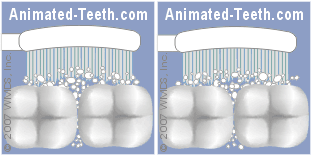
Why is this brushing action so important to have?
- As a primary cleaning action, toothbrush bristles scrubbing against the surfaces of your teeth at this rate of speed constitute a very effective brushing motion.
- Additionally, brush vibrations at this (sonic) frequency are also able to create a secondary (not as effective but still valuable) cleansing action that extends beyond where the brush’s bristles actually touch. (Yes, beyond.)
This secondary cleaning effect is termed “fluid dynamics” and it’s something that sets a sonic brush apart from other electrics. (If you’d like to read more about how sonic toothbrushes work, use this link.)
Which models offer Sonicare’s hallmark setting?
This used to be a very simple criterion for us to report about. But currently, we find we have concerns about the information that the Sonicare (USA) website contains because it seems to contradict what’s been stated there in previous years.
We can report with confidence that these toothbrush lines do feature Sonicare’s 62,000 brush movements-per-minute brushing action …
So these models are still candidates in our “best Sonicares” evaluation.
And can state with confidence that these lines don’t … and therefore are no longer in contention in our evaluation.
(If the DailyClean is really just the old Essence+, which we think it possibly may be, we would instead place it in the group below.)
And these models lie in question to us … and therefore have been cut from contention in our evaluation.
2 Series plaque control, Essence, EasyClean
Our concern – This last group of toothbrush lines includes ones that in previous years Sonicare has reported do feature their hallmark 31,000 brush strokes/minute (equivalent to 62,000 brush movements/minute) brushing action but currently do not. (A fact that seems questionable to us.)
But we don’t consider not including these lines to be all that much of a loss – That’s because these are some of Sonicare’s lowest-end models. And as such, it’s our impression that most users, especially those who have owned Sonicares before, are more favorably impressed with the brushing experience delivered by the models still included in our evaluation. And some of these have a low price too.
Sonicare features we tend to feel aren’t needed, or don’t offer much value.
a) The UV brush-head sanitizer – Hype not science.
- Rather than growing in availability, it’s been faded from the FlexCare line (where it originally premiered). It is, however, featured on one ExpertClean model.
- It’s not a feature offered on any of the models of the newer, higher-end Prestige, DiamondClean or DiamondClean Smart product lines.
We’d take that as evidence that consumers generally didn’t find it to be an especially important feature or good value.
We have always stated on our pages that we see no purpose for it. We based our opinion on that of the US Centers for Disease Control and Prevention (CDC) whose website states that toothbrush sterilization holds little benefit.
So, another model must come off our list.
Since one of our core comparison criteria is not to include toothbrushes that have unneeded options, we’ll go ahead and scratch the ExperClean model that has the UV sanitizer off our list.
b) The Sonicare smartphone app – We just don’t feel that this is a must-have.
We really do think that Sonicare did a good job with their smartphone app. Especially as implemented with the Prestige, DiamondClean Smart and FlexCare Platinum Connected lines.
But we primarily only see the app as a brushing discipline or motivational tool. (Having it doesn’t make the toothbrush brush better. It makes you brush better.) And if you are seeking that type of assistance, having it may make a good choice.
But in terms of identifying best-value models for people who just need a good effective electric toothbrush, and not really any coaching, it’s hard to justify this option.
So in light of that opinion, at this point, we’ll also mark the remaining ExpertClean models off our list, as well as the Prestige, DiamondClean Smart and FlexCare Platinum Connected brushes too.
c) Multiple brushing modes – What’s the purpose?
You couldn’t have found a website that has less faith in the importance of the various (and ever-changing on each new model) Sonicare brushing modes.
Just one mode (Clean) is all most people need.
We do think that a Sonicare toothbrush can be a valuable product to own. But just for one main reason, its full-power 62,0000 brush-movements-per-minute brushing action. This is labeled as “Clean” mode on almost all models.
Yes, we’ll concede that a few people may have special circumstances (like the need for a “sensitive” mode, or reduced-intensity setting). But these cases are the exception. For the vast majority of users, the best, most effective, most efficient brushing mode they can use is their brush’s constant full-power one.
- This is the brushing action that Sonicare invented and has built its reputation on.
- This is the mode that has been used to establish the benefits of using sonic toothbrushes in scientific research.
(Related page: Oral-b or Sonicare: Whose brushing action is more effective?)
- Read your brush’s manual. Many literally state: “When the Philips Sonicare is used in clinical studies, the default 2-minute Clean mode with high intensity must be selected.”
To us, that’s confirmation of how valuable using this mode is. When studies are performed, Sonicare only wants its most effective brushing action used.
(We explain the basis of our opinion in further detail on this page.)
It’s only human nature that you won’t really use all of the modes.
We find it hard to believe that over the long-term a brush’s multiple brushing mode options will continue to be used.
We’d anticipate that even those people who originally enjoyed this novelty will have long since forgotten that these options exist once the newness of their brush has worn off.
It’s not so much that we think a brush shouldn’t have multiple modes, we just wouldn’t buy one specifically because it does.
We do have to note, however, that as mentioned elsewhere on this page, we do feel that there are some advantages to purchasing a mid-range Sonicare as opposed to the lowest-end ones (better build, design and brushing experience).
And those models characteristically do feature more than one brushing option. So in practice, totally escaping this point isn’t entirely possible.
Trimming a few more model lines from consideration.
Prestige, DiamondClean, FlexCare Platinum, FlexCare+
Note: We’re not suggesting that these aren’t good toothbrushes.
We want to point out that we consider all of the higher-end Sonicare models that we’ve nixed so far from our evaluation (Prestige, DiamondClean Smart, DiamondClean, FlexCare Platinum Connected, FlexCare Platinum, FlexCare+, ExpertClean) to be superior brushes.
And if their expense was not a consideration, all would make excellent choices. But in terms of a best-buy (in terms of features, performance, AND price), we don’t consider them contenders.
Basic features that are common to most Sonicares.
HealthyWhite+, ProtectiveClean, Sonicare For Kids
(The lower-end models have been culled from consideration because they aren’t reported as having Sonicare’s hallmark brushing action. And we’ve decided, rather arbitrarily, that the higher-end lines don’t really represent a best-buy opportunity, based on their high prices and an overabundance of features.)
As a last section of FYI details, the remaining group of brushes still being considered in our best-Sonicares evaluation has the following features in common.
- SmarTimer (or KidTimer) – All of the models come with a 2-minute brushing timer.
Some people like having a timer because it helps them to achieve a higher level of brushing discipline. Others find them annoying because they may turn the brush off before they feel they have been able to complete their brushing duties. (This feature typically cannot be deactivated.)
- Quadpacer (or KidPacer) – This is basically a brushing timer too. It signals four times as you brush your teeth, indicating when you should move on to cleaning the next quadrant of your mouth (UL, UR, LL, LR).
- Excessive pressure indicator – The brushing action of all Sonicare models will tend to stall when the user applies too much force. And then beyond that, the ProtectiveClean models offer a dedicated excessive pressure indicator.
We’re of the impression that studies tend to show that the use of excessive pressure isn’t generally a major concern with Sonicare use. And for that reason, we don’t place great emphasis on having this type of feature. (More about Sonicare brushing pressure indicators.)
- Easy-Start – The Easy-Start feature helps you get used to the vigorous nature of a Sonicare by gradually ramping up its power over a period of several brushing sessions. (The Sonicare For Kids does not have this feature.)
- A charging unit that can run on both 110 and 220 volt electrical systems.
This capability can be an important one for world travelers. However, you will need plug adapters for the various types of outlets you encounter.
Some model differences.
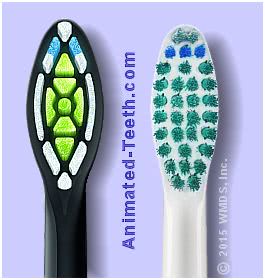
Sonicare DiamondClean and original ProResults brush heads.
a) Brush heads.
(We discuss Sonicare brush head options in greater detail on this page.)
b) Battery type.
Sonicare rechargeable models come with either a NiMH or Lithium-ion battery. A Lithium-ion one offers some advantages:
- Due to its smaller size, the handles of models that have one tend to be lighter and sleeker.
- The nature of this type of battery offers some performance and recharging advantages.
To us, the battery type isn’t an insignificant consideration. But if a particular model met our needs in all other ways, we’d let this one slip by. However, as a point of convenience, it just so happens that all of the models we’re still considering have a Lithium-ion one.
(This page discusses the subject of battery options in greater detail.)
Our Best-Sonicare list.
HealthyWhite+, ProtectiveClean, Sonicare For Kids
For each, we list what distinguishes that line from others. More importantly, we also provide a link to our Sonicare Toothbrush Lines page where you can learn specific details about that group of brushes.
Have questions?
If you have a question about something you read on this page, or Sonicare models in general, leave a comment below and we’ll see if we can get an answer for you.
Double-check brush features before you buy.
We’ve gone to a lot of effort in compiling this information, trying to make sure we got everything right. But before you buy, do us a favor and just double-check what we state against the packaging or description of the actual product you plan to purchase. We don’t want you to be disappointed.
You may have an out if you’ve made a poor choice.
Philips Sonicare has traditionally offered a 90-day money-back guarantee with their toothbrushes, allowing you to return yours if you’re unsatisfied with it.
Obviously, we don’t speak for Philips. So if having this option is important to you, use the link above or read the packaging of the product you’re considering before making your purchase, just to make sure you have all of the details straight.
The best Sonicare toothbrushes – From highest MSRP to lowest.
Per all of the discussion above on this page, we think it’s easy enough to make the case that the following Sonicares make the best choice when features, function and price are all taken into consideration.
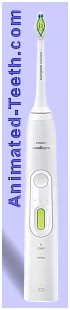
Sonicare Healthy White+ HX8911/02
► The Sonicare HealthyWhite+ (plus).
Brushing experience vs. cost.
That’s because we think that within their lines, a model’s price makes a reasonably good proxy for its level of design, build quality and refinement (all of which directly influence the user’s brushing experience). (Right around $100, plus or minus, seems to be the comfort spot for us in regard to this issue.)
Based on the comments we’ve seen posted on both our own and retailer websites, it seems to us that the HealthyWhite+ is one that most purchasers are happy with.
First-time Sonicare buyers, and those who previously owned lower-end models, are usually favorably impressed. Those who previously owned higher-end models seem to notice a difference. But in light of the substantially lower price they have paid, find it understandable and just minimally objectionable.
Reliability.
With the current era’s emphasis on planned obsolescence and lowest-possible-cost manufacturing, we don’t consider the electric toothbrushes made by any brand, including Sonicare, to be notably reliable. And feel that what any one owner can expect to experience in terms of product longevity/reliability to simply be a roll of the dice.
Reliability vs. cost.
We also don’t really feel that spending more on a Sonicare improves the owner’s outlook substantially. (This is easily confirmed by reading reviews on retailer websites.)
All of this simply means that only you can determine at what price point you should buy. If you feel that the sting of having a brush die prematurely would be too great at this level, we discuss cheaper models below that we feel can make a reasonable choice too.
Details about the HealthyWhite+.
The features that the HealthyWhite+ shares with the other “best Sonicares” below have been outlined above.
This brush differs from others by way of having:
- 2 brushing modes and 3 intensity settings.
- A (non-charging) travel case.
- Sample promotional leaflet: HealthyWhite+ toothbrush.
The following link provides a full outline of the HealthyWhite+’s features, more opinions from us about it, and information about other Sonicare lines for comparison.
Review ► HealthyWhite+ – Features, details, comparisons to other Sonicare lines.
► The Sonicare ProtectiveClean.
Regular MSRP range: $170 to $50.
Associated model numbers: HX6877/84, HX6877/41, HX6877/21, HX6876/21, HX6871/49, HX6871/41, HX6857/11, HX6853/11, HX6850/60, HX6829/71, HX6817/01, HX6815/01, HX6810/50, HX6809/81, HX6481/13, HX6481/12, HX6481/11, HX6463/50, HX6462/05, HX6462/06, HX6461/04, HX6423/34
This is a comparatively new Sonicare line. When we first started reporting about this line, we were generally leery of it. That’s because Sonicare has a history of introducing new models to meet specific price points in their lineup, and in some cases, we haven’t been so favorably impressed by them.
Now, with a longer history, we feel more comfortable with the ProtectiveCleans. And the statistics found on retailer websites seem to confirm that owners tend to consider these reasonable brushes.
There are a plethora of ProtectiveClean models.
This toothbrush line has a number of member models the 6500, 6100, 5300, 5100, 4300, and 4100). And each one of them has its own unique features list and price, which makes keeping things straight about this line difficult.
The 6500.
At a price of $170 (MSRP), and considering that the lesser models also have the brushing action we feel that’s important to have, we don’t really consider the 6500 to meet the criteria of a best-value toothbrush.
The 6100.
The typical price for the 6100 is $120 (MSRP), which puts it slightly above the HealthyWhite+.
A part of the expense of this model seems to be due to its having BrushSync (brushing mode pairing, brush head replacement reminder) and advanced sensing (brushing pressure sensor) capabilities, which are features that we don’t feel add much value.
We’ll also point out that for the first two functions to work, the microchipped BrushSync type of Sonicare brush head must be used, which means an added expense with owning this brush. (For more details, see our BrushSync Explained page.)
The 5300 and 5100.
With a reduction in its number of features and a cost in the range of $90 to $100 (MSRP), these models fall back into what we consider best-value territory. And it still resides at a level within the Sonicare lineup (low end of the mid-range models) where we feel brush design and build quality aren’t terribly compromised.
Once again, it must be pointed out that for this model to function fully (brush replacement feature) it must be used with the more expensive BrushSync brush heads. (So owning a HealthyWhite+ would likely prove less expensive in the long run.)
The 4300 and 4100.
With MSRP’s in the range of $50 to $70, these models fall into that category where we have concerns about the refinement of the user’s brushing experience. This would tend to be most notable to previous Sonicare owners, especially those who have used high-end models.
However, new-to-Sonicare users may find this brush to be an improved experience over their current situation. (We will state that online reviews seem to suggest this.)
Details about the ProtectiveClean models.
The features that the ProtectiveCleans share with the other “best Sonicares” on this page have been outlined above.
These brushes differ from others (depending on model) by way of having:
- 1 or up to 3 brushing modes. 0 or up to 3 intensity settings.
- Requires the use of BrushSync (microchipped) brush heads for full functionality.
- Excessive brushing pressure sensor. (We don’t feel strongly about a need for this feature. But we will note that this is the only one of our best-value lines that has it.)
- Brush head replacement reminder. (We consider visual inspection to be a perfectly adequate way to evaluate the status of a brush head.)
- BrushSync brushing mode paring (6500, 6100). (The brush automatically switches to the brushing mode matched to the installed brush head. Without this feature, you would simply switch modes manually, if you chose to do so at all.)
- Not all models come with a travel case, so take note. The 6500 comes with a USB charging travel case.
- Sample promotional leaflet: ProtectiveClean toothbrush.
The link below provides a full outline of the ProtectiveClean line’s features (according to model), more opinions about the line from us, and information about other Sonicare lines for comparison.
Review ► ProtectiveClean – Features, details, comparisons to other Sonicare lines.
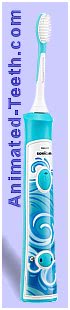
Sonicare For Kids HX6321/02
The Sonicare For Kids.
Details about the Sonicare For Kids.
The features that the For Kids shares with the other “best Sonicares” on this page have been outlined above.
This brush differs from others by way of having:
- A single (preset) brushing mode and two brushing intensity settings (High, Low).
- KidTimer and KidPacer (features that correspond to SmarTimer and QuadPacer found on other Sonicares).
- This line supports integration with a smartphone brushing app. (This is more limited than Sonicare’s app for “adults.” However, it does aid with brushing fun and motivation, and tracks brushing sessions.)
- This line does not feature the EasyStart function.
- No travel case is included.
- Sample promotional leaflet: Sonicare For Kids toothbrush.
The link below provides a full outline of the Sonicare For Kids line’s features, more opinions about the line from us, and information about other Sonicare lines for comparison.
Review ► Sonicare For Kids – Features, details, comparisons to other Sonicare lines.
If you’re an adult considering using a For Kids.
There’s no question that everything about this brush is focused on children. That includes the way it looks, and the way its timers (which you can’t turn off) function and sound. (So familiarize yourself with them before buying.)
As one of Sonicare’s models that utilize click-on brush heads. An adult using this brush will be able to choose from any of Sonicare’s line of click-on heads. Not just the ones designed for children.
What about the other Sonicare models?
Higher-end Sonicare lines.
Except for their price, we don’t think you can go wrong with buying any of the higher-end Sonicare models. They are generally exceptional toothbrushes (design, build quality, brushing experience), they’re just not best-buys in terms of value (features and function vs. price).
Additionally, as a reminder to what’s stated above, we don’t really feel that spending more for a Sonicare brings you any substantial benefit in terms of improved product reliability or longevity. That, in our opinion, still remains a wild card with all lines and models. And if you’ve chosen to buy one that’s comparatively more expensive, it will just sting that much more if it dies prematurely.
Lower-end Sonicare lines.
Purchasing low-end models can be problematic. We feel that even in the $70 to $50 range that the brushes seem to noticeably operate more crudely, and don’t deliver the same polished brushing experience that even the $100 to $150 brushes do.
And based on the primary tenant of this page, we wouldn’t consider buying any Sonicare model that can’t be documented as featuring their full-power, 62,000 brush-movements-per-minute brushing action. And at this point in time, it seems that many of them don’t, or at least can’t be confirmed that they do.
What to read next?
If you have any questions about the features of any of the models mentioned on this page (which you should), our “Review of the Sonicare toothbrush lines” page will likely answer them.
[Philips and Sonicare are registered trademarks of Koninklijke Philips Electronics N.V. Easy-start and QuadPacer are registered trademarks of Philips Oral HealthCare, Inc.]
Last reviewed: June 05, 2021
Author: Paul Cotner, DMD — retired dentist.
Published by: WMDS, Inc. — owner of Animated-Teeth.com.
Educational information only — not a substitute for professional dental care.
Page references sources: