Looking for information about other Dental Topics?
Full Website Index• Animated-Teeth.com •

Comparing Porcelain Veneers vs. Dental Crowns – When should one or the other be placed?
Porcelain veneers or crowns, which makes the right choice for your smile?
When explaining details about smile makeover cases on our website, we often mention that either dental crowns and porcelain veneers could be used to achieve the same cosmetic result.
However, while both do enhance a tooth’s appearance, they are fundamentally different kinds of dental restorations in terms of structure, construction, application, and purpose. Understanding these differences is essential in determining which offers the most suitable option for a dental case.
What you need to know.
This guide explores the key distinctions between crowns and porcelain veneers, detailing how they function, the types of cases they are best suited for, and the factors that influence a dentist’s decision when making a recommendation for your smile.
What is the difference between a dental crown and porcelain veneer?
Probably the easiest way to explain the difference between these two is to give you their definitions. (We’ve taken the following from a dental procedures textbook.)
- Crown – “a dental device used to cover the whole of a tooth” …
- Veneer – “a dental device used as a ‘false front’ to a tooth” …
(Hollins)
So as a start, and as our animation illustrates, a fundamental difference between a veneer and a crown is the extent of the tooth that it becomes.
- Crowns cup over and encase their entire tooth (meaning all of that portion that lies above the gum line). It becomes the tooth’s new outer surface.
- In contrast, veneers are bonded onto the front side of teeth (the side you and other people see). They literally are a veneering (thin layer of material covering over a substrate).
Crown vs. Veneer
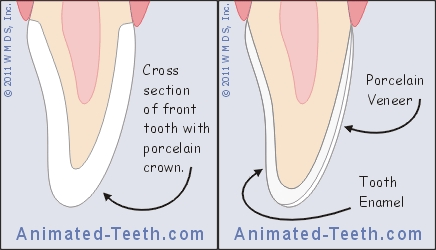
A crown encases the entire tooth, a veneer just its front side.
What are other basic differences?
While looking at our animation you probably noticed how different in size veneers and crowns are. One replaces a substantial portion of the tooth. The other is just a sliver that’s attached to its front side.
And as you might expect, that means the type of functions these two kinds of restorations are intended to provide, while overlapping in some regard, are substantially different.
To complete the Hollins definitions:
- Veneers are used … “usually to hide discolouration or to alter the shape of a tooth.”
- Crowns are used … “to strengthen the remaining tooth structure or to improve the aesthetics.”
▲ Section references – Hollins
So to recap their differences …
… but this time using more of our own words:
- Crowns cup over and encase their entire tooth, and therefore are a way of rebuilding teeth. And due to the nature of the materials that can be used in their fabrication, these restorations are frequently used to simultaneously strengthen and improve the appearance of the teeth they’re placed on.
- In contrast, veneers are a sliver of dental restorative (we discuss porcelain on this page) bonded onto the front side of a tooth solely to make a cosmetic enhancement (relatively minor shape or color improvements).
So now you know. The rest of this page discusses technical differences between the two, and best-practice applications for each.
Comparing Crowns and Porcelain Veneers.
a) Crown placement requires more tooth reduction.
Making a dental crown for a tooth requires a significant amount of tooth trimming.
When a dentist prepares (trims) a tooth for crown placement The procedure outlined., it’s reduced in size and shape down to a tapered nub.
The idea is when the crown is cemented, it becomes the tooth’s new outer surface. (That’s why a crown can be used to make substantial changes with both a tooth’s color and shape.)
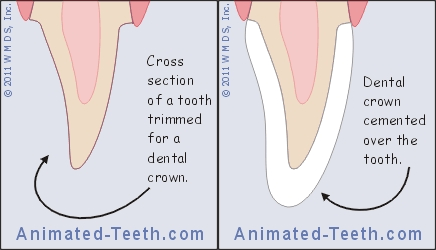
Placing a dental crown requires a significant amount of tooth trimming.
How much trimming is needed?
The amount of tooth reduction that’s required usually lies on the order of around 2mm. This is why. (FYI: 2 millimeters is just slightly more than one-sixteenth of an inch.)
- The 2mm measurement is based on the fact that most crowns need to be at least 2mm thick.
That’s both for strength and to allow for enough porcelain thickness to give a lifelike appearance.
- Since all-metal crowns are strong by nature, the amount of tooth trimming required for them is less (along the lines of 1.5mm).
How does that compare with veneers?
We ran across a pair of studies (Edelhoff) that measured how much tooth structure was removed when different types of restorations were placed.
Using that data, it’s easy enough to understand how much more aggressive the act of placing a dental crown is vs. a porcelain veneer. (We’ll discuss the importance of this issue later on this page.)
- Crowns – A preparation for this type of restoration typically involves trimming away 63% to 76% of the tooth’s anatomical crown (the portion of the tooth that lies above the gum line).
- Veneers – Minimal-prep porcelain veneers may only require 3% anatomical crown reduction. More extensive preparations may involve up to 30%.
- This data as a general comparison – Crown placement typically involves 2 to 4 times as much tooth reduction as laminates (veneers).
▲ Section references – Edelhoff, Edelhoff
b) Porcelain veneers are much thinner restorations.
Porcelain veneers are wafer-thin.
As you might have guessed from the tooth reduction figures above, crowns and porcelain veneers (typically) differ by way of their comparative thickness.
- Porcelain veneers are wafer-thin, with a thickness measurement usually around 1 millimeter or less.
- Dental crowns usually have a thickness of 2 millimeters or more.
Little to no tooth trimming is needed when a veneer is placed.
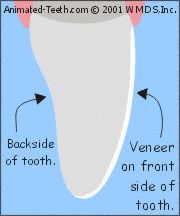
Less tooth grinding is required.
This means that significantly less tooth trimming is required when veneers are placed.
- Less reduction is needed on the tooth’s front side, where the veneer is bonded.
- Possibly no trimming is needed on the tooth’s backside. If any is, it should be just minimal.
- Actually, with some veneering techniques, no tooth reduction is needed at all How is this possible?.
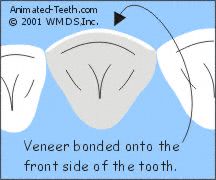
A veneer just covers the front surface of a tooth.
Why is that significant?
This is a very important feature of veneers. It means that as compared to crowns, when they are placed less healthy tooth structure is sacrificed.
- Philosophically, conserving natural tooth structure is the right thing to do. It alters your tooth as minimally as possible.
- Less trimming allows for a quicker, easier, more enjoyable placement process. (Compare procedures ► Porcelain Veneer vs. Crown.)
- Preserving tooth structure allows you more options later in life when your restorations need to be replaced. (Compare longevity statistics ► Crowns vs. Porcelain Veneers)
- The preparation process is less traumatic for your tooth, thus helping to avoid complications sometimes associated with crown placement. Like the need for root canal.
Comparing applications for crowns vs. veneers.
Crowns and veneers have their own individual set of characteristics that generally make one or the other more suitable for certain applications.
Here are some of the factors dentists take into consideration when determining which one makes the better choice for a patient’s case.
a) Applications for dental crowns –
- Can be used to produce a large color change for a tooth.
- Can create significant shape changes for a tooth.
- Can be used to improve the apparent alignment of teeth.
- Are often used to rebuild and strengthen teeth that are badly broken or decayed.
- Crowns are very strong and durable. They make a good choice in those situations where a tooth is exposed to heavy chewing or biting forces, or else forces created by tooth clenching and grinding (bruxism).
- Placing a crown requires a significant amount of tooth reduction.
- Once a crown has been placed on a tooth, it will always require one.
As you’ll see in the next list, as compared to crowns that can be used to rebuild and strengthen teeth, porcelain veneers are typically used in applications that are just cosmetic in nature.
b) Applications for porcelain veneers –
Dental crowns vs. Porcelain veneers.
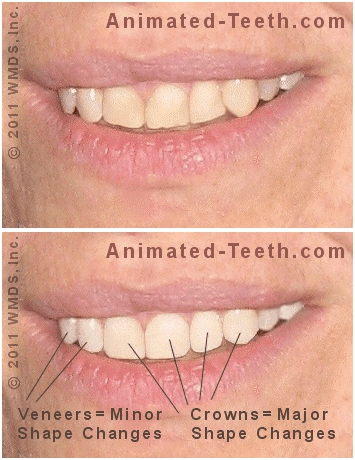
Crowns are stronger restorations and used to make more significant tooth changes.
- Can be used to produce a color change for a tooth. Slight to moderate changes usually give the most life-like results.
- Can create minor shape changes for a tooth or cover over surface irregularities.
- Can be used to improve the apparent alignment of teeth. (Instant orthodontics. How it’s done.)
- Are placed on teeth whose underlying tooth structure is generally healthy and intact. Possibly can serve as a replacement for aged white fillings.
- Require much less tooth trimming than dental crowns. Some veneering situations may require no tooth reduction at all.
- Are strong but brittle. Porcelain veneers typically do best in those situations where the forces placed upon them are relatively light or passive.
- In some special instances, porcelain veneer placement may be reversible. In most cases, however, once a veneer has been placed, the tooth will always require some type of covering. This might be another porcelain or other type of veneer, or else the tooth could be further reduced and a dental crown placed.
c) Times when crowns and veneers may barely differ at all.
There can be times when the distinction between what a dentist chooses to classify as an all-ceramic crown What’s this? vs. a ceramic veneer can be difficult to make.
Crown-like veneers.
There is a growing trend where dentists sometimes trim teeth they are veneering quite aggressively. (Cutting into them deeper, and on a larger number of their surfaces (sides), than outlined by the original, very conservative, protocol for this procedure.) It’s especially the multiple-tooth-surface aspect of the resulting restoration that makes it much more crown-like than the usual veneer.
The need for this type of zealous trimming is sometimes a symptom of the dentist applying veneering technique to situations not best suited for it. This would include using veneers to “straighten” severely misaligned teeth (“instant” orthodontics) or lightening very dark, extensively stained ones. (FYI: These types of cases are frequently plagued with longevity issues. Study findings.)
Veneer-like all-ceramic crowns.
Historically, the way a crown (fully) cupped over its tooth was an important consideration in aiding its retention (how well it stayed in place on its tooth).
Nowadays, adhesive dental cement (types of cement capable of creating a bond with both the tooth and crown) are available and can assist with crown retention.
Taking advantage of this fact, some dentists (for better or worse) choose to reduce the degree to which they trim a tooth. If so, the finished “crown” covers over the sides of the tooth less fully. The rationalization/justification associated with using this technique is that it makes crowning a tooth a more conservative procedure.
Last reviewed: February 02, 2025
Author: Paul Cotner, DMD — retired dentist.
Published by: WMDS, Inc. — owner of Animated-Teeth.com.
Educational information only — not a substitute for professional dental care.
Page references sources:
Edelhoff D, et al. Tooth structure removal associated with various preparation designs for anterior teeth.
Edelhoff D, et al. Tooth structure removal associated with various preparation designs for posterior teeth.
Hollins C. Basic Guide to Dental Procedures. (Glossary of Terms)
Sonis S. Dental Secrets. Chapter: Restorative Dentistry
Comments.
This section contains comments submitted in previous years. Many have been edited so to limit their scope to subjects discussed on this page.
Comment –
Crowns or Veneers
Hello,
I just had 2 consultations here in Philly today. I clench my teeth and the front four are worn and thin after 10 years of this. They also affect my speech since they are a bit sensitive at times. One dentist suggested 8 Lumineers across the top row of teeth but later after e-mailing questions I was informed that they are wrap around veneers “essentially crowns” she said.
The second dentist recommended 4 crowns on the top front teeth but said my teeth won’t be ground down to a nub. I’m leaning toward the crowns even though there’s a lot of tooth sacrifice regardless of what he said because I’ll still continue to clench my teeth and the crowns seem more likely to address functionality rather than appearance. Would you share your thoughts please?
Thank you,
Deb
Reply –
Hopefully the following will help you formulate more questions for your dentists.
We’re not entirely sure that what the two are offering are complete opposites, at least for the 4 teeth that evidently have the most wear.
One dentist says they’re placing veneers that wrap around the teeth so they’re almost full crowns. (But for all 8 teeth rather than just the 4 the other dentist plans to treat? If the other dentist thinks they can treat your situation by working on just 4 teeth, why do an additional 4 require veneering?)
The other dentist says they are placing crowns but not grinding the teeth down as fully as what might normally be expected.
Generally speaking we’d lean toward the crowns but are the planned ones all-ceramic ones? (They must be if the tooth will be ground down less and usual.) If so, not all types of all-ceramics are as strong as others. The ceramic used to create Lumineers (Cerinate) is known for it’s strength (a positive for the Lumineer “crowns”), as are some but not all types of porcelains used to make all-ceramic crowns.
Like you mention, your clenching habit won’t cease just because your teeth have been rebuilt. And the effects of your future grinding will simply affect the weakest link that remains (possibly breaking your new restorations, result in wear or breakage of the opposing teeth, or result in a loosening effect of your teeth).
So whichever dentist acknowledges this and has a plan for helping you to mitigate the effects of your grinding (usually by way of wearing some type of appliance, at night or even during the day if needed) would seem to us to be the one who has a better grasp of what’s needed to create a successful result.
Since you live in a large metropolitan area where no doubt some are available, we will mention a “fixed” prosthodontist is a type of dentist that specializes in just placing veneers, crowns and bridges. So if you think your case might be one that needs that level of expertise you might considering consulting with one.
Best of luck on this.
Staff Dentist
Comment –
Veneers v crowns
I have been advised that I will need seven implants,then 24 crowns…
I have missing teeth at the back on both sides..so I’m ok with implants,but my own teeth at top and bottom (at the front) are fairly ok I think..as crowns require a lot of fileing I was wondering if I could have both crowns and veneers..I would like to preserve my own teeth as much as possible..
I hope you can advise me..Thank you!
Anne K.
Reply –
There’s nothing wrong with dentist placing a mixture crowns and veneers on different teeth, assuming that each makes an appropriate choice for that tooth.
Here are some things to consider:
There can be times when there is a lot of grey area between what exactly is a crown vs. a veneer. So maybe your teeth won’t be trimmed quite as extensively as you imagine.
If dental insurance is involved, it’s probably to your benefit that the restorations are classified as crowns. (Porcelain veneers typically aren’t covered.)
The cost for veneers and crowns is usually about the same, so there’s no motivation for your dentist to recommend one over the other in that sense.
If you’ve just had front teeth for a while, they very likely may have experienced more wear and tear than you realize. A common location for this wear is the backside of the upper teeth, or the biting edges of the teeth (upper, lower, either, both). And for that reason the teeth really are best rebuilt with crowns.
Or if there is wear, there may be areas where a tooth’s enamel has been worn off entirely, therefore creating a situation where it’s more difficult to predictably bond a veneer.
Or your dentist may feel that the level of force associated with your bite on the front teeth (like if you have a habit of teeth clenching or grinding) makes placing porcelain veneers a less predictable choice.
Quiz your dentist, no doubt they can explain. Good luck.
Staff Dentist