Looking for information about other Dental Topics?
Full Website Index• Animated-Teeth.com •

Guide to Dental Post-and-Cores and Core Buildups – Why are they needed?
Cores and Post-and-Cores – What are they? Why are they needed?
Buildup?
and Core?
When a tooth has been weakened by decay, trauma, or the aftermath of root canal treatment its remaining tooth structure may not be adequate to support the crown that’s needed to rebuild it.
In such cases, a dentist will place a core or a post-and-core buildup to replace the tooth’s missing structure. Doing so creates the ideal foundation for the new crown, enhancing its stability and helping to ensure its long-term success.
This guide explains the differences between core-only buildups and post-and-cores, along with detailing when each option is necessary. It also provides insights into the materials used, cost considerations, and the expected longevity of these restorations. Having these details can help you in making informed decisions about the planning of your upcoming dental care.
Guide to Dental Cores and Post & Cores – What are they? Why are they needed?
A) What is a “core buildup”?
Placing a dental core refers to a procedure where a dentist replaces/rebuilds a large portion of a tooth’s missing or compromised “coronal” tooth structure, typically in preparation for making a dental crown for it.
(Coronal = that portion of the tooth that lies at and above the gum line.)
What is the purpose of placing a core buildup?
Teeth are sometimes missing a large part of their structure due to decay, fracture, the loss of a filling, or as a consequence of creating the access cavity needed for their root canal work. And this reduction in size and shape may not provide a suitable foundation for the tooth’s planned final restoration (crown or dental bridge abutment).
The placement of a core buildup restores a tooth closer to its original dimensions, therefore making it possible for the dentist to achieve a more idealized shape when preparing (trimming) it for its new restoration.
Why is a core buildup needed?
Background.
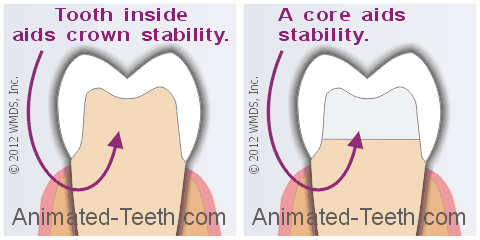
A great deal of a crown’s retention and stability (meaning how well it stays in place) depends on the amount of tooth structure that extends up into its interior.
A core replaces lost tooth structure that’s needed for crown stability.
If not enough tooth structure reaches into this space, the crown will be more easily dislodged by occlusal forces (chewing forces), especially those that have a lateral orientation (at an angle) component.
How a core solves this problem.
By first “building up” a broken down tooth with a core buildup (rebuilding the tooth so it’s closer to its original dimensions), the dentist can greatly increase the stability of the crown.
Once the core has been placed, the dentist has the optimal amount of structure (tooth + core) to work with. When shaping the tooth for its planned crown, they can optimize the degree to which it extends into the crown’s interior, thus improving the restoration’s long-term chances for survival (longevity) to the continual punishment of occlusal forces.
When, precisely, is a core buildup needed?
The need for this procedure is a judgment call made by the dentist about whether enough tooth structure currently exists. However, as a general rule of thumb, cores are typically only placed in situations where one-half or more of the tooth’s coronal tooth structure (the portion of the tooth that lies at and above the gum line) is compromised or missing.
▲ Section references – Shillingburg
What materials are used to make a dental core?
A core can be made out of any type of permanent dental restorative. In most cases, it’s either:
- Dental amalgam – the metal used to make “silver” fillings.
- Dental composite – Composite resin (dental bonding) like that used to make “white” fillings.
(Shillingburg)
How is a core placed?
The process of placing a core is generally the same as when the same materials are used to create a filling for a tooth.
FYI: We explain the process in greater detail on our Core Buildup Procedure page. Jump
Additional FAQ about dental cores.
Is a core buildup the same as a filling?
They are similar and are made using the same kind of dental materials but they each serve a different function.
A core buildup is placed for the specific purpose of allowing the dentist an opportunity to create the ideal foundation for a new dental crown. As such, a core won’t meet many of the criteria a filling must, such as the way it contacts neighboring teeth or teeth that bite against it. (The crown that’s placed over the core will meet these criteria, not the core itself.)
Does having a core buildup placed require a local anesthetic?
Yes, using a local dental anesthetic is usually needed Here’s why. to keep you comfortable.
B) What is a “post and core”?
A post & core, just like a core buildup, provides a way for a dentist to replace missing or compromised tooth structure so the shape of the tooth can be idealized as a foundation for the crown being made for it. However, this kind of restoration also includes the placement of a post inside the tooth that helps to anchor the core in place.
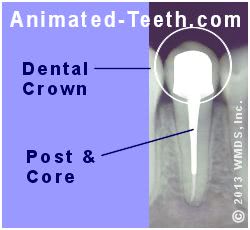
X-ray of a tooth that has a post & core and dental crown.
The post is cemented in the tooth’s root. Its attached core extends up inside the tooth’s crown.
While a dental core can be created for any tooth, a “post and core” can only be placed for a tooth that has already had root canal treatment. What’s this? That’s because the post (a small rod) is cemented inside one of the tooth’s root canals (the space previously occupied by tooth nerve tissue). (See picture below.)
When is a dental post needed?
As general rules of thumb:
- If more than half of a tooth’s original crown portion (the part of the tooth normally visible above the gum line) has been lost, a post is needed to assist with anchoring the core to the tooth.
- If more than half of the tooth’s crown still remains, it’s generally considered that enough tooth structure still exists that a core by itself will suffice.
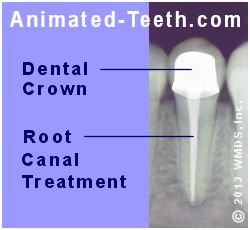
Enough of this tooth’s crown portion remained following its root canal procedure that no post was required.
FYI: Posts don’t strengthen teeth.
In decades past there was a misconception that metallic dental posts played a role in reinforcing (strengthening, providing fracture resistance for) the teeth in which they were placed.
On the contrary, dental research has since shown that posts provide no reinforcement benefit and in fact, can actually weaken teeth and therefore place them at increased risk for fracture. (Raedel)
Research.
Heydecke – This study determined that case failures where a post had not been placed were more likely to be “repairable.” (Meaning that procedures could be performed where the damaged tooth could still be salvaged.)
Failures involving a post were more likely to result in tooth extraction due to the damage involved (such as root fracture).
Willershausen – This study evaluated 775 endodontically treated (root canalled) teeth, some of which had been restored with a post and core.
- It was determined that as a group, these teeth had a complication rate of 6.6%. (This included events such as root fracture.)
- In comparison, the subgroup composed of just those teeth having metal posts had a complication rate of 13.2% (twice as high).
The findings above aren’t meant to suggest that post placement is a “bad thing.” However, a dental post should be recognized as just an aid in helping to anchor a dental core and provides no role in strengthening a tooth.
If enough natural tooth structure still exists (per the rules mentioned above), then no post is needed and for good reason, one should not be placed.
▲ Section references – Raedel, Heydecke, Willershausen
What are dental posts made out of?
Posts are fabricated out of a variety of materials. This includes metals such as stainless steel, titanium, or dental alloy. Other materials include zirconia (a ceramic-like material), engineered dental ceramic, glass fiber, or carbon fiber.
A post may be custom-made for the patient’s tooth by a dental laboratory. Or your dentist may select a prefabricated, standard-sized post and customize it before using it with your tooth.
How are post and cores placed?
- If the post is a separate object from the core (like when a prefabricated post is used), the post is cemented inside the tooth’s root canal space first and then the core is built up around it (not terribly unlike when a filling is placed).
- If both parts have been fabricated as a single unit (like a cast or milled post and core), then it is cemented into place.
FYI: We cover the topics of post construction and placement in greater detail on our Post and Core Procedure page. Jump
Additional FAQ about post & cores.
Is a dental post the same as an implant?
No. A dental post is cemented inside the prepared root canal space of a tooth that has had endodontic (root canal) treatment. Its sole purpose is to help anchor its attached core buildup to the tooth.
In comparison, a dental implant can be considered an artificial tooth root that fuses with bone tissue. An artificial tooth (a dental crown) is then placed over the exposed end of the implant.
You can learn more about Dental Implants using this link.
Does having a post and core placed require a local anesthetic?
Can a post and core be removed and replaced?
Yes, doing so is possible but unpredictable. When removing the post, there is some potential that the tooth’s root will be irreparably cracked. So, if a dentist can make use of a previously placed post & core, they usually will.
For some procedures, however, removal may be mandatory (like when performing root canal therapy re-treatment or removing advanced tooth decay).
Fees for core buildups and post & cores.
Here is an estimate of the fees your dentist might charge for the procedures discussed on this page.
Note: This fee is in addition to the cost of the final dental restoration (e.g. dental crown, dental bridge abutment) that will ultimately be placed on the tooth. It is also in addition to any endodontic procedure (root canal) that has been performed if that has been needed.
How much does a core buildup cost?
- Core (only).
$245.00 – $395.00
How much does a post and core cost?
- Prefabricated post and core.
$272.00 – $480.00(A prefabricated post and core is the type whose placement we describe on this page. The steps.)
- Cast post and core.
$328.00 – $550.00(A cast post and core is a one-piece unit that is custom-made in a dental laboratory and then cemented in the tooth. Placing one is a two-appointment process. While its construction is different, it serves the same function as a prefabricated one.)
About the fees we show.
Low fee = Small rural city or town.
High fee = Large metropolitan area.
How did we come up with these estimates?
Does dental insurance cover post and cores?
When covered, this procedure is usually categorized as a “major” dental service. Defined. As such, benefits typically run on the order of 50% of the procedure’s UCR fee. How this is calculated. To receive maximum benefits, the policyholder will need to have met their plan’s deductible.
If your plan covers dental crowns, it probably covers post and cores too.
Common insurance limitations.
- Some plans don’t cover cores alone (as in without post placement).
- When covered, these procedures typically carry the same general restrictions Examples. that the policy involved applies to dental crowns. This can include waiting periods, age restrictions, and limitations on replacement.
- Coverage for post and cores may be limited in frequency (as in one per tooth per 5-year period).
How much does your dentist pay for a post and core?
There are a lot of procedures in dentistry where the cost of the main item itself only makes up a small percentage of the dentist’s overall expenses when performing the service, and thus the fee charged. Post and core placement is one of these.
Dental laboratory fees for dental post and cores: (Your dentist’s cost.)
- Cast post and core - $20.00 to $35.00
- Prefabricated post, metal - $10.00 to $18.00
Longevity.
a) How long do core buildups last?
As compared to a post and core, dental core placement alone is a comparatively less involved procedure. And as such, one might expect that core-(only)-with-crown combinations typically have a high survival rate. Unfortunately, we could not find a contemporary (recent) source to quote that had investigated this issue.
Based on studies performed in the 1950s and ’60s, Shillingburg (reference link above) states that cores have been found to deliver successful service for severely damaged teeth restored with cast restorations (i.e. dental crowns) for periods of nearly 50 years.
b) How long do post and cores last?
There have been a number of studies that have evaluated different aspects related to the survival of teeth having post and cores. Generally, they seem to report a mid to long-term survival rate of around 80%.
- Two studies (Jung, Gomez-Polo) evaluated the success of teeth from a standpoint of the type of post used (prefabricated vs. cast How they’re different.).
It was determined that both types generally offered the same expected rate of success – Jung: 90% vs. 94% at 8.5 years. Gomez-Polo: 83% vs. 85% at 10 years. (Cast vs. prefabricated posts respectively.)
- A study by De Backer evaluated teeth whose restoration included a post and core (and hence had had root canal treatment) vs. vital teeth (teeth that have a live nerve and therefore no post). It determined that the long-term survival rates (16 to 20 years) for both were similar: 75% vital vs. 79% RCT.
▲ Section references – Gomez-Polo, Jung, De Backer
How long will your tooth last?
It should be pointed out that crown failure usually does not involve tooth loss, whereas post and core failure more commonly does (often due to complications associated with root fracture).
One study (Raedel), concluded that on average teeth restored with cast post and cores survived for 13.5 years (from post insertion to tooth extraction).
It was specifically discussed in the paper that this span seemed short. Their explanation was that they felt that cast post and cores (as opposed to prefabricated ones) were typically placed in the most severely damaged teeth, thus explaining the group’s low survival rate.
Long-term success likely depends on your tooth’s initial conditions.
The findings above suggest that when determining the prudence of saving an existing tooth (via performing root canal treatment and then rebuilding it with a post and core and crown) versus what technically is possible (dental “heroics”) may not equate with making the best choice.
By definition, posts are only placed in teeth where so much structure is missing that a core cannot otherwise be adequately anchored. And if your tooth’s status is an extreme example of this condition (ask your dentist for their opinion), choosing another route instead (such as dental implant placement, we compare these treatment approaches here Pros / Cons) may make the wiser choice than trying to salvage your existing tooth.
▲ Section references – Raedel
Additional FAQ about treatment success.
What happens if you don’t have a core or post and core placed?
Both of these restorations serve the same general purpose. They help to make the crown that’s placed over them more stable and retentive. (They help it stay in place better.) And in cases where placing either one is indicated but instead is not, the patient runs a greater risk that their crown will dislodge.
In some cases, the consequences of a crown coming off might be relatively minor. Lost crowns frequently can be recemented. But teeth sometimes fracture when their crown comes off. And while off, the tooth’s unprotected root canal work may become compromised (causing the need for endodontic retreatment). Not replacing a lost crown promptly may lead to tooth decay formation. So, there can be some serious consequences.
Post and cores often seem like an expensive and time-consuming dental work addon. But when a tooth requires the assistance one provides, it serves an important purpose.
Related pages about restoring root canalled teeth.
- The post and core placement procedure. The steps.
- Final restorations – When is a crown required after root canal treatment? The factors that decide.
- Can the tooth’s original crown just be reused? Considerations.
- This topic’s full menu. Go
Last reviewed: January 10, 2025
Author: Paul Cotner, DMD — retired dentist.
Published by: WMDS, Inc. — owner of Animated-Teeth.com.
Educational information only — not a substitute for professional dental care.
Page references sources:
De Backer H, et al. Long-term survival of complete crowns, fixed dental prostheses, and cantilever fixed dental prostheses with posts and cores on root canal-treated teeth.
Gomez-Polo M, et al. A 10-year retrospective study of the survival rate of teeth restored with metal prefabricated posts versus cast metal posts and cores.
Heydecke G, et al. Fracture strength and survival rate of endodontically treated maxillary incisors with approximal cavities after restoration with different post and core systems: an in-vitro study.
Jung RE, et al. A comparison of composite post buildups and cast gold post-and-core buildups for the restoration of nonvital teeth after 5 to 10 years.
Raedel M, et al. Survival of teeth treated with cast post and cores: A retrospective analysis over an observation period of up to 19.5 years.
Shillingburg HT, et al. Fundamentals of Fixed Prosthodontics. Chapter: Preparations for Severely Debilitated Teeth.
Willershausen, B. et al. Survival rate of endodontically treated teeth in relation to conservative vs post insertion techniques – a restrospective study.
Comments.
This section contains comments submitted in previous years. Many have been edited so to limit their scope to subjects discussed on this page.
Comment –
Post after root canal ?
just had a root canal, did not complete previous root canal due to the fact that i hate dental work. so.. tooth that the root canal was started on cracked 5 months later..re did the work. now doc says i need a post before crown.. is this a must? i am trying to do just one last visit.. but getting a post plus crown may take 3 visits..
kc
Reply –
Crowns are routinely used to rebuild damaged teeth that have also had root canal. And how well the crown will stay in place (stay cemented) has a lot to do with how much tooth structure it cups over.
If a great portion of the tooth’s structure has been lost (you mentioned that your tooth deteriorated during the past half-year), the dentist will place a dental core to replace the missing tooth structure. If the dentist doesn’t think the dental core will stay in place well on its own, they will place a post that helps to anchor the core to the tooth.
So, evidently your dentist feels that a post is needed. It’s purpose is to help to insure the long-term success of your tooth’s treatment (helping to insure the crown stays in place).
Staff Dentist
Comment –
Troublesome post.
About thirty years ago I damaged the nerve in one of my front teeth at this time I had a root canal done. In June when visiting my dentist he remarked how black me front tooth had become. He said that I should consider having a crown fitted, I maid an appointment for this to be done, after a week I went back and he created a post from the damaged front tooth. He fixed a temporary crown and told me it would be about two weeks to get a new crown, when the crown arrived it was the wrong colour so had to be remade. After another week or so the temporary crown came off, so I went back to the dentist to have it replaced. A lady dentist replaced it with what I can only say is a substance which was expelled from a gun and molded to shape. A few days later I went back to the male dentist to have the new crown fitted.
The dentist had a hard job to pull off the temporary crown so much so that I felt a cracking sound and feeling, I asked it my tooth was ok and was told it’s fine, after fitting the new crown I left. About two weeks later wile getting in my car the crown fell off including the post maid from my tooth. I returned to the dentist the lady dentist replaced the crown with what she called a flexible post how ever this was very flexible. I did complain but was told that if it came off, she would fit a new crown with a steel post. By December I returned and she agreed that she would fit a new crown an steel post the new post was fitted three days ago and despite telling her that it was still very loose she said it was fine. However this morning Saturday it dropped out I contacted the helpline but they was unable to help, it appeared to me that there were no adhesive on the post but only around the tooth. What would advise me to do now
j b
Reply –
Generally, a core is placed to idealize the shape of the tooth (replace portions of missing tooth structure) so the trimmed-down nub of tooth the crown fits over is ideal in shape (this aids with crown retention). The purpose of a post is to anchor the core.
Posts can be made out of flexible (fiber) or rigid (metal, ceramic) materials. Each type has its own advantages. Neither type is best for all considerations.
The important question here is why three attempts at anchoring a post have failed.
It could be a failure with the materials used (cement, bonding), kind of like you explain. But a post should not be held in just by the grip of its “cement.” Its Resistance Form (resistance to being dislodged due to its shape and fit inside the tooth) is a more important factor.
“Adhesive” cements have only been available in dentistry over the last 30 years or so. For many many decades prior to that, dentists were able to place successful post and cores just with cements that acted as “fillers” between the cemented parts. They worked due to the mechanical design of the post/tooth relationship.
Having said that, for future attempts, probably your dentist will choose a cement known to bond to both tooth structure and metal. That can certainly be an aid.
Repeated failure could also be due to the fact that something is amiss with the “bite” of your crown(s). If it is too prominent in some aspect (like possibly just when you slide your teeth a certain way) and the tooth receives excessive forces, the post might get dislodged.
In your case, it seems you have had multiple crowns on your tooth. It seems unlikely that each one would have been crafted with the same “bite” discrepancy.
Another issue that may be playing a role is the lack of a crown/crown preparation ferrule effect. Go to Google images and type in “crown ferrule” and look at the pictures for an explanation.
A crown ferrule has to do with the way the edges of a crown rest on the tooth. This effect helps to direct forces to the tooth itself. A short, incomplete or nonexistent ferrule would allow a higher level of force to be directed to the post and core complex (thus dislodging it).
The cure in this case would be to replace the post and core, then re-prepare the tooth (reshape it so a more substantial ferrule design exists). A new impression would then need to be taken and a new crown made (to fit the new shape of the tooth).
Only your dentist can determine what is going on and what solution is needed. Good luck.
Other than being successful with the post and core, there’s no other avenue for rebuilding your tooth as it exists.
Conceivable some type of design could be contrived where a neighboring tooth shares in receiving some of the force directed to the tooth (like making a 2-unit bridge or such) but that wouldn’t typically be considered a first-choice approach like getting the post anchored successfully would.
Staff Dentist