
Free infographic: Most pregnant women don’t seek the dental care they should.
( How to embed this graphic on your own website.)
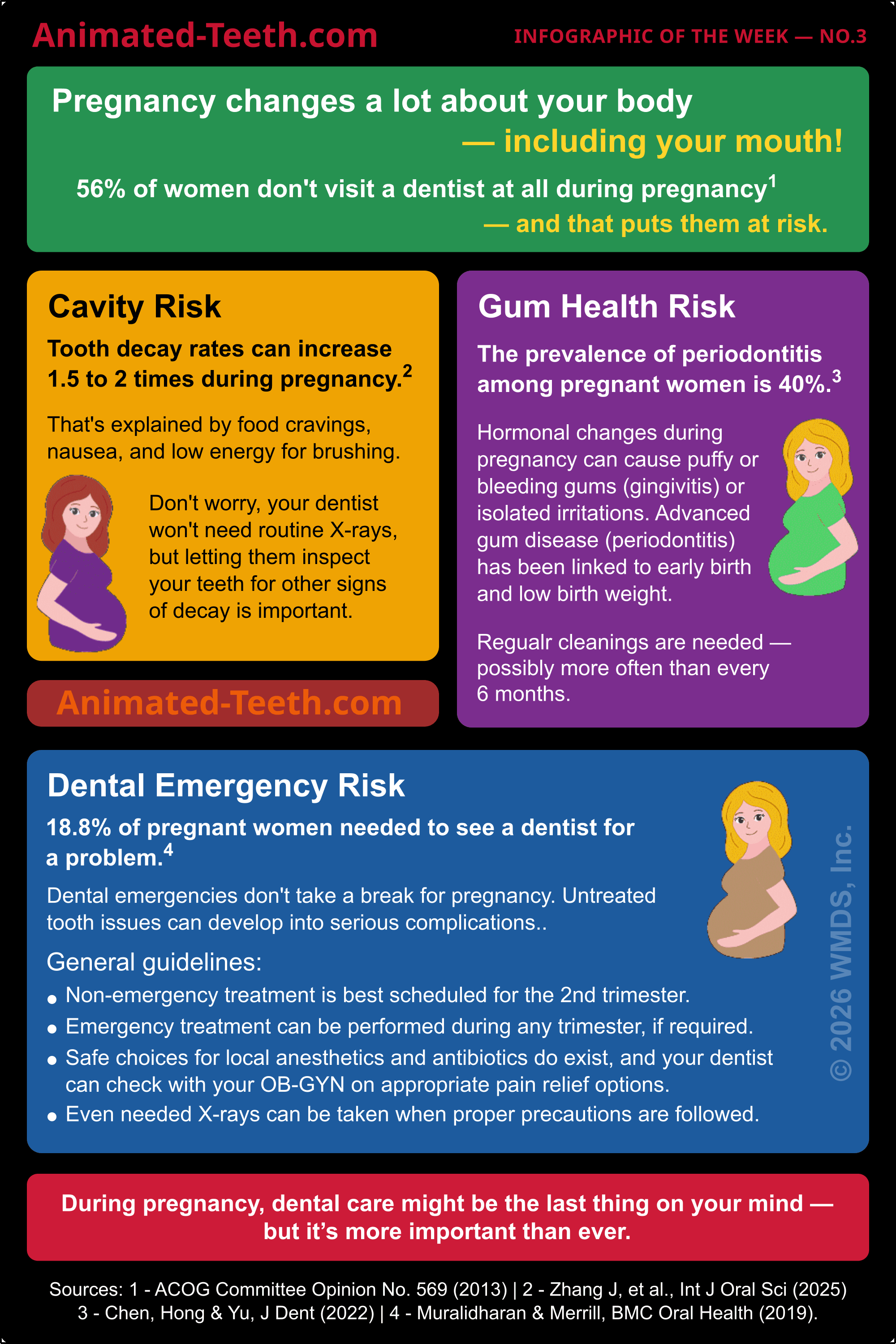
▲ Infographic: Oral Health Risks During Pregnancy ▲
What information is this infographic based on?
Some statistics we were surprised to learn.
While investigating the subject “dental care guidelines for pregnant women,” we ran across a paper that stated these statistics.
- 56% of US women did not visit a dentist during their pregnancy.
- 60% of women did not have their teeth cleaned during their most recent pregnancy.
(Source — Oral Health Care During Pregnancy and Through the Lifespan  )
)
Pregnancy needs to be a period of mindful vigilance.
What we found disturbing about these statistics is that pregnancy is a period of increased risk for dental problems — not fewer. It’s a time when maintaining regular dental checkups, having preventive care, and even correcting dental problems before they escalate is more important than ever.
Where the risks lie.
With just a little more digging around, we found additional statistics that revealed where potential oral health problems tend to lie.
- Dental decay — Cavity rates for pregnant women can run 1.5 to 2 times greater than in the general population. (Source — Expert consensus on the treatment of oral diseases in pregnant women and infants. )
- Gum disease — The above source also mentioned that gingivitis (reversible gum inflammation) is common among pregnant women. And looking further, we found a reference that stated that the prevalence of periodontitis (a more serious type of gum disease) in pregnant women is 40%. (Source — Prevalence of periodontal disease in pregnancy: A systematic review and meta-analysis. )
This latter issue, the presence of periodontitis, is of special concern because there is an association between it and adverse pregnancy outcomes (preterm delivery and low birth weight).
What about pregnancy causes oral health risks to rise?
To a great extent, the dental health risks associated with pregnancy can be explained by hormonal changes that promote fetal development. Admittedly, there are other factors involved, but the role hormones play is a predominant theme.
a) Gum health.
The hormone estrogen affects the vascular and cellular nature of gum tissue. Progesterone increases blood flow to gum tissue and amplifies the tissue’s inflammatory response to oral bacteria.
Together, these effects frequently result in pregnancy gingivitis (generalized swollen, bleeding gums) and localized irritations known as pregnancy granulomas. Pre-existing periodontitis cases can also become aggravated.
b) Tooth decay.
While the decay process is a multifaceted syndrome, hormonal changes can affect the normal balance of things by:
- Altering the amount and composition of saliva. Saliva acts as a natural shield that neutralizes cavity-causing acids. A reduction in saliva production or a change in its composition can weaken this protective effect.
- Increasing levels of gum tissue inflammation that make brushing and flossing painful, and ultimately less effective. Swollen gums can harbor higher numbers of decay-causing bacteria.
- Contributing to morning sickness and acid reflux, both of which expose teeth to harsh stomach acids. This exposure damages a tooth’s enamel layer and makes it more vulnerable to cavity formation.
- Changing hormonal levels influence cravings for carbohydrate-rich or sugary foods, the exact kinds of food sources that promote the growth of cavity-forming bacteria.
[FYI: The process of cavity formation is genuinely fascinating — it’s a constant tug-of-war playing out in your mouth. If you’d like to learn more, we’d suggest reading these two pages on our site: Cavity Formation (Demineralization), followed by Decay Repair (Remineralization).]
We discovered an additional statistic that disturbed us.
While researching the kinds of dental problems that often come up during pregnancy, we came across a study conducted in Utah that reported a number we found surprising: 18.8% of women — almost 1 out of 5 — perceived a dental problem serious enough that they felt they needed to see a dentist during their pregnancy. That’s not a small number — and one that’s a bit alarming.
(Source — Dental care during pregnancy based on the pregnancy risk assessment monitoring system in Utah. )
The story our infographic attempts to spin.
Here’s the narrative we’re attempting to tell via our infographic, using the statistics we’ve mentioned so far. Admittedly, we’re stitching together cherry-picked data, taken from separate studies, but here’s the storyline we’re suggesting.
- The setup: pregnancy is a period of elevated risk for dental problems, especially gum issues and tooth decay.
- The gap: 56% of pregnant women don’t visit a dentist at all during pregnancy.
- The (speculative) result: almost 1 in 5 end up needing to see a dentist for a problem during their pregnancy — as a result of increased pregnancy risks during a period of decreased dental care.
When you line things up this way, it reads like cause and effect. It might even be. But that’s our own conjecture, not a documented finding — we didn’t want to try to slide that past you.
So what could explain that kind of gap?
Why do so few pregnant women go to the dentist?
Well, there is an elephant in the room, and actually more than one.
- If you think that the cost of dental care must play a role, we’d agree that it probably does. But that’s a subject for a future infographic, not this one.
- If you feel that dental fear must play a significant role, once again, we whole-heartedly agree. And, by the way, we did do that subject as an infographic, you can find it here: Dental fear is higher than previously reported.
- But as a third hypothesis, could some part of this phenomenon be that women simply don’t understand what kinds of dental treatments are appropriate during pregnancy?
We found a paper that supports this idea.
A study titled Pregnant Patient Knowledge and Behavior Regarding Perinatal Oral Health reported the following details.
- Only 10–20% of pregnant women were aware that dental X-rays are safe during pregnancy.
- Only 5–17% were aware that safe local anesthesia options exist.
- Only 16–26% were aware that there are safe options for antibiotic use.
- 9 to 21% of pregnant women didn’t realize that having dental cleanings is safe, when, in fact, performing this procedure helps to ensure their dental health.
Clearly, a large percentage of pregnant women are simply unaware that, with the right precautions and the right choices, all of the above can be utilized safely throughout pregnancy, and that may be keeping them away from the dentist!
And that’s the approach we chose for wrapping up our infographic.
Our graphic concludes with a brief listing of current dental standards that many pregnant women may not realize are appropriate for their situation — practices all founded on the findings of evidence-based studies.
The current status.
Modern dentistry no longer considers providing care for pregnant women as a sandbox where only isolated procedures are permissible. Instead, modern guidelines focus on implementing protections for the mother and child, but also acknowledge that when these standards are followed, a wide range of dental procedures can be performed — ranging from routine preventive care (dental checkups, dental cleanings) to emergency care if needed.
If you’re looking for more information.
Here are some links that provide additional information about appropriate guidelines for dental care during pregnancy.
MouthHealthy.org
This is a website owned by the American Dental Association. That organization isn’t exactly known for having outstanding consumer content, but if you’d like to confirm much of what’s stated here on an “authority” website, here’s the link: Pregnancy and your dental health.
Zhang et al. (2025)
This is one of the papers we cited for our infographic. It’s written for dentists, so it’s fairly technical — but it’s a really complete reference source. Rather than reading the whole thing, try using your browser’s “find” function to search the page for keywords you’re interested in. Link: Expert consensus on the treatment of oral diseases in pregnant women and infants.
Animated-Teeth.com
We have a webpage that discusses issues of concern with extractions during pregnancy. You can find it here: Tooth Extractions During Pregnancy and Breastfeeding: What You Need to Know.
How to embed this infographic on your website.
Feel free to embed this infographic on your own website. It must be shown in its entirety, without alteration. (Creative Commons Attribution-NoDerivatives 4.0 International License.) The code below already includes a link back to us, so no extra attribution is needed on your end.
Instructions: Use the embed code found in the box below. If you have difficulty with getting the infographic to render properly, try pasting the code into your site’s raw HTML or code editor — not a visual/rich-text (WYSIWYG) editor. (In WordPress Classic Editor, use the Text tab; in the Block Editor (Gutenberg), use a Custom HTML or Code block.)
<div style="text-align:center;">
<a href="https://www.animated-teeth.com/infographic/pregnancy-dental-care" target="_blank" rel="noopener">
<img src="https://www.animated-teeth.com/infographics/hotlink-ok/2026/pregnancy-dental-care-2x.png"
alt="Infographic: Pregnancy and Dental Care — 56% of pregnant women don’t see a dentist. Risks include cavity risk (1.5-2x higher), gum health risk (40% periodontitis prevalence), and dental emergency risk (18.8% need urgent care). Guidelines for safe dental care during pregnancy."
style="max-width:100%; width:600px; height:auto;" />
</a>
<p style="font-size:12px; color:#666;">
Courtesy of <a href="https://www.animated-teeth.com/infographic/pregnancy-dental-care">Animated-Teeth.com</a>
</p>
</div>
Want to learn more about dentistry?
Last reviewed: August 26, 2026
Author: Paul Cotner, DMD — retired dentist.
Published by: WMDS, Inc. — owner of Animated-Teeth.com.
Educational information only — not a substitute for professional dental care.