
Free infographic: People harbor more dental fear than previously thought.
( How to embed this graphic on your own website.)
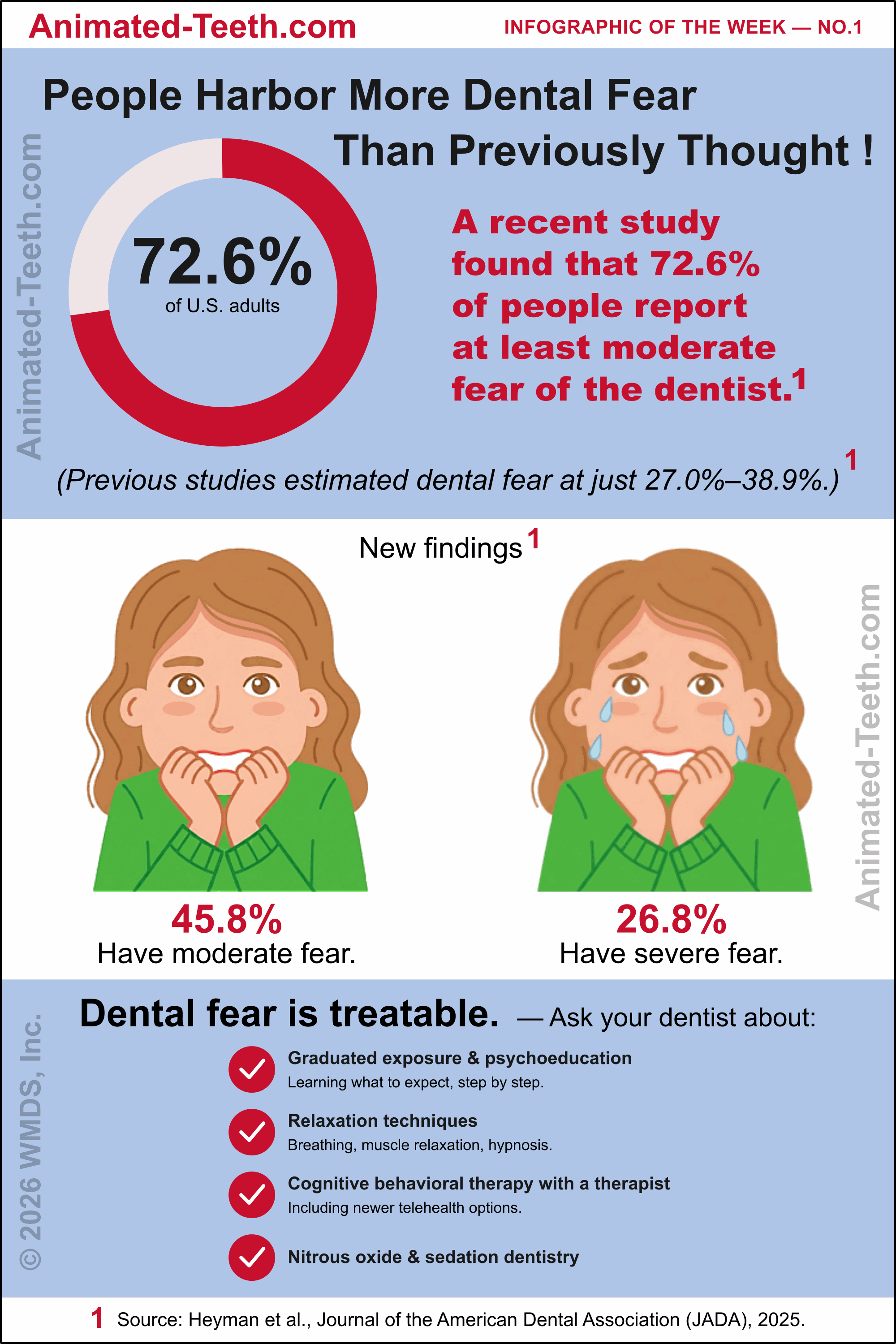
▲ Infographic: Dental fear is more common than thought. ▲
This infographic is based on a recent study.
Inspiration for our Dental Fear infographic comes from the findings of a study published in the Journal of the American Dental Association titled “A census-matched survey of dental fear and fear-treatment interest in the United States” (Heyman 2025) 
What this study evaluated.
The study was designed to measure how common dental fear is among adults in the U.S., using the first nationally representative, census-matched sample ever assembled for this purpose. Earlier studies of dental fear had relied on smaller, regional samples — a single city, county, or state — collected anywhere from 18 to 32 years earlier, so a current, nationally representative picture didn’t previously exist.
The study’s participants (1,003 U.S. adults) rated their dental fear on a 0–10 scale. Respondents reporting moderate to severe fear were then asked whether they’d be interested in participating in a brief, free digital treatment program — delivered by computer, mobile app, or telehealth — and if not, why.
What the study found.
The authors found that 72.6% of U.S. adults report at least moderate fear of the dentist — 45.8% moderate, 26.8% severe. Among those with fear, 71.2% said they’d be interested in trying a brief digital treatment program. Of the roughly 3 in 10 who declined, the most common reasons were skepticism that it would actually help, a feeling that their current coping methods were already good enough, and doubts that it would be worth the time.
What was important or novel about this study’s findings?
1) Its nationwide scope.
This is the first dental fear study designed to be demographically representative of the full U.S. adult population — matched to Census data on age, sex, race, income, education, and region, rather than drawing from a single city or clinic. That national scope is itself the key contribution: it lets the study speak to the country as a whole in a way regional surveys couldn’t.
2) A higher fear rate than previously measured.
The 72.6% figure reported by this study is notably higher than the 27—39% range reported in prior research. The study’s authors specifically suggested that this higher level was most likely due to improved measurement methods, rather than a genuine rise in fear over time. Earlier regional and clinic-based studies likely underestimated the true national rate.
3) Strong interest in dental fear treatment.
The study also highlights a practical opportunity: with more than 7 in 10 fearful adults open to trying a brief digital treatment, there appears to be substantial unmet demand for accessible, low-cost options to address dental fear.
What are some of the real-life implications of this study’s findings?
While only our conjecture (the study did not discuss these points), this significantly higher level of adult dental fear suggests that two phenomena well-known in the dental community can now be more easily understood.
1) It explains why people delay necessary dental care.
A high level of fear may explain why many patients delay necessary treatment, even after receiving a diagnosis from their dentist or experiencing early symptoms. Since dental problems tend to worsen over time, this counterproductive behavior can now be more easily explained.
2) It explains why dental benefits are frequently underutilized.
Dental insurance companies bank on the fact that a substantial portion of their policyholders will never utilize their benefits, even for procedures where no copay is required. Understanding that a large part of the general population harbors dental fear explains this phenomenon perfectly.
Need help with managing your dental fear or anxiety?
Our infographic provides a general outline of accepted techniques used to help manage dental fear and anxiety. And once your dentist knows you need some extra support, the two of you can talk through these options and pick out the ones that seem best suited to you.
To help you get more out of that conversation, the rest of this page adds a bit more detail on each technique.
When creating our outline, we relied heavily on this paper: “Strategies to manage patients with dental anxiety and dental phobia: literature review” (Appukuttan, 2016). The paper was written for dental professionals, but its narrative style makes it approachable — if you need more detail before speaking with your dentist, it’s a good place to start.
Methods used to treat dental fear and anxiety.
a) Graduated exposure and psychoeducation.
Learning what to expect, and easing into it step-by-step, is a simple, time-tested approach that every dentist can offer. It typically starts with a conversation about which situations feel most stressful — the sound of the drill, the numbing injection, simply being in the chair — so those can be ranked from least to most anxiety-provoking. Your dentist can then walk you through them gradually, starting with the easiest, so each step feels manageable before moving to the next.
A related technique some dentists use is called “tell-show-do”: they explain a step in plain language, demonstrate it (for example, letting you see or feel an instrument before it’s used), and only then perform it. This removes a lot of the uncertainty that fuels dental fear in the first place.
b) Relaxation techniques.
Some dentists can provide coaching in the same techniques used to manage other types of stress and fear. This includes breathing exercises, muscle relaxation, and possibly even hypnosis. A common example is progressive muscle relaxation, where you deliberately tense a muscle group for several seconds and then release it — repeating this through the major muscle groups helps the body physically let go of tension before or during treatment.
Other options include slow, deep “diaphragmatic” breathing, and guided imagery, where you’re coached to picture a calm, specific scene in detail. These techniques are often taught chairside and can be practiced at home ahead of an appointment. Hypnosis is also used by some practitioners, though it typically requires additional training on the dentist’s part.
c) Cognitive behavioral therapy (CBT).
This type of therapy is typically provided by a trained therapist, though your dentist should be able to steer you toward a program. CBT is a structured, multi-session approach that combines relaxation and gradual exposure (similar to the techniques above) with work on changing the anxious thoughts and beliefs that often drive dental fear — for example, expecting pain or a loss of control before anything has actually happened.
Because it’s more involved than a single chairside technique, CBT is generally reserved for people with more persistent or severe fear, rather than mild nervousness. It’s considered one of the most well-supported treatments available for phobia-level dental anxiety.
d) Nitrous oxide and sedation dentistry.
These are procedural options that, once administered, can reduce patient anxiety without requiring the same active participation as the techniques above. Nitrous oxide (commonly known as “laughing gas”), mixed with oxygen and breathed in through a mask, has a mild calming and muscle-relaxing effect. It works quickly and wears off quickly too, so most people feel back to normal shortly after treatment ends.
For higher levels of anxiety, some dentists offer additional sedation options — taken by mouth or, in some cases, administered intravenously — that produce a deeper level of calm. These options require specific training and monitoring, so availability varies by dental practice; it’s worth asking your dentist directly what they’re able to offer.
FYI we offer more information about sedation techniques on our website, you can find it here: Animated-Teeth.com Guide to Conscious Sedation.
How to embed this infographic on your website.
Feel free to embed this infographic on your own website. It must be shown in its entirety, without alteration. (Creative Commons Attribution-NoDerivatives 4.0 International License.) The code below already includes a link back to us, so no extra attribution is needed on your end.
Instructions: Use the embed code found in the box below. If you have difficulty with getting the infographic to render properly, try pasting the code into your site’s raw HTML or code editor — not a visual/rich-text (WYSIWYG) editor. (In WordPress Classic Editor, use the Text tab; in the Block Editor (Gutenberg), use a Custom HTML or Code block.)
<div style="text-align:center;">
<a href="https://www.animated-teeth.com/infographic/dental-fear" target="_blank" rel="noopener">
<img src="https://www.animated-teeth.com/infographics/hotlink-ok/2026/dental-fear-infographic-2x.png"
alt="Infographic: A 2025 JADA study found that 72.6% of U.S. adults report at least moderate fear of the dentist — higher than prior estimates of 27.0%–38.9%. Includes treatable options such as graduated exposure, relaxation techniques, CBT, and sedation dentistry."
style="max-width:100%; width:600px; height:auto;" />
</a>
<p style="font-size:12px; color:#666;">
Courtesy of <a href="https://www.animated-teeth.com/infographic/dental-fear">Animated-Teeth.com</a>
</p>
</div>
Want to learn more about dentistry?
Last reviewed: August 08, 2026
Author: Paul Cotner, DMD — retired dentist.
Published by: WMDS, Inc. — owner of Animated-Teeth.com.
Educational information only — not a substitute for professional dental care.