
Free infographic: Is Cannabis Use Associated with Tooth Loss?
( How to embed this graphic on your own website.)
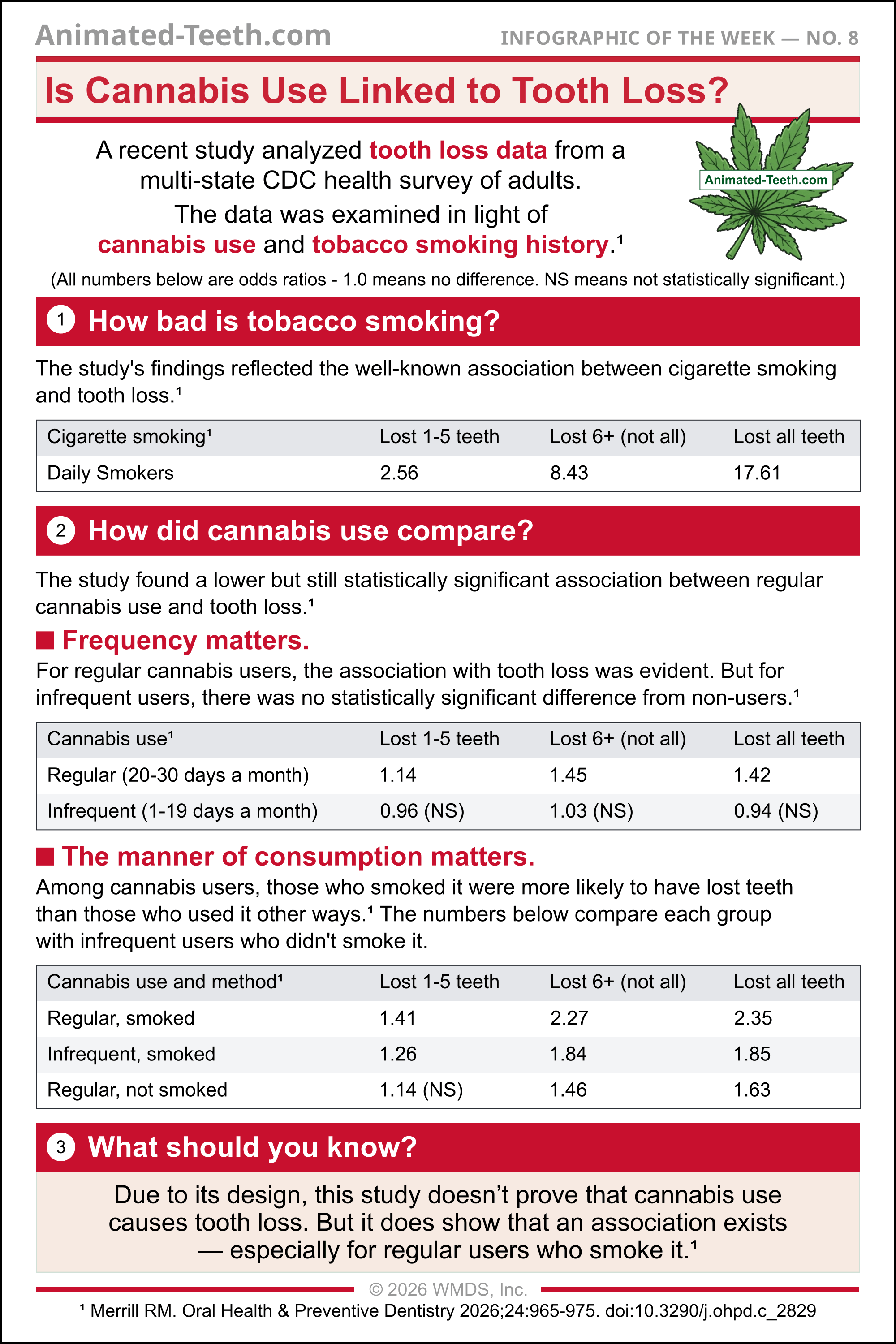
▲ Infographic: Cannabis use association with tooth loss. ▲
What is our infographic about?
Title — Is cannabis use linked to tooth loss?
Our infographic is about cannabis (marijuana) use and its association with tooth loss — along with how that association compares with cigarette smoking.
Our data source.
We’ve drawn all of the information presented in our graphic from a 2026 study titled: Exploring Associations Between Frequency and Methods of Cannabis Use and Tooth Loss (Merrill, 2026) 
Details about the study.
The study utilized self-reported survey data from the Centers for Disease Control and Prevention (CDC) Behavioral Risk Factor Surveillance System (BRFSS).
- 577,848 adults, from 37 US jurisdictions (33 states, Washington D.C., and 3 territories) participated in the 2016, 2018, 2020, 2022, and 2024 cross-sectional surveys.
- About 12.3% of survey participants reported using cannabis in the past 30 days — with 6.5% categorized as infrequent users and 5.8% as daily or near-daily users.
- Smoking was the most common method of cannabis consumption (76.7% of users).
- For the study, the term “tooth loss” was defined as permanent teeth removed because of decay or gum disease — not teeth lost to injury or orthodontics.
- The study’s results were adjusted for age, sex, race/ethnicity, survey year and tobacco smoking, and additional analyses also adjusted for 10 chronic medical conditions.
- Note, however, the study didn’t account for oral hygiene habits, diet, dental care access and socioeconomic status — all of which are important factors in tooth loss.
What were the study’s findings?
1) A strong correlation exists between cigarette smoking and tooth loss.
This study’s findings documented an association between tooth loss and smoking tobacco. That comes as no surprise — many previous studies have already reported this correlation.
The CDC data this study evaluated showed a clear pattern — the more often people smoked, the stronger the link to tooth loss. As you can see in the table below, the link was strongest for people who had lost all of their teeth — but even former smokers still showed some association.
A note about the data contained on this page — All numbers shown in the tables are odds ratios. An odds ratio compares the odds of tooth loss in one group with the odds in another, here people who have never smoked. A number of 1.0 means no difference, and higher numbers mean a stronger link. Odds ratios aren’t the same as “times as likely,” so they’re best read as higher or lower than 1.0.
| Cigarette smoking | Lost 1-5 teeth | Lost 6+ (not all) | Lost all teeth |
|---|---|---|---|
| Daily | 2.56 | 8.43 | 17.61 |
| Some days | 1.81 | 3.91 | 7.25 |
| Former | 1.48 | 2.62 | 3.42 |
2) There is a link between cannabis usage and tooth loss.
While that is true, this study found that the correlation between cannabis/marijuana use and tooth loss only showed up for people who use it regularly — defined as 20 to 30 days a month. When compared with people who don’t use cannabis, regular users had higher odds of tooth loss — even after the researchers accounted for age, sex, race/ethnicity, survey year and tobacco smoking.
However, people who used cannabis less often — 1 to 19 days a month — showed no statistically significant difference in tooth loss from non-users.
| Cannabis use | Lost 1-5 teeth | Lost 6+ (not all) | Lost all teeth |
|---|---|---|---|
| Regular (20-30 days a month) | 1.14 | 1.45 | 1.42 |
| Infrequent (1-19 days a month) | 0.96 (NS) | 1.03 (NS) | 0.94 (NS) |
(The numbers compare each group with non-users. 1.0 means no difference, and NS means not statistically significant.)
When the researchers adjusted for 10 chronic medical conditions, the numbers for regular users got smaller, but the link with tooth loss remained.
3) When compared to smoking cigarettes, the cannabis/tooth-loss link is much weaker.
For daily cigarette smokers, the correlation with tooth loss climbed steeply with the number of teeth lost — from 2.56 up to 17.61. For regular cannabis users, the correlation stayed relatively flat — between 1.14 and 1.45.
This flatter pattern could mean that some of the correlation attributed to cannabis use comes from other factors — like oral hygiene habits, diet, dental care access and socioeconomic status — which the study didn’t measure. But it doesn’t rule out a small effect from cannabis itself.
| Group | Lost 1-5 teeth | Lost 6+ (not all) | Lost all teeth |
|---|---|---|---|
| Daily cigarette smokers (compared with never-smokers) | 2.56 | 8.43 | 17.61 |
| Regular cannabis users (compared with non-users) | 1.14 | 1.45 | 1.42 |
Please note: Both sets of numbers come from the same analysis, so they do give a fair sense of scale. But the study didn’t test cigarettes against cannabis directly — meaning the numbers shouldn’t be divided to suggest how many times worse one is than the other.
4) The manner of cannabis consumption seems to affect the correlation.
Most of the survey participants who used cannabis smoked it — 76.7% of users. Smoking was more common among regular users (84.7%) than infrequent users (69.5%). The other 23.3% used it in other ways. The study only distinguished whether people smoked it, so all other ways of using it, like consuming edibles, are grouped together.
Among cannabis users, the study found that those who smoked it were more likely to have lost teeth than those who used it other ways. This trend held in every age group from 25 on up.
The numbers shown below compare each group with infrequent users who didn’t smoke it. 1.0 means no difference, and NS means not statistically significant.
| Group | Lost 1-5 teeth | Lost 6+ (not all) | Lost all teeth |
|---|---|---|---|
| Regular users who smoked it | 1.41 | 2.27 | 2.35 |
| Infrequent users who smoked it | 1.26 | 1.84 | 1.85 |
| Regular users who didn’t smoke it | 1.14 (NS) | 1.46 | 1.63 |
Some points to note.
Two things stand out in this table:
- Smoking raised the numbers at both levels of cannabis use, and they were highest for regular users who smoked it.
- But regular users who didn’t smoke it still had higher numbers for losing 6 or more teeth (but not all) and for losing all teeth, so smoking doesn’t appear to be the whole story.
Why might smoking matter? Cigarette smoking, a well-established risk factor for gum disease and tooth loss, involves tobacco combustion — and the study’s author suggests that smoking cannabis may pose a similar risk. But the study didn’t test this hypothesis.
Also, keep in mind that the comparison group here is infrequent users who didn’t smoke cannabis, not non-users. So, these numbers don’t show how people who smoke cannabis compare with people who never use it at all.
5) What the study doesn’t tell us.
This study documents an association between cannabis/marijuana use and tooth loss — but that fact doesn’t prove that cannabis causes tooth loss. Here are some of the reasons why:
- The CDC information the study was based on came from survey data taken at one point in time — so it can’t show which came first, the cannabis use or the tooth loss.
- All survey data was self-reported and didn’t include information about past cannabis use — which may matter more for tooth loss than current use.
- As noted previously, the data didn’t include information about participant oral hygiene, diet, dental care access or socioeconomic status.
Also, the study’s author describes the paper’s findings as exploratory and calls for longer-term studies to better understand the relationship.
How to embed this infographic on your website.
Feel free to embed this infographic on your own website. It must be shown in its entirety, without alteration. (Creative Commons Attribution-NoDerivatives 4.0 International License.) The code below already includes a link back to us, so no extra attribution is needed on your end.
Instructions: Use the embed code found in the box below. If you have difficulty with getting the infographic to render properly, try pasting the code into your site’s raw HTML or code editor — not a visual/rich-text (WYSIWYG) editor. (In WordPress Classic Editor, use the Text tab; in the Block Editor (Gutenberg), use a Custom HTML or Code block.)
<div style="text-align:center;">
<a href="https://www.animated-teeth.com/infographic/cannabis-tooth-loss" target="_blank" rel="noopener">
<img src="https://www.animated-teeth.com/infographics/hotlink-ok/2026/cannabis-tooth-loss-infographic-2x.png"
alt="Infographic: Regular cannabis use is linked to tooth loss, but far less than daily cigarette smoking (odds ratios 1.42 vs 17.61 for losing all teeth)."
style="max-width:100%; width:600px; height:auto;" />
</a>
<p style="font-size:12px; color:#666;">
Courtesy of <a href="https://www.animated-teeth.com/infographic/cannabis-tooth-loss">Animated-Teeth.com</a>
</p>
</div>
Want to learn more about dentistry?
Last reviewed: November 03, 2026
Author: Paul Cotner, DMD — retired dentist.
Published by: WMDS, Inc. — owner of Animated-Teeth.com.
Educational information only — not a substitute for professional dental care.