
Free infographic: What is Ozempic Mouth? — Signs and Symptoms.
( How to embed this graphic on your own website.)
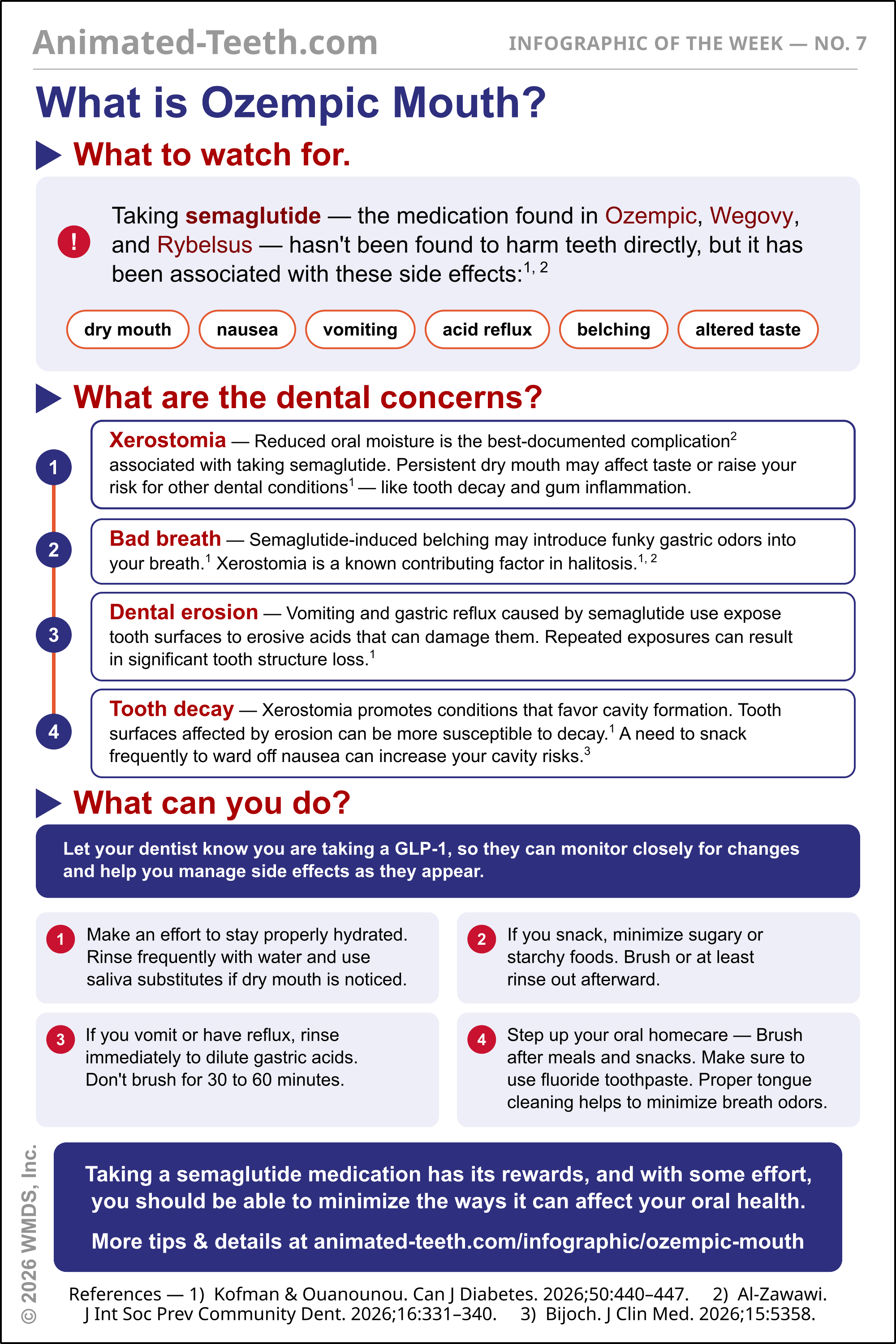
▲ Infographic: Ozempic Mouth — What to watch out for. ▲
What’s the subject of our infographic?
Ozempic Mouth — Oral complications associated with using semaglutide (a GLP-1 drug).
Our infographic explores oral-health side effects and complications that have been reported by patients taking semaglutide medications — like Ozempic, Wegovy, and Rybelsus. We primarily focus on dental-health effects — the kinds of issues that your dentist would assist you in managing.
The information stated in our infographic comes from the following publications.
Infographic resources —
- Oral health considerations and dental management guidelines for semaglutide medications. (Kofman, 2026)

- Oral adverse effects of semaglutide therapy: a narrative review. (Al-Zawawi, 2026)
- Oral health implications of GLP-1 receptor agonists and other incretin-based therapies. (Bijoch, 2026)
What is Ozempic Mouth?
“Ozempic Mouth” isn’t a medical diagnosis — it’s a popular, non-scientific term that refers to a loose collection of oral side effects and conditions that people taking semaglutide medications (like Ozempic, Wegovy, and Rybelsus) have reported.
As an initial point, it must be stated that research hasn’t found that semaglutide use harms teeth directly. The concern with this medication is indirect — its effects on the stomach and mouth can create conditions that may predispose one to dental problems or aggravate existing ones. In some cases, permanent tooth damage may result.
It’s also important to point out that evidence about these side effects is still limited. Most of what’s known comes from case reports and adverse-event reports, not from studies specifically designed to identify and evaluate them.
What oral-health issues are associated with Ozempic Mouth?
Dry mouth (xerostomia)
This is the best-documented oral side effect. Dry mouth conditions are known to interfere with eating (chewing and swallowing), taste perception, speech, and wearing dental prosthetics, like dentures. Having a dry mouth can also elevate your risk of bad breath, tooth decay, and gum inflammation.
Altered taste
Some users report a metallic, bitter, or unusual taste in their mouth when taking semaglutide. This may be a side effect of the medication or a secondary effect associated with experiencing persistent dry mouth/reduced salivary flow.
Bad breath (halitosis)
“Ozempic breath” may have several contributing causes. Sulfur-containing gases from the stomach may be brought up by belching or gastric reflux. In addition, dry mouth (xerostomia) is a known aggravating factor for bad breath.
Dental erosion
Stomach acids that enter the mouth due to vomiting or gastric reflux can erode tooth surfaces. Repeated episodes can result in significant and permanent tooth structure loss. (Fluoride vs. Dental Erosion infographic.)
Tooth decay
Dry mouth conditions, tooth surface erosion, and a need for frequent sugary or starchy snacking to ward off semaglutide-induced nausea can all raise cavity risk.
How can your dentist help you manage the effects of Ozempic Mouth?
Here’s an outline of suggestions, tips, and treatments your dentist should be able to offer as assistance in managing your oral-health needs while taking semaglutide.
Dry mouth (xerostomia)
If you experience dry mouth, your dentist can help you manage your condition and protect your teeth while it lasts. Common first steps include hydration counseling — like optimizing fluid intake, choosing water vs. sugary drinks, using sugar-free xylitol gum or lozenges to stimulate saliva flow, and employing over-the-counter saliva substitutes or oral moisturizers to ease dryness and discomfort.
Because saliva protects teeth and gums, adding preventive measures is usually indicated. That may include prescription-strength fluoride toothpaste, professionally applied fluoride treatments, and more frequent checkups and cleanings so gum inflammation or early cavities are caught sooner. If dry mouth is severe or persistent, your dentist may coordinate with your physician about the use of a prescription saliva-stimulating medication.
Altered taste
Your dentist can’t directly treat a medication-induced taste change, but they can evaluate for oral factors that may be contributing to the problem — such as dry mouth, a coated tongue, or an oral yeast infection (thrush) — and treat them. Keeping up with tongue cleaning and good dental hygiene typically helps.
Bad breath (halitosis)
Evaluation by your dentist can help to sort out where your oral malodor is coming from (gastric vs. oral cavity). Since bad breath most often begins in the mouth, they’ll evaluate levels of dental plaque, tartar buildup, food and debris trapped between your teeth, tongue coating (especially the posterior of your tongue), and the tonsil area.
Treatment usually centers on improved plaque removal and regular professional cleanings, as well as performing tongue cleaning with a scraper, using an antibacterial toothpaste, zinc-containing products, fluoride rinses when appropriate, and maintaining good hydration. If the odor seems to come from the stomach — like belching or reflux — your dentist may suggest checking with your physician.
Dental erosion
Early detection of the effects of dental erosion matters because any tooth enamel that’s lost doesn’t grow back. Reporting your history of vomiting or gastric reflux to your dentist puts them on alert to evaluate for early signs of erosion, which typically shows up on the tongue-side surfaces of the teeth, particularly the upper ones, and track any changes from one visit to the next.
To slow further erosion, your dentist may recommend prescription-strength fluoride toothpaste or rinses, fluoride varnish, and a few preventive measures: rinse with water or a baking-soda solution after vomiting or reflux, and wait 30 to 60 minutes before brushing so softened enamel isn’t scrubbed away. If sensitivity develops, desensitizing toothpastes can help.
If a significant amount of erosion has already occurred, restorative treatment can protect exposed tooth structure and relieve sensitivity. In extreme cases, dental crown placement may be indicated. Your dentist may also suggest consulting with your physician about frequent vomiting or reflux, since fewer episodes means less acid exposure for your teeth.
Tooth decay
Each individual patient’s risk for decay will vary. For example, the mix of dry mouth conditions, oral acid exposure, and effects of frequent snacking will all tend to vary from person to person. If it’s determined that you’re at elevated risk, your dentist will probably suggest having more frequent checkups and cleanings (every three to four months, for example), so early cavities can be found and treated while they’re small.
Other steps that may be suggested are fluoride varnish applications, prescription-strength fluoride toothpaste, xylitol products to help stimulate saliva, and dietary counseling on snacking. Non-sugary snacks are a better choice than frequent sugary or starchy ones, and sugar-containing anti-nausea lozenges should be limited. Rinsing or brushing after meals or snacks is also important.
Our infographic’s reference sources.
Linked below are the sources we cite in our infographic.
- WHO guideline on environmentally friendly and less invasive oral health care for preventing and managing dental caries (2026)
- Pit and fissure sealants for preventing dental decay in permanent teeth. — Ahovuo-Saloranta et al., Cochrane Database Syst Rev 2017.
- Pit and fissure sealants versus fluoride varnishes for preventing dental decay in the permanent teeth of children and adolescents. — Kashbour et al., Cochrane Database Syst Rev 2020.
- Longevity of materials for pit and fissure sealing—Results from a meta-analysis — Kühnisch et al., Dental Materials 2012.
- Absence of Fluoride Varnish–Related Adverse Events in Caries Prevention Trials in Young Children, United States. — Garcia et al., Prevting Chronic Disease 2017.
How to embed this infographic on your website.
Feel free to embed this infographic on your own website. It must be shown in its entirety, without alteration. (Creative Commons Attribution-NoDerivatives 4.0 International License.) The code below already includes a link back to us, so no extra attribution is needed on your end.
Instructions: Use the embed code found in the box below. If you have difficulty with getting the infographic to render properly, try pasting the code into your site’s raw HTML or code editor — not a visual/rich-text (WYSIWYG) editor. (In WordPress Classic Editor, use the Text tab; in the Block Editor (Gutenberg), use a Custom HTML or Code block.)
<div style="text-align:center;">
<a href="https://www.animated-teeth.com/infographic/ozempic-mouth" target="_blank" rel="noopener">
<img src="https://www.animated-teeth.com/infographics/hotlink-ok/2026/ozempic-mouth-infographic-2x.png"
alt="Infographic: Semaglutide (Ozempic) hasn’t been found to harm teeth directly, but dry mouth, bad breath, erosion, and decay are concerns to watch for."
style="max-width:100%; width:600px; height:auto;" />
</a>
<p style="font-size:12px; color:#666;">
Courtesy of <a href="https://www.animated-teeth.com/infographic/ozempic-mouth">Animated-Teeth.com</a>
</p>
</div>
Want to learn more about dentistry?
Last reviewed: October 11, 2026
Author: Paul Cotner, DMD — retired dentist.
Published by: WMDS, Inc. — owner of Animated-Teeth.com.
Educational information only — not a substitute for professional dental care.