
Free infographic: The overuse of antibiotics in dentistry — globally.
( How to embed this graphic on your own website.)
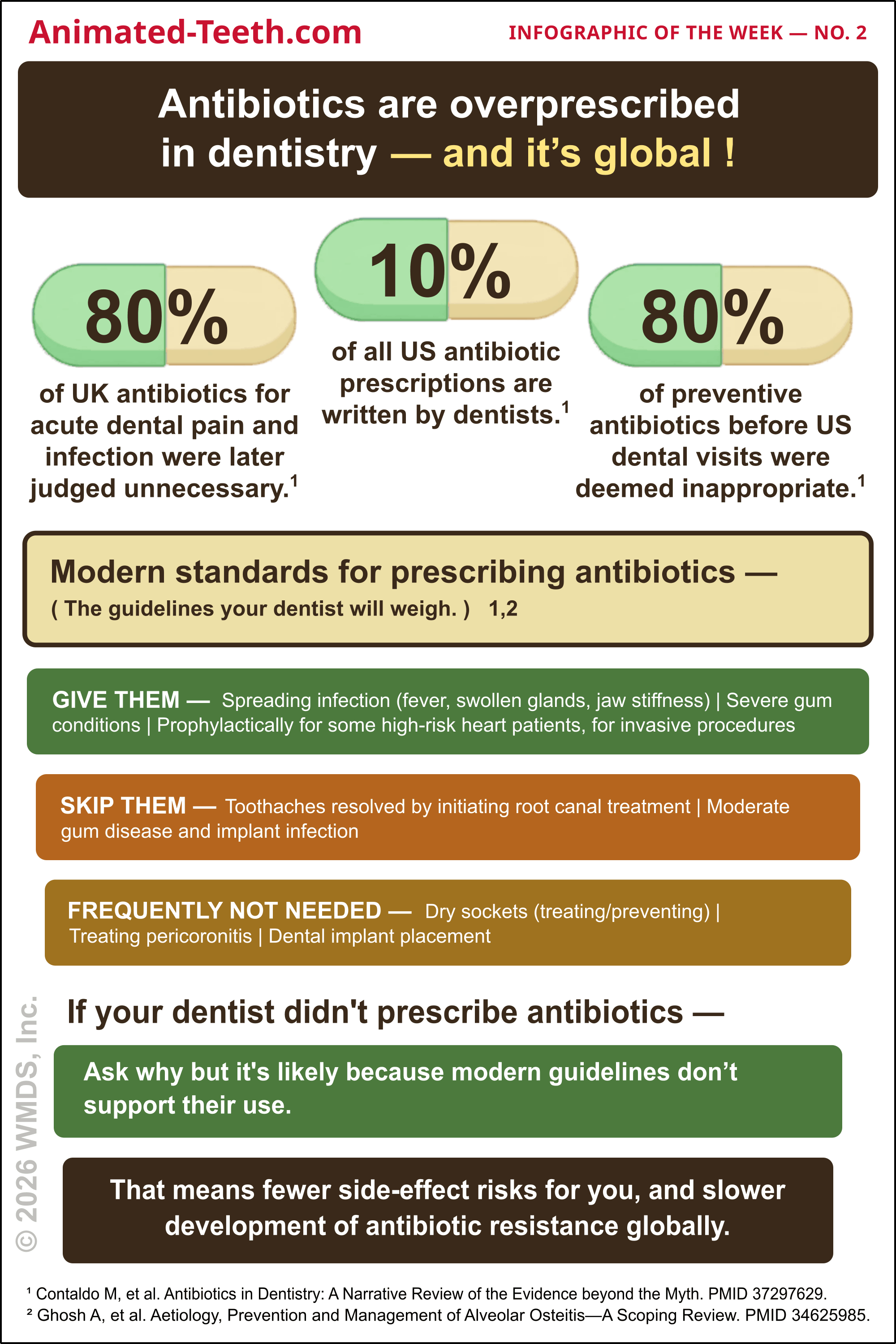
▲ Infographic: Antibiotic overuse in dentistry. ▲
This infographic is based on a recent study.
Inspiration for this infographic comes from the findings of a study published in 2023 titled Antibiotics in Dentistry: A Narrative Review of the Evidence beyond the Myth (Contaldo et al.) 
What this study evaluated.
The authors of the paper evaluated 78 individual studies dating from 2000 through early 2023 that documented how antibiotics are actually prescribed in dental practices around the world and how that use compares with modern guidelines.
They focused specifically on how often antibiotics were prescribed, both for treating active infections and as a preventive measure, along with the reasoning associated with those prescribing decisions.
What the study found.
The paper’s central finding was that antibiotics are routinely prescribed in dental practices well beyond what current guidelines call for. Studies cited in the paper revealed that:
- 80% of antibiotics prescribed in the U.K. for acute dental pain were later judged unnecessary.
- 80% of preventive antibiotics given before dental visits were inappropriate.
- Dental prescribing accounts for roughly 10% of all U.S. antibiotic prescriptions.
The review also laid out instances where the evidence does support antibiotic use:
- Treating infections that show signs of spreading, such as fever or swollen glands.
- Treating certain severe gum conditions.
- Prescribing them prophylactically for some classes of high-risk heart patients before invasive procedures.
As well as situations where antibiotics are frequently unnecessary:
- Treating routine toothaches that initiating root canal treatment can resolve.
- Treating moderate gum disease and many pericoronitis cases.
- Prescribing them for standard dental implant placement.
- Preventing dry sockets.
What was important or novel about this study’s findings?
One issue that stands out is how consistent the pattern of overprescribing was found to be — across dozens of studies spanning more than two decades and many countries — rather than an isolated finding from one clinic or one country.
At the same time, the review makes it clear that guidelines for appropriate antibiotic use already exist. The issue isn’t a lack of guidance but instead inconsistent adherence to it by practitioners.
What are some of the real-life implications of this study’s findings?
A growing bacterial resistance to antibiotics.
The issue of bacterial resistance to antibiotic therapy is approaching crisis levels globally, and this phenomenon is promoted by two factors associated with antibiotic use. They are:
- Overprescribing antibiotics — Bacteria can become resistant to a given antibiotic, and once resistant strains exist within a population, a course of antibiotic treatment kills off the susceptible ones while others survive and proliferate in their place. This dynamic is known as selective pressure.
The more frequently antibiotics are prescribed, the more frequently this dynamic occurs. Prescribing antibiotics judiciously helps to limit the number of opportunities for resistant bacteria to take hold and spread.
- Patient non-compliance — The way a patient takes their antibiotic medication also affects bacterial resistance. A failure to follow their dentist’s directions — skipping doses, stopping early, etc. — leads to the same selective pressure phenomenon where hardier, less susceptible bacteria continue to survive, multiply, and spread, rather than being eradicated.
The blame for antibiotic overuse does not rest with dentists alone.
Dentists do not practice in a vacuum. Like any healthcare provider, they are motivated not only by a desire to care for their patients, but also to please and satisfy them. Unfortunately, these goals do not always align.
What the patient does and says matters.
Patient expectations absolutely play a role in antibiotic overprescribing, and that pressure can take many forms. A direct request for a prescription, visible skepticism about a treatment plan that doesn’t include one, or gestures of frustration when medication is not provided can all influence a clinician. And when faced with these cues, a dentist may prescribe against their better clinical judgment just to ease the tension of the moment.
Why less is often more.
This dynamic is a crucial takeaway from this infographic. Notice that it shows far more situations where antibiotics probably are not needed as opposed to ones where they clearly are. That disparity is not arbitrary. It directly reflects a vast body of evidence-based research showing that for many dental conditions antibiotic therapy offers only marginal benefits — ones that may be heavily overshadowed by the risk of adverse side effects.
The traditional practice of prescribing “just to cover all bases” carries a substantial, hidden cost. It accelerates the spread of antibiotic-resistant bacteria, fueling a global public health crisis that will ultimately affect us all.
About our references for our infographic.
As stated and linked to above (full text is available), the primary reference source we used for our infographic was:
Contaldo M, et al. Antibiotics in Dentistry: A Narrative Review of the Evidence beyond the Myth. PMID 37297629.
For the single statement in our infographic regarding the treatment of dry sockets, we chose this as the supporting document:
Ghosh A, et al. Aetiology, Prevention and Management of Alveolar Osteitis—A Scoping Review. PMID 34625985. (Full text is available.)
How to embed this infographic on your website.
Feel free to embed this infographic on your own website. It must be shown in its entirety, without alteration. (Creative Commons Attribution-NoDerivatives 4.0 International License.) The code below already includes a link back to us, so no extra attribution is needed on your end.
Instructions: Use the embed code found in the box below. If you have difficulty with getting the infographic to render properly, try pasting the code into your site’s raw HTML or code editor — not a visual/rich-text (WYSIWYG) editor. (In WordPress Classic Editor, use the Text tab; in the Block Editor (Gutenberg), use a Custom HTML or Code block.)
<div style="text-align:center;">
<a href="https://www.animated-teeth.com/infographic/dental-antibiotics" target="_blank" rel="noopener">
<img src="https://www.animated-teeth.com/infographics/hotlink-ok/2026/dental-antibiotics-infographic-2x.png"
alt="Infographic: Antibiotics are overprescribed in dentistry. Key findings: 80% of UK antibiotics prescribed for acute dental pain were judged unnecessary, 80% of preventive antibiotics given before U.S. dental visits were deemed inappropriate, and 10% of all U.S. antibiotic prescriptions are written by dentists. Includes guidelines on when antibiotics are and aren’t needed."
style="max-width:100%; width:600px; height:auto;" />
</a>
<p style="font-size:12px; color:#666;">
Courtesy of <a href="https://www.animated-teeth.com/infographic/dental-antibiotics">Animated-Teeth.com</a>
</p>
</div>
Want to learn more about dentistry?
Last reviewed: August 17, 2026
Author: Paul Cotner, DMD — retired dentist.
Published by: WMDS, Inc. — owner of Animated-Teeth.com.
Educational information only — not a substitute for professional dental care.