
Free infographic: Methods for protecting your child’s new permanent molars from decay.
( How to embed this graphic on your own website.)
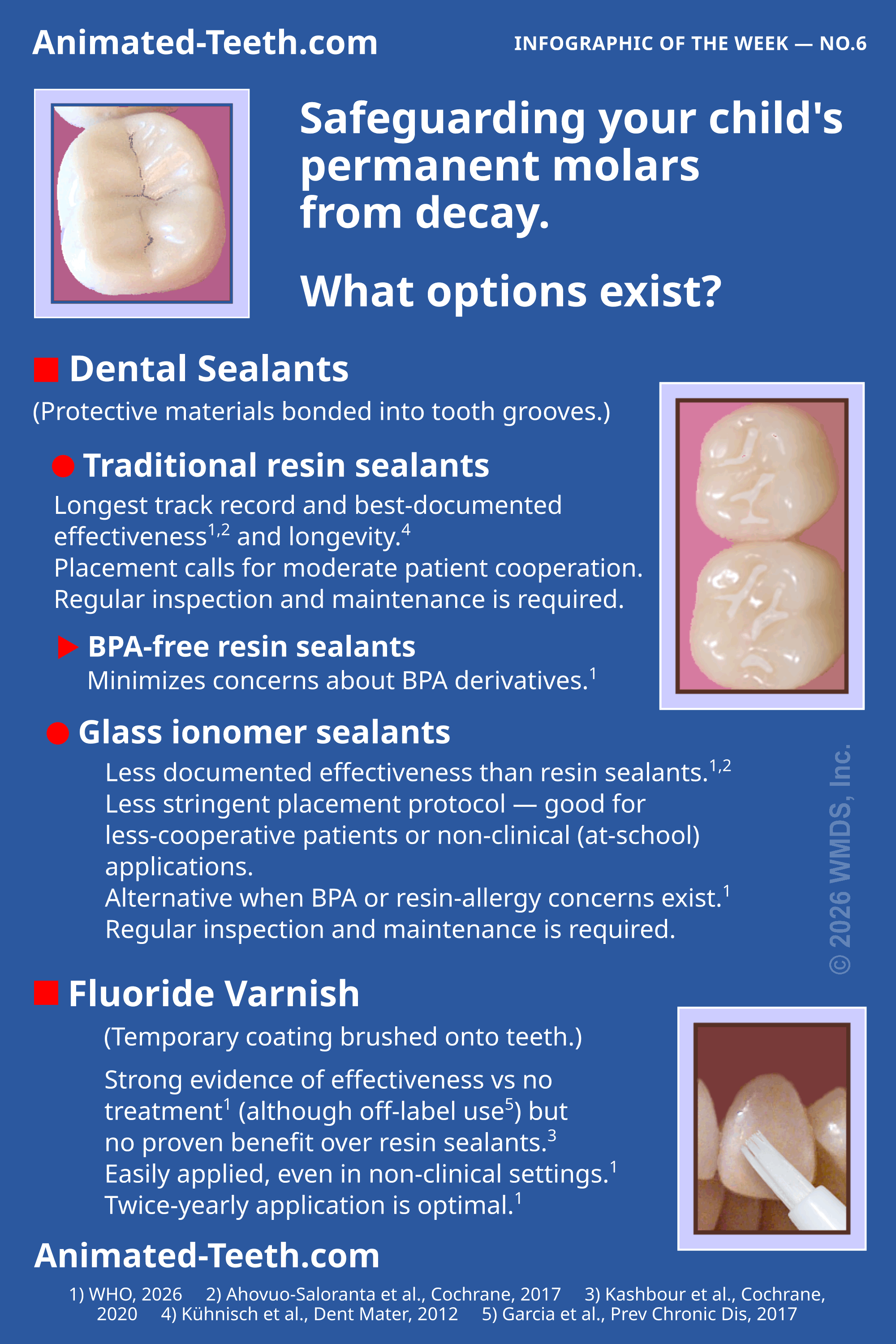
▲ Infographic: Options for protecting a child’s new permanent molars from decay. ▲
What’s the point of our infographic?
This infographic serves as an update — outlining modern guidelines about effective methods for protecting children’s newly erupted permanent molars from tooth decay.
World Health Organization recommendations for decay prevention.
Our interest in this subject was piqued when reading a 2026 publication from WHO (World Health Organization) titled WHO guideline on environmentally friendly and less invasive oral health care for preventing and managing dental caries. 
This paper discusses various measures that might be considered appropriate for cavity prevention in children. Among its suggestions are dental sealant placement, fluoride varnish application, and the application of silver diamine fluoride.
Silver Diamine Fluoride (SDF)
We were relatively unfamiliar with this compound. While researching it further, we developed the impression that use of silver diamine fluoride as a caries preventive was not yet in widespread usage in the US and therefore an unlikely recommendation by general dentists for their patients (so we did not include it in our infographic). Part of this limitation seems to be related to the fact that it can cause black staining on teeth and a lack of insurance reimbursement for this treatment.
Resin-based Dental Sealants
Most parents are probably familiar with the placement of resin pit-and-fissure dental sealants as a preventive for tooth decay. This technique has been utilized since the 1970s.
When refreshing our familiarity with this procedure, we discovered that in many ways it can still be considered the gold standard approach. It has the longest track record, best-documented effectiveness, and due to the tenacious bond this material forms with a tooth’s surface, the best-documented retention among sealant materials.
Glass-ionomer Dental Sealants
Our WHO reference source also suggests the placement of glass-ionomer sealants as a cavity preventive. These sealants are similar in nature to conventional resin ones, except that a different material is used.
As an advantage, glass-ionomer materials can be placed using a less stringent placement protocol. And this difference allows for two distinct advantages. They are more easily applied in a non-clinical setting — making at-school programs easier to arrange — and may make sealant placement possible for less-cooperative patients. As a downside, however, this type of sealant has less evidence of effectiveness.
Fluoride Varnish
This was the surprise recommendation by the WHO paper for us. While there is nothing new about this type of product, we were surprised to learn that there may be evidence that as a decay preventive its effectiveness may run along the lines of resin sealant placement. As a giant plus, its application is far simpler than sealant placement (it’s just brushed on) — however, it must be applied more than once a year.
What anticavity techniques do we cover in our infographic?
Per the information just discussed, we selected resin-based sealants, glass-ionomer sealants, and fluoride varnish as the techniques covered in our infographic — with that selection being entirely based on the options we feel a general dentist in the USA would most likely have to offer a parent.
Why are only permanent molars referenced in our infographic?
While always deferring to your dentist’s judgment, the information stated in our infographic can generally be assumed to apply to minimizing tooth decay on other permanent teeth, and deciduous (baby teeth) ones too. However, from a standpoint of accurately citing our sources for our infographic, the information we referenced primarily focused on the issue of protecting permanent molars alone.
The remainder of this page provides expanded coverage about each of the techniques discussed in our infographic — offered from a standpoint of providing a solid foundation on which a parent can base their conversation with their family dentist about what approach seems best for protecting their child’s teeth.
More details about techniques used to prevent decay in permanent molars of children.
Here’s a further explanation of the details stated in our infographic:
1) Resin-based Dental Sealants
FYI — “Sealing” teeth refers to a procedure where a dental restorative (plastic in the case of resin-based sealants) is bonded into the pits and fissures (grooves) of a tooth. The idea is that untreated grooves may trap and harbor debris and bacteria that can lead to the formation of decay. Filling in at-risk grooves with the restorative prevents this from occurring.
Longest track record of the methods discussed.
Placing resin-based sealants became commonplace in the 1970s. In comparison, glass-ionomer sealants weren’t introduced until the 1980s and fluoride varnish became commonplace in the US in the 1990s.
Best-documented effectiveness.
In part due to its long-term use, published studies have definitively documented the benefit of resin-based sealants in preventing pit-and-fissure decay (decay in the grooves of teeth).
Best-documented retention among sealant materials.
Resin sealants utilize the same tenacious bonding science as composite (white) fillings and porcelain veneers. The longevity of these restorations is well documented.
Resin sealant placement is technique-sensitive.
Of the methods covered in our infographic, placing resin sealants is the most exacting. The tooth must be kept completely dry throughout the placement procedure, and every step of the protocol must be followed carefully for the sealant to bond and last.
That means resin-based sealants are best applied in a true clinical setting (dentist’s office), whereas the other preventive techniques we discuss might be applied during at-school programs. Additionally, the patient needs to be willing enough or old enough to provide adequate cooperation during the process.
Regular inspection and maintenance required.
Resin sealants can wear, chip, or break off and therefore lose their effectiveness. However, whenever a defect is found, repair is simple.
Bisphenol A concerns.
Some resin sealants contain BPA derivatives. BPA-free products are available for cases where this issue is a concern.
Bottom line: Our take on resin-based sealants as a preventive for tooth decay in children.
As mentioned above, in many ways resin-based dental sealants can be considered the gold standard for decay prevention for permanent molars — especially in terms of proven effectiveness and treatment longevity. And if your dentist has recommended this procedure, and your child has the maturity and/or willingness to provide a modicum of cooperation, placing them can be an excellent choice.
As a side note, we’ll mention that dental sealants only provide protection against decay where they are physically placed — meaning the grooves of teeth. They don’t provide meaningful protection for other tooth surfaces, like the areas in between teeth. (Compare to what is stated about fluoride varnish below.)
2) Glass-ionomer Dental Sealants
FYI — A glass-ionomer sealant is essentially the same as a resin one. It’s just that a different type of dental restorative is placed in the tooth’s grooves.
Evidence about effectiveness is considered “low certainty.”
The evidence on the effectiveness of glass-ionomer dental sealants is currently “uncertain.” That is not the same as saying they don’t work — it means the research so far isn’t strong enough to draw firm conclusions. Further studies may eventually give a clearer answer. In the meantime, your dentist’s judgment matters. They may have good reasons for considering this the best option for your child’s case.
Placement is more forgiving.
Glass-ionomer materials can better tolerate less-than-ideal conditions during placement — in particular, moisture control isn’t as critical as it is with resin materials. That makes their placement possible in unconventional (non-clinical) settings, such as at-school programs. It may also make successful placement possible with less-cooperative patients.
Lower complete retention than resin.
Resin-based dental sealants have been found to have a superior retention rate compared to glass-ionomer ones.
As an alternative procedure.
Glass-ionomer sealant can provide an alternative option for cases where BPA or resin-allergy concerns exist.
Regular inspection and maintenance required.
Sealants can wear, chip, or break off and therefore lose their effectiveness. However, whenever a defect is identified, it can be easily repaired.
Bottom line: Our take on glass-ionomer sealants as a preventive for tooth decay in children.
In terms of proven effectiveness and longevity, resin-based sealants seem to hold an edge over glass-ionomer ones. However, the somewhat relaxed protocol needed to place them may create an opportunity for a child to receive sealants that might otherwise not be available. For example, low-cost or free at-school programs are sometimes available.
As a side note, an interesting property of glass-ionomer sealant is that it releases fluoride — potentially further aiding in cavity prevention.
3) Fluoride Varnish
FYI — As its name implies, fluoride varnish is painted (or dabbed) onto exposed tooth surfaces. Fluoride ions then interact with and are held in reserve by minerals on the tooth’s surface. During times of acid attack, this reserve of fluoride ions is available to aid in tooth remineralization and the formation of fluorapatite (a more decay-resistant type of tooth mineral). The varnish itself wears off as hours pass after its application.
Good evidence of effectiveness in preventing decay.
As a decay preventive, there’s strong evidence of effectiveness compared to receiving no treatment, but no proven benefit of varnish over resin-based sealants. It should be noted that the use of fluoride varnish as a preventive for decay is officially an off-label use. (The FDA recognizes these products as tooth desensitizers only.)
Easy application.
Fluoride varnish is applied using a brush or sponge applicator, which allows for application in essentially any setting — in-office, at-home, at-school. No special skill is required.
Multiple applications.
As opposed to sealant placement — which can be considered a permanent or at least semi-permanent application — to maintain effectiveness, fluoride varnish must be applied at least twice a year, and more often for higher-risk children.
Bottom line: Our take on fluoride varnish as a preventive for tooth decay in children.
Fluoride varnish, as opposed to sealant placement, might be the preferred option in instances where a simple, decidedly non-clinical approach is called for, either due to poor patient cooperation or the environment in which the measure must be applied (like at-school programs). Also in contrast, we’ll point out that varnish application helps to protect all tooth surfaces, not just tooth grooves.
Additionally, and as you may have already deduced, placing sealants and applying fluoride varnish are not mutually exclusive. The two can be used together to provide even broader anticavity protection.
Choosing the preventive method that’s best for your child.
As this page has shown, some methods for protecting newly erupted permanent molars are better established than others, but several good options exist. Which one is best for your child can depend heavily on patient-based factors, primarily how well your child can cooperate, as well as the setting where the procedure will be performed (for example, in-office vs. at-school application).
As a final point, we’ll also mention that dental sealant placement and fluoride varnish application are two different dental procedures. And it is quite possible that your dental insurance policy provides for both — making it easy for your dentist to recommend utilizing both approaches.
Our infographic’s reference sources.
Linked below are the sources we cite in our infographic.
- WHO guideline on environmentally friendly and less invasive oral health care for preventing and managing dental caries (2026)
- Pit and fissure sealants for preventing dental decay in permanent teeth. — Ahovuo-Saloranta et al., Cochrane Database Syst Rev 2017.
- Pit and fissure sealants versus fluoride varnishes for preventing dental decay in the permanent teeth of children and adolescents. — Kashbour et al., Cochrane Database Syst Rev 2020.
- Longevity of materials for pit and fissure sealing—Results from a meta-analysis — Kühnisch et al., Dental Materials 2012.
- Absence of Fluoride Varnish–Related Adverse Events in Caries Prevention Trials in Young Children, United States. — Garcia et al., Preventing Chronic Disease 2017.
How to embed this infographic on your website.
Feel free to embed this infographic on your own website. It must be shown in its entirety, without alteration. (Creative Commons Attribution-NoDerivatives 4.0 International License.) The code below already includes a link back to us, so no extra attribution is needed on your end.
Instructions: Use the embed code found in the box below. If you have difficulty with getting the infographic to render properly, try pasting the code into your site’s raw HTML or code editor — not a visual/rich-text (WYSIWYG) editor. (In WordPress Classic Editor, use the Text tab; in the Block Editor (Gutenberg), use a Custom HTML or Code block.)
<div style="text-align:center;">
<a href="https://www.animated-teeth.com/infographic/child-first-molar-decay-prevention" target="_blank" rel="noopener">
<img src="https://www.animated-teeth.com/infographics/hotlink-ok/2026/molar-decay-protection-infographic-2x.png"
alt="Infographic: Options for protecting a child’s permanent molars from decay, covering resin dental sealants, glass ionomer sealants, and fluoride varnish."
style="max-width:100%; width:600px; height:auto;" />
</a>
<p style="font-size:12px; color:#666;">
Courtesy of <a href="https://www.animated-teeth.com/infographic/child-first-molar-decay-prevention">Animated-Teeth.com</a>
</p>
</div>
Want to learn more about dentistry?
Last reviewed: October 04, 2026
Author: Paul Cotner, DMD — retired dentist.
Published by: WMDS, Inc. — owner of Animated-Teeth.com.
Educational information only — not a substitute for professional dental care.