
Free infographic: Fluoride’s other benefit — protecting your teeth from Dental Erosion.
( How to embed this graphic on your own website.)
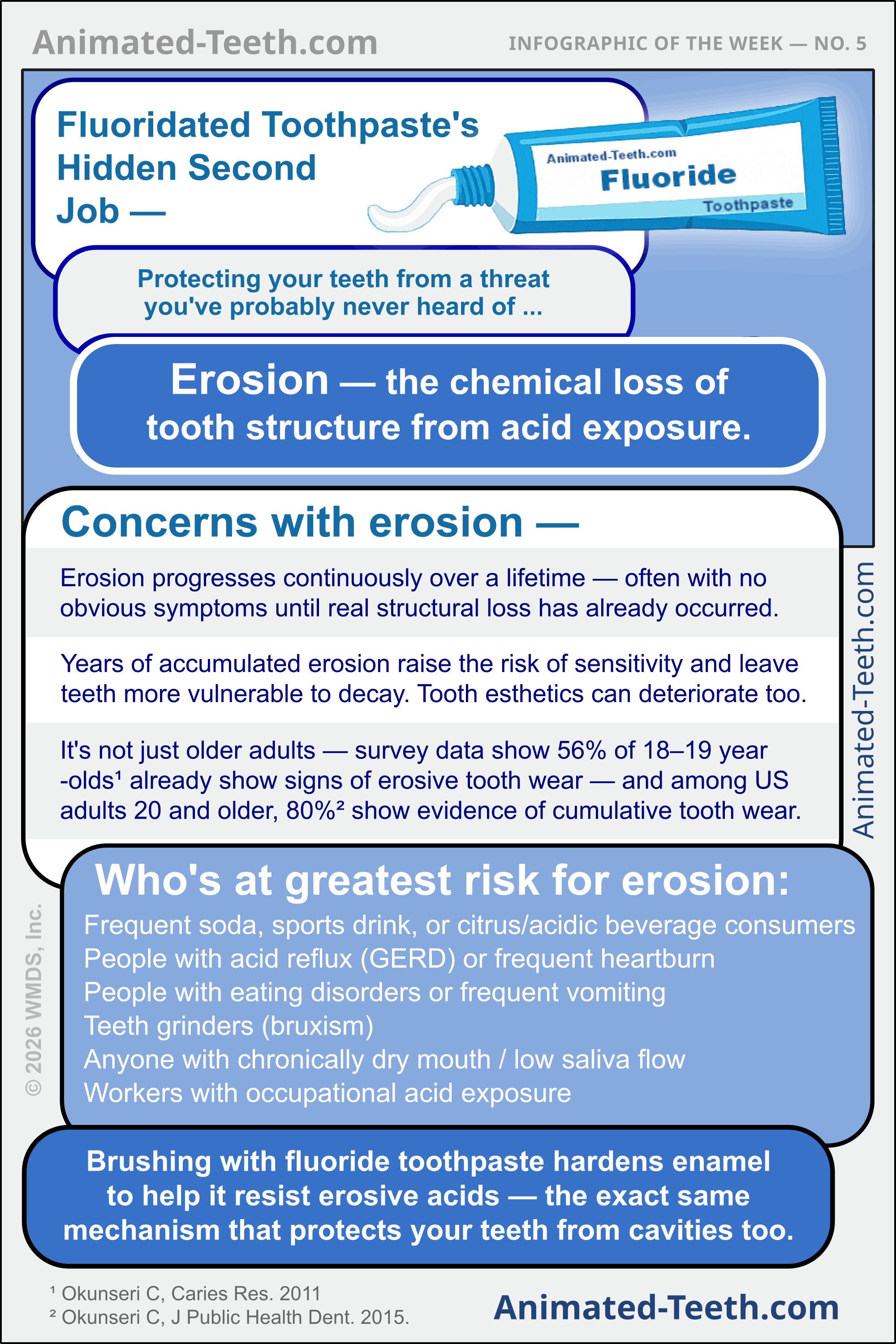
▲ Infographic: Dental erosion prevention using fluoridated toothpaste. ▲
What’s the point of our infographic?
Fluoride helps to protect your teeth in more than one way.
Ask anyone what the benefit of using fluoridated toothpaste is and they’ll probably be pretty quick to answer that it helps to prevent cavities. After all, so many of these products literally have the word “anticavity toothpaste” printed right on their label.
But if you ask the same question to a dentist, they’ll probably also volunteer that appropriate fluoride exposure helps to prevent dental erosion too.
What is dental erosion?
Dental erosion is the loss of tooth structure that occurs when acids come into contact with your teeth and dissolve away their mineral content. Unlike cavities, which form as a result of bacterial acids coming from dental plaque, erosion occurs as a result of other types of acid exposure.
Where do the acids come from?
The acids responsible for causing tooth erosion can come from a few different sources.
- Dietary acids (from soda, citrus fruits, sports drinks, wine, and similar foods and beverages) are one common source.
- Damaging acids can also originate from within a person’s own body, such as from acid reflux (GERD) or frequent vomiting.
- Less commonly, an acidic exposure may come from the person’s occupational setting (work or home) when they are exposed to acidic vapors or liquids.
How does erosion develop?
Erosion forms as mineral content is lost from hard tooth tissues — specifically tooth enamel and dentin. Very similar to the process that causes cavities, when the oral environment in the mouth is net acidic (a pH below around 5.5 begins to affect enamel), mineral content is leached from the exposed tooth surfaces that the acid comes in contact with.
It’s a cumulative effect.
With each exposure that occurs, a little more mineral content is lost. Over time, these individually minor losses accumulate, gradually affecting the overall surface structure of the tooth. Erosion characteristically affects teeth bit by bit and silently over a person’s lifetime. Frequently no noticeable symptoms appear until a meaningful amount of tooth structure has already been lost.
What are the signs and symptoms of dental erosion?
Because erosion tends to progress gradually, its early signs can be subtle and easy to miss.
What to look for.
As a tooth’s enamel thins, one of the most common visual changes is that it will take on a yellow tint — because now the darker, naturally yellowish dentin layer underneath begins to show through more clearly. The edges of front teeth may also start to look thin, translucent, or glassy in areas where their enamel has worn away.
Other signs.
As erosion progresses further, additional changes frequently become noticeable too.
- The biting edges of teeth may develop minor chips, cracks, or rough, uneven lines.
- On back teeth, small dents or smooth, cupped-out depressions can form on their chewing surfaces.
- In more advanced cases, a person’s teeth may appear visibly shorter, and existing dental fillings can start to look raised or prominent, since the surrounding natural tooth structure has dissolved or worn away while the filling material has not.
Tooth sensitivity is a common sign.
Noticing tooth sensitivity — particularly to hot, cold, or sweet foods and beverages — is another frequent symptom, especially once erosion has progressed enough to expose a tooth’s underlying dentin (the layer of tooth structure that lies underneath enamel). However, experiencing symptoms can lag behind the actual loss of tooth structure, meaning a person can have a meaningful amount of erosion occur before they notice any discomfort.
How does fluoride help to prevent dental erosion?
Topical fluoride exposure.
Fluoride’s protective effect against erosion is primarily a topical event — meaning the fluoride ions must be in direct contact with the tooth’s surface.
- This is the situation that exists after brushing with a fluoride toothpaste. Even after you spit the toothpaste foam out, fluoride ions remain in your mouth. (This is a reason why rinsing immediately after brushing isn’t ideal.)
- In comparison, the fluoride you ingest (like when drinking fluoridated tap water), plays a lesser role in providing protection against erosion.
Fluoride’s protection works in two ways.
Fluoride protects teeth from erosion via two different mechanisms. One makes it harder for erosive damage to occur. The other helps to repair the damage that has occurred due to an acidic episode.
- Fluoride helps harden tooth structure (both enamel and dentin) — by promoting the formation of a different, more acid-resistant type of mineral (fluorapatite, rather than the more acid-vulnerable hydroxyapatite that normally makes up tooth mineral).
- Fluoride enhances the tooth’s natural remineralization process — helping lost mineral content be redeposited back into the tooth surface more rapidly and more favorably after an acid exposure than would occur without fluoride present.
It’s worth mentioning again — for these mechanisms to work, the fluoride needs to be present in your mouth right at the tooth’s surface. If you’re not routinely creating this kind of fluoride exposure in your mouth by using fluoridated toothpaste (or some other fluoridated product, like a rinse) you don’t reap these preventive and reparative benefits. At least not nearly to the same degree.
Who’s at greatest risk for erosion occurring?
While anyone can develop dental erosion, certain people face a higher risk due to more frequent or more severe acid exposure.
At-risk persons.
- Frequent consumers of soda, sports drinks, or citrus/acidic beverages — these beverages are typically acidic in nature and therefore promote tooth demineralization (mineral content loss).
- People with acid reflux (GERD) or frequent heartburn — gastric fluids are notoriously acidic in nature, and when they come in contact with tooth surfaces, they can cause pronounced erosion.
- People with eating disorders or frequent vomiting — self-induced vomiting (purging), such as that associated with bulimia nervosa and anorexia nervosa, can regularly introduce acidic gastric fluids into the mouth.
- Teeth grinders — people who brux accelerate the wear of compromised tooth structure.
- Anyone with chronically dry mouth or low saliva flow — saliva helps to buffer oral acids, and a reduction in saliva flow promotes conditions favorable to demineralization.
- Workers with occupational acid exposure — occupations such as battery manufacturing, industrial chemical work involving acidic fumes, and professional wine tasting have all been associated with elevated erosion risk from repeated acid exposure.
Our infographic’s reference sources.
Linked below are the two sources we cite in our infographic.
- Erosive tooth wear and consumption of beverages among children in the United States.

- The relationship between consumption of beverages and tooth wear among adults.
How to embed this infographic on your website.
Feel free to embed this infographic on your own website. It must be shown in its entirety, without alteration. (Creative Commons Attribution-NoDerivatives 4.0 International License.) The code below already includes a link back to us, so no extra attribution is needed on your end.
Instructions: Use the embed code found in the box below. If you have difficulty with getting the infographic to render properly, try pasting the code into your site’s raw HTML or code editor — not a visual/rich-text (WYSIWYG) editor. (In WordPress Classic Editor, use the Text tab; in the Block Editor (Gutenberg), use a Custom HTML or Code block.)
<div style="text-align:center;">
<a href="https://www.animated-teeth.com/infographic/dental-erosion-fluoride" target="_blank" rel="noopener">
<img src="https://www.animated-teeth.com/infographics/hotlink-ok/2026/dental-erosion-fluoride-infographic-2x.png"
alt="Infographic: Fluoridated toothpaste has a hidden second benefit — protecting teeth from dental erosion, the chemical loss of tooth structure from acid exposure — not just preventing cavities. Erosion damage progresses continuously over a lifetime and can raise the risk of sensitivity, decay, and esthetic changes. 56% of 18–19 year-olds already show signs of erosive tooth wear, and 80% of US adults 20 and older show cumulative tooth wear. Those at greatest risk include frequent soda or acidic beverage drinkers, people with acid reflux, eating disorders, teeth grinding, dry mouth, or occupational acid exposure. Brushing with fluoride toothpaste hardens enamel to resist these erosive acids, the same mechanism that protects against cavities."
style="max-width:100%; width:600px; height:auto;" />
</a>
<p style="font-size:12px; color:#666;">
Courtesy of <a href="https://www.animated-teeth.com/infographic/dental-erosion-fluoride">Animated-Teeth.com</a>
</p>
</div>
Want to learn more about dentistry?
Last reviewed: September 19, 2026
Author: Paul Cotner, DMD — retired dentist.
Published by: WMDS, Inc. — owner of Animated-Teeth.com.
Educational information only — not a substitute for professional dental care.