Looking for information about other Dental Topics?
Full Website Index• Animated-Teeth.com •

Do wisdom teeth cause crowding of your front teeth?
Fact checking: Will having your wisdom teeth removed prevent your other teeth from shifting?
The role of wisdom teeth play in contributing to teeth crowding has been a topic of long-standing debate. Some dental professionals continue to believe that the eruption of third molars can cause shifting or misalignment of front teeth and ultimately spoil the appearance of a person’s smile. Others remain less convinced.
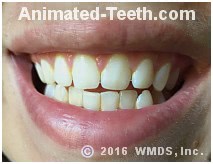
Is this kind of tooth crowding caused by wisdom teeth eruption?
Numerous studies have attempted to determine if wisdom tooth eruption pressure leads to crowding, particularly in the lower front teeth. Early research seemed to support this theory. However,more recent findings have cast doubt on its validity. In response, dental professionals, especially those trained in recent decades, have become increasingly skeptical about the need to remove third molars solely as a preventive measure against tooth crowding.
This guide examines this topic from both historic and modern perspectives and goes on to explain other potential causes of tooth shifting. It also highlights the role orthodontic appliances can play in both preventing alignment changes and correcting those that have occurred.
Whether you’re evaluating the need for the removal of your wisdom teeth or seeking to understand the changes you have noticed in your dental alignment, this guide provides a comprehensive overview to help you understand this subject.
For decades, the belief that wisdom teeth cause crowding has influenced the way dentistry has been practiced—but is it fact or fiction? Before we can evaluate this theory, we must first define what it involves and consider the risks of it being wrong.
The third molar eruption / tooth crowding theory – What is it?
It’s a belief that teeth shift due to pressure from emerging wisdom teeth.
A significant percentage of people, and even many dental professionals, subscribe to the belief that events associated with third molar formation and eruption result in pressure being exerted on the teeth in front of them, causing generalized tooth misalignment and crowding.
Which teeth are said to be affected?
The teeth most commonly associated with this theory are the lower front teeth, particularly the lower incisors (mandibular incisors). In contrast, upper front teeth are less frequently mentioned in discussions about this phenomenon.
Example of lower (mandibular) incisor crowding blamed on wisdom teeth eruption.
Why is determining the truth about this theory so important?
- Experiencing this kind of later-in-life tooth shifting can range from just a minor annoyance to a significant cosmetic concern. For individuals who have previously undergone orthodontic treatment, this kind of relapse undermines the effort they expended in achieving a perfect smile.
- Correcting the misalignment that has developed can be expensive and time-consuming to fix. Some level of orthodontic treatment will be required.
- If the misalignment is not corrected, crowded teeth can be more difficult to brush and floss. A failure to clean them effectively may lead to complications with tooth decay or, more likely, gum health.
What if the tooth-crowding theory is correct?
Whether or not tooth shifting can be caused by wisdom teeth eruption matters quite a bit.
- If the theory it is correct … then most people who have third molars, at least lower ones, should have them removed as a preventive measure so to reduce their risk for teeth shifting in the future.
- But if it isn’t … then at least some percentage of the recommendations made by dentists to their patients for the removal of their third molars would have been without merit because doing so would serve no purpose.
That means that those patients who had been subjected to their extraction procedures (and associated costs, risks, and complications) would have undergone them for no benefit.
(This issue has some obvious ethical implications associated with it too. For example, was the provider’s recommendation for removal driven by sincere medical considerations or financial incentive?)
Can wisdom teeth removal prevent dental crowding?
What does research say about the potential for third molars coming in to cause tooth shifting?
You might be surprised to learn that the dental community has been investigating and debating this issue for over 100 years.
And while it seems that currently the majority of dentists, especially those trained more recently, now consider this theory to be invalid (as in – wisdom teeth do not cause tooth shifting and therefore should not be extracted as a preventive for it), it must be stated that even today this controversy has still not been totally resolved.
a) Background – How the opinion of dentists has changed over time.
As recently as 50 years ago (and possibly less, see below), a majority of dentists (specifically oral surgeons and orthodontists) felt that a correlation between wisdom tooth eruption and teeth shifting did exist.
- 65% of orthodontists and oral surgeons support the idea that wisdom teeth produce an anteriorly directed force that causes the crowding of the mandibular incisors. (That’s dental jargon for the problem we’ve stated above.)
- And based on this opinion, they favored the removal of third molars to help prevent this shifting from occurring.
(The above information is cited from Stanaityte (2014). Linked below.)
This stance was founded on the research of the era.
- A 1961 study by Bergstrom evaluated 60 patients who had congenitally missing (missing from birth) third molars on one side but not the other.
It determined that a greater amount of tooth crowding existed in quadrants (for example the “lower left quadrant,” which means all teeth on a person’s lower left side) where wisdom teeth were present.
- A study by Vego in 1962 came to the same conclusion after evaluating 65 patients, 25 of which had congenitally missing (missing at birth) third molars.
(The above information is cited from Almpani (2015). Linked below.)
Probably what was overlooked by the dental community was that each of these studies only involved a small sample size. Also, at this point in time, it seems not enough research had yet been performed to allow the formation of group conflicting or alternative views.
b) What has more recent research shown about wisdom tooth eruption causing tooth shifting?
Over the course of the last 50 years, quite a bit of additional research has been conducted on this subject. Admittedly, however, much of it paints a contradictory or inconclusive picture.
As a help in plowing through this data and passing judgment on it, we’ve decided to rely on the findings of several literature reviews that have already performed this job.
Literature reviews that have evaluated the wisdom teeth / teeth crowding theory.
Study #1- Costa (2013)
Study title: Is there justification for prophylactic extraction of third molars? A systematic review.
The primary goal of this review was to see if evidence could be found that supported the prophylactic (preventive) removal of wisdom teeth in general. It evaluated 260 papers. Only two of these met their screening criteria and also addressed the topic of tooth crowding.
The opinion drawn was that the only scientific proof available suggests that the prophylactic extraction of wisdom teeth for the purpose of preventing the shifting of the lower incisors is not justified.
Study #2- Stanaityte (2014)
Study title: Do wisdom teeth induce lower anterior teeth crowding? A systematic literature review.
This paper evaluated 223 articles, of which only 21 met its screening criteria. The authors readily stated that collectively they were quite contradictory and supported both sides of the teeth-shifting argument.
They concluded that “third molars do not cause tooth crowding.” But did state that they may play some role in combination with other factors (see below). However, this review did not make a recommendation for the prophylactic removal of wisdom teeth.
Study #3- Almpani (2015)
Study title: Role of third molars in orthodontics.
This review pointed out that the insufficiency of high-quality studies makes it difficult to formulate definitive guidelines. But stated that there is currently “no sound research evidence supporting the prophylactic removal of non-pathological impacted third molars.”
What’s interesting is that the authors of this paper noticed a transition in the opinion of researchers over the decades.
- Studies conducted in the 1960, 1970 and 1980s seemed more likely to associate the occurrence of tooth shifting with the presence of wisdom teeth.
- In contrast, from the 1990s forward study findings tend to exculpate third molars in this matter and generally characterize their removal as a preventive measure as unjustifiable.
Study #4- Genest-Beucher (2018)
Study title: Does mandibular third molar have an impact on dental mandibular anterior crowding? A literature review.
This study evaluated articles published between 1974 to 2014. It concluded that, in total, “83% of articles did not find any significant relationship between lower third molar and mandibular dental anterior crowding.” However, the authors had concerns about the quality of some of the included studies and therefore did not consider the issue definitively settled.
The bottom line: What has dental research concluded about the need for prophylactic wisdom tooth removal to prevent tooth crowding?
In light of the findings of the literature reviews just cited, it seems safe to state that there is a lack of evidence documenting that removing wisdom teeth for the express purpose of preventing tooth shifting and crowding is effective. And for that reason, using this justification for removing third molars is questionable at best.
What’s the opinion of most dentists about wisdom teeth removal to prevent tooth shifting?
As the findings of the following study suggest, and in comparison to previous decades, the current opinion of dental professionals seems to be trending toward a stance where they are less and less likely to recommend wisdom teeth removal for the prevention of dental crowding. This is especially true for practitioners who have been trained more recently.
Study – Lindauer (2013)
Study title: Orthodontists’ and surgeons’ opinions on the role of third molars as a cause of dental crowding.
This study surveyed roughly 400 orthodontists and oral surgeons (for a total of over 800 clinicians) in regard to the theory: Do erupting wisdom teeth cause anterior tooth crowding?
The findings of the study were:
- 57% of oral surgeons “generally” or “sometimes” recommend the prophylactic removal of 3rd molars to prevent tooth shifting.
- In comparison, 64% of orthodontists stated they “rarely” or “never” recommend wisdom teeth removal for this reason.
The differences between these two groups is telling.
- Oral surgeons, clinicians whose business is performing extractions, still slightly leaned toward recommending prophylactic wisdom tooth removal.
- Note, however, that if extracting third molars does reduce the potential for tooth shifting, orthodontists would have fewer case failures (termed “orthodontic relapse”) overall. So, their lack of support for this theory (the fact that the majority don’t recommend third molar extractions) is telling.
The age of the clinician seems to be a factor in which opinion they hold.
The author noticed a relationship between the age (year graduated) of the clinician and their response.
- More recently graduated orthodontists were less likely to favor removal.
- Oral surgeons further along in their careers (had graduated in the 1970s or ’80s) were more likely to recommend wisdom tooth removal.
These findings suggest that the developing trend in the opinion of clinicians is that removing wisdom teeth doesn’t play a significant role in preventing tooth crowding and is therefore unwarranted.
Solutions for preventing tooth crowding / alignment changes.
How can teeth shifting be prevented?
If the theory linking third molar eruption to tooth shifting is not supported by strong evidence, yet many people still experience changes in tooth alignment over time, it raises the question: what proactive steps can be taken to maintain straight teeth and prevent crowding?
The role of orthodontic retainers in preventing tooth crowding.
Orthodontic retainers, whether fixed or removable, are a key tool for preserving the alignment of a person’s teeth.
Granted, these appliances are most often associated with post-orthodontic treatment (as a way of preventing orthodontic relapse) but retainers can also be beneficial for individuals who have never had braces simply by maintaining their status quo.
- Fixed retainers, which are permanently bonded to the back of teeth, provide constant support and are particularly effective for maintaining the alignment of the lower front teeth, where crowding is most common.
- Removable retainers, such as Hawley (plastic and wire) or Essex (vacuum-formed clear plastic) models, are convenient options that allow for flexibility while still offering reliable results when worn as directed.
What can be done if tooth shifting has already occurred?
Whatever the cause of the problem, misaligned teeth can only be realigned by wearing some type of orthodontic appliance. As examples, the patient’s treatment might involve the use of traditional (wire-and-bracket) braces or removable appliances (like Invisalign®).
Preventing orthodontic relapse.
Once the patient’s tooth alignment has been restored and perfected, the use of orthodontic retainers will be needed to guarantee the long-term success of their treatment.
Other theories about the cause of dental crowding.
We’d like to point out that nothing on this page is meant to suggest that people who have third molars don’t sometimes have teeth, especially mandibular incisors (lower incisors), that shift and become misaligned.
But, adamantly, we want to point out that research has not been able to definitively demonstrate a firm statistical correlation between the two and therefore the validity recommending wisdom teeth removal as a preventive for teeth crowding is suspect.
That’s led some researchers to suggest other reasons why dental crowding occurs.
Suggested theories.
a) Jawbone shape changes.
Over time, natural biological processes, such as continuous bone remodeling, can gradually alter the size and shape of a person’s jawbone. This remodeling is a normal aspect of human anatomy and occurs throughout life.
When the dimensions of the jawbone become reduced in specific regions (like between the eyeteeth of the lower jaw), the available space for teeth decreases while their size remains unchanged. This discrepancy inevitably leads to tooth crowding. (This explanation makes a lot of sense to us.)
b) Other factors that may play a role.
- The original positioning of permanent tooth buds (the tissues from which teeth grow) can impact the stability of the teeth once they have erupted.
- The timing of baby tooth loss and the subsequent eruption of permanent teeth can influence tooth alignment.
- Soft tissue pressure on teeth (like from the lips, tongue, and cheeks) can cause tooth movement, as can the alignment and force exerted by opposing teeth.
(Information cited in this section comes from Karasawa (2013) Cross-sectional study of correlation between mandibular incisor crowding and third molars in young Brazilians.)
For more information on this subject –
We offer the following pages for additional information about reasons to or not to remove wisdom teeth:
- An overview of valid reasons to have third molars extracted. Jump to page.
- Determining when not to extract wisdom teeth. Jump to page.
Last reviewed: February 15, 2025
Author: Paul Cotner, DMD — retired dentist.
Published by: WMDS, Inc. — owner of Animated-Teeth.com.
Educational information only — not a substitute for professional dental care.
Page references sources:
Almpani K, et al. Role of third molars in orthodontics.
Costa MG, et al. Is there justification for prophylactic extraction of third molars? A systematic review.
Genest-Beucher S, et al. Does mandibular third molar have an impact on dental mandibular anterior crowding? A literature review.
Karasawa L, et al. Cross-sectional study of correlation between mandibular incisor crowding and third molars in young Brazilians.
Lindauer SJ, et al. Orthodontists’ and surgeons’ opinions on the role of third molars as a cause of dental crowding.
Sidlauskas A, et al. Effect of the lower third molars on the lower dental arch crowding.
Stanaityte R, et al. Do wisdom teeth induce lower anterior teeth crowding? A systematic literature review.