Looking for information about other Dental Topics?
Full Website Index• Animated-Teeth.com •

Instruments used during root canal treatment. | Root canal files & others.
Guide to root canal files and other instruments used during root canal therapy.
Root canal files are miniaturized rasps specifically designed for use within the intricate confines of a tooth’s root canal system. When worked in an up-and-down, twisting motion, a file’s abrasive surface creates a cutting action that “cleans and shapes” the canal. This process removes infected and necrotic pulp tissue from within a canal while simultaneously giving the canal the optimal shape and flare for sealing it during a later step.
This guide explores root canal files, detailing their design, component parts, and usage. You’ll learn about the various types of files, including rotary (drill-operated) versions, and how dentists use them to perform precise work within your tooth. Additionally, we provide insights into what you, as a dental patient, might experience during their use, helping you approach your appointment with greater confidence and ease.
This guide also explores topics such as whether root canal files should be reused and provides an overview of additional instruments utilized during the root canal procedure.
Root canal files – What are they? How are they used?
Root canal files are small needle-like instruments that a dentist uses inside a patient’s tooth when they perform endodontic therapy. They are used when performing the cleaning and shaping The steps. portion of the procedure.
What do root canal files look like?
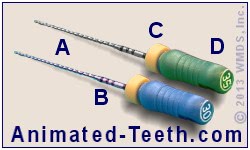
Since a picture is worth a thousand words, take a look at our graphic below. It shows two root canal files.
Root canal files.
As you can tell from our picture’s labeling, each file has a few component parts. Here’s what they are and do.
The parts of a root canal file.
A = The working end.
This is the metal part of the file that’s inserted into your tooth’s root canal to clean and shape it. It’s made out of a flexible metal alloy, with steel or nickel-titanium being the ones most commonly used.
These instruments are literally miniaturized files.
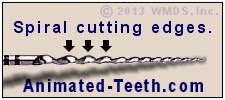
Just like their name implies, root canal files are actual files (as in tools used to abrade and shape objects).
In the case of these instruments, the surface of the file’s metal shaft has a tight spiral of grooves (“flutes”) carved into it. These flutes (their sharpness and roughness) give the instrument the friction and bite it needs to scour (clean and shape) the walls of a root’s canal when it’s twisted up and down inside it.
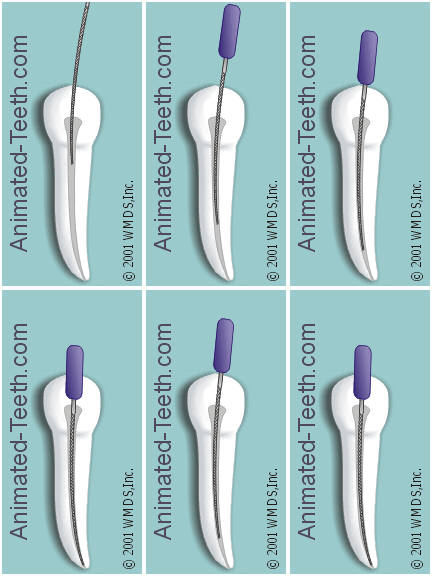
The primary cutting action of a file is on the upstroke.
Kinds of root canal files.
A dentist has a few different types of “files” to choose from. They include K-files, Hedstrom files (H-files), and reamers. A similar-looking tool is the barbed broach.
Each type of file has its own characteristic design (often a derivative of its method of fabrication), and that dictates how it’s used. As examples:
Some files are intended to be used as rasps.
The dentist will insert the file to a chosen depth inside the tooth. Then as they draw it back out, they’ll scrape it against the walls of the canal to shave and abrade them. (A pulling-planing action.)
Others are designed to be used with a reaming motion.
The dentist will first wedge the file snugly in the canal. They’ll then twist it a fraction of a turn (so its cutting edges engage the walls of the canal). They’ll then draw it back out, removing a bit of tooth structure as they do. (A twisting-cutting action.)
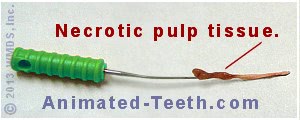
An entirely different type of finger instrument is the barbed broach. As its name suggests, it’s similar to a single strand of barbed wire that’s been given a handle.
Pulp tissue snagged on a barbed broach.
It’s used inside a tooth in an up-and-down motion. When inside a canal its sharp barbs snag, dislodge, and remove live or dead tissue and debris.
▲ Section references – Torabinejad
What you’ll feel when a file is used inside your tooth.
Since you’ll be numbed up for your procedure, feeling pain when a root canal file is used inside your tooth’s canal(s) shouldn’t be a factor. It is, however, routine and expected that you’ll feel the (vague/minor) vibrations or strokes of the file as your dentist works it around inside your tooth.
Additional characteristics of the working end of root canal files.
File size and taper. – You may have noticed in our pictures that root canal files are tapered and they come in various sizes (different taper diameters).
The idea is that a dentist will use a series of files as they clean and shape a canal, starting with small ones and progressing on up to larger sizes. As each file is used in turn, the internal shape of the canal is gradually opened up (widened and flared) just a little bit more.
File length. – Just like teeth, root canal files come in different lengths. 21 mm files are typically long enough for use with back teeth and lower incisors. The roots of upper front teeth and lower eyeteeth are usually larger, so a longer file is needed for them (25 mm is common and even 31 mm is available).
Your dentist choosing the shortest length file that is appropriate means that you won’t have to open nearly as wide during your appointment. That’s actually a pretty big deal, both for your comfort and your dentist’s ease and quickness of work.
The type of metal. – Any alloy that’s chosen for making root canal files must be flexible and strong.
Flexibility helps the file to passively follow the gradual curves that canals frequently have. Good strength and durability characteristics are needed because it’s important that the file doesn’t break easily (separate) as it’s being used (a situation that can result in case failure Here’s why.).
Nickel-titanium alloy is a relatively newer innovation in the field of endodontics. And much of the current mechanization of the root canal process (see rotary files section below) has been possible because of the greater flexibility and resistance to fatigue that files made out of this alloy offer. (Hargreaves)
▲ Section references – Hargreaves
B = File measurement markings.
The dark rings (labeled “B”) on the shaft of the files in our picture are calibration markings.
They give your dentist a way to conveniently and quickly know the length measurement from the tip of the instrument to that point. (Marked in whole number millimeters. The first marking you see on the 21 mm files in our picture, the one right above the “B”, is at the 16 mm point from their tip).
Why they’re important.
Using these markings, the dentist knows precisely how far into the tooth and canal the file extends. That’s critical because their goal will be one of cleaning the canal all the way to its end but not beyond the end of the root. (Doing so helps to minimize postoperative complications. Here’s why.)
C = Movable plastic stopper.
The yellow items you see on the shafts of the files in our picture (labeled “C”) are movable plastic stoppers.
The idea is that the dentist slides the stopper to that point on the file’s measuring scale (the lines labeled “B”) that correlates with the needed “working length” for the file (the extent of the file needed to clean the full length of the canal How a canal is measured.).
They’re just markers, not bumpers.
Since the stoppers are movable, they’re just markers rather than fixed bumpers (that would limit the amount of file length that can enter the tooth). Their presence simply provides a quick visual indication for the dentist as to how much of the needed working length has already been extended into the canal.
D = The file handle.
The portion of the file we have labeled with a “D” is its handle. This is the part that the dentist holds with their fingers as they work the file with a combination of up-and-down and twisting motions.
What may not be obvious to you is that the color of the handle (and the number embossed on it) indicates its size (its diameter, both at specific points along its taper and at its tip).
File sizes.
Root canal files come in a series of graduated sizes (i.e. sizes 10, 15, 20, 25, etc…, increments of 5 are built into the scale for smaller sizes, increments of 10 for larger ones). The specific dimensions associated with each size are industry standards. (This same scale is used for gutta-percha points Picture comparison., the material usually used to fill in and seal a tooth’s cleaned-and-shaped root canals.)
The number itself indicates the diameter of the file at its tip. For example, size 25 = .25 mm, which is about 1/100th of an inch. As you are no doubt aware, that’s a pretty small number. And with increments of just .05 mm between sizes, it can be difficult to tell much difference between two consecutive files (see picture).
Hand files vs. Rotary files.
The importance of hand files.
What we’ve described so far are root canal files that are hand, or more precisely “finger,” instruments. And actually, the finger-manipulated nature of these instruments provides a distinct benefit.
As they are used, the dentist gains information about the internal anatomy of the tooth via their tactile senses. Something that wouldn’t be possible if the instruments were “hand” held.
Newer isn’t better.
Related to that advantage, although modern automated/mechanized root canal systems have been developed (see rotary files, discussed next), their use can never entirely replace the need for the use of individual finger instruments.
No tooth’s root canal system can be, or should be attempted to be, completed via the use of rotary instruments alone (Ingle). Instead, anticipate that your dentist will probably use a mix of both.
Rotary root canal files.
Nickel-titanium.
As mentioned above, the introduction of nickel-titanium alloy to the field of dentistry has resulted in significant changes in the way root canal treatment is routinely performed.
The advantages that it offers are that of superelasticity (the ability of the metal to retain its shape after being deformed) and high resistance to cyclic fatigue. Due to these characteristics, files made from this alloy can be successfully used in curved root canals using a continuously rotating motion. (Hargreaves)
That last sentence opens the door for further mechanization of the root canal process. It means that nickel-titanium files, driven in a rotating manner by a dental handpiece (engine-driven as opposed to finger-manipulated files), can be safely and predictably used, even in curved canals. That’s a big deal.
What this means for you the patient.
Mechanization of the process has been a substantial game-changer for the field of endodontics. It offers a way of adding speed and efficiency to the procedure while still providing predictable, effective root canal treatment.
Mechanization makes one-visit endodontic therapy Instead of two. easier to accomplish. The reduction in patient chair time it provides may result in a lower fee for the patient. Endodontic fees. And studies suggest that the use of rotary-file systems may result in fewer operator errors, a factor that might be important with non-specialists (general dentists). (Torabinejad)
As alluded to above, don’t expect that your tooth’s entire cleaning and shaping process will be completed just via the use of handpiece-driven files, because it shouldn’t be. But for whatever aspect of your procedure it can be used, it should be a positive event for you and your tooth’s work.
▲ Section references – Torabinejad, Hargreaves
Appearance differences between finger and rotary files.
The metal shafts of rotary (engine-driven) root canal files generally look the same as hand files (they make use of calibration marks and movable stoppers too). The main exception would be that some rotary systems come in different sizes/tapers than is standard (the files are often fatter).
And, of course, rather than having a handle designed to be grasped by fingers, this portion of the file will have a shape that can be inserted into and latched securely in the handpiece that’s used to generate its working motion.
What you’ll notice when a handpiece and rotary files are used.
Engine-driven files are generally intended to be used with a passive action inside a canal (Ingle). So beyond the minor vibrations you notice from the handpiece running, what you experience should be a non-event.
Some rotary systems work the file in a continuously rotating motion, others in a reciprocating one (back-and-forth action). Some handpieces even back the file off by reversing its rotation if it senses that it’s being placed under too much torque (stress).
During your procedure, you may get a sense of each of these motions as they’re created. Also, since these drills are often electrically driven, you’ll hear the gentle whine of its motor.
▲ Section references – Ingle
Can/Should root canal files be reused?
The policy of reusing root canal files between patients, or patient visits, is one that’s set by a dentist for their office. There is no industry standard that applies to this issue.
File sterilization.
The component parts of files are designed with sterilization in mind. And while attention to detail is required, several studies have documented that effective cleansing is possible.
Typically there will be a series of steps that the files are subjected to (rinsing, scrubbing, ultrasonic cleaning, and then sterilization). A frequent method of sterilization involves the use of a steam or chemical autoclave (a 20-minute cycle of 250°F/121°C at 15 psi), which is sufficient to kill all bacteria, spores, and viruses.
▲ Section references – Torabinejad
Why shouldn’t root canal files be reused?
File separation (breakage).
Inadequate sterilization typically isn’t the issue of concern with reusing files between patients. Instead, it’s metal fatigue (caused by repeated use of the instrument) that results in file separation (breakage).
As mentioned (and linked) above, instrument separation is a procedural complication that can result in case failure. And while guidelines exist, knowing the precise status of any file, especially a used one, is impossible.
New instruments for every case.
The potential for file breakage during use can be reduced by simply considering files (both hand and rotary types) to be disposable instruments. As a side benefit, this choice can help to increase the efficiency of the dentist’s work. It’s been shown that a root canal file loses roughly 50% of its cutting efficiency after its initial use. (Hargreaves)
With this approach, the dentist of course incurs an added expense. Considering that some mix of hand and rotary files would typically be needed to perform a tooth’s work, our calculations suggest that the added cost for this group of instruments might run on the order of $40 to $50.
▲ Section references – Hargreaves
What other kinds of dental tools and instruments are used during the root canal procedure?
The bulk of the work that’s done inside your tooth will be accomplished using root canal files. But in addition to them, there are other basic instruments that are needed.
Rubber dam frame and clamp.
At the very beginning of your appointment, your dentist will “isolate” your tooth by way of placing a rubber dam.
In a nutshell, this is a sheet of rubber (latex really) that’s stretched over your tooth so only it pokes through. Isolating a tooth in this fashion keeps oral contaminants (saliva, bacteria) from entering your tooth during its procedure.
FYI: This page provides details and pictures about rubber dam placement and purpose. Jump
Endodontic Burs
Burs are the name given to the minute drill bits that dentists use in their drill. During the root canal procedure, a dentist will use different burs (different sizes, shapes, and designs) to make the tooth’s “access cavity.” (The opening in your tooth through which your dentist will perform their work.)
FYI: This page provides details (and pictures) about root canal access cavities. Jump
Root canal explorer.
Once your tooth has been “opened” (its access cavity made), your dentist will search the floor of your tooth’s pulp chamber for the openings that lead to each of its root canals.
Some will be found via simple visual inspection. But the assistance of a root canal explorer (a pointed pick-like hand instrument) may be needed when searching for very minute canal openings.
FYI: This page provides more details about locating a tooth’s root canals. Jump
Ultrasonic instruments.
This kind of device is a mechanized pick-like instrument that creates an intense vibratory motion (vibrations) when turned on. (It also produces a characteristic high-pitched sound that you’ll notice.)
Like an endodontic explorer, it’s used to locate and clean out minute root canal openings. Especially ones that are calcified or have endodontic or restorative materials in them.
Additional drills.
Using mechanical tools like a drill inside your tooth’s root canals instead of just hand instruments (root canal files) will speed up the completion of your procedure. Gates-Glidden drills and Peeso Reamers are two drill designs that dentists frequently use.
Spreaders and pluggers.
After cleaning and shaping a tooth’s root canal system, a dentist will complete its treatment by filling in and sealing off this space using a bio-compatible compound called gutta-percha.
This material has a rubbery nature (even more so after being heated). As it is placed bit by bit, a dentist will use various-sized spreaders and pluggers to compact it inside the tooth.
FYI: This page provides more details about placing gutta-percha. Jump
What’s next?
There’s lots more to learn about having root canal therapy.
Last reviewed: January 20, 2025
Author: Paul Cotner, DMD — retired dentist.
Published by: WMDS, Inc. — owner of Animated-Teeth.com.
Educational information only — not a substitute for professional dental care.
Page references sources:
Hargreaves KM, et al. Cohen’s Pathway of the pulp. Chapter: Instruments, materials, and devices.
Ingle JI, et al. Ingle’s Endodontics. Chapter: Endodontics instruments and armamentarium.
Torabinejad M, et al. Endodontics. Principles and Practice. Chapter: Endodontic instruments.